
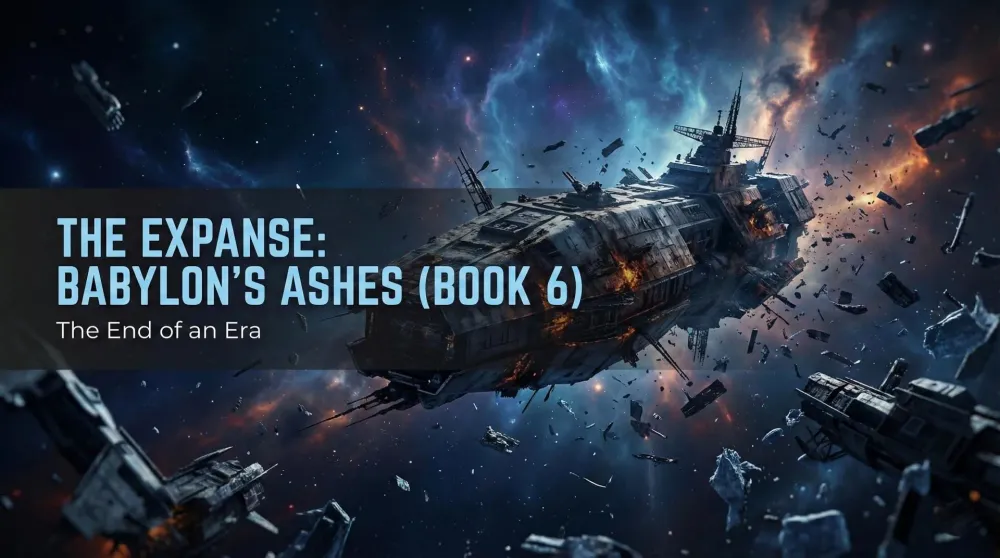
Babylon's Ashes (The Expanse Book 6) – A Pivotal Masterpiece
The explosive conclusion to the Free Navy War. Babylon's Ashes is the high-stakes finale that redefines the solar system. A 4.5/5 masterpiece.
This post contains affiliate links. We may earn a commission if you make a purchase, at no extra cost to you. As an Amazon Associate, Dadnology earns from qualifying purchases.
1.0 Introduction: The Unputdownable Apex of a Modern Sci-Fi Epic
📚 This review is part of the The Expanse Book Series – read the definitive sci-fi saga in order.
The Expanse series by James S.A. Corey has cemented its status as a landmark of modern science fiction, a sprawling space opera celebrated for its deft synthesis of scientific realism and profound, character-driven drama. The sixth novel, Babylon’s Ashes, represents a stunning culmination of the series’ primary conflicts, delivering a narrative so compelling that, as one reader aptly put it, “you won’t be able to put it down.” It is a masterfully constructed climax that brings a major series arc to a deeply satisfying, high-stakes conclusion. By brilliantly balancing explosive action with the intimate struggles of its characters, the book earns a definitive 4.5/5 rating and proves the franchise’s continued commitment to the exceptional quality for which it is known.
To fully appreciate the weight and consequence of the novel’s events, it is essential to first understand its strategic position within the broader narrative architecture of The Expanse universe.
AdBabylon's Ashes (The Expanse, 6) (opens in a new tab)
The war for the solar system. Earth is wounded, Mars is fading, and the Free Navy reigns. The final battle for the future of humanity begins.

2.0 Context is King: Locating Babylon’s Ashes in the Transmedia Canon
In a vast, multi-platform franchise like The Expanse—which spans literature, television, comics, and games—understanding where a single installment fits is paramount. The true narrative weight of Babylon’s Ashes is only felt when it is viewed not as a standalone story, but as a crucial pivot point for the entire saga, marking the definitive end of one era and the violent birth of the next.
Babylon’s Ashes is the sixth of nine main novels in the literary series. Its primary function is to conclude the cataclysmic “Free Navy Arc,” resolving the system-wide war that was meticulously built up in the preceding book, Nemesis Games. More than just a finale, it serves as the final chapter before a significant 30-year time jump that occurs between its conclusion and the beginning of the seventh novel, Persepolis Rising. This makes the book a narrative watershed, closing the door on the conflicts that defined the first two-thirds of the series.
The television series adaptation largely aligns with this structure, with its sixth and final season adapting the war-torn events of Babylon’s Ashes. The book’s role as the end of an era is further underscored by the supplementary materials created to bridge this narrative chasm. It is crucial to note that these comics, particularly Dragon Tooth, are officially designated as “show-canon,” a deliberate choice that solidifies the television adaptation’s timeline as a distinct yet parallel narrative stream. This decision privileges the visual canon for continuation, making Babylon’s Ashes not just the end of a book arc but the definitive closing of the on-screen era.
This structural importance provides the framework for the visceral, system-altering conflict the novel so effectively portrays.
3.0 The Crucible of Conflict: The System-Wide War Against the Free Navy
The central conflict of Babylon’s Ashes is not merely a series of space battles; it is the violent, explosive climax of deep-seated socio-political tensions that have simmered for generations between the Inner Planets of Earth and Mars and the exploited inhabitants of the Asteroid Belt. The novel chronicles the brutal, all-out war that erupts from this powder keg.
The primary antagonists are Marco Inaros and his Free Navy, a rogue faction of Belters who have assembled a fleet to wage a revolutionary war against the “Inners.” In the preceding story arc, the Free Navy committed an unthinkable act of terror, devastating Earth with stealth-shielded asteroids. This catastrophic attack sets the stage for the desperate conflict in Babylon’s Ashes, where the stakes are nothing less than the survival of Earth and the future of humanity in the solar system.
The narrative chronicles the shotgun wedding of the Combined Fleet, forcing the two superpowers of Earth and Mars—locked for decades in a tense Cold War—into a bloody and mistrustful partnership against a common enemy who rose from the very populations they collectively oppressed.
This epic, system-spanning war serves as the ultimate crucible, forging not just a new political reality but also the final, breaking-point tests for the series’ beloved characters.
4.0 The Human Element: Character Arcs at a Breaking Point
The Expanse is first and foremost a character-driven story, and its greatest strength lies in its intimate portrayal of humanity against an epic backdrop. Babylon’s Ashes excels in this regard, forcing its core characters to confront the culmination of their long-running personal journeys amidst the chaos of war. The common praise that the series features “insanely good long arc character development” is not hyperbole; it is the core thesis of the saga, and this novel serves as the ultimate payoff for that long-term investment.
The war with the Free Navy becomes the final, harrowing test for the crew of the Rocinante. The novel’s Point-of-View (POV) structure—a hallmark of the literary series—provides an unparalleled intimacy, allowing the reader to experience the sweeping conflict through the distinct lenses of individual experiences, fears, and triumphs. This approach grounds the epic scale of the war in relatable human emotion, making every tactical decision and personal sacrifice resonate with immense power.
While the television adaptation features many of the same characters, it often consolidates roles for narrative efficiency. The show’s version of Camina Drummer, for instance, assumes the plot functions of multiple book characters, including Michio Pa and Bull. This review, however, celebrates the novel’s distinct presentation, which uses its broader cast of POV characters to paint a more sprawling and multifaceted portrait of the war’s human cost.
The struggles of these characters are made all the more believable by the meticulously crafted, scientifically grounded world they inhabit.
AdThe Expanse: The Complete Collection (opens in a new tab)
The ultimate way to experience the full saga. From Leviathan Wakes to the galaxy-altering finale, this is the modern gold standard for space opera.
5.0 The Pillars of Realism: Grounded Science and Political Complexity
The Expanse’s rigorous adherence to physics is not mere set dressing; it is a narrative constraint that generates the very conflicts and societal divisions the story seeks to explore. This commitment elevates the story from “space fantasy” to a plausible, immersive vision of the future, making the threats tangible and the stakes profoundly real. In the television adaptation, showrunner Naren Shankar, who holds a Ph.D. in applied physics, ensured this internal consistency was a paramount priority.
What makes this realism so effective is the authors’ and showrunners’ refusal to patronize the audience. The narrative never pauses for a physics lecture; rather, the science is an ambient fact of the universe. When a character pours a drink on Ceres and the liquid arcs unnaturally due to the Coriolis effect, the moment is presented without comment, trusting the reader to absorb the world’s “lived-in” texture. This “show, don’t tell” philosophy makes the world feel discovered, not explained.
In Babylon’s Ashes, this adherence to physics directly shapes every facet of the narrative, from military tactics to societal structure.
| Scientific Principle | Narrative & Sociological Impact |
|---|---|
| Thrust Gravity | In this universe, there are no magical gravity generators. A ship under constant acceleration at 1g simulates Earth's gravity, making the "flip-and-burn" maneuver—where a ship flips midway to decelerate—a constant tactical and physiological consideration during battle. |
| Spin Gravity | Large habitats like Ceres Station create artificial gravity by rotating, pressing inhabitants to the outer hull via centrifugal force. This has tangible physical consequences, such as the Coriolis effect, which causes poured liquids to flow in noticeable curves—a small but powerful detail that grounds the world. |
| Human Biology | The physical environment has a direct impact on human evolution. Belters, born and raised in low-gravity environments, have developed taller, thinner skeletal structures. This is not just a cosmetic detail; it is a biological reality that fuels social and political division, as many Belters are physically incapable of surviving Earth's heavy gravity. |
This scientific verisimilitude is matched by the story’s political complexity. The narrative is built upon the long-simmering tensions between the United Nations of Earth, the independent military power of Mars, and the Outer Planets Alliance (OPA), the fractured and often violent independence movement of the Belters. The Free Navy war is presented as the inevitable, violent outcome of this cold war, a direct result of generations of exploitation and resentment.
Crucially, this climactic novel is not just an ending. Even as it resolves the system’s greatest war, it carefully lays the groundwork for the rise of the Laconian Empire, the authoritarian threat poised to emerge from beyond the Ring Gates.
6.0 Final Verdict: A Resounding 4.5/5 Achievement
Babylon’s Ashes is a masterclass in science fiction storytelling. It is a powerful and resonant novel that successfully delivers the cataclysmic payoff to a system-wide war that was seasons—and novels—in the making. It is a story of immense scale told with profound humanity, a testament to the authors’ skill in balancing spectacle with substance.
The 4.5/5 rating is earned through the novel’s brilliant synthesis of high-stakes military action, deeply affecting character development, and intelligent, scientifically-grounded world-building. In bringing a major era of The Expanse saga to a thundering and definitive close, Babylon’s Ashes continues the series’ streak of exceptionally high quality. It is a gripping, consequential, and fundamentally unputdownable reading experience that solidifies the novel’s place not merely as a great sequel, but as a pivotal masterpiece in the modern science fiction canon.
AdThe Expanse: The Complete Series [Blu-Ray] (opens in a new tab)
Experience the visual masterpiece. All six seasons of the acclaimed TV adaptation in high definition.
Pros
- A satisfying, consequential payoff to the Free Navy arc
- Grounded, believable war strategy over empty spectacle
- A sprawling POV cast that deepens the whole solar system
- Real emotional weight for the Rocinante crew
- Mature storytelling that treats its themes seriously
Cons
- The many-POV structure dilutes momentum at times
- Feels more like 'cleanup' after Nemesis Games' explosive setup
- Marco Inaros is less compelling than the series' best villains
🗣️ Conclusion
Babylon’s Ashes is a gripping, consequential, and unputdownable finale to the Free Navy Arc. It honors the science, respects the characters, and delivers a war story that matters. A masterpiece.
🎧 Rather listen than read? Audiobooks are how busy dads actually finish books — start a free 30-day Audible trial and turn your commute into reading time.
📌 FAQ
Is this the end of the series?
Who is Michio Pa?
Keep this in your inbox
One email a week: what we actually watched, built and reviewed — the stuff worth a dad's time. No hype, no daily spam.
Dadnology Weekly
One email a week: the LEGO, gaming and movie news worth a dad's time — plus what we actually reviewed. No hype, no daily spam.
Disclaimer: This review and its visuals were created with the help of AI. Some links may be affiliate links – we may earn a commission if you make a purchase, at no extra cost to you.
You might also like
Leviathan Falls (The Expanse Book 9) – A Worthy Finale
Leviathan Falls offers a definitive, if slightly imperfect, conclusion to the saga. It prioritizes closure over spectacle, earning a solid 3.5/5 for sticking the landing.
Tiamat's Wrath (The Expanse Book 8) – A Masterclass in Escalation
Tiamat's Wrath is a masterpiece of tension and release. It delivers the series' highest highs and lowest lows, setting the stage for the finale with a resounding 4.5/5.
The Expanse Season 6 Review – A Fitting, Bittersweet Finale
Season 6 is a powerful, if brief, conclusion. It resolves the immediate conflict with style and heart, cementing the show's legacy as a sci-fi legend. A 4.5/5.