Batman: Arkham Trilogy review – The games that made you Batman
Our review of Rocksteady's Batman: Arkham trilogy. FreeFlow combat, predator stealth, and the games that finally made you feel like the Dark Knight.
This post contains affiliate links. We may earn a commission if you make a purchase, at no extra cost to you. As an Amazon Associate, Dadnology earns from qualifying purchases.
🦇 The night you finally became Batman
🦇 This review is part of our DC Universe Hub — the Nolan Trilogy, the old DCEU, the new DCU, the Elseworlds films, and the Batman Arkham games.
For decades, Batman games were a graveyard. Licensed cash-ins, clunky beat-‘em-ups, the occasional movie tie-in that nobody asked for. Then in 2009, a studio nobody had heard of called Rocksteady released Batman: Arkham Asylum, and everything changed. For the first time, a game didn’t just put you in the suit — it made you feel like the Dark Knight.
At Dadnology, we’ve played the whole trilogy front to back, more than once. And the verdict is simple: Batman is just badass, and these are the games that finally proved it. The FreeFlow combat. The predator takedowns where you hang criminals from gargoyles and pick them off one by one. The cape that snaps open as you dive off a clock tower and glide across a rain-soaked Gotham. Detective Mode. And Mark Hamill’s Joker, cackling in your ear the entire way. These three games are the definitive superhero power fantasy — the cowled twin to Insomniac’s Spider-Man saga.
We’re scoring the trilogy an honest 4/5. Not a perfect 5, and we’ll be upfront about why: Arkham Knight leans far too hard on its Batmobile, and the third game’s sprawling open Gotham loses some of the surgical focus that made Asylum so tight. But the highs here are some of the highest in the genre. Let’s get into it.
🎮 FreeFlow: The combat that launched a hundred imitators
Here’s the thing about the Arkham combat system: you can spot its DNA in nearly every action game made since. Spider-Man uses it. The Middle-earth games use it. Mad Max, the Mordor games, half the open-world brawlers of the last fifteen years — they’re all standing on Rocksteady’s shoulders.
FreeFlow is deceptively simple. You attack, you counter, you dodge, you stun. But the magic is in the rhythm. When it clicks, you’re a one-man riot squad, flowing from one thug to the next without ever stopping, chaining a counter into a cape stun into a beatdown into a batarang throw, the combo counter ticking up into the dozens. It looks like the choreography from the best Batman comic you’ve ever read, and crucially, you are the one making it happen. There’s no quick-time event doing the work for you.
What makes it work is that it always feels fair. You can take on a dozen armed goons and feel like an absolute force of nature — but get sloppy, miss a counter, ignore the guy winding up behind you, and you’ll get knocked flat. It’s the rare power fantasy that still demands you pay attention. For a tired dad with an hour after bedtime, that balance is perfect: easy to feel awesome, hard to feel bored.
🕶️ Predator mode: The best part of being Batman
If the FreeFlow combat is the trilogy’s headline act, the predator sections are its soul. This is where the games understand something fundamental about Batman that the films often forget: he is not a brawler first. He is a creature of fear.
You drop into a room full of armed mercenaries who would shred you in a straight fight. So you don’t fight straight. You grapple up to a gargoyle, vanish into the dark, and wait. You glide-kick one guy off a ledge. You string another up to hang from the ceiling. You blow a hole in a wall behind a third just to watch the rest of them panic. The room’s heart rate — which you can literally see ticking up on their dialogue and their increasingly frantic patrols — becomes the real scoreboard. By the time you take the last one down, they’re shouting at shadows.
It’s the purest expression of the Batman fantasy any medium has ever delivered. You are not the strongest thing in the room. You are the scariest. Rocksteady nailed this in Asylum and only sharpened it across the sequels, adding more gadgets, smarter enemies, and bigger arenas to terrorize.
🏚️ Arkham Asylum (2009): The tight origin of the formula
The first game is a masterclass in restraint. The entire thing takes place across a single night on Arkham Island, after the Joker engineers a takeover of the asylum and locks Batman inside with every lunatic he’s ever put away.
That confined setting is its greatest strength. Asylum is a Metroidvania at heart — a single, interconnected location you slowly unlock as you gain new gadgets, doubling back through familiar corridors that now hold new secrets. There’s no open world to pad out, no map cluttered with icons. Just a brilliantly paced descent into Gotham’s most haunted building, with a genuinely unsettling Scarecrow detour that remains one of gaming’s best psychological set-pieces.
It’s the shortest game of the three and, structurally, still maybe the most perfect. Nothing is wasted. If you want to understand why this series mattered, Asylum is where it all starts — lean, focused, and confident from the very first cell block.
🌃 Arkham City (2011): The undisputed peak
Then Rocksteady did the hard thing right. For the sequel, they cracked the formula open into a walled-off super-prison district — a chunk of Gotham that Hugo Strange has cordoned off and handed over to the inmates. It’s bigger than Asylum, but it never feels bloated, because every street corner is hand-placed and every alley hides something worth finding.
This is the high point of the trilogy, and it isn’t especially close. Arkham City packs in the deepest rogues’ gallery — Two-Face, the Penguin, Mr. Freeze, Ra’s al Ghul, Hugo Strange, and a Joker arc that builds to one of the boldest endings in any superhero game. The Riddler trophies, often a chore elsewhere, here become a genuinely clever side obsession. The combat gained more gadgets and more enemy types. The gliding, now over open rooftops rather than indoor corridors, finally let you string together long, swooping traversal runs across the whole district.
If you only play one Arkham game, play this one. It is the sweet spot where scale and focus shake hands — ambitious enough to feel like a real city, disciplined enough to never waste your time. It’s the reason the whole series is on this list.
🏙️ Arkham Knight (2015): Spectacular, Batmobile and all
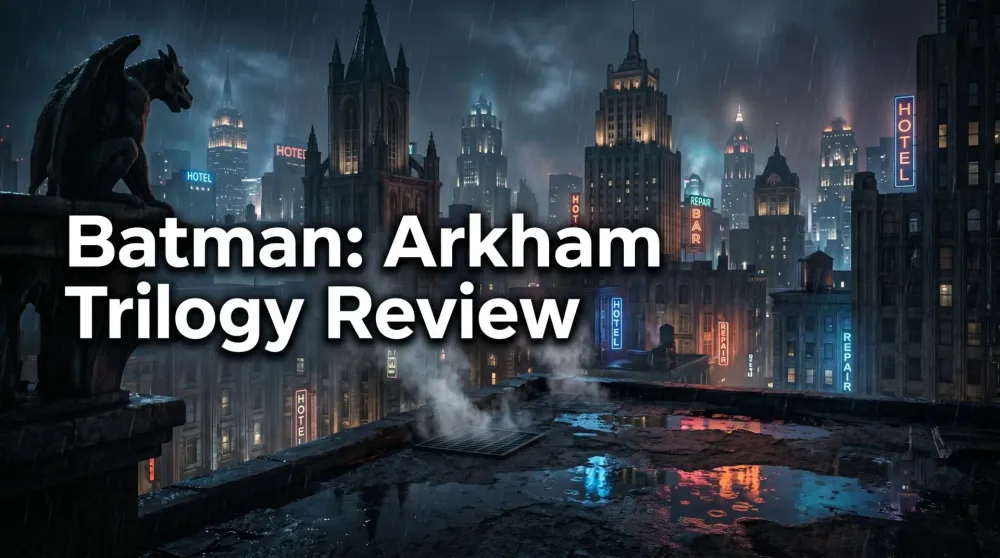
For the finale, Rocksteady went full open world. The whole of Gotham City — three islands, evacuated of civilians, overrun by Scarecrow’s forces and a mysterious militia led by the titular Arkham Knight. It is, without question, the most jaw-dropping game in the trilogy. The rain-soaked, neon-drenched Gotham at night is a genuine technical showpiece even years later, and the core combat and predator gameplay are the most refined they ever got.
And then there’s the Batmobile.
Look, the Batmobile is cool. The first time you summon it mid-glide, drop in, and tear through a city street, it’s a thrill. The problem is that Rocksteady fell in love with it. The game is built around it. Huge stretches of the campaign are tank battles against unmanned drones — and a tank battle, no matter how you dress it up, is not Batman. Batman doesn’t drive a tank around blasting things. He grapples into the dark and terrifies people. Every hour spent in the Batmobile’s combat mode is an hour you’re not doing the thing the series does best.
To be clear, this is still a great game and an 8 in its own right. The story is strong, the Joker’s role is inspired (no spoilers), and when it lets you out of the car, it’s the best Batman has ever played. But the over-reliance on the Batmobile and the slightly diffuse open world are exactly why the trilogy lands at a 4 instead of a 9. The finale is spectacular; it’s just not as focused as the island that started it all.
🎭 Mark Hamill’s Joker: The glue that holds it together
You cannot talk about these games without talking about Mark Hamill. Yes — Luke Skywalker. For a generation of fans, Hamill is the Joker, and the Arkham trilogy is his masterpiece in the role. His performance across these games is genuinely one of the great villain turns in any medium: gleeful, menacing, heartbroken, and hilarious, often in the same breath.
The Joker is the gravity the whole trilogy orbits. He’s your tormentor in Asylum, your dying obsession in City, and his shadow looms over Knight in ways we won’t spoil. Hamill voices him with a manic, theatrical relish that makes every cutscene crackle. When people say the Arkham games have great stories, what they often mean is that they have a great Joker — and a Batman, voiced by Kevin Conroy, who is his perfect, weary counterweight. Two definitive performances, anchoring three games.
📊 The trilogy at a glance
| Aspect | Arkham Asylum | Arkham City | Arkham Knight |
|---|---|---|---|
| Year | 2009 | 2011 | 2015 |
| Setting | Single island asylum | Walled prison district | Full open-world Gotham |
| Scope | Tight Metroidvania | Dense, hand-crafted city | Sprawling open world |
| Traversal | Indoor grapple | Open rooftop gliding | Gliding + Batmobile |
| Combat | Genre-defining debut | Refined and expanded | Most polished |
| Biggest flaw | Short runtime | Almost none | Batmobile overload |
| Our verdict | The tight origin | The undisputed peak | Spectacular but unfocused |
The shape of the trilogy is a climb and a slight stumble: Asylum invents it, City perfects it, Knight goes for broke and gets tangled in its own ambition. None of them is bad. All three are worth your time. But if you understand why City sits at the top and Knight trades focus for spectacle, you understand the 8.
👨👧 The dad angle — Why Arkham still lands
Here’s the practical pitch. The Arkham trilogy is rated T for Teen, and it earns that rating gently — stylized comic-book violence, no gore, a bit of mild language and some suggestive Gotham sleaze. This is a game you can play with a kid in the room without wincing. In fact, kids tend to love watching it: gliding over a glowing city and stringing up bad guys is basically an interactive Saturday-morning cartoon with better lighting.
For dads specifically, the appeal runs deeper than nostalgia for the animated series we grew up on (and yes, hearing Conroy and Hamill reprise those voices hits hard if you were a ’90s kid). These games respect your time. The combat is satisfying in five-minute bursts. You can knock out a predator room, glide across a few rooftops, and put the controller down when bedtime negotiations break down — no live-service grind, no online lobby, no FOMO. It’s a single-player power fantasy you can pause the instant dad-duty calls.
And the power fantasy itself ages well. There’s something genuinely restorative about, after a long day of being responsible and reasonable and tired, becoming the most competent, terrifying, in-control person in the room for an hour. Batman doesn’t lose. Batman has a plan. Batman is, to use the technical term, just badass. Some evenings, that’s exactly the fantasy you need.
🦇 Where the trilogy sits in the superhero pantheon
We’ve made no secret of our love for Insomniac’s Spider-Man saga — it’s also on this list, and it’s a 10. So how do these two superhero benchmarks compare?
They’re solving different fantasies. Spider-Man is movement — the kinetic, optimistic joy of swinging through a sunlit Manhattan, all momentum and lightness. Batman is dread — the slow, methodical, brooding terror of a predator in the dark. Insomniac makes you feel free. Rocksteady makes you feel dangerous. Both are masterclasses; they just live in opposite emotional registers.
The reason Spider-Man edges ahead to a 5 while Arkham lands at a 4 comes down to consistency. Insomniac’s trilogy never stumbles — each entry refines the last without a single misstep. Rocksteady’s trilogy has a clear peak in City and a clear wobble in Knight’s Batmobile obsession. But make no mistake: across three games, the FreeFlow combat, the predator sections, and Mark Hamill’s Joker make this the definitive Dark Knight experience and one of the two best superhero franchises gaming has ever produced. If you want to feel like Batman — actually feel it — there is still nothing else that comes close.
You can find the whole collection together via our Batman: Arkham Collection link, or grab the remastered first two games as Return to Arkham if you just want the tightest part of the run.
Pros
- FreeFlow combat is genre-defining — fluid, fair, and endlessly satisfying across all three games
- Predator stealth sections are the purest 'feel like Batman' fantasy ever made
- Mark Hamill's Joker and Kevin Conroy's Batman are two of the greatest performances in gaming
- Arkham City is a near-flawless high point packed with Gotham's deepest rogues' gallery
- T-for-Teen rating and pause-anytime single-player design make it ideal for time-poor dads
Cons
- Arkham Knight leans far too hard on the Batmobile, especially the repetitive tank battles
- Knight's full open-world Gotham loses the surgical focus of Asylum's tight island
- Riddler collectibles can tip from clever to exhausting if you chase 100% completion
From the game to the shelf: the trilogy opens inside Arkham Asylum — recreate it with the LEGO DC Batman Arkham Asylum (76300) review.
The final verdict: The Dark Knight, done right
The Batman: Arkham trilogy is the moment superhero games grew up. Across Asylum, City, and Knight, Rocksteady built a combat system the whole industry copied, a stealth fantasy nobody has bettered, and a Gotham worth getting lost in — all wrapped around the best Joker performance in any medium.
It isn’t perfect. Knight drives its Batmobile straight into the trilogy’s one real weakness, and the final game trades focus for spectacle. But the peaks here — a flawless Arkham City, the predator rooms, the FreeFlow flow state — are some of the highest in the genre. Batman is just badass, and these are still the games that prove it.
Final Rating: 4/5 — The Definitive Dark Knight Power Fantasy
What’s next in the Living Novel
We’ve swung through Manhattan, ridden through the dying Wild West, and now prowled the rooftops of Gotham. The Hall of Fame keeps growing.
Ready for more? Explore the rest of our Living Novel Hall of Fame to find your next great adventure.
❓ FAQ: The bat-questions
Which Arkham game is the best?
What order should I play the Arkham games?
Is the Arkham trilogy appropriate for kids?
Do you need to be a Batman fan to enjoy the Arkham games?
Is Arkham Knight worth playing despite the Batmobile?
Keep this in your inbox
One email a week: what we actually watched, built and reviewed — the stuff worth a dad's time. No hype, no daily spam.
Dadnology Weekly
One email a week: the LEGO, gaming and movie news worth a dad's time — plus what we actually reviewed. No hype, no daily spam.
Disclaimer: This review and its visuals were created with the help of AI. Some links may be affiliate links – we may earn a commission if you make a purchase, at no extra cost to you.
Current deals in Gaming
Verified live discounts tracked on Amazon

Gaming · Tested by Dadnology
Marvel’s Spider-Man 2 (PS5)
5/5“Bigger, bolder, near-perfect superhero storytelling”Read our review
Gaming · Tested by Dadnology
God of War Ragnarök (PS5)
4.5/5“The bold reinvention that rocked the PlayStation”Read our reviewPrice as of Oct 21, 09:11 PM UTC

Gaming · Tested by Dadnology