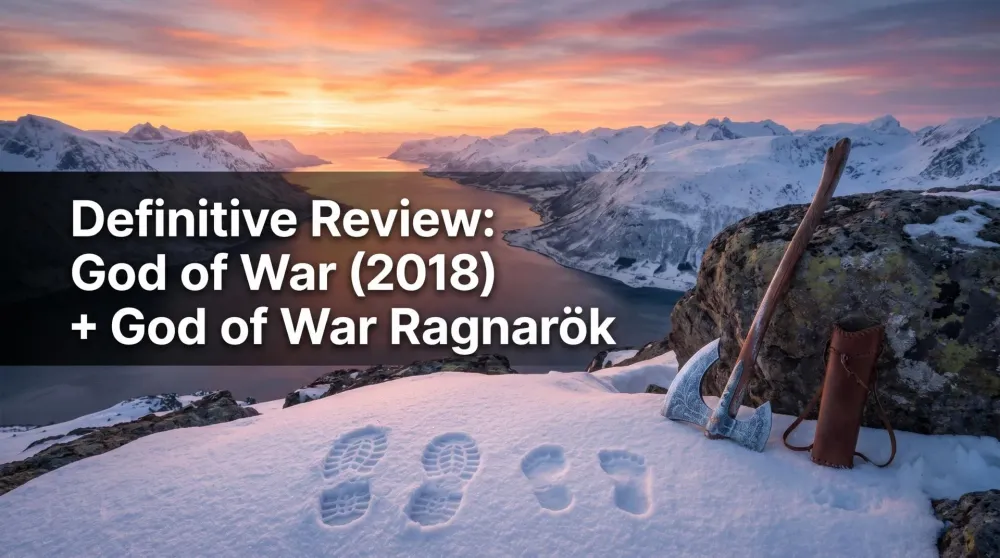
God of War Norse saga review: Kratos, Atreus, and the best dad story in gaming
Our combined review of God of War (2018) and Ragnarok. A grumpy god raising a boy, the best axe in gaming, and one of the most Dadnology stories ever told.
This post contains affiliate links. We may earn a commission if you make a purchase, at no extra cost to you. As an Amazon Associate, Dadnology earns from qualifying purchases.
❄️ Boy. — A 4.5/5 introduction
There is a specific kind of tired that every dad knows. It is the tired of carrying something heavy while a small person trails behind you asking questions you can’t answer, and you are trying to do the right thing despite having no idea what the right thing actually is. God of War put that feeling into a video game, handed it an axe, and made it one of the greatest stories the medium has ever told.
At Dadnology, we played both halves of the Norse saga back to back — God of War (2018) and God of War Ragnarök (2022) — the way they were meant to be experienced. Our verdict? This is a 4.5/5 masterpiece, and the missing point is one of the most honest, dad-specific gripes we’ve ever filed. More on that later. First, let’s talk about why this saga earns every bit of its reputation.
This isn’t the old Kratos. The PlayStation 2 Kratos was a screaming red rage-engine who tore gods apart and felt nothing. The Norse Kratos is older, quieter, and far more interesting. He has a son now. His name is Atreus. And the whole saga is built around a question every parent recognizes: how do you protect a child while also teaching them to survive a world that will try to break them?
🪓 The Leviathan Axe — The real star of the show
Let’s get the most important thing out of the way first, because it deserves top billing: the axe just rocks.
The Leviathan Axe is the best weapon in the history of action games, and it isn’t close. It is a frost-enchanted hand axe that Kratos can throw across the screen to freeze an enemy solid — and then, with a press of the trigger, recall it back into his hand, where it lands with a thwack you feel in your wrists. You will throw that axe ten thousand times across both games, and not one of those throws will get old.
🧊 Throw, recall, repeat
What makes it so good is the loop. You hurl the axe to freeze a distant archer, punch a nearby brute bare-fisted, then summon the axe back mid-combo so it flies past the brute and clatters home. On the PS5, the DualSense haptics make the recall land in your palms — you feel the tension, the release, the impact. It’s the single best argument for the controller’s adaptive feedback that exists.
⚡ Two weapons, one saga
By the time you’re deep into the story, Kratos also reclaims the Blades of Chaos — his old chained blades from the Greek era — and the combat opens up into a dance between frost and fire. Freeze with the axe, immolate with the blades, recall, repeat. It is tactile, weighty, and deeply satisfying. There’s a reason “Boy” and “the axe” are the two things every God of War fan brings up first.
👨👦 The story — A god learns to be a dad
Here is where the saga earns its place in our Living Novel Hall of Fame. The plot of both games can be summed up in one sentence: a grieving, emotionally walled-off father has to raise his son alone after his wife dies, in a world where everyone is trying to kill them both.
❄️ The 2018 game: Spreading the ashes
The first game is, on paper, a simple journey. Kratos and Atreus must carry the ashes of Faye — wife and mother — to the highest peak in all the realms, as was her dying wish. That’s it. That’s the quest. Everything else is the relationship.
And what a relationship it is. Early on, Kratos can barely look at the boy. He’s stiff, cold, terrified of passing his own monstrous nature down to his son. The famous “BOY.” — Kratos barking at Atreus to keep up — became a meme, but it’s also genuinely how a certain kind of overwhelmed father talks when he’s scared and doesn’t have the words. Over the journey, you watch that wall come down, brick by brick. It is one of the most carefully written arcs in gaming, and it earns its tears honestly.
🌍 Ragnarök: The world closes in
The sequel raises the stakes to match its title. The prophecy of Ragnarök — the end of everything — is bearing down, and Atreus is no longer a wide-eyed kid. He’s a teenager now, which means he’s stubborn, secretive, and convinced his father doesn’t understand him. (Dads of teenagers: you will feel this.) Where the first game was about Kratos learning to be present, the second is about him learning to let go — to trust the boy to make his own choices, even dangerous ones.
The nine realms open up. There’s more variety, more spectacle, more side content, more characters to love — Mimir the severed talking head, the dwarves Brok and Sindri, the wolf-riding Angrboda. Ragnarök is bigger in every measurable way. And mostly, that bigness is glorious.
📺 It rocks the PlayStation — The technical showcase
If you want to show a skeptical friend why a modern console is worth the money, you put on God of War.
🎬 The “One-Shot” camera
Both games are filmed as a single, unbroken camera shot. There are no hard cuts — the camera never leaves Kratos from the opening frame to the credits. Combat, cutscenes, quiet walks through the woods, brutal boss fights: it all flows as one continuous take. It’s a staggering technical and directorial achievement that makes the world feel utterly seamless and present.
🌨️ Next-Gen fidelity
On PS5, Ragnarök runs at a buttery 60fps with high-fidelity visuals — snow that deforms under your boots, fur that catches the firelight, water that looks genuinely cold. The realms range from the frozen wastes of Helheim to the golden grasslands of Vanaheim, and each one is a postcard. The 3D audio puts you inside the world: the creak of Kratos’s leather, the distant howl of wolves, the satisfying crunch of an axe finding bone.
🎮 DualSense and haptics
The controller is part of the experience. You feel the weight shift as Kratos hauls a chain, the rumble of a giant’s footsteps, and — best of all — that axe recall landing in your hands. This is a saga built to flex what the hardware can do, and it does it without ever feeling like a tech demo. The spectacle always serves the story.
⚖️ Two games, one saga — How they compare
Both halves are essential, but they have different strengths. The original is leaner and more focused; the sequel is grander and more varied. Here’s how they stack up.
| Feature | God of War (2018) | God of War Ragnarök | Edge |
|---|---|---|---|
| Story Focus | Tight, intimate father-son journey | Sprawling, world-ending epic | 2018 (focus) |
| Scale & Variety | One main realm, focused path | Nine realms, huge variety | Ragnarök |
| Combat Depth | Axe-centric, building up | Axe + Blades + spears, fully realized | Ragnarök |
| Emotional Core | Kratos learns to be present | Kratos learns to let go | Tie (both gut-punch) |
| Hack-and-Slash Padding | Lean, well-paced | More arenas, occasionally crowded | 2018 (tighter) |
| Spectacle & Bosses | Strong, restrained | Bigger, louder, more frequent | Ragnarök |
The honest summary: if you want the purest version of the father-son story, the 2018 game is the tighter experience. If you want scope, spectacle, and a grand finale, Ragnarök delivers. Played together, they’re a complete and devastating arc — which is exactly how we recommend taking them.
🤔 Why it’s not a perfect 5 — The honest dad gripe
Here’s the part that keeps this saga off the perfect-score podium, and it’s worth being honest about because it’s a real, considered opinion rather than nitpicking.
There is a tick too much hack-and-slash.
This saga is at its absolute best in its quiet moments — Kratos and Atreus rowing a boat while Mimir tells a story, a tense conversation by a campfire, the wordless grief of a father who can’t say “I love you” out loud. Those scenes are the masterpiece. They’re why this is one of the most Dadnology stories ever put in a game.
But every so often, the game corrals you into yet another circular combat arena, locks the doors, and throws three waves of draugr at you before it’ll let the story continue. The combat is excellent — that axe never stops being satisfying — but in the back third of Ragnarök especially, the ratio tips. You start to feel the seams of a big-budget action game that needs to justify its runtime with fights, when what you actually want is more of the slow, human, father-son drama that makes the saga special.
For our money, we’d happily trade a third of the wave-combat arenas for more quiet boat rides and difficult conversations. A bit more story, a bit less spectacle, and this would be a flat 5. As it stands, the combat padding is the one thing standing between a brilliant saga and a perfect one. It’s a small complaint about a genuinely great pair of games — but it’s an honest one, and it’s the reason for the score.
👨👩👧 The Dadnology perspective — Why this one hits different
Plenty of games have fathers in them. Very few games are actually about fatherhood, and fewer still understand it. God of War does.
Kratos is not a good communicator. He’s gruff, he over-protects, he struggles to say the warm things he clearly feels, and he’s terrified of passing his worst traits onto his kid. If you’ve ever lain awake worrying that your own flaws are quietly becoming your child’s, you will recognize this man completely. Watching him slowly, awkwardly learn to be a better dad — to listen, to trust, to let Atreus be his own person — is the emotional engine of the whole saga, and it lands harder the older you are.
💾 Why it respects your time
This is a single-player story you can pause the instant Dad-duty calls. The chapter structure means you can play for 30 focused minutes and still feel like you moved the story forward. There’s no online pressure, no live-service treadmill, no FOMO — just a great story that waits patiently for you to come back to it after bedtime.
🎧 The right setup
Like all the best PlayStation showcases, this saga rewards a good screen and good audio. An HDR TV makes the snowscapes and fire effects sing, and a quality headset puts you inside Bear McCreary’s enormous score. If you’ve got a PS5, play Ragnarök in 60fps performance mode — the combat feels even better, and the axe recall is even crisper.
Pros
- The Leviathan Axe — the throw-and-recall mechanic is the most satisfying weapon feel in any action game, and the haptics sell it perfectly
- One of gaming's greatest fatherhood stories: Kratos raising Atreus is a genuinely moving, deeply Dadnology arc across both games
- A technical showcase that rocks the PlayStation — the unbroken single-shot camera, the realm-spanning visuals, the 3D audio
- Two distinct, complementary halves: 2018's tight focus and Ragnarök's grand scale make one complete saga
- Respects a busy dad's time — pausable single-player story with no live-service nonsense
Cons
- A touch too much hack-and-slash — the combat arenas occasionally crowd out the quiet father-son story that is the real masterpiece, especially late in Ragnarök
- PlayStation (and PC) only — no Xbox version of either game
- The sheer amount of side content in Ragnarök can dilute the focused pacing of the main story
The final verdict: A 4.5/5 masterpiece of fatherhood
The God of War Norse Saga is one of the finest achievements in story-driven action gaming. It took a one-note rage machine and turned him into a weary, careful father — and built around that transformation the most satisfying weapon ever coded and a technical showcase that genuinely rocks the PlayStation.
It lands at a 4.5 rather than a 5 for one honest reason: there’s a tick too much wave-combat padding crowding out the quiet, brilliant father-son story that is the real heart of this saga. We’d have traded a third of the arenas for more boat rides and campfire conversations in a heartbeat.
But make no mistake — this is emphatically a masterpiece. If you have a PlayStation and a pulse, and especially if you’re a dad, this is essential.
Final Rating: 4.5/5 — The Best Dad Story in Gaming
Related Dadnology reviews: God of War (2018) Review: Kratos Reborn as a Weary Father · God of War Ragnarok Review: The Bigger, Bolder End of the Norse Saga
What’s next for the Living Novel?
We’ve raised a son through the dying world of Norse myth and thrown an axe more times than we can count. The saga of Kratos and Atreus is one of the high points of our hall of fame.
Ready for more? Explore the rest of our Living Novel Hall of Fame to find your next great adventure.
❓ FAQ: The God of War questions
Do I need to play the 2018 game before Ragnarok?
Is it ok for kids to watch?
How long does each game take?
Which game is better, 2018 or Ragnarok?
Is the Leviathan Axe really that good?
Keep this in your inbox
One email a week: what we actually watched, built and reviewed — the stuff worth a dad's time. No hype, no daily spam.
Dadnology Weekly
One email a week: the LEGO, gaming and movie news worth a dad's time — plus what we actually reviewed. No hype, no daily spam.
Disclaimer: This review and its visuals were created with the help of AI. Some links may be affiliate links – we may earn a commission if you make a purchase, at no extra cost to you.
Current deals in Gaming
Verified live discounts tracked on Amazon

Gaming · Tested by Dadnology
The Last of Us Part I (PS5)
5/5“A masterpiece rebuilt for the modern era”Read our review
Gaming · Tested by Dadnology
Assassin's Creed: The Ezio Collection
4.5/5“The game that fixed everything and gave us Ezio”Read our review
Gaming · Tested by Dadnology
Halo Wars - Xbox 360 (Renewed)
4.5/5“An RTS that actually works on a controller, in a universe built for war.”Read our reviewPrice as of Oct 27, 10:05 AM UTC