
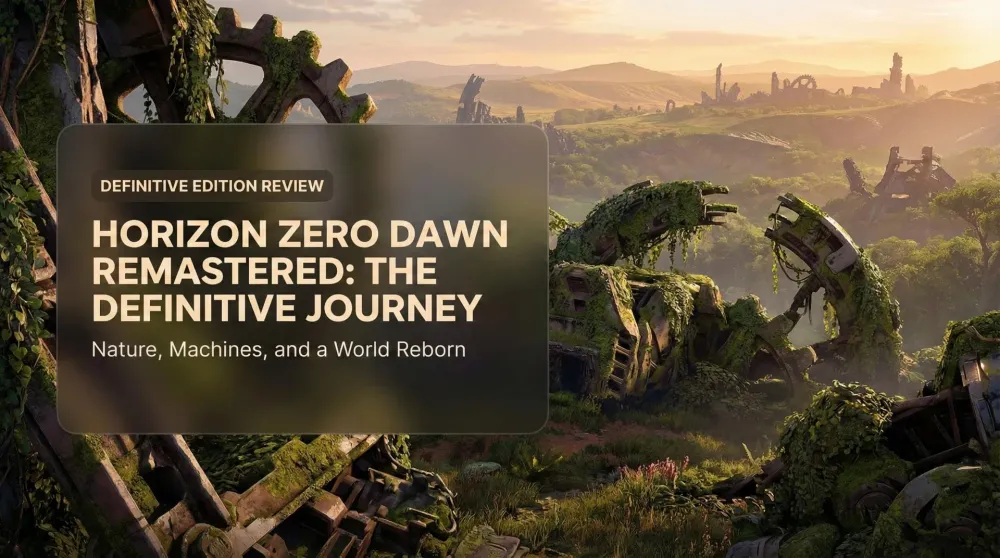
Horizon Zero Dawn Remastered – Aloy’s definitive journey (with the frozen wilds)
The ultimate way to experience Aloy’s origin. With The Frozen Wilds included, upgraded visuals, faster loading, and refined tech, Horizon Zero Dawn Remastered turns a modern classic into a definitive adventure for archers, strategists, and open-world explorers.
This post contains affiliate links. We may earn a commission if you make a purchase, at no extra cost to you. As an Amazon Associate, Dadnology earns from qualifying purchases.
🎮 Introduction — A masterpiece, refined
🏹 This review is part of the The Horizon Saga – play Aloy’s saga in order.
Some games are great because they do many things well. Horizon Zero Dawn Remastered is great because it does everything with intention. The opening hours fuse mystery and momentum; the middle game blooms into tactical hunts; and the ending pays off with answers that reframe every ruin you passed along the way. The remaster doesn’t reinvent Aloy’s origin—it removes friction and elevates beauty, letting the world’s art direction breathe at modern fidelity while bundling The Frozen Wilds to complete the arc.
We’ve long preferred ranged, tactical play over button-mashing brawls, and Horizon remains the gold standard for that fantasy. You plan, you probe, you execute—and when a thunderjaw finally topples because your last precision arrow clipped the right canister at the right second, you feel like you earned it. That never gets old.
🌍 World & lore — Ruins, Tribes, and living machines
Horizon’s world is a character unto itself. Vine-wrapped skyscrapers whisper of fallen ancestors; tribal settlements reinterpret old-world relics; and the machine ecology animates the landscape with convincing behaviors. Grazers startle and flee. Watchers patrol. Predators hunt with pack logic. You don’t just pass through biomes; you observe systems in motion, learning which sounds agitate which species and how terrain—grass, rock, water—can be read like a tactical map.
The genius is how the macro mystery (“How did the world fall?”) and the micro storytelling (tribal politics, personal quests) braid without bloating. Information arrives in different voices: artifacts, glyphs, side characters, and environmental storytelling. Step by step, you assemble the answer—and it’s as devastating as it is hopeful.
🏹 Combat — Archery as strategy, not a minigame
Horizon’s combat loop is built from readable anatomy and elemental cause-and-effect:
- Scan with Focus to reveal plates, canisters, blaze tanks, data nodes.
- Plan: lay traps, pick high ground, route an escape arc.
- Execute with the right arrowheads—tear, shock, fire, freeze, corruption—and swap bows quickly as opportunities appear.
- Adapt when plans shatter, using rolls, slides, and line-of-sight breaks to reset.
Even on normal difficulty, the game invites precision thinking: remove a cannon before it fires; freeze a threat, then burst with high-damage shots; chain-trip a charging sawtooth into a well-placed blast. The feel is closer to hunting than to action-movie mowing. Enemies hit hard, but fights are fair, and the rules are consistently communicated.
Why bow-first combat sings
For lifelong ranged players, Horizon rewards the three habits that make archers happy:
- Distance Management — fights play better with sightlines you choose.
- Target Triage — break the weapon that hurts the most first.
- Elemental Setups — status, then strike (freeze → tear; shock → critical).
It’s immensely satisfying because success isn’t a reaction test; it’s a plan meeting execution.
🦾 Machines — Anatomy, behaviors, and boss-scale encounters
Horizon’s machines feel alive because they’re built like puzzles first and HP bars second.
- Watchers teach scanning and eye-shot discipline.
- Grazers/Lancehorns teach resource risk: disrupt, or spook and chase?
- Sawtooths/Stalkers teach sound, invisibility, and trap value.
- Shell-Walkers teach shields and position breaking.
- Stormbirds/Thunderjaws teach vertical reads, weak-point sequencing, and arena control.
The stand-offs against giants—rockbreakers tunneling beneath, stormbirds dive-bombing from cloudline, thunderjaws leveling treelines—are never cheap. Each has telegraphs, cooldowns, and counter-windows that become obvious with time. The remaster’s cleaner image and animation frames make those tells even easier to read without gutting challenge.
🧭 Exploration — The joy of getting lost (on purpose)
Horizon is full of “what’s over that ridge?” moments. The remaster’s faster loads and improved streaming mean you can follow that curiosity without stutters or long waits. Tallneck climbs remain the purest expression of this: a gentle route-finding puzzle that rewards you with map clarity and peerless views. Cauldrons—Horizon’s sci-fi dungeons—are still highlights: puzzle combat, environmental manipulation, and override unlocks that transform how you approach the open world afterward.
Side quests matter. Many conclude with character turns or micro-lore that deepens the setting instead of padding your checklist. And Photo Mode? It’s dangerously absorbing. The remaster’s material upgrades and lighting tweaks make screenshots pop like concept art.
🎒 Builds, gear & skills — Pick a style, then evolve it
Aloy’s kit invites identity. You can lean into stealth hunter (silent strikes, long grass, tear shots), adaptive controller of space (traps, tripwires, elemental priming), or precision burst (high-damage headshots, concentration time dilation). Armor choices add flavor—resistances, stealth multipliers, elemental shrug—and modifiers let you chase feel: faster draw, better handling, or raw damage.
The best part is that the game’s encounter grammar never forces a single meta. In a pinch, you can pivot mid-fight—swap bows, lay wires, set a blast, take control of the high ground—and the systems respect that adaptation.
❄️ The frozen wilds — Demanding, beautiful, essential
Bundled here, The Frozen Wilds is both expansion and capstone class. The Banuk frontier layers harsh weather, smarter enemy movesets, and new machine types that test the habits you built in the base game. It’s harder, yes, but also richer: new bows, mods, and skills amplify archery in satisfying ways. The story threads are intimate—loss, resilience, tradition vs. change—and the final hunts are some of the cleanest fights Guerrilla has ever shipped.
As part of the remaster, it feels less like DLC and more like Act 4, the place where confident players go to prove the craft they learned.
🛠️ What the remaster adds — Feel the upgrade
While the soul is intact, the remaster polishes the body:
- Sharper assets and denser foliage that preserve Horizon’s painterly palette while lifting clarity in motion.
- Improved character models and materials—faces, hair, cloth, and armor reads feel more present.
- Better lighting and atmospheric effects for dusk/dawn vistas and stormy hunts.
- Near-instant loading on modern hardware, making failure and fast travel frictionless.
- Controller feedback that subtly underscores surfaces (crunching snow, metal grates, loose shale) and draw tension, enriching the archery fantasy.
None of this changes the story; it removes layers of glass between you and it.
👩🦰 Aloy — A protagonist worth following
Aloy works because she’s resolute without bravado, curious without naivety, and skilled because she learned—not because a prophecy said so. Her outsider’s empathy turns fetch tasks into favors worth doing; her engineer’s brain makes machine fights feel like debates she intends to win. The performances land, the writing respects silence, and the character arc stands up even after you know the twist. She’s among the medium’s best.
🧒👨👧 Dad & family notes — Play your way, on your time
For families, Horizon is a perfect “after bedtime” game and a great spectator game on weekends. The rhythm of scout → plan → strike fits shorter sessions, and the map leaks many off-ramps for stopping points. Teens can absolutely play; for younger kids, consider watching the exploration and saving the more intense hunts. Content is broadly PG-13: intense machine combat, peril, and themes of loss and responsibility.
🧠 Tips for new hunters (spoiler-light)
- Scan everything. Knowing a part’s weakness is half the win.
- Tear then burn (or freeze then burst). Status first multiplies damage.
- Fight the arena. Lead machines into choke points or trap gardens you set up.
- Prioritize canisters. Removing the most dangerous weapon early often flips the fight.
- Respect retreat. Breaking line of sight is a tool; use it to reset and re-plan.
- Buy variety, not just raw DPS. Having the right arrow beats having the strongest arrow.
🔊 Audio, music & feel — Technology serving story
Horizon’s soundscape layers mechanical animal timbres with windswept ambience and tribal instrumentation for a sonic identity that sticks. Machine calls communicate mood—agitated, hunting, searching—and weapon feedback teaches timing by ear. The score lifts intimacy and scale without smothering either. In the remaster, the mix feels cleaner in busy encounters; the world has room to breathe.
🎨 Art direction — The secret sauce
Horizon isn’t just technically impressive; it’s tasteful. Color keys separate biomes cleanly; costume design reads culture at a glance; silhouette design gives every machine personality from 200 meters away. The remaster’s higher fidelity clarifies those choices rather than replacing them; you notice the braidwork, the fabric grain, the micro-scratches on plates you once only felt.
🧱 Where it’s not perfect (and why it hardly matters)
- Inventory fuss can resurface when you hoard mods; the remaster streamlines some friction, but optimization goblins can still overthink.
- Stealth AI occasionally ping-pongs between states, especially with multi-wave fights in dense brush.
- Some side errands land softer than the mainline, though the ratio of great to meh is far better than most open worlds.
None of these dent the verdict: the core is timeless.
🔄 How it compares to Horizon Forbidden West
The obvious question for anyone who’s played Forbidden West: is it worth going back to Zero Dawn?
The Remaster makes the case easier. Zero Dawn’s world is smaller, the UI is slightly more dated, and Aloy’s movement feels marginally less fluid than her Forbidden West version. But the story — the mystery of the machines, the revelation of the old world — is tighter and more surprising the first time through. Forbidden West is the bigger, more refined game. Zero Dawn is the more emotionally resonant one, because the mystery is intact.
For new players choosing where to start: begin here. The story setup and character foundation in Zero Dawn pay off more when experienced in order; Forbidden West rewards knowing where Aloy came from.
For returning players: the Remaster is worth it for the visual upgrade alone on a capable display. The lighting rework transforms specific biomes — the Carja Sun-Ring at dusk, the foggy lowlands near Meridian — into genuinely stunning environments the original PS4 version couldn’t render. It’s the definitive way to revisit a masterpiece before the next chapter arrives.
Pros
- Strategic, precision-first combat where planning beats brute force
- Unforgettable worldbuilding with living machine ecology
- Remaster polish: sharper assets, better lighting, faster loading
- The Frozen Wilds included—series-best hunts and gear
- Aloy’s character and arc still stand among the best in the genre
Cons
- Inventory/mod tinkering can distract optimization-prone players
- Occasional stealth AI wobble in dense multi-enemy scenarios
- A handful of side errands land below the main quest’s high bar
From the game to the shelf: nothing says Horizon like a Tallneck on the horizon — build the icon with the LEGO Horizon Forbidden West: Tallneck (76989) review.
🗣️ Conclusion
Horizon Zero Dawn Remastered is the definitive way to experience Aloy’s beginning—a rare open world that prizes strategy over spam, clarity over clutter, and heart over hollow scale. With The Frozen Wilds folded in and the presentation meaningfully refreshed, every hunt, climb, and mystery beat lands with renewed force. If you love third-person action, archery, or just great worlds, this is essential. Some games you finish; this one you remember. And when you’re done, the story continues in Horizon Forbidden West.
📌 FAQ — Frequently asked questions
Do I need to play the original before this remaster?
How hard is the combat if I’m not great at shooters?
Is The Frozen Wilds worth doing during or after the story?
Can kids watch or play?
Keep this in your inbox
One email a week: what we actually watched, built and reviewed — the stuff worth a dad's time. No hype, no daily spam.
Dadnology Weekly
One email a week: the LEGO, gaming and movie news worth a dad's time — plus what we actually reviewed. No hype, no daily spam.
Disclaimer: This review and its visuals were created with the help of AI. Some links may be affiliate links – we may earn a commission if you make a purchase, at no extra cost to you.
Current deals in Gaming
Verified live discounts tracked on Amazon

Gaming · Tested by Dadnology
Marvel’s Spider-Man 2 (PS5)
5/5“Bigger, bolder, near-perfect superhero storytelling”Read our review
Gaming · Tested by Dadnology
Assassin's Creed: The Ezio Collection
4.5/5“The game that fixed everything and gave us Ezio”Read our review
Gaming · Tested by Dadnology
The Last of Us Part I (PS5)
5/5“A masterpiece rebuilt for the modern era”Read our reviewYou might also like
Horizon Forbidden West Complete Edition (PS5) – Aloy’s epic, evolved (with Burning Shores)
Everything wonderful about Horizon returns, turned up: stunning biomes, sharper writing, and tactical, parts-based combat that rewards planning over button mashing. Aloy’s toolkit blossoms with new weapons and movement toys; machines push back with trickier patterns; and Burning Shores adds jaw-dropping, late-game adventures across volcanic islands and towering cloudscapes. On PS5, DualSense feedback and fast loading make discovery feel effortless. For us, it’s an easy 5/5—one of the generation’s essential action adventures and a sequel that truly earns the word “complete.”

Marvel’s Spider-Man: Miles Morales (PS5) – Heart, style, and swinging brilliance
A near-perfect Spider-Man experience: dazzling swing physics, expressive Venom combat, and a wintery New York that begs to be explored. The story is heartfelt and propulsive—you always want one more mission—and PS5 features add real feel. As a dad with limited time, this was the rare game I 100% completed happily. If you love story-driven action, you need this on your shelf. For us, it’s a joyous, confident 5/5 and a clear PS5 system seller.
The best cinematic third-person action games (2026 best-of guide)
A curated best-of guide to story-driven, movie-like third-person action games — the blockbusters you control, ranked for busy dads.