Mass Effect Legendary Edition review – Commander Shepard: One person. One ship. The fate of the galaxy.
A deep-dive into the Mass Effect trilogy. Why your choices as Commander Shepard create a unique, 5/5 legendary journey.
This post contains affiliate links. We may earn a commission if you make a purchase, at no extra cost to you. As an Amazon Associate, Dadnology earns from qualifying purchases.
The galaxy awaits: A 5/5 introduction
There is a feeling you get when you walk onto the bridge of the SSV Normandy for the first time. The hum of the engines, the glowing consoles, and the vast expanse of the galaxy waiting on the star map. It’s not just a game level; it’s your home. And the people standing there—the turians, the asari, the krogan, and the humans—aren’t just NPCs. They are your crew. Your friends. Your family.
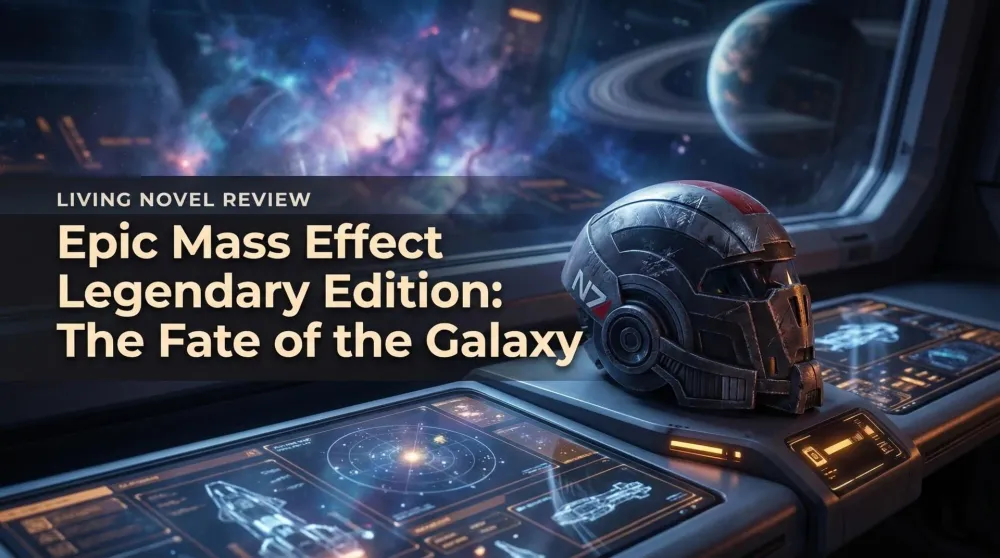
At Dadnology, we consider Mass Effect Legendary Edition to be the high-water mark of the “Living Novel.” It is a series that respects the player’s intelligence by offering consequences that don’t just resolve in a single scene, but ripple across a 100-hour saga. Commander Shepard isn’t just a protagonist you’re controlling; Shepard is the vessel for your own moral compass. It is a 5/5 masterpiece because it manages to be both a galaxy-spanning epic and a deeply intimate character study.
When the collection launched in 2021, it wasn’t just a “pretty coat of paint.” It was an invitation to relive a legacy or to start one for the first time. For the Dad who missed out on the original run between 2007 and 2012, this is the ultimate “Time-Travel” device. It brings the visuals and mechanics up to modern standards while preserving the soul of the best sci-fi ever coded.
Commander Shepard: Your legend, your way
The genius of Mass Effect starts with Shepard. Unlike most RPG heroes, Shepard is a “blank slate” with a voice. Whether you play as a man or a woman (Jennifer Hale’s voice acting as “FemShep” is considered by many to be the definitive performance), you are in total control of their personality.
🔴 Paragon vs. Renegade: The moral compass 🔵
The game uses a morality system that goes beyond “Good vs. Evil.”
- Paragon: The diplomat. The hero who follows the rules and tries to save everyone through cooperation.
- Renegade: The “ends justify the means” soldier. The one who punches the annoying reporter and makes the hard, often cold-blooded choices to get the job done.
For a Dad, this system is fascinating. It often reflects how we view leadership in our own lives. Do you lead with empathy, or with a heavy hand? In Mass Effect, there is no “wrong” way to play, but there are consequences. Choosing to be a Renegade might get the mission done faster, but you might lose the trust of your crew. Being a Paragon might be the “right” thing, but it could lead to the death of an ally because you refused to take a dirty shortcut.
The ripple effect of choice
Mass Effect did something no other series has truly replicated: your save file carries over. A person you save in the first game might show up as a crucial ally in the third. A choice to commit genocide on a hostile alien race (the Rachni) in the first game might come back to haunt you two games later when you desperately need their help. This continuity makes the story feel “heavy.” Every click of the dialogue wheel matters.
⚙️ The science of the “Mass Effect”
Before we dive into the games, we need to address the “Tech” in Dadnology. The “Mass Effect” isn’t just a cool title; it’s a grounded (if fictional) physics concept based on the discovery of Element Zero (or “Eezo”).
In the lore, when Eezo is subjected to an electric current, it creates a field that can increase or decrease the mass of space-time. This isn’t just “space magic”—it’s a consistent set of rules that governs everything from how you travel across the galaxy to how you throw a biotic grenade.
How the Normandy actually flies:
- The “Weightless” Ship: By pumping a negative current into the Eezo core, the ship creates a field that reduces its own mass to a negligible or even negative value.
- Breaking Physics: Because the ship effectively has “zero” mass, it can achieve Faster-Than-Light (FTL) travel without the infinite energy requirements usually demanded by Einstein’s laws of relativity.
- Combat Utility: On the battlefield, this same tech allows for “Biotics”—soldiers who use internal Eezo nodules to create gravity wells or kinetic shields.
This grounded approach is why the world feels so lived-in. It’s not a “wizard with a wand” scenario; it’s a technological leap with an internal logic that feels earned. For a Dad who appreciates a well-engineered machine, the SSV Normandy is the ultimate piece of high-performance hardware.
The Reaper threat: Cosmic horror in 4K
The overarching plot—the return of the Reapers, ancient sentient machines that “harvest” all organic life every 50,000 years—is pure sci-fi gold. It turns the game from a political thriller into a survival horror on a galactic scale.
Mass Effect 1: The discovery
The first game is a mystery. You are a “Spectre,” an elite agent for the galactic council, chasing a rogue agent named Saren. As the plot unfolds, you realize Saren is just a pawn for a Reaper named Sovereign. The Legendary Edition fixes the clunky combat of the original release, but the discovery of Virmire remains one of the greatest “drop the controller” moments in gaming.
Mass Effect 2: The Dirty Dozen (the peak)
If the first game was Star Trek, the second is Ocean’s Eleven in space. You are working for Cerberus (a pro-human splinter group) to build an elite team for a “Suicide Mission.” This game is widely considered the best because of its focus on Loyalty. You spend the whole game getting to know your crew, knowing that at the end, your bond with them will determine if they make it home.
Mass Effect 3: Total War
The final chapter is a harrowing look at a galaxy under siege. It’s about building alliances and making the final stand. While the original ending caused controversy, the Legendary Edition includes the “Extended Cut,” which provides the emotional closure the fans deserved. The weight of your 100-hour journey rests on these final decisions.
| Feature | Mass Effect 1 | Mass Effect 2 | Mass Effect 3 | Overall Rating |
|---|---|---|---|---|
| Focus | World-Building | Character/Squad | Total War/Payoff | 5/5 Narrative |
| Combat | Tactical/Remastered | Punchy/Action | Refined/Fast | Solid Progression |
| Choice Weight | Foundational | Personal/Critical | Galactic/Final | Unmatched |
| Vibe | Classic Mystery | Gritty Heist | Epic War Drama | The Best Space Opera |
The crew of the Normandy: Found family
A Living Novel is only as good as its supporting cast, and Mass Effect has the greatest ensemble in history. As a Dad, you’ll start to see these characters as more than just polygons.
🦎 Garrus Vakarian: The ultimate Wingman
There is no Shepard without Vakarian. The turian vigilante who starts as a frustrated cop and becomes your most loyal friend is the heart of the series. His dry wit and “calibration” jokes are iconic. For many, Garrus represents the “Best Bro” archetype—the one friend you’d trust with your life (and your ship).
🧬 Liara T’Soni: The intellectual soul
The asari scientist who evolves from a naive researcher into the “Shadow Broker,” the most powerful information broker in the galaxy. Her romance arc is one of the most beautiful and well-written stories in the medium. It spans all three games, showing a depth of intimacy rarely seen in gaming.
🛡️ Wrex and Grunt: The krogan muscle
Whether it’s the grizzled veteran Wrex or the “born-in-a-bottle” powerhouse Grunt, the krogans provide the series with its most visceral perspective on war and survival. Their quest to cure the Genophage—a biological weapon that sterilized their race—is the series’ most difficult moral dilemma.
The “suicide mission”: 5/5 gameplay design
The finale of Mass Effect 2 remains the single greatest mission in RPG history. Why? Because your choices actually matter. If you didn’t do a crew member’s loyalty mission, they might die. If you assign the wrong person to lead the fire team (like sending a non-technical person into the vents), they will die. The tension of walking through that final portal, knowing that your decisions over the last 30 hours will determine who lives and who dies, is the ultimate expression of player agency. It’s not a scripted cutscene; it’s a consequence of your leadership. It is the gold standard for how to end a story-driven game.
The technical polish: Why “legendary” is the right word
Bluepoint and BioWare didn’t just upres the textures; they rebuilt the experience for the 2026 gamer.
- Unified Combat: The combat mechanics of the first game were brought closer to the sequels. Weapon handling, cover mechanics, and squad AI were all overhauled, making a full “marathon” run feel cohesive.
- 4K/60fps Visuals: The lighting and textures were overhauled. The Citadel has never looked more beautiful, and the character models (especially the aliens like Thane and Tali) look incredible. On a high-end PS5 or Xbox, the HDR makes the neon of Omega and the stars of the galaxy pop with reference-quality brightness.
- Loading Speeds: On current-gen hardware, the “Elevator Rides” (the original game’s hidden loading screens) are gone in seconds. This keeps the pacing tight and the immersion high.
🔊 Sound design & immersion
If you have a high-end subwoofer, the Reaper “horns” are a terrifying experience. The sound design of the Reapers landing on Earth or Palaven is a physical experience—a low-frequency dread that vibrates your floorboards. Combined with the Logitech G Pro X 2 Headset, the spatial awareness of the combat and the clarity of the voice acting create a 5/5 auditory environment.
The Dadnology perspective: A heroic escape
As Dads, we spend a lot of time being responsible for others—kids, spouses, employees. Mass Effect leans into that responsibility. It gives you a ship and a crew who look to you for answers.
💾 Respect of time
The “Living Novel” for Dads needs to be respectful of a busy schedule. Mass Effect Legendary Edition allows for clear mission-based progression. You can play a single “Loyalty Mission” in 45 minutes, save at the Normandy, and feel like you’ve achieved a significant narrative goal before heading to bed.
🧔 The legacy of Shepard
By the end of the third game, you feel like you’ve lived a life. You’ve seen friends fall, you’ve brokered peace between warring empires, and you’ve stood on the edge of the abyss. For a Dad, the theme of “Legacy”—what we leave behind and the hard choices we make for the future—hits home in a way few other games can. It’s not just about winning; it’s about how you chose to lead.
Pros
- Choices carry across all three games for an unmatched sense of consequence
- The greatest ensemble cast in gaming, led by Garrus, Liara, and Wrex
- ME2's Suicide Mission is still the gold standard for player-driven payoff
- The remaster unifies combat and 4K visuals into one cohesive 100-hour saga
- Includes nearly all DLC, including the essential Shadow Broker and Citadel
Cons
- Mass Effect 1's combat, even improved, still feels dated next to the sequels
- ME3's ending remains divisive despite the included Extended Cut
- The 100-hour length and DLC volume can be daunting for a busy schedule
The final verdict: The greatest space opera
Mass Effect Legendary Edition is a 5/5 masterpiece. It is the definitive “Living Novel”—a story that belongs to you and you alone.
Commander Shepard is an icon, but the true stars are the world BioWare built and the choices they forced us to make. Whether you’re romancing an alien archaeologist, deciding the fate of the krogan race, or making the final stand against the Reapers, the games never lose their heart. It is the best sci-fi experience in gaming history, and it is a journey every father should take at least once.
Final Rating: 5/5 — The Unrivaled Epic of Choice
FAQ: Everything a commander needs to know
Is the combat in the first game still clunky?
Should I play the DLCs?
Can I change my character's appearance between games?
Is there a 'perfect' ending?
What’s next for the Living Novel?
We’ve saved the galaxy and made our choices. Next, we’re coming back to Earth for a colorful, ancient adventure through the eyes of a hero who redefined the “Open World” for a new generation. We’re heading to the vibrant lands of Hyrule to see how Link’s journey holds up against the modern epic.
Keep this in your inbox
One email a week: what we actually watched, built and reviewed — the stuff worth a dad's time. No hype, no daily spam.
Dadnology Weekly
One email a week: the LEGO, gaming and movie news worth a dad's time — plus what we actually reviewed. No hype, no daily spam.
Disclaimer: This review and its visuals were created with the help of AI. Some links may be affiliate links – we may earn a commission if you make a purchase, at no extra cost to you.
Current deals in Gaming
Verified live discounts tracked on Amazon

Gaming · Tested by Dadnology
Marvel’s Spider-Man 2 (PS5)
5/5“Bigger, bolder, near-perfect superhero storytelling”Read our review
Gaming · Tested by Dadnology
Assassin's Creed: The Ezio Collection
4.5/5“The game that fixed everything and gave us Ezio”Read our review
Gaming · Tested by Dadnology