
Metroid Prime 4: Beyond – First Look on Switch 2 (and Switch 1)
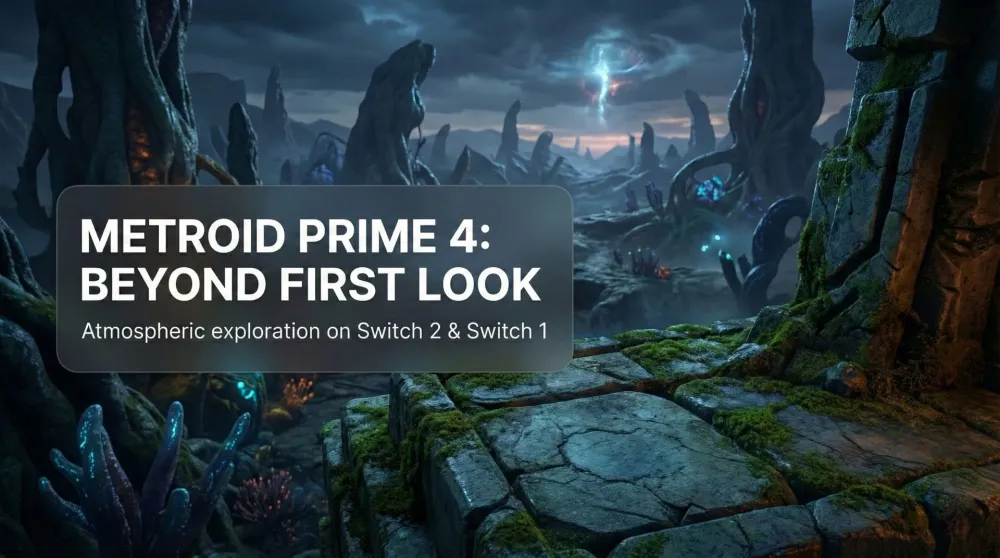
Our dad-focused First Look at Metroid Prime 4: Beyond on Switch 2 (and Switch 1). Atmosphere is back, the Prime ‘explore → unlock → master’ loop feels right, and optional mouse-style aiming is surprisingly good.
This post contains affiliate links. We may earn a commission if you make a purchase, at no extra cost to you. As an Amazon Associate, Dadnology earns from qualifying purchases.
🎮 Introduction — The Prime Feeling Is Back
🎮 This preview is part of our Nintendo Brand Hub – why Nintendo keeps earning a place in our family setup.
From the opening minutes, Metroid Prime 4: Beyond hits that unmistakable rhythm: quiet corridors, eerie soundscapes, a puzzle you don’t fully grasp yet, and the creeping realization that you’re threading a loop you’ll master on your next pass. That’s the Prime magic we’ve been waiting for—and it lands immediately on Switch 2, with cleaner image stability and snappier input feel that help every scan, strafe, and charge shot. Our First Look has been short but sweet: the atmosphere is thick, the progression loop feels right, and the ”scan → unlock → route rewire” cadence is alive and well.
We’re especially surprised by the optional mouse-style aiming mode on Switch 2—it feels natural for lining up weak points and quick micro-adjustments (we’re still deciding if it’ll replace our usual dual-stick+motion habit long-term, but the first impression is strong). Early previewers and reviewers are calling this out too, noting that the new aiming options broaden how you can play without breaking the Prime identity.
To help frame our First Look, here’s what day-one reviews are saying—and how that matches what we’ve felt so far.
AdMetroid Prime 4: Beyond (Switch 2 Edition) (opens in a new tab)
Check out Metroid Prime 4: Beyond (Switch 2 Edition).

⏳ Eight Years, Zero Apologies
The development history of Prime 4 deserves a paragraph. Nintendo announced the game at E3 2017 — a brief logo reveal that sent Metroid fans into a frenzy. Then, in January 2019, Nintendo did something almost unheard of: they publicly scrapped what they’d built, admitted it wasn’t good enough, and handed the project to Retro Studios — the Texas-based team that made the original Prime trilogy. They restarted from scratch.
That’s a six-year rebuild. And it shows — not as a game that feels patched together, but as one where every system has clearly been stress-tested and refined. The scan visor, the morph ball puzzles, the three-dimensional route memory you build across a playthrough: none of it feels like first-draft thinking. It feels like a team that fully understood what they were building and refused to ship until it was right. For dads who remember pre-ordering and waiting, and waiting, and waiting — this is a vindication that Nintendo occasionally earns.
🔍 What Is Metroid Prime, Actually?
For dads who haven’t played the series: Metroid Prime is a first-person action-adventure, not a shooter. You don’t grind through corridors blasting everything — you explore, scan alien architecture and creatures to understand them, collect abilities that recontextualize rooms you’ve already visited, and gradually build a mental map of a world that slowly yields its secrets. The comparison that lands best: it’s the 3D equivalent of a Castlevania or Hollow Knight — a Metroidvania in its truest form, just from inside the helmet.
What makes it work for adult players specifically is the cadence. A 45-minute session always feels meaningful. You might unlock a new beam upgrade, discover an energy tank, or finally decipher a traversal puzzle that’s been nagging at you since chapter one. There’s no filler. Every room has a purpose. That density — of design, of atmosphere, of implication — is rare, and it’s why the Prime series has fans who’ve been asking for a fourth entry for nearly two decades.
📰 What Early Reviews Agree On (Day One Roundup)
-
Atmosphere & classic Prime loop
Multiple outlets highlight the moody isolation, layered level design, and ability-gated progression as the series’ main strengths returning intact. Boss arenas and routing puzzles are frequent standouts. That mirrors our feel: when Prime 4 is simply being Prime, it sings. -
New aiming options / “mouse mode”
Coverage praises mouse-style aiming as a legit alternative (especially on Switch 2), while some writers still prefer motion for that signature snap. Our take matches: mouse-style is startlingly good for precision; motion remains wonderfully “Prime.” -
Contentious additions
Early reviews call out a bland desert overworld hub and talkative companion characters that undercut solitude—issues that fade when the game funnels you into denser, interior-style spaces. If you love the silent, lonely side of Prime, expect some early friction between big-hub pacing and the tighter “dungeon box” excellence.
🧪 Our First Sessions — Hands, Eyes, Ears
Controls & feel. Dual-stick + motion is still a winner for us; the mouse-style option on Switch 2 is shockingly usable for glyphs and weak points—we’ll keep testing to see which we stick with. (Reviewers are split the same way: “great option, not mandatory.”)
Readability & pacing. Indoors, readability is excellent: bold silhouettes, clean specular cues, and audio tells that make boss punish windows fair. In the open desert hub, some outlets report pacing drag—our brief time there suggests it’s better treated as a connective space, not a playground.
Performance. On Switch 2, early tech impressions are positive (higher, steadier frame-rates; faster loads), with some reviewers even citing very high refresh modes. We’ll stress this more in our full review, but so far the responsiveness feels great for an FPS Metroid.
🔁 Progression & The Prime Loop (Still Gold)
You know the dance: scan a mystery, suspect a traversal answer, mark it mentally, then return later with the tool to thread that route. Day-one reviews confirm Prime 4 preserves this cadence while layering in new abilities (some call them “psychic powers” with mixed utility). The new stuff won’t eclipse the fundamentals—and that’s probably the point.
🆚 Switch 2 vs Switch 1 — Which Version to Buy?
The landscape right now: Switch 2 Edition with enhanced features, and a Switch 1 version that can be upgraded via a Switch 2 Upgrade Pack when/if you move hardware. That means families can buy confidently on current systems without losing the path to the better-feeling version later.
The practical differences that matter for how Metroid Prime feels:
- Resolution and frame-rate stability: Switch 2 runs Prime 4 with notably steadier performance — fewer dips in complex rooms, cleaner image in motion. For a game where you’re constantly scanning fine environmental detail, that clarity matters.
- Load times: Faster. Not transformative, but meaningfully shorter between room transitions — which adds up across a long session.
- The mouse-style aiming: This is the Switch 2 exclusive feature that reviewers keep mentioning. Using the Joy-Con 2’s mouse mode on a flat surface to aim — rather than motion controls or dual stick — is reportedly excellent for locking onto weak points and scanner targets. It doesn’t replace motion; it’s a third option.
- Switch 1 verdict: Still a great version of a great game. If you’re not upgrading hardware anytime soon, buy the Switch 1 version without guilt. The Upgrade Pack means you’re not making a permanent sacrifice.
Metroid Prime 4: Beyond (Switch 1) (opens in a new tab)
Play on original Switch today and upgrade later with the Switch 2 Upgrade Pack.
👨👧 Dad Perspective — Why This Clicks for Us
Prime’s solo immersion and short-session viability are a rare combo. You can meaningfully progress in 30–45 minutes: snap a scan route, test a shortcut, unlock a door, or down a miniboss and save. With headphones after bedtime, it’s pure flow—and the Switch form factor still shines (handheld or docked on Switch 2, handheld/docked on Switch 1).
The key reason Metroid Prime works particularly well for time-starved adults: it doesn’t punish gaps. Come back after three days and the world doesn’t reset, the systems don’t decay, no live-service timer has expired. You pick up exactly where you left off, re-read your last couple of scans, and you’re back in the loop. Compare that to a live-service multiplayer game — where a week away means being meaningfully worse than everyone else — and the appeal of a structured single-player adventure becomes obvious. Metroid Prime 4 is a game you can actually finish, in stolen 45-minute windows, over a month or two.
There’s also an argument that this is the right game to play after your kids have gone to bed. Not because of difficulty or content, but because the atmosphere — the silence, the alien ambience, the deliberate pacing — demands a kind of focused attention that’s best enjoyed when the house is quiet. It’s not a background game. It rewards being present. That’s increasingly rare.
If you’ve been waiting for a must-buy Switch 2 title that isn’t another platformer or racer, this feels like it. And it remains available on Switch 1, which we love for households with mixed hardware.
AdMetroid Prime Remastered (Switch) (opens in a new tab)
The best way to warm up: a pristine refresh of the original classic—perfect primer before Beyond.
🎮 Should You Play Metroid Prime Remastered First?
Short answer: yes, strongly recommended if you haven’t already. Metroid Prime Remastered is a pristine rebuild of the 2002 original — the game that established every mechanic and design principle that Prime 4 inherits. Playing it first means you’ll arrive at Beyond already fluent in the Prime language: scan visor logic, morph ball routing, ability-locked progression, isolation as atmosphere rather than weakness. The story connections are light enough that Beyond is playable cold, but the feel difference between “I understand what Prime is” and “I’m learning as I go” is significant for immersion.
Remastered also serves a practical purpose: it’s shorter, cheaper, and available now. If you play it and the Prime loop doesn’t click for you, you’ve spent less before deciding Prime 4 isn’t your genre. If it does click — and for most people it will — you’ll approach Beyond with the best possible foundation.
🧠 Quick Tips (First Look)
- Pick a scheme early (dual-stick+motion or mouse-style) and stick with it for muscle memory. Reviewers like both; consistency beats fiddling.
- Treat the hub as a hallway, not a playground—chase interiors for the best level design.
- Scan everything. It’s storytelling and routing intel in one. (Critics emphasize how strong the atmosphere reads when you lean into scanning.)
Pros
- Atmosphere and classic Prime loop feel excellent
- Switch 2 polish: faster loads, higher/steadier frame-rates
- Optional mouse-style aiming is surprisingly strong
- Boss arenas and interior “dungeon box” design shine
Cons
- Desert overworld hub can feel bland and slow
- Talky companions dilute solitude in early hours
- New ability set divides opinion in usefulness
🗣️ First-Look Verdict
We’re impressed. Metroid Prime 4: Beyond immediately captures the feel that made Prime special—lonely exploration, layered spaces, and satisfying upgrades—while giving Switch 2 players modern comforts and control options. Early criticism of a bland overworld and chatty companions seems valid, but when Prime 4 is “just Prime,” it’s compelling. For us, this is the must-buy we hoped for on Switch 2—and a confident pick on Switch 1 with an upgrade path.
Related Dadnology review: our Nintendo Switch 2 review covers the console upgrade behind this game’s improved image stability and responsiveness. Samus isn’t done after this one, either — the September 2026 Direct just confirmed Metroid Ravenous, a new 2D entry landing January 28, 2027.
📌 FAQ — Frequently Asked Questions
Is this a full review?
Does mouse-style aiming replace motion?
What are critics’ main complaints?
Is there an upgrade path from Switch 1 to Switch 2?
Is Metroid Prime 4 good for dads with limited playtime?
Is Metroid Prime 4 appropriate for kids?
Keep this in your inbox
One email a week: what we actually watched, built and reviewed — the stuff worth a dad's time. No hype, no daily spam.
Dadnology Weekly
One email a week: the LEGO, gaming and movie news worth a dad's time — plus what we actually reviewed. No hype, no daily spam.
Disclaimer: This review and its visuals were created with the help of AI. Some links may be affiliate links – we may earn a commission if you make a purchase, at no extra cost to you.
You might also like
Star Fox (Switch 2) Review: The Comeback Dads Wanted
Star Fox on Switch 2 keeps the on-rails gameplay that made Lylat Wars timeless and dresses it in gorgeous visuals and a thrilling score. New cutscenes and mission briefings recontextualize the branching routes in a way I didn't expect and genuinely loved. Falco's cynicism occasionally misfires and the enemy chatter is more subdued, but the team banter still sings. If you want Star Fox to come back for real, this is a 4.5/5 you have no excuse to skip.
The Legend of Zelda (NES) Review: Where It All Began
The original Legend of Zelda is one of the most important games ever made: an open world before open worlds existed, built on curiosity, secrets and trust in the player. It is cryptic in places, but it has aged far better than it has any right to. Played on the Game & Watch it is pure, distilled wonder. A 5/5 and the foundation of everything.
Mineru's Construct amiibo Lands 17 September
Nintendo's Mineru's Construct amiibo arrives 17 September with something no Zelda amiibo has had before: articulated, posable arms.