
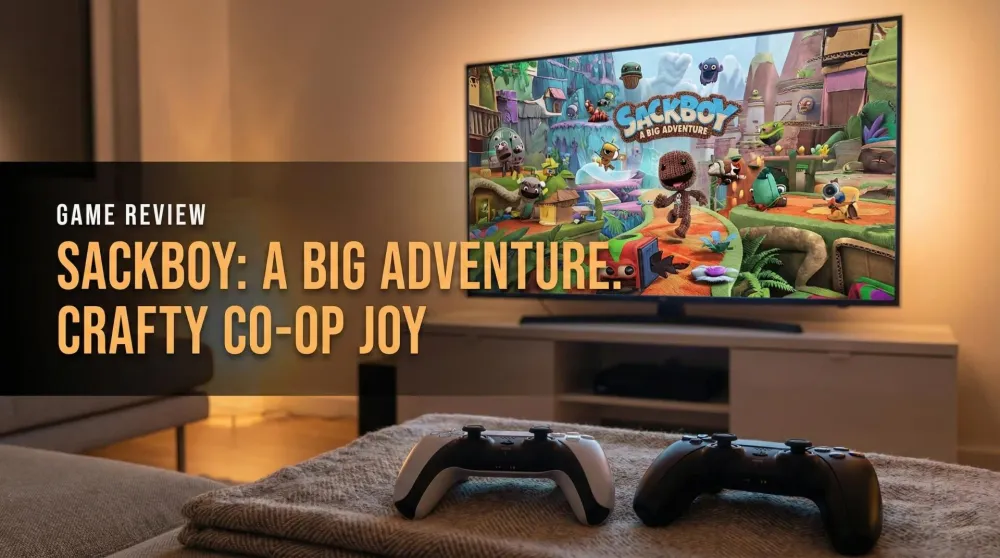
Sackboy: A Big Adventure – Crafty co-op joy on PlayStation 5
A charming, tactile platformer where co-op shines. With DualSense haptics, crisp visuals, and inventive handcrafted levels, Sackboy is a playful PS5 showcase and a family favorite.
This post contains affiliate links. We may earn a commission if you make a purchase, at no extra cost to you. As an Amazon Associate, Dadnology earns from qualifying purchases.
🎮 Introduction
🎮 This review is part of our Best Family Co-Op Games ranking – the couch games that actually work with kids.
Some games feel like they were built specifically for a shared couch. Sackboy: A Big Adventure is one of them. From the first hop onto a fabric ramp to the last celebratory emote at a goal ring, it wraps platforming fundamentals in a tactile craft aesthetic that’s instantly readable for kids and quietly satisfying for veterans. We played it on PlayStation 5—me and my daughter—and it quickly became our “just one more level” staple: colorful, funny, and brimming with little ideas that keep hands and eyes busy.
Sackboy doesn’t redefine platformers the way a wild experiment might. Instead, it nails the basics—running, jumping, grabbing, throwing—and seasons them with DualSense haptics, smart co-op setups, and musical set pieces that groove under your feet. It’s the sort of game you can hand to a child with minimal explanation and still find depth in perfecting routes, nailing timing windows, and hunting collectibles. We came for the cute craft look; we stayed for the co-op cadence that rewards communication without punishing imperfection.
🧩 Design DNA – Classic courses, modern craft
At its core, Sackboy is a course-based 3D/2.5D platformer. Levels are cleanly segmented playgrounds: learn a mechanic, remix it, squeeze out a finale. One zone might revolve around trampoline drums and zipper bridges; the next asks you to carry a throwable gadget while dodging rolling spools. The handmade diorama look—felt, yarn, corrugated cardboard, glossy buttons—does more than charm; it telegraphs friction, bounce, and danger. Kids read it intuitively: soft looks safe, shiny looks slippery, prickly looks “don’t touch.”
Crucially, the camera stays legible. You’re rarely fighting depth perception; hazards are framed with silhouette contrast and rhythmic audio cues. Collectibles (Dreamer Orbs) are placed to teach scanning off the critical path—behind a dangling flap, above a rotating thread spool, under a lift you can grab and pull. It’s a design language that teaches without text, perfect for young co-pilots.
👥 Built for co-op (not just “supports co-op”)
Sackboy’s best trick is how naturally it turns two players into a team. Co-op isn’t chaos by default; it’s structured. You’ll:
- Tether puzzles: One player holds a platform or pulls a tab while the other crosses a gap.
- Carry-and-clear: One ferries a key item while the other peels enemies off with spins and throws.
- Time-lock switches: Count down and hit floor plates together.
- Throw-assist jumps: Toss a partner to a high ledge, then unlock a shortcut.
Then there are the co-op-only stages, clearly marked, that require two players. These aren’t token gates; they’re compact labs for communication—“you hold, I hop,” “you bait, I dash,” “three… two… jump!” We loved these the most because they gave our sessions a shared drumbeat. Failures were short and funny; successes felt like high-fives made tangible.
🎛️ DualSense magic – Feel the fabric
On PS5, the DualSense elevates small moments. Spring pads give a tight haptic thunk; zipper pulls tick across the trigger; rolling sponges rumble with soft texture; musical platforms pulse in time. The adaptive triggers lean in for gadgets that need resistance (cranks, winders), and 3D audio sprinkles positional cues—great for locating a hidden pop or teasing a nearby secret. None of this is mandatory, but together it adds texture that keeps kids engaged and lets adults feel micro-feedback while coaching.
🎵 Musical set pieces – Platforming that dances
Every few levels, the game punctuates with music-synced courses: obstacles pulse to a song’s beat, background elements shimmy in rhythm, and jump timing becomes a dance step. These stages are perfect co-op moments because rhythm becomes language. Even if a younger player isn’t watching telegraphs closely, they can feel when to move. It’s also where Sackboy’s personality bursts—costumes, emotes, and slapstick animations turn checkpoint retries into mini-performances.
🧢 Costumes, emotes & identity
Cosmetics aren’t just garnish; they’re motivation loops. Unlocking costume bits—hats, gloves, textured suits—lets kids build an avatar that feels theirs. We turned “collect one more orb” into “get the pom-pom cap,” which weirdly improved focus on careful play. Emotes are quick, silly, and perfect as ritual: we picked a pre-level emote (“Ready!”) and a post-finish emote (“Ta-da!”) as our tiny co-op handshake.
🧠 Difficulty & kid-friendliness
Sackboy walks a considerate line. The early worlds are welcoming, with generous checkpoints and simple enemies. Later levels tighten timing, adding moving hazards, multi-phase sections, and collectibles tucked behind trickier reads. If your child is younger, keep a leader/trailer pattern: the adult paces jumps; the younger player mirrors and learns. Because losing a life doesn’t nuke progress and restarts are fast, the cost of failure is low. That keeps laughter louder than groans.
For mastery-minded parents, post-campaign Knitted Knight Trials and time challenges provide real teeth—short, spicy gauntlets that demand clean execution.
🗺️ Structure, pacing & session design
World maps are bite-sized hubs with levels, side paths, and optional score/collectible challenges. In practice, that means you can sit down with 20–30 minutes, clear a course (or two), maybe replay for an orb, and still end on a win. Our rhythm:
- Warm-up with a comfy course.
- Focus on a new one, aiming for all orbs.
- Victory lap on a musical set piece or co-op-only stage.
Because course length is modest and checkpoints are fair, bedtime doesn’t collide with boss doors. We could choose to stop smiling.
⚔️ Enemies & encounters – Readable, remixable
Foes are designed more as platforming accents than attrition. Spiked rollers set path timing, shielded grumps ask for a throw or flank, and patterned baddies fold neatly into jump routes. Bosses escalate mechanics you already learned: pull three tabs while dodging sweeps, throw charged items at a core, climb moving stacks without losing rhythm. With two players, the fights reward role assignment—one stays safe with the objective, the other peels pressure.
🔍 Collectibles & replay
Dreamer Orbs drive progression; costume pieces and prize bubbles drive personality. Replays feel worthwhile because levels hide branching micro-lanes and fold-back secrets. We’d clear a stage, then return with a plan: “You take the high zipline, I’ll check the low drum path; meet at the mid-ring.” This subtle route planning turns repetition into discovery practice rather than grind.
👨👧 Our father–daughter playbook
- Count the beat on musical levels: “3…2…jump!” works wonders.
- Divide verbs: thrower vs. hopper, tab-puller vs. gap-crosser.
- Call the camera: leader announces speed; trailer bubbles (respawns) if off-screen.
- Celebrate micro-wins: every orb, every flawless section gets an emote.
- Rotate roles each level to prevent hero/sidekick ruts.
These little habits kept sessions collaborative instead of competitive.
🎯 Where it shines vs. Where it’s safe
Shines:
- Tactile craft aesthetic that teaches readability.
- DualSense feedback that makes tiny actions feel special.
- Co-op-only levels that genuinely require teamwork.
- Musical set pieces that translate timing into instinct for kids.
- Polish—menus, checkpoints, cosmetic rewards, everything flows.
Plays it safe:
- The core moveset is intentionally simple; if you crave wild mechanical invention every stage, this is comfort food rather than cuisine shock.
- Camera can occasionally hide a depth cue when multiple planes overlap (rare, but it happens).
- Scoring doesn’t matter much unless you self-impose goals.
For us, the consistency was the point: an always-reliable co-op platformer we could trust any evening.
🧭 Accessibility tips for families
- Remap grab/throw if younger hands fumble default placements.
- Subtitles & icon hints on, vibration strong—multisensory cues help.
- Practice throws in a calm space: stand side-by-side, aim, toss, cheer.
- Use costumes as micro-goals: “Let’s get the scarf tonight.”
📈 Performance, visuals & audio
On PS5, performance is buttery, with crisp image quality and punchy color that sells the materials. The sound mix is playful—squeaks, taps, thumps—and helps signal safe vs. hazardous surfaces. In musical levels, the arrangement carries you; in standard stages, per-object sounds act like micro-tutorials. It’s not just cute; it’s communicative audio.
🧮 Who it’s for (and who might bounce)
Perfect for: Families wanting a friendly, polished couch co-op; kids who respond to tactile, readable worlds; parents who like structured sessions with optional mastery.
Maybe not for: Players seeking constant mechanical reinvention or precision gauntlets as the main course (save that itch for time trials and post-game challenges).
🆚 How it compares to other family platformers
Sackboy earns its place in a competitive field. Here’s where it lands against the games you’re most likely comparing it to:
vs. Yoshi’s Crafted World (Switch): Both games share a handcrafted aesthetic and gentle difficulty, but Sackboy’s co-op is more deliberately designed. The co-op-only stages require genuine communication that Yoshi doesn’t ask for. Yoshi’s Crafted World is the better first co-op game for very young kids; Sackboy is the natural step up once they’re comfortable with basic platforming.
vs. New Super Mario Bros. U Deluxe (Switch): NSMBU is more precision-focused with a higher skill ceiling. Sackboy is more about tactile exploration and visual spectacle. They serve different moods: NSMBU when you want a sharper challenge, Sackboy when you want a joyful and immersive tour through inventive environments.
vs. Astro’s Playroom (PS5, pre-installed): Astro’s Playroom comes free on every PS5 and delivers a brilliant 4-hour DualSense showcase. Sackboy is the longer, richer game for families who want more. Play Astro’s Playroom first as a warm-up that costs nothing; buy Sackboy when you’re ready for a full campaign.
vs. LittleBigPlanet 3 (PS4): Sackboy is the better game by a significant margin — tighter design, better co-op structure, no creation mode complexity. If you’re choosing between them on PlayStation, there’s no contest: Sackboy every time.
The verdict: Sackboy doesn’t top any single category outright, but it excels at consistency — a family-friendly co-op experience that delivers session after session without frustrating anyone at the table.
Pros
- Genuinely cooperative design with co-op-only stages
- DualSense haptics and 3D audio add delightful texture
- Readable craft aesthetic ideal for kids and teaching
- Musical set pieces and varied course concepts
- Short, satisfying sessions with strong replay hooks
Cons
- Core moveset is intentionally simple; fewer wild mechanics than genre leaders
- Occasional camera depth ambiguity in multi-plane scenes
- Scoring/progression can feel light unless you chase 100% or trials
🗣️ Conclusion
Sackboy: A Big Adventure is a co-op joy machine—a playful, tactile platformer that flatters new players and still gives veterans clean routes to master. On PlayStation 5, DualSense feedback and musical levels make the craft world feel alive; co-op-only stages ask you to count, toss, and time together. It’s less showy than the wildest platformers, but almost never less fun. For families who value consistency, charm, and teamwork, this one is an easy recommendation.
Buy now(Ad)
📌 FAQ – Frequently asked questions
Is Sackboy good for younger kids?
Do I need two players to enjoy it?
How important is the PS5 DualSense?
Is there challenging content for experienced players?
Keep this in your inbox
One email a week: what we actually watched, built and reviewed — the stuff worth a dad's time. No hype, no daily spam.
Dadnology Weekly
One email a week: the LEGO, gaming and movie news worth a dad's time — plus what we actually reviewed. No hype, no daily spam.
Disclaimer: This review and its visuals were created with the help of AI. Some links may be affiliate links – we may earn a commission if you make a purchase, at no extra cost to you.
Current deals in Gaming
Verified live discounts tracked on Amazon

Gaming · Tested by Dadnology
Marvel’s Spider-Man 2 (PS5)
5/5“Bigger, bolder, near-perfect superhero storytelling”Read our review
Gaming · Tested by Dadnology
Assassin's Creed: The Ezio Collection
4.5/5“The game that fixed everything and gave us Ezio”Read our review
Gaming · Tested by Dadnology
The Last of Us Part I (PS5)
5/5“A masterpiece rebuilt for the modern era”Read our reviewYou might also like
Marvel’s Spider-Man: Miles Morales (PS5) – Heart, style, and swinging brilliance
A near-perfect Spider-Man experience: dazzling swing physics, expressive Venom combat, and a wintery New York that begs to be explored. The story is heartfelt and propulsive—you always want one more mission—and PS5 features add real feel. As a dad with limited time, this was the rare game I 100% completed happily. If you love story-driven action, you need this on your shelf. For us, it’s a joyous, confident 5/5 and a clear PS5 system seller.
Horizon Forbidden West Complete Edition (PS5) – Aloy’s epic, evolved (with Burning Shores)
Everything wonderful about Horizon returns, turned up: stunning biomes, sharper writing, and tactical, parts-based combat that rewards planning over button mashing. Aloy’s toolkit blossoms with new weapons and movement toys; machines push back with trickier patterns; and Burning Shores adds jaw-dropping, late-game adventures across volcanic islands and towering cloudscapes. On PS5, DualSense feedback and fast loading make discovery feel effortless. For us, it’s an easy 5/5—one of the generation’s essential action adventures and a sequel that truly earns the word “complete.”
Best co-op games to play with your kids – A dad's guide
Our definitive family co-op list celebrates games that bring people together – the inventive brilliance of *It Takes Two* and *Split Fiction*, and the timeless joy of Nintendo classics. Whether you’re laughing, shouting, or high-fiving, these are the titles that turn game nights into family memories.