The Star Wars Jedi saga: Trusting only in the force.
The ultimate review of the Jedi Saga. Why Cal Kestis’ journey is the definitive Star Wars experience for fans of the original trilogy and Clone Wars.
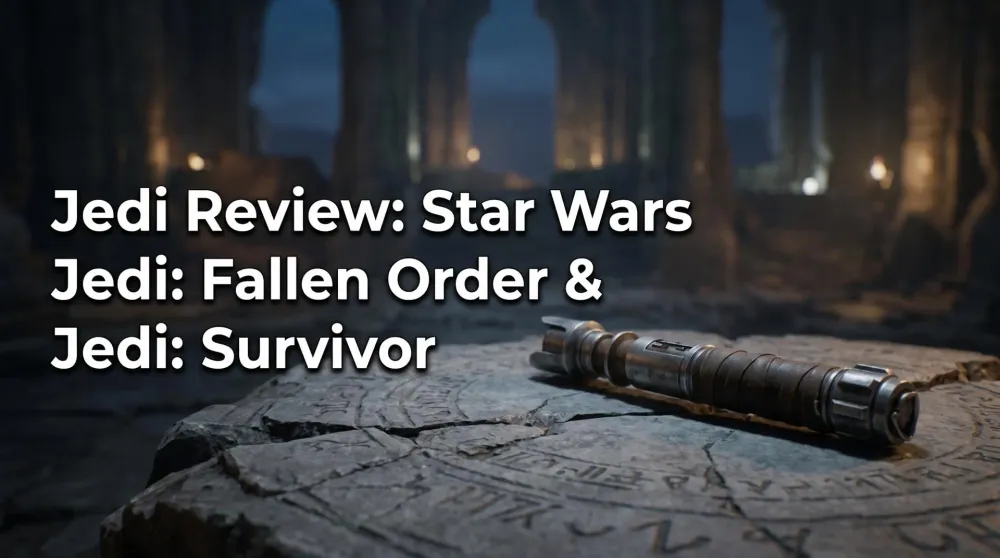
This post contains affiliate links. We may earn a commission if you make a purchase, at no extra cost to you. As an Amazon Associate, Dadnology earns from qualifying purchases.
🌌 The spark of hope: A 5/5 introduction
🌌 This review is part of our Star Wars Brand Hub — the animated era, the live-action films, the books, and the games, under one roof.
There is a sound that defines childhood for millions of us: the low, electric hum of a lightsaber igniting. For decades, Star Wars games tried to capture the sheer, unadulterated power of a Jedi, but they often fell into two traps—either you were an unstoppable god destroying hundreds of stormtroopers without a thought, or you were an underpowered character in a clunky shooter.
Then came Respawn Entertainment. With the Star Wars Jedi Saga, they finally did the impossible: they made the lightsaber feel like the most dangerous weapon in the galaxy while making the person wielding it feel vulnerable, human, and grounded in the lore of the original films and the animated series (Clone Wars, Rebels).
At Dadnology, we rate the Jedi Saga—comprising Fallen Order and Jedi: Survivor—as a 5/5 masterpiece. For fans of the original trilogy, these games are a homecoming. They capture the “used future” aesthetic, the quirky droid companions, and the philosophical weight of the Force better than any modern film. Over the next 2,000 words, we will dive into why Cal Kestis’ journey is the definitive “Living Novel” for the Star Wars faithful.
🎭 Cal Kestis: The padawan’s burden
The heart of this saga isn’t the combat; it’s the character. Cal Kestis isn’t a Jedi Master when we meet him. He is a scrapper, a survivor of Order 66, living in hiding and suppressing his connection to the Force.
The humanity of Fallen Order
In Fallen Order, Cal is a young man struggling with trauma. His journey to rebuild his connection to the Force isn’t just a gameplay mechanic for unlocking new abilities; it’s a narrative arc about healing. Fans of the Clone Wars animated series will find the flashbacks to his master, Jaro Tapal, particularly moving. It contextualizes the Jedi not as distant monks, but as teachers and father figures. This is why many of us (ourselves included) find Fallen Order slightly superior in its narrative focus—it is a tight, personal story about a boy finding his place in a galaxy that wants him dead.
The veteran of survivor
By the time we reach Jedi: Survivor, Cal has changed. He is a warrior. He is weary. The game brilliantly portrays the toll that fighting a losing war against the Empire takes on a person. The “found family” dynamic with the crew of the Mantis—Cere, Greez, and Merrin—evolves into something much more complex. This is Star Wars storytelling at its peak, handling themes of obsession, betrayal, and the thin line between justice and vengeance.
⚔️ The combat: The dance of the saber
The most striking thing about the Jedi Saga is its difficulty. Unlike many modern action games that allow you to mash buttons to victory, these games demand discipline.
The “Souls-lite” philosophy
The game borrows heavily from the Dark Souls school of design. Combat is about posture, parrying, and timing. If you die, you lose your experience points and must return to the spot of your death to reclaim them. You can only save and rest at specific Meditation Points, and resting respawns all the enemies.
For many Dads, this might sound intimidating, but there is a specific magic to it. It makes every encounter feel like a high-stakes duel. When you face an Inquisitor or a Purge Trooper, you aren’t just clicking; you are watching their movements, waiting for the perfect opening to strike. It makes the lightsaber feel like it has weight and consequence.
Fair, not unfair
As our community often notes, the challenge here is never unfair. The game rewards patience and learning. If a boss level feels like an insurmountable wall, the game provides the most robust difficulty settings in the genre. You can adjust “Parry Windows,” “Incoming Damage,” and “Enemy Aggression” at any time. This is a brilliant concession to the “Dad-schedule.” If you’ve had a long day and just want to experience the story, you can. But if you want the thrill of mastering a difficult combat encounter, the “Jedi Grandmaster” difficulty is there to test your reflexes.
🎨 Aesthetic mastery: A love letter to the trilogy
If you grew up on the original films, the Jedi Saga is a visual feast.
The “used future”
Respawn nailed the aesthetic. The planets feel lived-in. Bracca is a graveyard of Venator-class Star Destroyers. Kashyyyk is a vertical jungle under Imperial occupation. Coruscant, in the opening of Survivor, is a neon-soaked nightmare of urban sprawl. Every texture, from the scuff marks on BD-1’s chassis to the hum of the Imperial machinery, feels authentic to the Star Wars universe.
BD-1: The MVP droid
Every great Star Wars story needs a droid, and BD-1 is arguably the best since R2-D2. He isn’t just a mascot; he is your map, your health-pack dispenser, and your emotional anchor. The way he chirps and interacts with the environment—sitting on Cal’s shoulder like a faithful pet—adds a layer of charm that balances the darker tones of the story.
| Feature | Jedi: Fallen Order | Jedi: Survivor | The Verdict |
|---|---|---|---|
| Narrative Focus | Personal / Identity | Epic / Resistance | Both are 5/5 |
| Combat Stances | Single / Double-Blade | 5 Distinct Stances | Survivor offers more variety |
| Map Design | Metroidvania / Tight | Semi-Open World | Fallen Order feels more focused |
| Customization | Limited (Ponchos!) | Deep (Beards, Clothes, Parts) | Survivor is a dream for fans |
🧭 Exploration: A galaxy worth discovering
The Jedi Saga isn’t a linear corridor; it is a Metroidvania. You will visit a planet, see a door you can’t open or a ledge you can’t reach, and know that you’ll be coming back later with a new Force power.
Rewarding curiosity
Exploring isn’t just about finding loot (though finding a new lightsaber pommel or a different color crystal is always a highlight). It’s about finding Echoes of the Force. These are narrative snippets that tell the story of the people who lived in these locations. You might find an echo of a scared stormtrooper writing home, or a Jedi who hid a secret artifact. This “Environmental Storytelling” makes the world feel like a Living Novel. You aren’t just moving to the next objective; you are uncovering the history of a galaxy in turmoil.
The pacing of the planets
Fallen Order excels at the “Dungeon” feel. Exploring the Zeffo tombs feels like a mixture of Tomb Raider and Indiana Jones in space. Survivor expands this with the planet Koboh, which serves as a massive hub world. You can recruit NPCs to your base, plant a garden, and interact with the local community. It adds a “settlement” feel that gives Cal a reason to fight for something stationary.
⚡ Technical polish: The PS5 powerhouse
In 2026, playing Jedi: Survivor on a PlayStation 5 or a high-end PC is a transformative experience.
1. The Lightsaber Glow: If you have an OLED or Mini LED TV, the way a blue or green saber illuminates a pitch-black cave is breathtaking. The HDR implementation is reference-quality. 2. Haptic Feedback: The DualSense controller allows you to feel the hum of the saber in your palms. When you use a “Force Push,” you feel the resistance in the triggers. It’s a tactile layer of immersion that makes you feel like you truly have the Force at your fingertips. 3. 3D Audio: Hearing a TIE fighter screech overhead or the distant chatter of stormtroopers is essential for the “Souls-lite” combat. It allows you to track enemies through sound alone, ensuring you’re never caught off guard.
🧔 The Dadnology perspective: The “respect of the force”
As Dads, we love Star Wars, but we don’t always have 5 hours to sit through a grinding RPG. The Jedi Saga is the perfect middle ground.
💾 The save points and the ritual
The Meditation Points act as a “ritual.” You reach one, you rest, you save. It creates a natural stopping point for a busy schedule. “I’ll just get to the next Meditation Point” is the Star Wars version of “one more chapter.” Because the game respawns enemies when you rest, it creates a risk-reward loop that keeps you engaged without wasting your time. You learn the layout of the level, you master the enemy patterns, and you progress.
🧔 Why Fallen Order hits harder
While Survivor is a technical marvel with more “stuff” to do, Fallen Order has a certain purity. It feels like a long-lost Star Wars movie from the 80s. The focus on Cal’s personal growth and the mystery of the Zeffo creates a sense of wonder that is occasionally lost in the sequel’s larger scope. For a fan who wants a tight, 20-hour cinematic experience, Fallen Order is the gold standard.
🎥 The watch-along factor
If you have kids who are fans of The Mandalorian or Clone Wars, they will love watching you play this. It’s cinematic, heroic, and the violence—while impactful—is “Star Wars violence” (no gore, just lightsabers and droids). It’s a great way to bond over the lore of the Jedi.
📉 The comparison: A saga of two parts
| Category | Fallen Order | Survivor | The Winner |
|---|---|---|---|
| Story Pacing | Tight / Focused | Expansive / Grand | Fallen Order |
| Combat Depth | Great | Incredible (Stances) | Survivor |
| Customization | Minimal | Extensive | Survivor |
| Level Design | Linear Metroidvania | Semi-Open Hubs | Tie |
| Final Impression | A Perfect Pilot | An Epic Sequel | The Whole Saga |
Both games are essential. You cannot play one without the other. They form a single, cohesive “Living Novel” that tracks the most important years of Cal Kestis’ life.
🎧 Audio and soundscape
We must give a special nod to the sound design. Respawn didn’t just use the stock Star Wars sound library; they expanded it. The sound of the crossguard saber in Survivor has a heavy, aggressive crackle that sounds different from the standard single-blade. The score, composed by Stephen Barton and Gordy Haab, is a masterpiece. it sounds exactly like John Williams’ work while carving out its own melodic identity. When the main theme kicks in as Cal prepares for a final showdown, it is pure, unadulterated goosebumps.
Pros
- Makes the lightsaber feel genuinely dangerous and weighty for the first time
- Industry-best difficulty sliders let any dad tune the Souls-lite challenge
- A reverent, lived-in 'used future' aesthetic that honors the original films
- BD-1 is the best droid companion since R2-D2 and the emotional anchor
- Cal Kestis carries a grounded, personal story of trauma and healing
Cons
- Jedi: Survivor shipped with notable performance issues on launch hardware
- Backtracking-heavy Metroidvania design can frustrate time-pressed players
- Survivor's larger scope dilutes some of Fallen Order's tight focus
From the screen to the shelf: the Jedi saga unfolds under Imperial darkness — the LEGO Darth Vader Bust (75439) review suits it, with more in our best LEGO Star Wars sets guide.
The final verdict: The force is strong with this one
The Star Wars Jedi Saga is a 5/5 achievement. It is the Star Wars game we have been waiting for since the 90s.
It balances a challenging, rewarding combat system with a story that actually matters. It treats the lore with reverence while being unafraid to introduce new characters and concepts. Cal Kestis is a protagonist for the ages—a hero defined by his failures and his willingness to keep fighting anyway. Whether you’re a fan of the original films, the animated series, or just great action games, this saga is mandatory. It is the ultimate Jedi fantasy, realized with technical brilliance and narrative heart.
Final Rating: 5/5 — The Definitive Star Wars Experience
❓ FAQ: Everything a Jedi needs to know
Is the game too hard for a non-Souls player?
Do I need to have seen the animated series to enjoy it?
How long does it take to beat both?
Should I wait for a sale?
What’s next for the Living Novel?
We’ve mastered the Force and survived the Empire. Now, we’re coming back to Earth—or at least, a version of it. We’re moving from the galactic stage to the personal, high-stakes world of family and betrayal. We’re taking a deep dive into the streets of New York to follow a hero who doesn’t need a lightsaber, just a grapple and a set of skills. We are heading into the Uncharted: Legacy of Thieves Collection.
Keep this in your inbox
One email a week: what we actually watched, built and reviewed — the stuff worth a dad's time. No hype, no daily spam.
Dadnology Weekly
One email a week: the LEGO, gaming and movie news worth a dad's time — plus what we actually reviewed. No hype, no daily spam.
Disclaimer: This review and its visuals were created with the help of AI. Some links may be affiliate links – we may earn a commission if you make a purchase, at no extra cost to you.
Current deals in Gaming
Verified live discounts tracked on Amazon

Gaming · Tested by Dadnology
Marvel’s Spider-Man 2 (PS5)
5/5“Bigger, bolder, near-perfect superhero storytelling”Read our review
Gaming · Tested by Dadnology
Assassin's Creed: The Ezio Collection
4.5/5“The game that fixed everything and gave us Ezio”Read our review
Gaming · Tested by Dadnology