The Last of Us Part I & II: Naughty Dog at the Peak of Storytelling
Our combined review of The Last of Us Part I and Part II. Why Naughty Dog is the king of story-driven games — and why a dad still rates it a 9, not a 10.
This post contains affiliate links. We may earn a commission if you make a purchase, at no extra cost to you. As an Amazon Associate, Dadnology earns from qualifying purchases.
The Kings of the Genre — An Honest Introduction
Let’s get the headline out of the way: Naughty Dog is the king of story-driven games. Not a king. The king. Across two generations of PlayStation hardware, no other studio has stacked together this many narrative gut-punches with this level of technical polish. The Last of Us Part I and Part II are the proof — two games that treat a video game controller as a delivery mechanism for grief, love, and the kind of moral weight most films don’t dare attempt.
So this should be a 5/5, right? Two masterpieces, the best in the business, slam dunk.
Here’s where I’m going to be honest with you, because that’s the whole point of this blog. I rate this saga a 9. And I want to explain that 9 properly, because it’s not a knock on the craft — the craft is flawless. It’s a knock on my own taste, and you deserve to know exactly where my thumb is on the scale before you trust my number.
I’ll also tell you something that divides this fanbase down the middle: I prefer Part I to Part II. The original’s tighter, more focused journey hits harder for me than the bolder, messier sequel. We’ll get into why. But first, the thing that makes both games unmissable for any dad who’s ever felt that protective reflex kick in.
AdThe Last of Us Part I (PS5) (opens in a new tab)
The ground-up PS5 remake of the original. The definitive way to play the focused, devastating Joel-and-Ellie journey that started it all.

The Dad-Sim Nobody Markets as One
On paper, The Last of Us is a survival-horror game about fungal zombies. In practice, it’s the most accurate protective-parent simulator ever made.
Joel is a smuggler who lost his daughter in the first ten minutes of the outbreak. Twenty years later, he’s hired to escort a teenage girl, Ellie, across a ruined America. What starts as a job becomes the thing every dad recognizes instantly: the slow, terrifying, involuntary process of loving a kid so much that you’d burn the world down to keep them safe.
That’s it. That’s the hook. And it works on you whether you want it to or not.
If you’re a father, you don’t play Joel — you become him. Every time Ellie is out of sight, your stomach tightens. Every time she’s in danger, you stop playing a video game and start solving a problem that feels personal. Naughty Dog didn’t write a story about a dad. They built a machine that turns the player into one. The protective instinct isn’t a theme you observe; it’s a reflex they trigger.
That’s the Dadnology angle in a nutshell. This isn’t a game about saving the world. It’s a game about the one specific person you’d give up the world for. And the older you are, the more of your own kids you’ll see in Ellie.
Part I — The Focused Gut-Punch (And My Favorite)
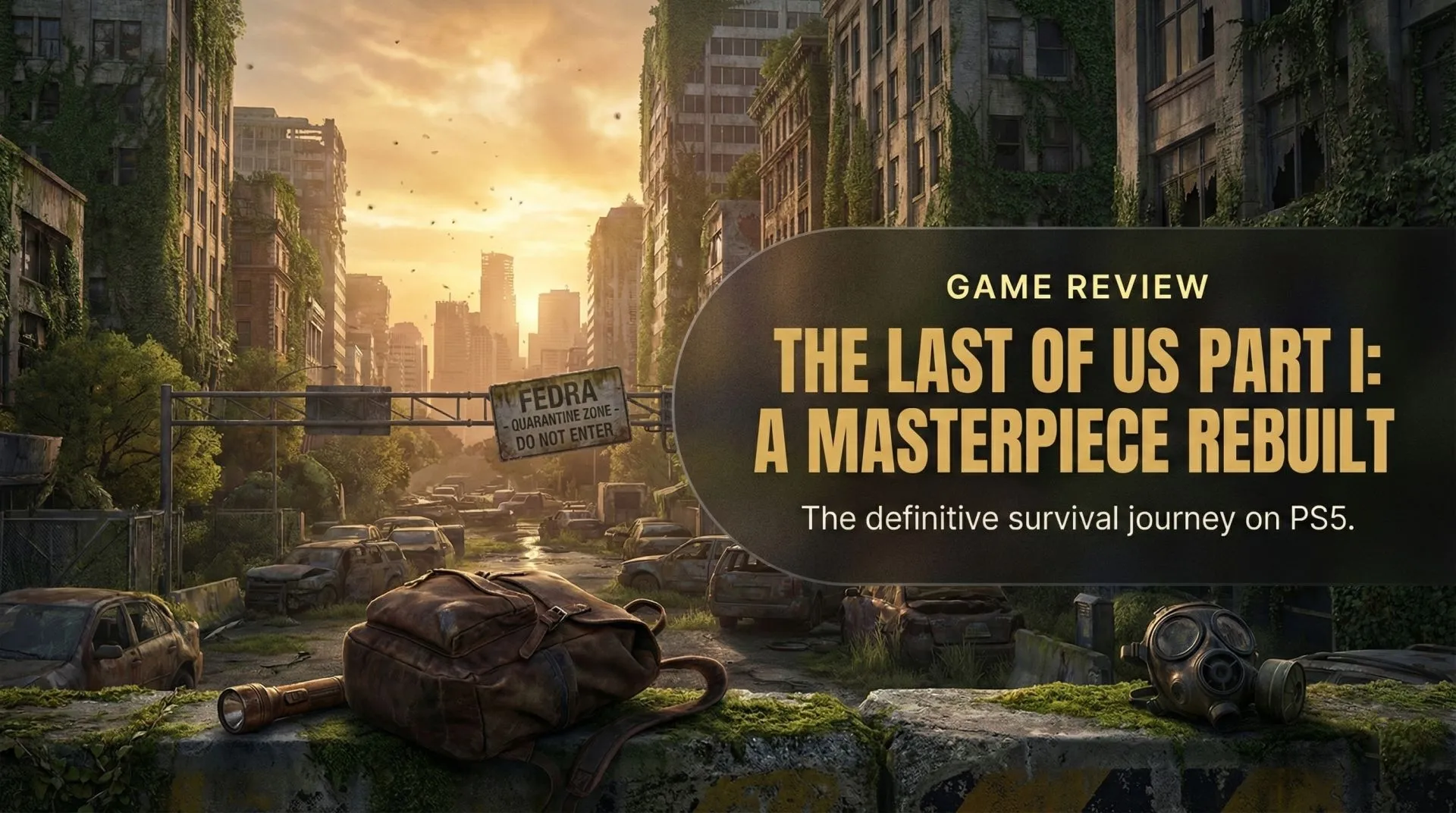
The Last of Us Part I — here in its ground-up PS5 remake — is, to me, the better game. Not the bigger one. The better one.
Everything about the original is focused. It’s a road trip. You go from point A to point B across a broken country, and the entire emotional architecture is built around two people learning to trust each other. There are no detours that dilute the core relationship. Every gameplay beat, every quiet moment scavenging a abandoned house, every brutal encounter with the infected, serves the one thing that matters: Joel and Ellie.
The pacing is the secret. Part I knows exactly how long to linger in a giraffe-spotting moment of calm before pulling the rug out. It knows when to let you breathe and when to suffocate you. And its ending — which I won’t spoil — is one of the most morally complicated final decisions in the medium, delivered with such precision that it reframes everything you just played.
This is a tighter, leaner, more disciplined piece of storytelling than its sequel. It does one thing — the bond between a broken man and the kid who gives him a reason to keep going — and it does it with total confidence. For me, that focus is what makes it the high point of the saga.
The PS5 remake rebuilds the original from the ground up: new lighting, vastly improved character models, the full DualSense haptic and adaptive-trigger treatment, and the accessibility suite from Part II. If you’re starting fresh, The Last of Us Part I on PS5 is unquestionably the way in.
Part II — Bolder, Staggering, and Divisive
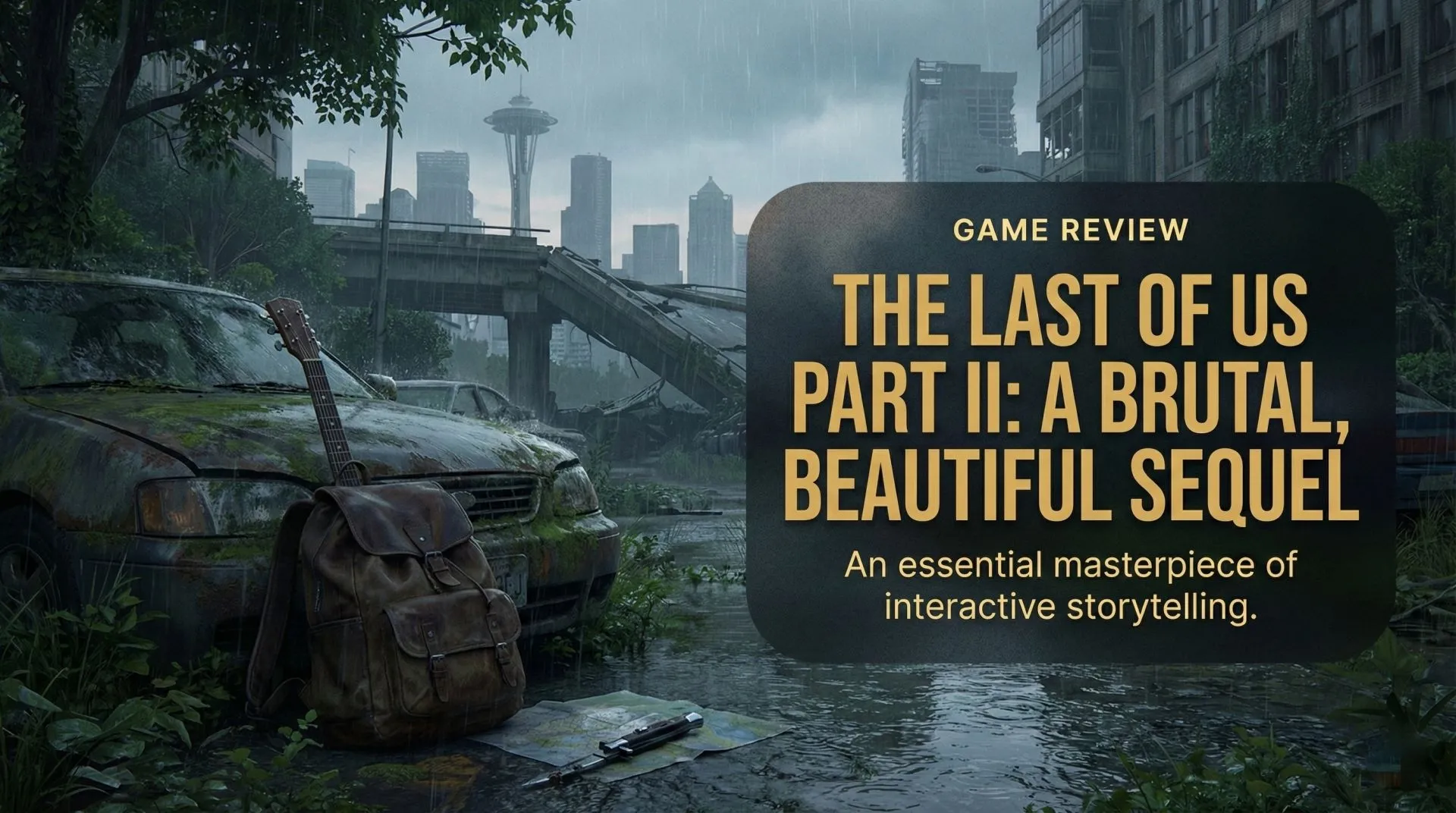
The Last of Us Part II is a more ambitious game than Part I in every measurable way. It’s longer, the world is denser, the combat is more sophisticated, and the technical presentation is, frankly, jaw-dropping — among the best-looking and best-animated games ever made on console.
It’s also the game that split the fanbase in half, and I understand exactly why.
Without spoilers: Part II makes structural and tonal choices that are deliberately uncomfortable. It asks you to sit inside perspectives you don’t want to inhabit. It refuses to give you the catharsis you’re craving. It’s a story about the cost of revenge that punishes you for wanting revenge — and a lot of players felt punished rather than moved.
I respect it enormously. As a piece of craft, it’s staggering. The motion-capture performances, the environmental detail, the way Seattle is rendered as a sprawling, waterlogged ruin you genuinely explore — this is Naughty Dog flexing at the absolute limit of what the hardware allows. The roguelike No Return mode bundled into the remaster is a genuinely great addition for people who want the combat without the emotional toll.
But for me, Part II’s bigger, more confrontational structure edges it below Part I. The focus is gone, traded for ambition. And while that ambition produces some of the most memorable sequences in gaming, it also produces stretches where I felt the game was testing my patience rather than earning my investment. It’s a brilliant, brave game. I just love the disciplined original more. Part II Remastered is still essential — go in with your eyes open about what kind of experience it’s trying to be.
Part I vs Part II — The Honest Breakdown
| Aspect | Part I | Part II | My Take |
|---|---|---|---|
| Focus | Tight, disciplined road trip | Sprawling, ambitious, dual-perspective | Part I |
| Length | ~15 hours, lean | ~25-30 hours, epic | Part I (respects your time) |
| Technical Peak | Gorgeous PS5 remake | Best-looking game on the platform | Part II |
| Emotional Tone | Bond, warmth, dread | Grief, revenge, discomfort | Part I (warmer) |
| Structure | Linear, confident | Bold, divisive, demanding | Part I |
| Combat & Systems | Excellent | Deeper, more brutal, more options | Part II |
| Overall (for me) | The favorite | Respected, not loved as much | Part I |
The short version: Part II is the more impressive game and Part I is the more complete one. If I could only keep one, I’d keep the original without hesitation — and I suspect a lot of fellow dads, who value a story that knows when to stop, would too.
AdThe Last of Us Part II Remastered (PS5) (opens in a new tab)
The bolder, technically staggering sequel, remastered for PS5 with the roguelike No Return mode bundled in.
The Setting Tax — Why It’s a 9 and Not a 10
Here’s the part where I have to be more honest than is strictly comfortable.
These games are, by any objective measure, 5-star craft. The writing, the performances, the animation, the sound design, the way the controller communicates tension through your palms — all of it is best-in-class. If I were grading on pure execution, this is a 5 and I’d defend it.
But I don’t grade in a vacuum, and neither do you when you decide what to buy. I don’t personally love the zombie, post-apocalyptic infected setting. It’s grim. It’s bleak. It’s mushrooms growing out of people’s faces in a perpetually overcast, rotting America. And while The Last of Us does that setting better than anyone, it’s still not the world I most want to spend my limited evening gaming hours in.
My genre heart belongs to adventure and exploration — the Uncharted-style globe-trotting, treasure-hunting, ancient-ruins-and-banter school of game. (Which, deliciously, is also Naughty Dog — the studio’s range is absurd.) Give me wonder and discovery over decay and dread, and I’m a happier dad. That’s not a flaw in The Last of Us. It’s a fact about me.
So the 4.5 is a setting tax. It’s me telling you: this is a masterpiece, and if the grim, infected, emotionally punishing post-apocalypse is your thing, mentally bump it to a 5 and don’t think twice. But I’d be lying if I pretended the genre lands for me the way an Uncharted does, and a number I don’t believe is worth nothing to you. The craft earns a 5; my taste pays a 4.5.
That’s the most Dadnology thing I can tell you: trust over hype. I’d rather give you an honest 4.5 with a clear reason than an inflated 10 that pretends I have no preferences.
The Right Way to Play (Late-Night Dad Edition)
A few practical notes for the time-poor, sleep-poor father considering this saga.
This is a headphones-after-bedtime game. Both entries are rated M for Mature, and they earn it — realistic violence, genuine horror, heavy themes, and language that you do not want echoing down the hall toward small ears. This is the antithesis of a watch-along. Play it alone, in the dark, after the house goes quiet.
Play Part I first. Always. I cannot stress this enough. Part II’s entire emotional foundation rests on what happens in the original. Starting with the sequel doesn’t just spoil the story — it actively dismantles the most important moment in the whole saga. The order is non-negotiable.
Pace it like a novel. Part I is a tight 15 hours; Part II runs 25–30. Neither has a ticking clock pushing you forward. Treat them like the prestige TV they basically are — a chapter at a time, over weeks, letting each beat land before the next.
The hardware matters. These are PS5 showcases. The DualSense haptics, the adaptive triggers tensing as you draw a bow, the near-instant loading, the fidelity — they were built for this platform. If you’re somehow still on the fence about the console, a PlayStation 5 earns its keep on these two games alone.
AdPlayStation 5 Console (opens in a new tab)
Both games are PS5 exclusives. The hardware delivers the DualSense haptics, fast loading, and fidelity these games were built to show off.
The Dadnology Verdict
The Last of Us Part I and Part II are the work of the best story-driven studio in the business, operating at the peak of their powers. Part I is my favorite — focused, disciplined, devastating. Part II is bolder, technically staggering, and divisive in ways I find more admirable than enjoyable. Together they’re a saga every adult gamer should experience at least once, and one that hits dads especially hard thanks to that involuntary protective reflex Naughty Dog weaponizes so well.
The 4.5 is honest. The craft is a 5; my taste for grim infected horror over bright adventure costs it a point. If that setting is your jam, round up and never look back.
Pros
- Naughty Dog at the absolute peak — best-in-class writing, performances, and animation across both games
- The Dad-Sim protective instinct between Joel and Ellie is gaming's most affecting parent-child dynamic
- Part I is a tight, disciplined, emotionally perfect road-trip story
- Part II is a technical and motion-capture showcase — among the best-looking games on the platform
- PS5 features (DualSense haptics, fidelity, fast loading) make both the definitive versions
- No Return roguelike mode in the remaster adds real replay value beyond the campaign
Cons
- Part II's bolder, more confrontational structure and tone genuinely divide players
- The grim, post-apocalyptic infected setting is bleak and emotionally heavy — not for everyone
- Strictly a late-night M-rated game; zero family or watch-along value
- Part II's ambition trades away the tight focus that made the original so complete
Final Verdict
The Last of Us Part I & II are masterpieces from the kings of story-driven gaming. Part I is the tighter, more focused gut-punch — and our favorite. Part II is the bolder, technically staggering, more divisive sequel. Both wield the protective parent-child bond between Joel and Ellie with a precision no other studio matches.
The craft here is a flat 5. Our 4.5 is an honest setting tax — a personal preference for bright adventure over grim, infected horror. If the bleak post-apocalypse is your world, round it straight up.
Final Rating: 4.5/5 — 10-Tier Craft, Honestly Graded by a Dad Who Prefers Adventure
What’s Next for the Living Novel?
We’ve swung through New York, ridden across the dying West, and now survived the infected ruins of America. The Living Novel Hall of Fame has more journeys waiting — find your next great story.
❓ FAQ: The Last of Us Questions
Should I play Part I or Part II first?
Is it too dark or violent for kids to watch?
Why does a brilliant game only get a 4.5 and not a 5?
Do I need to play Part II if I loved Part I?
Which PS5 version should I buy?
Keep this in your inbox
One email a week: what we actually watched, built and reviewed — the stuff worth a dad's time. No hype, no daily spam.
Dadnology Weekly
One email a week: the LEGO, gaming and movie news worth a dad's time — plus what we actually reviewed. No hype, no daily spam.
Disclaimer: This review and its visuals were created with the help of AI. Some links may be affiliate links – we may earn a commission if you make a purchase, at no extra cost to you.