
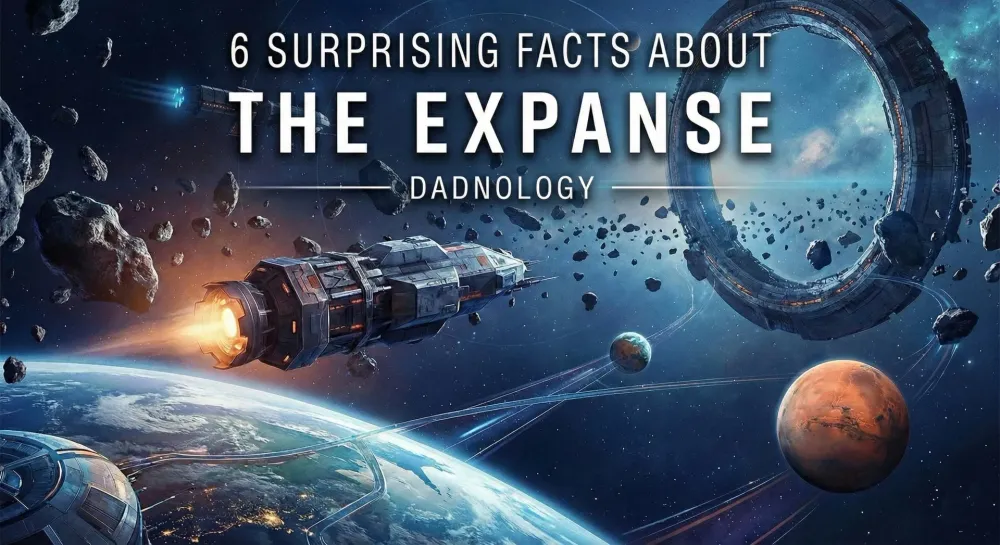
6 Surprising facts about 'The Expanse' that will change how you see the universe
From its origins as an MMORPG to the subtle physics you missed. These 6 facts reveal the hidden history of The Expanse.
This post contains affiliate links. We may earn a commission if you make a purchase, at no extra cost to you. As an Amazon Associate, Dadnology earns from qualifying purchases.
Introduction: Beyond the sci-fi surface
Fans of The Expanse rightfully celebrate its dense political intrigue, commitment to scientific realism, and a plot so intricate it rewards multiple viewings. It’s a series that respects its audience’s intelligence, building a universe that feels less like a set piece and more like a plausible, complicated future for humanity.
But even the most dedicated viewers might not be aware of the foundational truths that shaped the franchise from its inception. Beneath the surface of protomolecule mysteries and interplanetary warfare lies a rich history of adaptation, artistic choice, and transmedia evolution. Here, we unpack six foundational truths about the franchise’s creation—from its origins as a game to the on-screen alchemy that remixed its most beloved characters—that will permanently alter how you view the world of The Expanse.
For a complete guide to the main story, check out our hubs for The TV Series and The Book Series.
1. The science is so subtle, even experts miss it
Unlike many sci-fi franchises that either ignore physics or bog down the narrative with lengthy technical explanations, The Expanse embraces a “show, don’t tell” philosophy. Its commitment to realism is woven so seamlessly into the world that its most clever details are often missed. A perfect example is the subtle demonstration of the Coriolis effect on the spinning station of Ceres. When Detective Miller pours a drink, the liquid “doesn’t flow exactly straight ‘down,’” curving slightly due to the station’s rotation.
This detail is so understated that it’s frequently missed even by experts; members of the fan community have noted that an astrophysicist in a reaction video failed to spot the effect until it was explained. This approach is profoundly effective because it makes the universe feel lived-in. Characters who have spent their lives in artificial gravity wouldn’t stop to explain the everyday physics of pouring a drink, any more than we would explain Earth’s gravity to each other. It’s a world where science isn’t just a plot device; it’s the environment.
This philosophy demonstrates how scientific constraints, rather than limiting the story, can become a powerful world-building tool. As astrophysicist Katie Mack argues, these limitations can be a source of artistic enrichment:
“Great entertainment doesn’t have to get the science right any more than a poem has to stick to a prescribed rhyme or meter to be great poetry, but sometimes constraints themselves can enrich art in unexpected ways.”
2. The universe began as a video game, not a book
While The Expanse is now known as a nine-book novel series and a celebrated TV show, its universe didn’t start on the page. In a surprising twist of creative origin, the world was first conceived by creator Ty Franck as the setting for a Massively Multiplayer Online Role-Playing Game (MMORPG).
This detailed game world, with its factions, resources, and political tensions, existed as a complex digital blueprint long before it was ever considered for publication. The collaboration with author Daniel Abraham was the catalyst that transformed this sprawling game setting into the novel series published under their shared pseudonym, James S. A. Corey. This origin story helps explain the incredible depth of the world-building; the intricate dynamics between Earth, Mars, and the Belt feel organically developed because they were initially designed to support countless player stories and interactions within a game.
3. The TV show’s ending isn’t the end of the story
The television series concluded with its sixth season, adapting the sixth book, Babylon’s Ashes. This left many fans wondering about the fate of the crew and the major “Laconia” story arc, which takes place after a 30-year time jump in the books. The story, however, is far from over—it has just moved to a different medium.
The official continuation of the TV show’s canon is found in comic books published by BOOM! Studios. The 12-issue series The Expanse: Dragon Tooth is essential reading for any fan left wanting more. It was created specifically to bridge the three-decade gap between the events of Season 6 and the rise of the Laconian Empire detailed in the seventh book, Persepolis Rising. As publisher BOOM! Studios themselves state, this series is the “only place for fans to find official content” covering this crucial, uncharted period in the story.
4. Amos Burton is now writing his own story
In a move almost unheard of in franchise storytelling, the actor who embodies one of its most iconic characters is now shaping his official future. Wes Chatham, who portrays the gruff but loyal mechanic Amos Burton, is the co-writer for his character’s next canonical chapter.
Chatham is co-writing a new comic series titled The Expanse: A Little Death. Set after the events of Dragon Tooth, the story sees an old acquaintance pull Amos into a high-stakes conspiracy. This development is significant for the franchise, as it gives an actor unprecedented influence over the narrative direction of the character they’ve so masterfully brought to life. It ensures that the voice and soul of Amos Burton, which Chatham has cultivated for years on screen, will continue to evolve with authentic consistency in the official canon.
5. The show’s most iconic Belter is a mashup of multiple characters
Camina Drummer, a fan-favorite and a powerful symbol of Belter resilience in the television series, is a prime example of brilliant adaptation. The character viewers know and love is actually a “consolidation” of several different characters from the book series.
To streamline the narrative for television, the show’s writers merged the storylines and functions of multiple book characters into the single, formidable figure of Drummer. These include Bull, the UNN marine turned OPA security chief aboard the Behemoth; Sam Rosenberg, the technical expert crucial to the Belters’ efforts in the Slow Zone; and most significantly, Michio Pa, a primary point-of-view character in the books whose arc as a conflicted leader of the Belter fleet, and whose polyamorous family, form the emotional core of the show’s version of Drummer. This creative decision allowed the show to build a strong, central identification figure for the Belt, concentrating years of plot development and emotional weight into one character and forging a deeper, more immediate connection with the audience. For a deeper look into her origins, check out our review of The Expanse: A Telltale Series.
6. The characters should look far more alien
While the show mentions the physiological effects of living in low gravity—most notably through the concept of “gravitational torture” for Belters taken to Earth—it made a significant practical concession when it came to casting its main characters. In the novels, Belters who grow up in microgravity environments have “significantly longer and thinner” skeletal structures.
The books describe this in stark detail. Naomi Nagata is said to be close to or over 2 meters tall, standing a full head taller than James Holden. Detective Miller is even more imposing, described as being closer to 2.2 meters (over 7 feet) tall. The main cast of the show does not reflect these extreme physical differences, almost certainly for practical production reasons. While a necessary concession for production, this change fundamentally alters the visual power dynamic of the story. In the books, the Belters’ towering, fragile physiology makes them a visually distinct and almost alien subspecies, a constant, silent testament to their oppression and adaptation. The show, by necessity, shifts this distinction from a physical reality to a purely cultural and political one.
Conclusion: An ever-expanding universe
From its subtle use of physics to its origins as a video game, The Expanse is a franchise layered with fascinating stories, both on-screen and behind the scenes. Its evolution from novels to a TV series, and now to comics and games, demonstrates a remarkable capacity for growth and adaptation. The world feels so real precisely because so much thought has gone into its construction across every medium.
As the franchise continues its bleeding-edge migration across comics, games, and potentially new screen adaptations, the journey of The Expanse becomes more than just a great story; it’s a living blueprint for the future of collaborative, multi-platform world-building.
For new viewers: the six facts above are spoiler-light — you can read this before starting the show without losing anything. If you’re coming from the TV series and wondering where the story goes after Season 6, Dragon Tooth is the immediate next step. Start there before picking up Persepolis Rising, and the three-decade jump won’t feel like a discontinuity.
📺 Movie night sorted: thousands of films and shows are streaming on Prime Video — free for 30 days. Worth a look before you buy the disc.
Keep this in your inbox
One email a week: what we actually watched, built and reviewed — the stuff worth a dad's time. No hype, no daily spam.
Dadnology Weekly
One email a week: the LEGO, gaming and movie news worth a dad's time — plus what we actually reviewed. No hype, no daily spam.
Disclaimer: This review and its visuals were created with the help of AI. Some links may be affiliate links – we may earn a commission if you make a purchase, at no extra cost to you.
Current deals in Movies & TV
Verified live discounts tracked on Amazon
![The Legend of Korra — The Complete Series [Blu-ray]](https://m.media-amazon.com/images/I/51+1TXyb7aL._SL500_.jpg)
Movies & TV · Tested by Dadnology
The Legend of Korra — The Complete Series [Blu-ray]
4.5/5“A new Avatar, a modern city, a masked revolution”Read our review
Movies & TV · Tested by Dadnology
Zack Snyder's Justice League (4K Ultra HD)
4/5“Four hours. One vision. This is the film.”Read our review
Movies & TV · Tested by Dadnology
Space Jam (4K Ultra HD + Digital)
4/5“It's gonna be a whole new ball game”Read our reviewYou might also like
The Expanse Season 6 review – A fitting, bittersweet finale
Season 6 is a powerful, if brief, conclusion. It resolves the immediate conflict with style and heart, cementing the show's legacy as a sci-fi legend. A 4.5/5.
The Expanse Season 5 review – A masterclass in adaptation
Season 5 is a masterpiece. It breaks the crew apart to test them individually, delivering the series' most emotional moments and its best villain. A 4.5/5.
Persepolis Rising (The Expanse Book 7) – Beyond the TV show
Persepolis Rising brilliantly evolves the saga with a bold time jump and a terrifying new antagonist. It honors the past while pushing the story into a thrilling new era. A fantastic 4.5/5.