
Agents of S.H.I.E.L.D. – Season 6: A new path in a fragmented universe
Season 6 takes S.H.I.E.L.D. in a bold new direction – but breaks from the MCU timeline.
This post contains affiliate links. We may earn a commission if you make a purchase, at no extra cost to you. As an Amazon Associate, Dadnology earns from qualifying purchases.
🚀 Introduction
This review is part of the MCU Watch Order – explore all Marvel shows and movies in order!
Agents of S.H.I.E.L.D. Season 6 marks a shift in tone and timeline – literally. With the events of Infinity War and Endgame absent, this season exists in a parallel narrative space. But despite the detour, it’s still an emotionally powerful ride for fans of the team.
🧪 Story & characters
Set one year after Season 5, the story picks up with a fractured S.H.I.E.L.D. team. Fitz is lost in space, Simmons is determined to find him, and May, Mack, Daisy, and the rest are adjusting to their new roles. Meanwhile, a mysterious alien threat arrives on Earth – led by a man who looks exactly like Phil Coulson.
This season balances multiple timelines, quantum rifts, and dimension-spanning threats. While the MCU connections are gone, the show dives deeper into character psychology, loss, and destiny.
🎭 Performances
- Clark Gregg is riveting as Sarge, blending familiarity and menace.
- Ming-Na Wen continues to be the emotional rock of the team.
- Chloe Bennet as Daisy shines in her leadership role.
- Elizabeth Henstridge and Iain De Caestecker (Simmons and Fitz) deliver more heartbreaking brilliance as they navigate loss, space, and love.
It’s a smaller ensemble, but they carry the emotional weight beautifully.
🌌 Visuals & direction
Season 6 leans into its sci-fi roots with space-based visuals, alien environments, and intense action sequences. The use of portals and new tech keeps the visual experience engaging, even without big MCU cameos.
It’s polished, fast-paced, and feels bigger than a network show has any right to be.
🧭 Place in the MCU
This is where Season 6 stumbles for MCU purists. With no connection to Infinity War, the Snap, or Endgame, the story exists on its own terms. That’s a bold move – and while the storytelling holds up, it’s hard not to miss the tight integration that once made S.H.I.E.L.D. so special.
Still, the show makes a case for its own universe, embracing the freedom to explore alternate outcomes.
👨👧👦 Our experience & recommendation
Even without MCU crossovers, we were fully invested. After five seasons, the characters feel like family, and their struggles resonate. We missed the broader universe ties, but were still impressed by the emotional depth, clever plotting, and performances.
If you’ve followed S.H.I.E.L.D. this far, you won’t want to miss this chapter – just recalibrate your expectations.
👤 Sarge and the Doppelganger problem: Season 6’s most ambitious concept
Season 6 opens with a direct consequence of Coulson’s death: the team is in mourning, operating without their anchor, reconfiguring around an absence that no one has the vocabulary to process yet. And then a man who looks exactly like Phil Coulson walks into the season wearing different clothes, carrying a different name, and with no memory of ever having been anyone’s director of anything.
Sarge is not a clone. Not a robot. Not a resurrection wrapped in convenient amnesia. He is, as the show eventually explains across several episodes, a cosmic coincidence — a being who ended up wearing Coulson’s face through a process the show is careful never to fully explain. What matters dramatically is the effect: the team has to interact with Coulson’s face delivering Coulson’s expressions while consistently refusing to be Coulson in any way that matters.
This is genuinely bold writing. The show could have soft-pedalled Gregg’s return — given Sarge enough warmth to function as a comfort, let the grief blur into something easier. Instead, the season commits to making him actively alienating. He’s ruthless where Coulson was generous. He operates from self-interest where Coulson operated from duty. He looks at the team and sees obstacles rather than family. Clark Gregg plays the distinction with enough precision that you never forget you’re watching a performance — in the full sense of that word.
May’s relationship with Sarge is the season’s most emotionally loaded thread. She knew Coulson more intimately than anyone else on the team, which means she has the clearest read on how different this person is — and the least tolerance for pretending otherwise. Her scenes with Sarge carry a specific kind of grief: the grief of being forced to look at something familiar that keeps refusing to be what you need it to be. The show doesn’t resolve this tension neatly, which is the right instinct.
The concept does run into limits. Sarge’s trajectory in the latter part of the season bends toward conventional villain mechanics in ways that undercut the moral complexity his introduction established. But as a structural idea — grief doesn’t give you back what you lost, and the people who look like the ones you lost aren’t them — Season 6 executes it with more rigor than most network television would attempt.
🌌 Post-snap television: How SHIELD navigated the Infinity War gap
Season 6 of Agents of S.H.I.E.L.D. has an unusual production context that shaped almost every creative decision it made. It premiered in May 2019 — one year after Avengers: Infinity War, one month after Endgame — and exists in a complicated relationship to both films. The show’s producers had limited information about what Phase 4 would look like after the Snap. Committing to specific Snap events risked creating continuity problems that couldn’t be walked back on network television. So Season 6 largely sidesteps the whole question.
This is not the same as ignoring the Snap. The show was aware of it, worked around it deliberately, and structured its storytelling to be coherent without depending on it. The result is a season that has to carry its dramatic weight entirely from within — no external MCU scaffolding, no cameos to anchor the narrative to the larger universe, no Thanos-adjacent stakes to borrow against.
The Chronicom threat fills that vacuum. As villains, they are methodical, logical, and entirely free of emotional investment — they want Earth as their new homeworld and they will take it with the same dispassion they bring to cataloguing star systems. The contrast with the human grief running through Season 6’s emotional core is pointed: the team is processing the loss of Coulson while fighting beings who don’t experience loss at all and cannot understand why it slows humans down.
This contrast serves the season’s themes even when the execution is uneven. The Chronicoms work better as a conceptual foil than as immediate antagonists — their scenes are sometimes too cool and schematic to generate urgency. But the show earns genuine tension in the moments when the Chronicom threat intersects with the team’s emotional fractures: when Simmons has to operate efficiently while searching across space for a Fitz who may be dead, when Mack is trying to lead a team that is still recalibrating around an empty chair at the head of the table.
Making a show about a spy organization in the aftermath of a universe-scale catastrophe, without being able to address that catastrophe directly, is a real production challenge. Season 6 handles it imperfectly and honestly — which is probably the best outcome available given the constraints.
Pros
- Bold sci-fi narrative and new timeline
- Strong performances from core cast
- Impressive visual effects and pacing
- Clark Gregg’s dual performance as Sarge
Cons
- No direct ties to *Infinity War* or *Endgame*
- Less MCU integration than earlier seasons
🗣️ Conclusion
Season 6 may be an alternate path, but Agents of S.H.I.E.L.D. still delivers compelling stories, emotional arcs, and high-quality Marvel storytelling. It’s not the same without the timeline connections, but it doesn’t need to be. It stands strong on its own.
📺 Movie night sorted: thousands of films and shows are streaming on Prime Video — free for 30 days. Worth a look before you buy the disc.
Related Dadnology review: Agents of S.H.I.E.L.D. – Season 7: A Time-Bending Farewell
📌 FAQ – Frequently asked questions
Is Season 6 part of the official MCU timeline?
Is Coulson back in Season 6?
Do I need to watch the previous seasons?
Is the season suitable for kids?
Why doesn’t Season 6 address the Infinity War snap directly?
Is Sarge actually Phil Coulson?
Keep this in your inbox
One email a week: what we actually watched, built and reviewed — the stuff worth a dad's time. No hype, no daily spam.
Dadnology Weekly
One email a week: the LEGO, gaming and movie news worth a dad's time — plus what we actually reviewed. No hype, no daily spam.
Disclaimer: This review and its visuals were created with the help of AI. Some links may be affiliate links – we may earn a commission if you make a purchase, at no extra cost to you.
Current deals in Movies & TV
Verified live discounts tracked on Amazon
![The Legend of Korra — The Complete Series [Blu-ray]](https://m.media-amazon.com/images/I/51+1TXyb7aL._SL500_.jpg)
Movies & TV · Tested by Dadnology
The Legend of Korra — The Complete Series [Blu-ray]
4.5/5“A new Avatar, a modern city, a masked revolution”Read our review
Movies & TV · Tested by Dadnology
Zack Snyder's Justice League (4K Ultra HD)
4/5“Four hours. One vision. This is the film.”Read our review
Movies & TV · Tested by Dadnology
Space Jam (4K Ultra HD + Digital)
4/5“It's gonna be a whole new ball game”Read our reviewYou might also like
Agents of S.H.I.E.L.D. – Season 5: Time loops, Kree rule, and a snap that never came
Season 5 of *Agents of S.H.I.E.L.D.* is daring, emotional, and beautifully written. A two-part arc that takes us through dystopian futures, alien threats, and heartbreaking farewells. One of the MCU’s best.
Agents of S.H.I.E.L.D. – Season 7: A time-bending farewell
*Agents of S.H.I.E.L.D.* Season 7 takes the team on a final time-travel mission through history. While no longer part of the MCU timeline, it’s a touching and action-packed farewell that gives each character the ending they deserve.
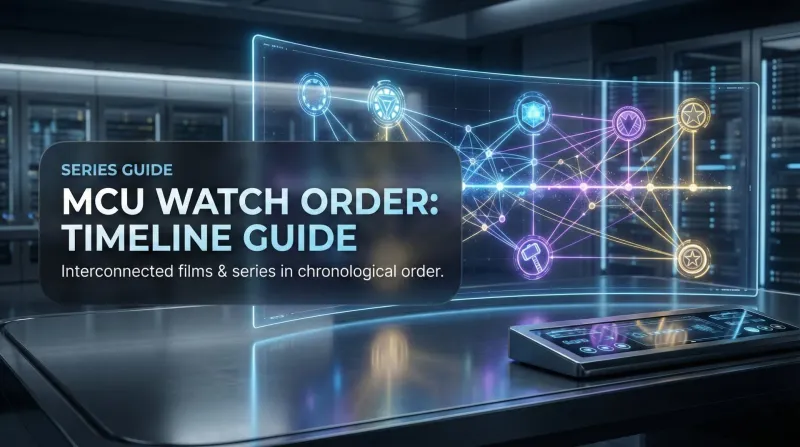
MCU watch order 2026 – All Marvel movies & series in timeline
As a lifelong Marvel fan, the MCU is more than a movie franchise – it's an emotional journey through heroism, sacrifice, and epic storytelling. The way films and series connect across timelines, characters, and genres is absolutely unique in cinema history. From Iron Man's first flight to the multiverse madness of recent phases, every chapter adds depth and excitement to this living, breathing universe. Whether you're watching solo or with your kids, the MCU delivers action, humor, and heart like no other. It's not just a saga – it's a part of my world.