
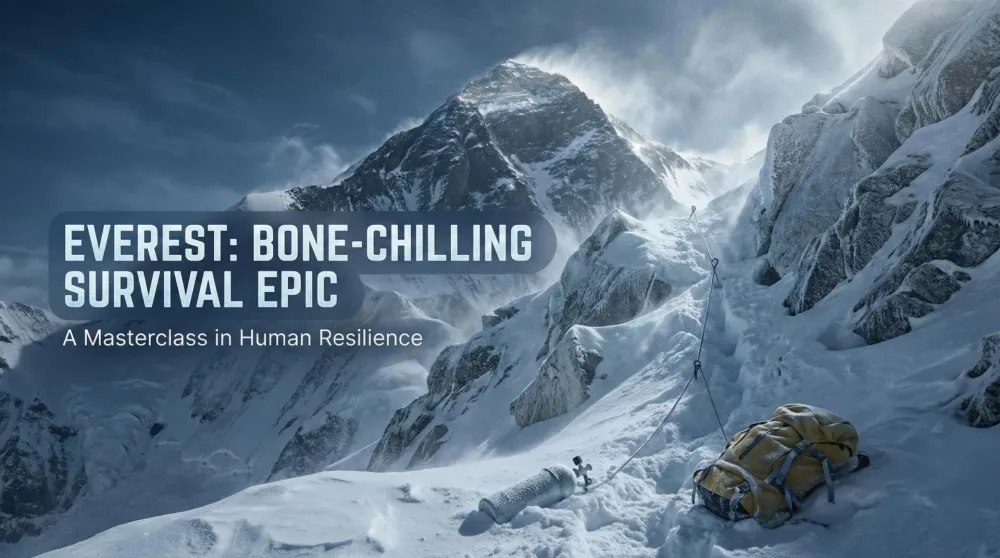
Everest: Why this bone-chilling survival epic is a masterclass in human resilience
A review of the 2015 masterpiece Everest. Why this true story of the 1996 disaster is a 'genial' 4.5/5 survival epic.
This post contains affiliate links. We may earn a commission if you make a purchase, at no extra cost to you. As an Amazon Associate, Dadnology earns from qualifying purchases.
🌪️ This review is part of the Top 30 Natural Disaster Movies – see where every disaster movie lands in our definitive ranking.
At Dadnology, we use the word “Genial” for films that respect the weight of their subject matter. Everest is exactly that. It doesn’t treat the mountain like a movie set; it treats it like a god—beautiful, indifferent, and capable of taking everything in a heartbeat.
Released in 2015, Everest moved the disaster genre away from the “fun” of 2012 and into a space of deep, visceral respect for reality. It is a movie that makes you appreciate the air in your lungs and the warmth of your home.
1. The death zone: Atmosphere as an enemy
In Everest, the antagonist isn’t a person; it’s the lack of oxygen. Director Baltasar Kormákur does an incredible job of visualizing the “Death Zone”—the altitude above 26,000 feet where the human body can no longer sustain itself.
The sound design is the secret weapon here. The thin, whistling wind and the heavy, ragged breathing of the actors (who were actually filmed in freezing conditions) create an atmosphere of suffocating tension. When the storm finally hits, it’s not just loud; it’s disorienting. For anyone with a high-end sound system, the way the wind moves around the room is a masterclass in spatial audio.
2. The dad stake: Rob hall’s final call
The heart of the movie is Jason Clarke as Rob Hall. He’s the ultimate “Professional Dad”—not just to his unborn daughter at home, but to the clients he treats as his responsibility. His drive to help Doug Hansen (John Hawkes), a mailman who just wants to reach the top once, is the noble but tragic engine of the plot.
The final radio call between Rob and his wife Jan (Keira Knightley) is arguably one of the most devastating scenes in cinema. It’s a moment of pure, agonizing reality that speaks to every father’s greatest fear: being unable to make it home to the people you love.
| Character | Role | The 'Dad' Rating |
|---|---|---|
| Rob Hall | Lead Guide / Future Dad | 10/10 - The ultimate protector who never leaves a man behind. |
| Beck Weathers | The Survivor Dad | 9/10 - A man fighting his way back from the brink for his family. |
| Jan Arnold | The Anchor | 10/10 - Her voice is the only thing keeping Rob tethered to Earth. |
| Scott Fischer | The Rival / Maverick | 8/10 - Jake Gyllenhaal brings a wild, charismatic energy to the climb. |
3. Visual purity: The beauty of the beast
Everest is a stunning visual achievement. By shooting on location in Nepal and the Italian Alps, the filmmakers avoided the “green screen” look that plagues so many modern survival films. The light hitting the ice, the deep shadows of the crevasses, and the sheer verticality of the Hillary Step are captured with terrifying clarity.
On a 4K display, the contrast between the blinding white snow and the bright, primary colors of the climbing gear is breathtaking. It is a film that reminds us why we invested in high-bitrate home cinema technology. Every frost-bitten face and every shimmering ice crystal is visible.
4. The home theater workout: The sound of the high altitude
If you want to test the dynamic range of your speakers, Everest is the disc to use.
- The Quiet: The moments of silence at the summit, where you can hear nothing but the faint hiss of oxygen tanks, are perfect for testing your system’s floor noise.
- The Storm: When the blizzard hits, it’s a chaotic, full-frequency assault. A good receiver like the Sony STR-AN1000 will help you distinguish between the roar of the wind and the desperate shouts of the climbers.
5. The survival lesson: Respecting the mountain
Watching Everest is a humbling experience. It’s a film about the consequences of “Summit Fever”—the dangerous obsession that makes us lose sight of our limits. For a dad, it’s a powerful lesson in the balance between following your dreams and knowing when to turn back for the sake of your family.
It honors the memory of those who died while celebrating the incredible survival of people like Beck Weathers (Josh Brolin). It’s a movie that stays with you, making you hug your kids a little tighter when it’s over.
6. The real 1996 disaster
What gives Everest its weight is that every frostbitten moment really happened. On May 10-11, 1996, a sudden, violent blizzard trapped multiple commercial expeditions high on the mountain, and eight climbers died — the deadliest day in Everest’s history at the time. The film centers on two competing guiding outfits, Rob Hall’s Adventure Consultants and Scott Fischer’s Mountain Madness, and the cascade of small decisions and bad luck that turned a routine summit push into a catastrophe. It’s a genuine tragedy, and the movie treats it with documentary seriousness rather than disaster-movie gloss.
The event became world-famous largely thanks to Into Thin Air, journalist Jon Krakauer’s gripping first-hand account (Krakauer was on Hall’s expedition). The film draws on that book, on other survivors’ accounts, and on transcriptions of the actual radio calls — which is exactly why it sometimes plays out in messy, ambiguous ways rather than tidy heroics. There’s real, lingering controversy about what went wrong that day: bottlenecks at the Hillary Step, missed turnaround times, the dangers of commercializing the mountain. The film wisely refuses to assign simple blame, presenting the disaster as the product of human ambition colliding with an indifferent environment. For viewers who get hooked, Krakauer’s book is the essential companion read.
7. An anti-spectacle triumph
Everest arrived the year after Into the Storm and the same era as San Andreas, and it could not be more different from that CGI-spectacle approach. This is the disaster genre stripped of all bombast: no hero outruns the storm, no last-second rescue saves the day, and the most powerful scene is a quiet, devastating radio call rather than a building collapse. By shooting on location in Nepal and the Italian Dolomites, Kormákur grounds everything in tactile, freezing reality.
That restraint is its greatest strength and the reason it earns a high spot in our rankings despite — or because of — its refusal to entertain in the conventional sense. It’s a sobering, humbling watch that respects both its real-life subjects and its audience’s intelligence. The one fair caveat is that its large ensemble can make it hard to track who’s who under all the goggles and oxygen masks, especially early on. But by the devastating final act, the human stakes are crystal clear, and they hit like an avalanche.
Pros
- A respectful, harrowing reconstruction of a real tragedy
- Stunning on-location cinematography in Nepal and the Dolomites
- Reference-grade, vertical spatial-audio sound design
- The Rob/Jan radio call is one of cinema's great gut-punches
- Refreshingly anti-spectacle and emotionally honest
Cons
- The large ensemble is hard to track under the gear early on
- Relentlessly bleak — a genuinely difficult emotional watch
- Light on traditional disaster-movie 'thrills' by design
The final verdict
Everest is a 4.5/5 “genial” survival epic. It is a brutal, beautiful, and deeply respectful reconstruction of a tragedy that changed mountaineering forever. It eschews Hollywood clichés for raw, freezing reality, making it a mandatory watch for anyone who appreciates the power of nature and the resilience of the human spirit.
Who is it for? This is the disaster movie for viewers who want unvarnished reality over popcorn spectacle — the survival-cinema equivalent of Deepwater Horizon or The Perfect Storm. If you value true stories told with restraint and respect, it’s essential, and it pairs beautifully with Krakauer’s Into Thin Air for a full-weekend deep dive. It’s a teens-and-up watch given the intense peril and emotional devastation, and not the film to throw on for light entertainment. But for a dad contemplating the pull of ambition versus the duty to come home, few films land harder. Bleak, beautiful, and unforgettable — it’s the kind of movie that recalibrates your perspective, sending you back to your warm living room and sleeping kids with a fresh wave of gratitude for the ordinary safety most of us take for granted.
📺 Movie night sorted: thousands of films and shows are streaming on Prime Video — free for 30 days. Worth a look before you buy the disc.
Is Everest (2015) based on a true story?
How did they film Everest?
Who is the 'Hero' of Everest?
Did the actors actually climb Everest?
Is the movie accurate to Jon Krakauer's book?
What is the 'Death Zone'?
Keep this in your inbox
One email a week: what we actually watched, built and reviewed — the stuff worth a dad's time. No hype, no daily spam.
Dadnology Weekly
One email a week: the LEGO, gaming and movie news worth a dad's time — plus what we actually reviewed. No hype, no daily spam.
Disclaimer: This review and its visuals were created with the help of AI. Some links may be affiliate links – we may earn a commission if you make a purchase, at no extra cost to you.
Current deals in Movies & TV
Verified live discounts tracked on Amazon
![The Legend of Korra — The Complete Series [Blu-ray]](https://m.media-amazon.com/images/I/51+1TXyb7aL._SL500_.jpg)
Movies & TV · Tested by Dadnology
The Legend of Korra — The Complete Series [Blu-ray]
4.5/5“A new Avatar, a modern city, a masked revolution”Read our review
Movies & TV · Tested by Dadnology
Zack Snyder's Justice League (4K Ultra HD)
4/5“Four hours. One vision. This is the film.”Read our review
Movies & TV · Tested by Dadnology
Space Jam (4K Ultra HD + Digital)
4/5“It's gonna be a whole new ball game”Read our reviewYou might also like
Dante’s Peak: Why this 90s volcano classic is the ultimate lesson in geological peril
Dante’s Peak is a 4/5 blast of nostalgia and heat. It perfectly captures the 'slow-burn' dread of a natural disaster before exploding into a chaotic, ash-drenched escape. With Pierce Brosnan bringing peak charisma and some of the best practical miniature work of the decade, it remains the king of the volcano sub-genre.
The Impossible: Why this heartbreaking true story is the gold standard for tsunami cinema
The Impossible is a 4/5 emotional juggernaut. It features one of the most terrifyingly realistic disaster sequences ever filmed, followed by a deeply moving exploration of human resilience. With incredible performances and a focus on the 'impossible' odds of survival, it is a mandatory, albeit difficult, watch.
The survival legends: Real stories of human resilience and genre classics
A profound 5/5 category. This collection features the highest emotional stakes and the most grounded 'Dad-energy' on our list. Whether it's the staggering realism of Everest or the heroic sacrifice in Only the Brave, these films are tributes to the unbreakable human spirit.