
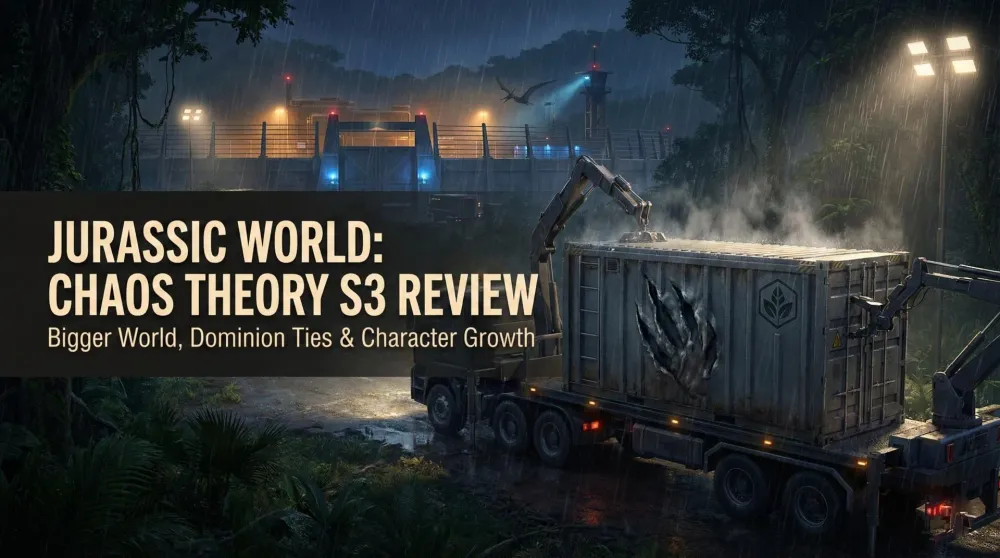
Jurassic World: Chaos Theory – Season 3: The world feels bigger (and worse)
Bigger stakes, tighter character work, and smart Dominion tie-ins. A must for dino fans.
This post contains affiliate links. We may earn a commission if you make a purchase, at no extra cost to you. As an Amazon Associate, Dadnology earns from qualifying purchases.
🦖 This review is part of the Jurassic World Watch Order 2025 – watch all Jurassic Park and Jurassic World movies, Camp Cretaceous, and Chaos Theory in timeline order.
🎬 Overview
Chaos Theory – Season 3 arrives with the confidence of a show that knows exactly what it is: a character-driven Jurassic thriller that treats its audience with respect. The season leans into mystery, consequence, and moral gray zones, while still delivering the creature spectacle you want from this universe. If Season 1 set the tone and Season 2 broadened the world, Season 3 sharpens everything—rhythm, stakes, and emotional payoff.
Yes, we’re unabashedly enthusiastic again. The kids (now young adults) are fantastic. Their choices feel earned, their conflicts feel human, and their victories never come free.
🧩 Characters who carry the legacy
The heart of Chaos Theory – Season 3 lies in the evolution of its six core characters. These aren’t just survivors anymore – they’re young adults navigating a world forever changed, carrying emotional scars and moral burdens that feel strikingly real.
- Darius remains the group’s compass, torn between building a life and answering a call to responsibility. His “lead or leave” dilemma gives the season real weight.
- Kenji wrestles with legacy—how to be better than the past without abandoning where he came from. His growth is one of the most satisfying threads.
- Brooklyn drives the investigative engine, following the money and the myths. Curiosity becomes courage—at a cost.
- Yaz balances protector instincts with vulnerability, learning when to hold the line and when to ask for help.
- Ben channels hard-won survivalism into strategy, now confronting what “normal” could even mean.
- Sammy remains the beating heart, calling out ethical lines when the mission blurs them.
Their shared history from Camp Cretaceous charges every decision. This is ensemble storytelling done right: no weak links, plenty of friction, and genuine affection.
🦕 Set pieces, scale & style
Season 3 keeps the action crisp and varied: claustrophobic close calls, open-terrain pursuits, and a few white-knuckle stealth sequences that feel straight out of a big-budget thriller. Dinosaurs are animated with tactile weight—predators stalk, herbivores thunder, and behavior reads as animal, not monster.
Sound and score do heavy lifting without shouting. The season uses silence and distant roars as well as full-tilt crescendos; it trusts the frame and the audience.
🧠 Themes that bite back
Three themes snap into focus:
- Accountability vs. Survival: When the world is messy, who cleans it up—and at what cost?
- Truth vs. Safety: Exposing corruption can save lives—or put yours on the line.
- Found Family: The only way through a Jurassic world is together.
The show never lectures. It lets choices and consequences do the talking.
🔗 Dominion crossovers – Explained
Even if Jurassic World Dominion wasn’t your favorite, the crossovers here are excellent—purposeful, tense, and story-first.
- The Black-Market Web: Season 3 threads the illegal dinosaur trade more explicitly, mapping routes, handlers, and buyers. It’s a grounded prelude to the large-scale trafficking we later see in Dominion.
- Corporate Fingerprints: Names, shell fronts, and “consultancies” surface around research permits and relocation ops—soft BioSyn fingerprints that reward attentive viewers without turning episodes into expos dumps.
- Handlers & Go-Betweens: The broker network resurfaces, bridging animated canon to Dominion’s world of fixers and middlemen. Their methods (asset tagging, falsified manifests, “rescues” that aren’t) echo what the film dramatizes at scale.
- Public Reality: News tickers, briefings, and chatter frame a world acclimating to dinosaurs among us—matching Dominion’s premise without spoiling film-specific beats.
Crucially, these nods serve this season’s plot. They raise danger, complicate choices, and make wins feel hard-fought. It’s fan service that actually services the story. Thanks, Netflix. More of this, please.
👉 Want the bigger picture? Our Dominion review
🧭 Pacing & structure
Season 3 is tight. Episodes open on a hook, close on a choice, and rarely waste motion. When the show slows down, it’s for character work that cashes out later—apologies that matter, boundaries negotiated, plans debated. You feel the group earn their outcomes.
👨👧👦 Family watch notes
This is still family-friendly at 12+: tense but not graphic, frightening in bursts but emotionally grounded. Parents will appreciate how the show handles consequence and empathy; kids will lock in for the dinosaurs and the friendships.
If you’ve followed Camp Cretaceous and the first two Chaos Theory seasons, this is unequivocally for you. Newer viewers can keep up, but you’ll get far more if you’ve done the homework.
🎯 Why animated Jurassic works (and live-action sequels struggled)
Here’s the uncomfortable truth the franchise spent a decade avoiding: the films’ biggest enemy was their own budget.
Jurassic World (2015) cost roughly $150 million to make and needed to clear $400 million globally just to break even on marketing and distribution. That math is not your friend when you’re trying to tell a nuanced story about six people processing trauma and growing up. Every dollar spent on a photorealistic Indominus Rex is a dollar not spent on a second act that breathes. By the time Fallen Kingdom and Dominion came around, the franchise had locked itself into a cycle: bloated budgets, global box office dependency, and the creative pressure to keep escalating spectacle whether the story needed it or not. The result was films that felt simultaneously overstuffed and hollow.
Animation snaps that trap open.
The economics are fundamentally different. Character work — two people arguing, a quiet moment of grief, a plan going sideways in a cramped corridor — is cheap in animation. You don’t need to rebuild a set. You don’t need to shoot pickups. A dinosaur moving through tall grass is a consistent asset call, not a $4 million VFX shot with a six-week render farm. And the 22-minute episode structure that Chaos Theory runs on? It’s a storytelling discipline the films never had. Every episode has to open on a hook, close on something that matters, and move the pieces without wheel-spinning. There’s no “third-act bloat” when your third act is the entire back half of a 22-minute runtime.
The result is visible on screen. Season 3 gives each of its six core characters individual arcs — genuine, evolving, emotionally coherent arcs — across ten episodes. That’s six character throughlines in roughly 220 minutes of total runtime. Jurassic World the film gave you two leads, a pair of comic-relief brothers, and a villain with a motivation the writers seemed to lose interest in around minute 90. The comparison isn’t close.
The post-Fallen Kingdom world is also, genuinely, more interesting in episodic TV than it ever could have been in a single film. Dominion tried to dramatize “dinosaurs living among humans” in two and a half hours and ended up touching nothing deeply. Chaos Theory takes the same premise and builds it slowly: black markets developing infrastructure, corporations adapting their cover stories, ordinary people navigating a world that changed overnight. Consequences compound. World-building earns its weight. That kind of storytelling is what episodic television does — and what blockbusters structurally cannot.
The honest takeaway: if Netflix keeps commissioning this level of craft, animated Jurassic might end up being the franchise’s creative high point. Not as a nostalgia exercise. Not as a kids’ spin-off. As the format where the story was finally allowed to be told properly.
Pros
- Fantastic ensemble arcs and chemistry
- Cinematic set pieces with real consequence
- Dominion tie-ins that enhance (not distract)
- Confident pacing; character beats pay off
- Sharp animation and sound design
Cons
- Context from prior seasons strongly recommended
- A plot turn or two leans on franchise shorthand
📝 Conclusion
Chaos Theory – Season 3 is peak modern Jurassic: heartfelt, propulsive, and lore-savvy without getting lost in it. The kids are wonderful, the dinosaurs feel alive, and the crossovers are integrated with craft—even for fans who didn’t love Dominion. This season respects your investment and rewards your attention.
Final Rating: 4.5/5 — A must for every dino fan.
📺 Movie night sorted: thousands of films and shows are streaming on Prime Video — free for 30 days. Worth a look before you buy the disc.
Related Dadnology review: Jurassic World: Chaos Theory – Season 4: Consequences Hit Hard
📌 FAQ – Frequently asked questions
Do I need to watch Camp Cretaceous first?
Where does Season 3 fit in the Jurassic timeline?
How are the Dominion crossovers used here?
Is it kid-friendly?
How many seasons does Chaos Theory have?
Is Chaos Theory a continuation of Camp Cretaceous?
Keep this in your inbox
One email a week: what we actually watched, built and reviewed — the stuff worth a dad's time. No hype, no daily spam.
Dadnology Weekly
One email a week: the LEGO, gaming and movie news worth a dad's time — plus what we actually reviewed. No hype, no daily spam.
Disclaimer: This review and its visuals were created with the help of AI. Some links may be affiliate links – we may earn a commission if you make a purchase, at no extra cost to you.
Current deals in Movies & TV
Verified live discounts tracked on Amazon
![The Legend of Korra — The Complete Series [Blu-ray]](https://m.media-amazon.com/images/I/51+1TXyb7aL._SL500_.jpg)
The Legend of Korra — The Complete Series [Blu-ray]
Korra's complete run on disc — the older, thornier follow-up to Airbender, best watched after it.
Price as of Oct 11, 09:13 PM UTC. Subject to change.

Zack Snyder's Justice League (4K Ultra HD)
The version you should actually watch. Four hours, properly realized. Get both to understand the full story.
Price as of Oct 11, 09:14 PM UTC. Subject to change.

Space Jam (4K Ultra HD + Digital)
The 4K restoration actually looks pretty great — the live-action footage and the Toon World animation both benefit from the upgrade.
Price as of Oct 11, 09:14 PM UTC. Subject to change.
You might also like
Jurassic World: Chaos Theory - Season 2: Trust starts to crack
While not quite as groundbreaking as Season 1, *Chaos Theory – Season 2* delivers strong character development and meaningful expansion of the Jurassic timeline. The story smartly plants seeds for what’s to come in *Dominion*, particularly through a well-timed crossover involving the shady broker. Action, intrigue, and heart are balanced well, making it another standout season for long-time fans. You’ll get more out of it if you’ve seen *Camp Cretaceous* and *Fallen Kingdom* first – it rewards those who know the saga. Highly recommended for dino-loving families.
Jurassic World: Camp Cretaceous Season 4 – New island, new rules
*Camp Cretaceous* Season 4 ditches Isla Nublar for a new, high-tech island filled with artificial biomes and robotic threats. While the story loses some grounding, the kids remain fun to watch and the dino action still delivers. Not as strong as earlier seasons, but still enjoyable for younger audiences.
Jurassic World watch order 2026 – All movies, shows & Camp Cretaceous in timeline
The *Jurassic Park* and *Jurassic World* saga blends epic dinosaur spectacle with survival thrills, family drama, and sci-fi suspense. From Spielberg's original classic to the animated Netflix series *Camp Cretaceous* and the new *Chaos Theory*, this franchise continues to evolve. Whether you're rewatching with nostalgic eyes or introducing your kids to the dino universe for the first time – this is your complete roadmap to watch everything in story order.