
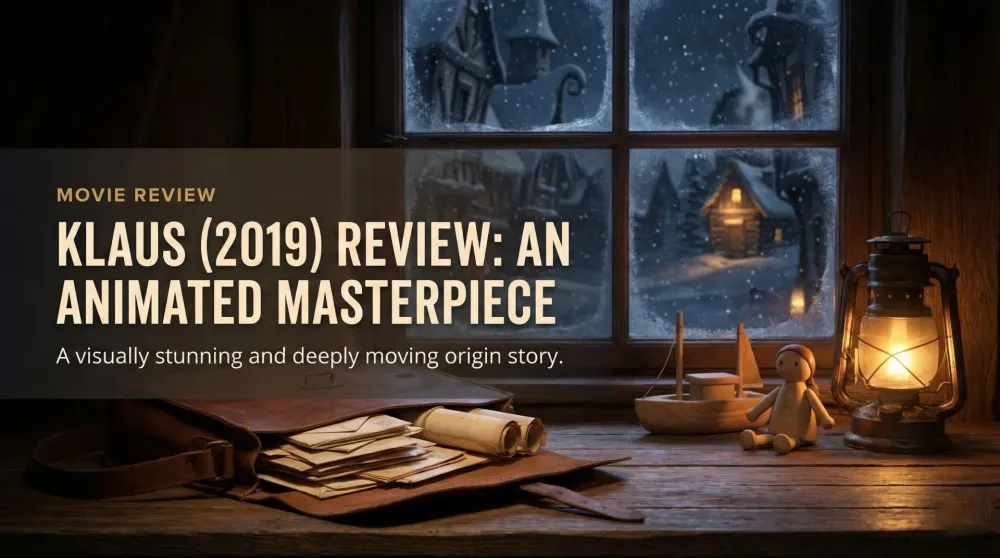
Klaus (2019) Review – A Masterpiece of Animation and Heart
Netflix’s 'Klaus' is a modern miracle. With groundbreaking 2D animation and a clever, touching origin story for Santa, it’s an instant classic. It’s funny, beautiful, and deeply moving.
This post contains affiliate links. We may earn a commission if you make a purchase, at no extra cost to you. As an Amazon Associate, Dadnology earns from qualifying purchases.
🎬 Introduction — A True Act of Goodwill
🎄 This review is part of the Best Christmas Movies 2025 – find your next cosy family movie night in our festive guide.
When Klaus dropped on Netflix in 2019, it didn’t just arrive; it landed. In an era of cookie-cutter 3D CGI, here was a film that looked like a moving illustration. Directed by Sergio Pablos (the creator of Despicable Me), it was a passion project that felt like a pushback against the industry standard.
But Klaus isn’t just a tech demo. It’s a smart, cynical, and eventually incredibly sweet retelling of the Santa Claus mythos. It asks: what if Santa wasn’t magic? What if he was just a sad old man, and the legend was an accident created by a desperate postman?
For a dad, this movie is a joy. It respects your intelligence. It doesn’t talk down to kids. It has a dry, sarcastic wit that balances out the sentimentality perfectly. The film trusts that you understand what a small act of kindness actually costs — and what it can set in motion. It’s the kind of movie you recommend not just as a “Christmas movie,” but as a “great movie.”
AdThe Art of Klaus (Book) (opens in a new tab)
Dive into the stunning visual development of the film. A must-have for animation fans and art lovers.

🧠 Story & Themes — A True Selfless Act
The film’s tagline—“A true selfless act always sparks another”—is the core of the narrative. We follow Jesper, a spoiled, lazy postman sent to the frozen, miserable town of Smeerensburg as punishment. The town is divided by a centuries-old feud between two clans. To get out, Jesper needs to post 6,000 letters. He teams up with a reclusive toymaker named Klaus to bribe kids into writing letters in exchange for toys.
It’s a cynical start. Jesper is doing “good” for selfish reasons. But watching that selfishness slowly transform into genuine care is the arc of the film. It shows how the act of giving, even if it starts with an agenda, can change a community.
The way the movie weaves in the origins of the reindeer, the sleigh, the red suit, and the “naughty list” is clever and satisfying. It grounds the magic in reality before letting it fly.
There’s also something worth naming specifically for dads: Jesper isn’t a hero who discovers inner greatness. He’s an unmotivated adult shielded from consequences his whole life, and he’s developed exactly the character you’d expect. His arc isn’t about unlocking hidden potential — it’s about learning that the act of doing something for someone else, even grudgingly at first, changes you in ways that waiting for greatness never could. That’s a more honest story than most family films are willing to tell.
🎭 Characters & Performances — An Odd Couple
Jason Schwartzman voices Jesper with a perfect mix of entitlement and desperation. He’s annoying at first, but you slowly warm to him. J.K. Simmons is the voice of Klaus, and he is magnificent. He says very little for the first half of the movie, but his presence is immense. When he finally opens up about his past, it’s heartbreaking.
Rashida Jones plays Alva, a teacher who has given up on the town and turned her school into a fishmonger’s shop. Her cynicism mirrors Jesper’s, and her eventual return to teaching is a great subplot about the value of education.
The kids of Smeerensburg, particularly the silent Sami girl Margu, are the catalysts for change. Their innocence breaks down the barriers the adults have built.
🎄 Klaus vs. the Christmas Movie Shelf — An Honest Comparison
“Instant classic” is a phrase deployed too easily. Here’s where Klaus actually stands.
Against the live-action staples (Home Alone, Elf, It’s a Wonderful Life): Klaus is quieter and more melancholic. It doesn’t have quotable gags your family will repeat for thirty years. What it has is a conclusion that genuinely earns its emotional payoff — something most Christmas comedies never quite reach because they’re too busy setting up the next laugh.
Against the Disney animated catalogue (Frozen, Encanto, Moana): Klaus has no musical numbers, which is a feature. It stays out of its own way, trusting the score and the visuals to do the emotional work. Less spectacle, more intimacy. A different lane, but one that respects your attention.
Against other Netflix animated originals: no competition. Klaus is in another class entirely — the only Netflix animation that belongs in the same conversation as the Pixar golden era.
The fair verdict: it’s the best animated Christmas film since The Nightmare Before Christmas. If that bar seems high, watch the final fifteen minutes and report back.
🎨 Visual Style, Animation & Audio — Lighting the Way
We have to talk about the look. Klaus uses a revolutionary technique that applies volumetric lighting to hand-drawn 2D characters. The result is characters that feel tactile and 3D but move with the snap and expressiveness of traditional animation. It is, simply put, one of the most beautiful animated films ever made.
The background art is equally stunning—twisted, German Expressionist architecture for the town, and sweeping, painterly landscapes for the forest. Every frame is a work of art.
The score by Alfonso G. Aguilar is sweeping and emotional, and the use of the song “Invisible” by Zara Larsson is a highlight.
To understand why the visual technique matters, consider how mainstream CGI animation moves: fluid, continuous, physically precise. It communicates competence. Klaus moves like a memory — the slightly imperfect cadence of traditional 2D carries a warmth that smoothness cannot replicate, because smoothness is mechanical and memory is not. The lighting adds dimension without erasing that warmth. When Jesper’s face catches the glow from Klaus’s workshop lantern, you understand something about belonging that no render farm delivers as directly.
The color palette reinforces the story deliberately: the town starts grey, cold, and desaturated. As small acts of kindness compound, the palette brightens. That’s not metaphor layered on top of the narrative — it is the narrative, told by the art department.
AdWatch on Netflix (opens in a new tab)
Stream the movie in high definition on Netflix.
👨👧 The Dad Perspective — A Bit Darker, A Lot Deeper
Runtime: 1 hour 36 minutes. Perfect.
Suitability: Smeerensburg is a grim place at the start. It’s grey, violent, and full of people trying to hurt each other (in a slapstick way). It’s a bit darker than your average Christmas fluff. The backstory of Klaus involves the loss of his wife, which is handled beautifully but is sad. I’d say 7+ is a good age. Younger kids might find the townspeople a bit scary initially.
The “Wow” Factor: Even if you’re not an animation nerd, you’ll notice this movie looks different. It’s a great way to show kids that cartoons don’t all have to look the same.
Rewatch Value: High. The story is so well-constructed that it holds up to repeat viewings. You notice new details in the background every time.
✅ Pros & Cons
Pros
- Groundbreaking animation style that is a feast for the eyes
- A clever, original story that breathes new life into old tropes
- J.K. Simmons gives a powerful, understated performance
- The message about kindness spreading is genuinely inspiring
- Funny, smart dialogue that adults will appreciate
Cons
- The first act is intentionally bleak and grey (stick with it!)
- Some of the pop music choices feel a bit modern for the setting
🗣️ Conclusion
Klaus is a modern masterpiece. It proves that you can tell a traditional story in a new way and make it feel vital. It’s a film that believes in the best of us, even when we’re at our worst.
If you’re tired of the same old Christmas movies, put this on. It will restore your faith in the genre. It’s magical, not because of elves and flying deer, but because of what it says about the human heart.
🗣️ Conclusion
A stunning, heartfelt, and visually revolutionary film. Klaus is destined to become a holiday classic. It’s a gift to animation fans and families alike.
📺 Movie night sorted: thousands of films and shows are streaming on Prime Video — free for 30 days. Worth a look before you buy the disc.
Related Dadnology review: Noelle (2019) Review – A Charming, Cozy Disney+ Surprise
📌 FAQ — Frequently Asked Questions
Is it computer animated or hand-drawn?
Is it scary?
Is it based on a book?
Is it better than Elf?
Does it have songs?
Keep this in your inbox
One email a week: what we actually watched, built and reviewed — the stuff worth a dad's time. No hype, no daily spam.
Dadnology Weekly
One email a week: the LEGO, gaming and movie news worth a dad's time — plus what we actually reviewed. No hype, no daily spam.
Disclaimer: This review and its visuals were created with the help of AI. Some links may be affiliate links – we may earn a commission if you make a purchase, at no extra cost to you.
You might also like

That Christmas (2024) Review – A New Holiday Classic is Born
Finally, a modern Christmas movie that feels like a classic. 'That Christmas' combines the wit of Richard Curtis with beautiful animation and a story that genuinely tugs at the heartstrings. It’s funny enough for kids and emotional enough for adults. If you want a new tradition that feels cozy and earned, this is it. **Rating: 4.5/5.**
Arthur Christmas (2011) Review – A High-Tech Holiday Gem
Smart, funny, and full of heart. 'Arthur Christmas' balances a clever sci-fi concept with a touching story about family dysfunction. The voice cast (James McAvoy, Bill Nighy, Hugh Laurie) is stellar, and the animation is top-notch. It’s the perfect antidote to schmaltzy holiday movies—a film with a brain and a soul. **Rating: 4/5.**
Home Alone (1990) Review – The Ultimate Christmas Comfort Movie
Decades later, 'Home Alone' hasn't lost a step. The physical comedy still hits, the music still gives you chills, and the message about family appreciation lands every time. It’s the rare movie that works for a 6-year-old and a 60-year-old for completely different reasons. A masterpiece of tone and timing. **Rating: 4.5/5.**