
Makoto Shinkai movies ranked – Your Name, Suzume & Weathering With You
Your Name, Suzume, and Weathering With You ranked — where to start with Makoto Shinkai and which of his films fit your family movie night.
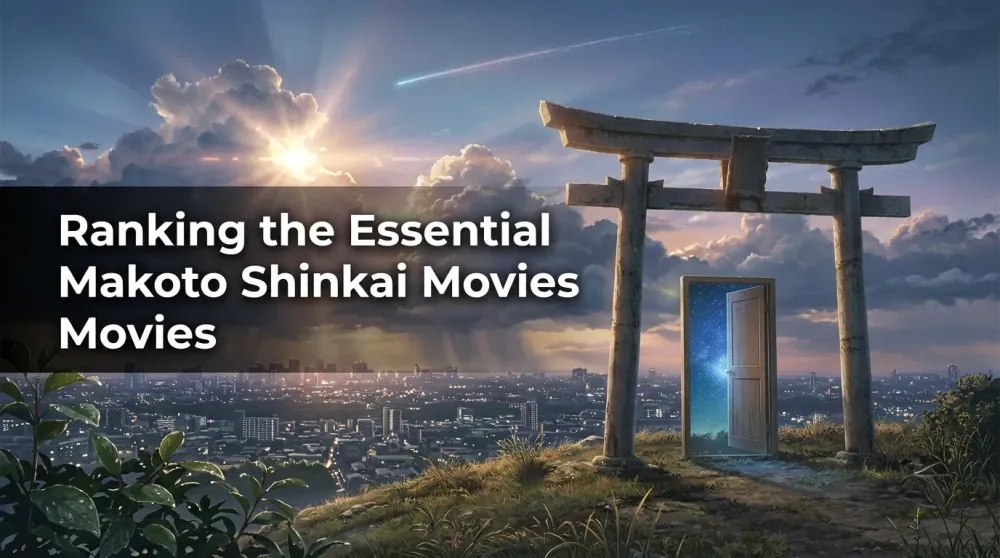
This post contains affiliate links. We may earn a commission if you make a purchase, at no extra cost to you. As an Amazon Associate, Dadnology earns from qualifying purchases.
TL;DR – Our Dadnology picks
Made your pick? The full reviews are just below. Still deciding? Read on — the ranking has reasons.
Why Shinkai is the best entry point into anime films
Here’s a conversation every dad in my circle has had at some point: someone recommends “an anime,” and the response is a polite nod and a mental note to never follow up. Fair enough — from the outside, anime looks like a commitment: hundred-episode series, in-jokes, homework. Makoto Shinkai’s modern run is the antidote. Three films — Your Name (2016), Weathering With You (2019), and Suzume (2022) — each fully standalone, each around two hours, each among the most beautiful things ever animated. No lore. No prerequisites. Just filmmaking.
The numbers back the pitch: Your Name grossed roughly 405 million dollars worldwide and stood as the highest-grossing anime film in history until 2020. Suzume took around 314 million and competed at the Berlinale — the first anime in the festival’s competition since Spirited Away, 21 years earlier. Weathering With You was Japan’s official Oscar submission. This is not a niche recommendation; this is world cinema that happens to be drawn.
All three films earned full reviews here, and this page is the map: the ranking, the watch order, what makes the style so instantly recognizable, and — because this is Dadnology — exactly which film fits which family movie night.
Series content
Explore all articles, reviews, and guides in this series.

The ranking, explained
1. Your Name (2016) — 5/5. The masterpiece, and not by accident. It’s the film where Shinkai’s fifteen years of craft — light, longing, distance — finally met a story structure worthy of them: a body-swap comedy that pivots, mid-film, into something devastating, with a RADWIMPS soundtrack welded directly into the edit. It’s one of my favorite anime films full stop, and the one I hand to people who “don’t watch anime.” They come back different. Full review here.
2. Suzume (2022) — 4.5/5. Fresh off a weekend rewatch, this ranking held firm. Suzume is Shinkai’s funniest film — a road trip across Japan starring a girl, a trickster cat, and a cursed three-legged chair — and simultaneously his most mature, because underneath the comedy it’s an honest, careful film about the 2011 earthquake and childhood grief. That both halves work in the same two hours is the achievement. Full review here.
3. Weathering With You (2019) — 4/5. Third of three, which in this trio is like finishing third in a Champions League final. It’s the most visually stunning film of the run — an entire feature set in supernatural rain, with sunbreaks that land like chemical events — and its ending is braver than either sibling’s. What it lacks is Your Name’s clockwork discipline: the middle act circles, the mythology stays vague. Still essential. Full review here.
The honest gap analysis: all three films share the same DNA — teenagers, folklore, impossible skies, RADWIMPS — so the ranking comes down to story discipline. Your Name executes its structure flawlessly. Suzume balances two tones most directors couldn’t hold separately. Weathering With You trades some structure for mood and nerve. There is no bad pick here.
The style: Why every frame looks like that
If you’ve seen a single still from any of these films, you know the look: skies that seem lit from inside, light flares straight off a camera sensor, backgrounds detailed down to the convenience-store shelf labels. I’ll say it plainly — I love this graphic style. All three films, every frame, perfect. It’s the thing that first pulled me in, and it’s the thing that keeps these films rewatchable long after you know every plot turn.
What makes the style more than wallpaper is that Shinkai uses it as grammar. In Your Name, twilight — the moment when faces blur — is literally the hinge of the plot. In Weathering With You, ninety percent of the film is drenched precisely so each sunbreak detonates. In Suzume, the beauty migrates to ruins — rusted ferris wheels, overgrown schoolyards — because the film is about the places disaster empties out. Same brush, three completely different arguments. That’s an auteur, not a filter.
The sound half of the signature is RADWIMPS, the rock band Shinkai has brought into production on all three films — joined on Suzume by Halo 5 composer Kazuma Jinnouchi. The songs aren’t laid over the films; scenes are built around them. It’s why these movies feel like they move differently than other animation.
Watch order & entry points
Release order is the right order, and conveniently also the quality-adjacent order:
- Your Name (2016) — the strongest opening argument the medium has.
- Weathering With You (2019) — watch for the rain, stay for the cameos: two Your Name characters appear briefly, a small reward for chronology.
- Suzume (2022) — fully standalone, and the ideal closer: it’s the film where Shinkai’s themes grow up.
If you’re optimizing for a specific scenario instead: starting with a skeptical partner, choose Your Name. Starting with kids around 10, choose Suzume — the chair is the best co-host imaginable. Saving the prettiest for a rainy evening, that’s Weathering With You, ideally with actual rain on the windows.
Head-to-head: The trilogy at a glance
| Your Name | Suzume | Weathering With You | |
|---|---|---|---|
| Our Rating | 5/5 | 4.5/5 | 4/5 |
| Year | 2016 | 2022 | 2019 |
| Runtime | 106 min | 122 min | 112 min |
| The Hook | Body swap with a twist | Road trip, cat, cursed chair | The girl who sells sunshine |
| Strongest Suit | Structure and payoff | Comedy plus maturity | Pure visual splendor |
| Family Fit | 10+ | 10+ | 12+ |
| Kleenex Risk | Severe | Moderate to high | Moderate |
The table tells you what two hours with each film costs and pays. What it can’t show is the consistency: there isn’t a skippable film in this run, which is precisely why this page exists — the question is never whether to watch Shinkai, only where to start.
Family & age suitability
The honest breakdown, from one dad to another. Your Name is fine from about 10 — some cheeky body-swap humor and a tense final act, nothing graphic, and teens especially get pulled in hard. Suzume is also a 10+, with an asterisk: the comedy makes it the most kid-friendly on the surface, but it engages real earthquake imagery and grief, so sensitive kids want a co-viewer — and it’s genuinely worth co-viewing. Weathering With You skews oldest at 12+: runaway minors, a firearm subplot, and the fringes of the adult city, all handled discreetly but present.
One practical note: all three work dubbed or subtitled. If your kids can read at speed, the original Japanese casts are worth it — but the dubs are solid, and a first watch that actually gets finished beats a purist one that doesn’t.
Pros
- Three standalone films — the lowest-commitment, highest-reward entry into anime cinema
- A visual style so consistent and gorgeous that any frame is identifiable at ten paces
- Every film works for family movie night at the right age — 10+ to 12+
- RADWIMPS scores that function as storytelling, not background
Cons
- Emotional damage is a feature of the whole catalog — stock up on tissues
- Shinkai's dream-logic folklore asks for a leap of faith in every film; strict rationalists will grumble
The bottom line
For most dads: start with Your Name tonight — it’s the best film of the three and the best case for the medium ever put on screen.
Follow release order from there: Weathering With You for the visuals and the cameos, Suzume to finish on the most mature note. If you’re programming family movie night with a 10-year-old, flip the order and lead with Suzume.
Our pick: Your Name as the essential purchase. Suzume if the family co-watch matters most.
Our full individual reviews appear above — each with detailed ratings, pros, cons, family watch notes, and buying links. More animation on Dadnology: The War of the Rohirrim review · One Piece anime starter guide · Star Wars: Visions review
📌 FAQ – Frequently asked questions
What is the best Makoto Shinkai movie?
In what order should I watch Makoto Shinkai's movies?
Are Your Name, Weathering With You, and Suzume connected?
Which Makoto Shinkai movie is best for kids?
Is Makoto Shinkai the next Miyazaki?
Keep this in your inbox
One email a week: what we actually watched, built and reviewed — the stuff worth a dad's time. No hype, no daily spam.
Dadnology Weekly
One email a week: the LEGO, gaming and movie news worth a dad's time — plus what we actually reviewed. No hype, no daily spam.
Disclaimer: This review and its visuals were created with the help of AI. Some links may be affiliate links – we may earn a commission if you make a purchase, at no extra cost to you.
Current deals in Movies & TV
Verified live discounts tracked on Amazon
![The Legend of Korra — The Complete Series [Blu-ray]](https://m.media-amazon.com/images/I/51+1TXyb7aL._SL500_.jpg)
Movies & TV · Tested by Dadnology
The Legend of Korra — The Complete Series [Blu-ray]
4.5/5“A new Avatar, a modern city, a masked revolution”Read our review
Movies & TV · Tested by Dadnology
Zack Snyder's Justice League (4K Ultra HD)
4/5“Four hours. One vision. This is the film.”Read our review
Movies & TV · Tested by Dadnology