
Silo – Season 1: A Masterclass in Sci-Fi Tension
A gripping dystopian mystery that nails the atmosphere of Hugh Howey's novels. Rebecca Ferguson is outstanding.
This post contains affiliate links. We may earn a commission if you make a purchase, at no extra cost to you. As an Amazon Associate, Dadnology earns from qualifying purchases.
🎬 Introduction
🕳️ This review is part of our Silo Series Hub – both seasons reviewed, the watch order and the Hugh Howey books behind the show.
Silo is the kind of show that reminds you why you love sci-fi. Premiering on Apple TV+ in 2023, it adapts Hugh Howey’s Wool trilogy with a reverence for the source material that is rare. It isn’t just about the mystery of why thousands of people live in a giant underground silo; it’s about the cost of keeping that society running.
For a Dad, it’s captivating. It’s a show about infrastructure, maintenance, and the lies we tell to protect our families. It’s gritty. You can practically smell the oil and the rust.
AdWool (Silo Series Book 1) (opens in a new tab)
The novel that inspired the hit Apple TV+ series. Explore the world of the Silo in Hugh Howey's groundbreaking bestseller.

🧠 Story & Themes
10,000 people live in a Silo. The outside air is toxic. No one knows who built the Silo or why. The only rule: do not ask to go outside. If you do, you get your wish—and you die within minutes, cleaning the sensors for those left behind.
The story follows Juliette Nichols (Rebecca Ferguson), a mechanic from the “Down Deep” who is thrust into the role of Sheriff. She starts pulling at a loose thread of a murder investigation and unravels the entire fabric of their reality.
The theme is Truth vs. Order. The leaders of the Silo believe that lies keep people safe. Juliette believes the truth is worth dying for. It’s a classic conflict executed perfectly.
Class Struggle. The vertical design of the Silo creates a literal class system. The elite live up top with the view; the workers live in the dark bottom, keeping the lights on.
🎭 Characters & Performances
Rebecca Ferguson as Juliette. She is a powerhouse. She plays Juliette not as a superhero, but as a stubborn, angry, competent engineer. She fixes things. When she applies that mindset to a conspiracy, she is unstoppable.
Tim Robbins as Bernard. He plays the bureaucratic villain perfectly. He isn’t twirling a mustache; he genuinely believes he is saving humanity. That makes him terrifying.
Common as Sims. The enforcer. He brings a quiet menace to the role.
The supporting cast is deep, fleshing out the world with characters who feel like they have lived underground their whole lives.
🎨 Visual Style, Animation & Audio
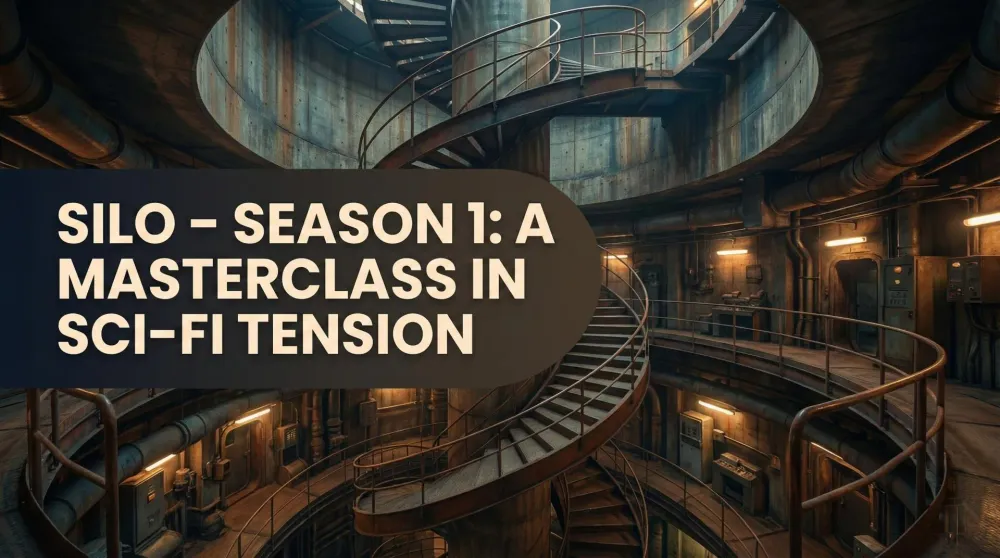
The Production Design is the MVP. The Silo feels huge. The central spiral staircase is a dizzying set piece. The technology is “retro-futuristic”—bulky screens, analog dials, pneumatic tubes. It feels grounded and real.
The Generator Scene. In an early episode, they have to repair the main generator. It is one of the most tense sequences of TV I have ever watched. It’s just people fixing a machine, but it’s shot like an action movie.
👨👧 The Dad Perspective
Suitability:
- Themes: Suicide is a major plot point. “Freedom Day” involves watching people die. It is heavy.
- Violence: Fights are brutal and realistic. People fall from great heights.
- Rating: 14+ is appropriate. It’s too slow and dark for kids.
Talking Points: The importance of questioning authority (respectfully!). How societies are built. The value of blue-collar work (the Down Deep keeps the place running).
Ad
Wool (Silo Series Book 1) (opens in a new tab)
The novel that inspired the hit Apple TV+ series. Explore the world of the Silo in Hugh Howey's groundbreaking bestseller.
🏗️ World-Building Done Right: Why the Silo Feels Real
Most sci-fi shows spend their first season explaining the rules. Silo trusts you to absorb them. Within two episodes you understand the economics — relics from the old world are currency, stairs cost sweat and time, and your floor number is shorthand for your entire social standing. You understand the politics — IT controls information flow and the narrative of history, Mechanical keeps the lights on and quietly resents everyone above Floor 100 for it. And you understand the unspoken social contract: don’t pull the thread, don’t ask what’s outside, don’t be the person who ends up cleaning.
The production design earns every bit of that clarity. The Silo’s retro-futurist aesthetic — pneumatic message tubes, analog pressure gauges, cathode-ray monitors, heavy mechanical levers that need two people to throw — tells you exactly what kind of civilization you’re looking at. This is a society that hit a technological ceiling generations ago and built downward around it. Nothing is wireless. Nothing is convenient. Everything has weight and friction, which is exactly how it should feel when your entire world is underground. The show’s team clearly understood that every environment should communicate status, function, and history simultaneously: the IT floor gleams and hums; the Down Deep smells like oil and sweat and earned expertise.
For dads who’ve worked in tech, there’s a specific horror in recognizing what the Silo actually is. It’s a legacy system. Nobody who’s still alive wrote the original code. The documentation has been lost, redacted, or rewritten so many times that even the administrators don’t know which rules matter and which are cargo-cult procedures. The only people who really understand how it works are the engineers at the bottom who keep it running through intuition, institutional memory, and stubbornness — and they’re the ones everyone above treats as second-class citizens. If that doesn’t map directly to three IT projects you’ve worked on, count yourself lucky.
Every frame the show uses to establish the Silo is doing at least two jobs at once. That’s not common in streaming television, which tends to explain everything twice and then run a recap. Silo respects your attention, and that respect alone makes it one of the best-made sci-fi shows in years.
📚 Hugh Howey’s Wool: Should You Read It Before or After?
The short answer: after. Here’s why.
Hugh Howey published Wool as a serial short story on Amazon in 2011, and it became one of the first major self-publishing success stories of the digital era — the royalties from a $0.99 Kindle short eventually let him quit his day job on a boat (yes, he lived on a boat). Apple TV+ paid a significant sum for the adaptation rights, and it shows in the production budget. But the show expands and deepens character motivations in ways the novel doesn’t always have space for, so watching first gives you a richer emotional foundation before you go back to the source.
The adaptation is faithful where it matters. All the major beats — the cleaning, the investigation, Juliette’s background in Mechanical, the nature of what’s actually outside — land exactly as Howey wrote them. What the show adds are elaborated supporting characters and a few new angles on the political dynamics that make the world feel even more inhabited. It doesn’t betray the book; it annotates it.
Once you’ve seen the season, the novel is a compelling read specifically because Howey’s prose fills in the texture of the Silo’s geography and history in ways that visual storytelling can only partially capture. The trilogy is complete — Wool, Shift, Dust — so there’s no risk of reading your way into unresolved loose ends. If you finish Season 1 and find yourself lying awake thinking about what’s really outside, the books are the answer. Start with Wool, give yourself a week, then come back for Season 2.
Pros
- Incredible world-building; the Silo feels real
- Rebecca Ferguson gives an award-worthy performance
- The mystery unfolds without feeling cheap
- Respects the intelligence of the audience
- The cliffhanger ending is earned and exciting
Cons
- Pacing can be slow in the middle episodes
- Some side characters are a bit one-note
- It’s very bleak; not a 'fun' watch
🗣️ Conclusion
Silo is a triumph. It is smart, tense, and beautifully made. It captures the paranoia of the books while expanding the emotional lives of the characters. If you like Blade Runner, The Expanse, or 1984, this is for you.
📺 Movie night sorted: thousands of films and shows are streaming on Prime Video — free for 30 days. Worth a look before you buy the disc.
📌 FAQ — Frequently Asked Questions
Is it faithful to the book?
Is the book series finished?
Why is the sensor cleaning so important?
Is there a Season 2 of Silo?
Is Silo like The Expanse or Dark?
Keep this in your inbox
One email a week: what we actually watched, built and reviewed — the stuff worth a dad's time. No hype, no daily spam.
Dadnology Weekly
One email a week: the LEGO, gaming and movie news worth a dad's time — plus what we actually reviewed. No hype, no daily spam.
Disclaimer: This review and its visuals were created with the help of AI. Some links may be affiliate links – we may earn a commission if you make a purchase, at no extra cost to you.
You might also like
Silo Season 2 Review: The Coil Tightens
A worthy successor that ups the stakes. The split narrative works surprisingly well, giving us both survival horror with Juliette and political thriller intrigue back in Silo 18. The world gets bigger, scarier, and more fascinating. **Rating: 4.5/5.**
In the Grey Review: An Hour of Planning, Then 30 Minutes That Rock
Not a film for everyone, and the critics were lukewarm. We had a great time. Gyllenhaal and Cavill are both on form, the first hour builds the plan with Ritchie's usual swagger, and the last half hour is pure action payoff. A grown-up Friday-night film. Rating: 4/5.
Silo Series Hub – Watch Order, Seasons & Why It Grips Dads
Silo is the rare mystery show that answers its questions and still leaves you desperate for more. Three seasons in, it has not wasted a single episode of our scarce dad-evenings, and the two we have reviewed both earn a 4.5/5.