
Studio Ghibli movies for kids – A dad's age-by-age guide
Which Studio Ghibli movie at which age? A dad's guide to all 24 films — first picks for little kids, big-kid upgrades, and the ones that should wait.
This post contains affiliate links. We may earn a commission if you make a purchase, at no extra cost to you. As an Amazon Associate, Dadnology earns from qualifying purchases.
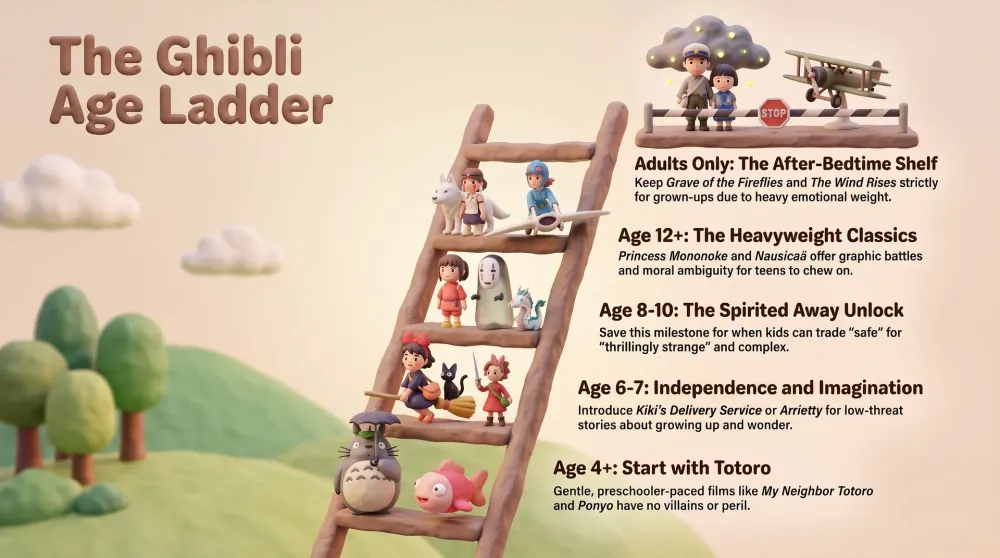
TL;DR – The Ghibli age ladder
Below: all 24 hand-drawn Ghibli films sorted into age bands — based on watching them with actual children, not on reading rating labels.
🍿 Why Ghibli is the best family catalog — With caveats
Studio Ghibli has a reputation as the gold standard of family cinema, and it is largely deserved: no cynical merchandise plots, no pop-culture references that expire in three years, and child characters written as actual people. When our complete Ghibli tier ranking calls the catalog dud-free, that includes the kids’ end of it.
But “family studio” does not mean “every film is for every kid.” The same catalog that contains the gentlest preschooler film ever made also contains a war drama that will wreck a forty-year-old. Ghibli never talks down to children — which is exactly why some of its films assume a viewer who can sit with sadness, ambiguity, or a decapitation. The age bands below come from one household’s worth of real testing: which films held a four-year-old, which ones prompted the “is she going to be okay?” hand-squeeze, and which ones we quietly saved for later.
One general note: even the family-friendly end of the catalog deals in genuinely serious themes — illness, loss, war, growing up — so a little parental caution pays off across the board, not just at the obvious heavyweights. And these bands are our judgment calls as parents, not official certifications — you know your own kid’s scare threshold better than any list. Sensitive kids may need a year or two more on everything below; fearless ones will negotiate you down. That is what the pause button is for.
🧸 Around 4+: The first Ghibli films
My Neighbor Totoro (1988) is the answer to “where do we start?” — full stop. Two sisters, a house in the countryside, and a forest spirit shaped like the concept of a nap. There is no antagonist. The scariest thing in the film is a mother being ill in hospital, handled with more care than most dramas manage. It runs at toddler pace in the best way, and the Catbus alone buys you fifty rewatches.
Ponyo (2008) is the other true preschooler pick: a goldfish girl who wants to be human, a tsunami of hand-drawn water, and an energy level that matches a five-year-old’s. In our tier ranking it’s a 3.5/5, Tier 3 — for the adults it lacks the deeper layers — but for its actual target audience it is a straight masterpiece.
My Neighbors the Yamadas (1999) works surprisingly well here too: it is a series of comic-strip family sketches rather than one story, so short attention spans can dip in and out. Nobody’s favorite film, everybody’s easy Tuesday.
🚲 Around 6-7: Small stakes, big imagination
Kiki’s Delivery Service (1989) is the perfect step-up: a young witch moves to the city alone to start her delivery business, loses her confidence, and earns it back. Mild peril, a sarcastic cat, and — bonus for the adults in the room — the most honest film about burnout ever aimed at children.
Arrietty (2010) is a 4.5/5 Tier 1 essential in our ranking, and this is the age where it detonates: tiny people living under the floorboards, borrowing sugar cubes and pins. Expect a week of your kids checking behind the skirting boards. Low threat, enormous imagination payoff.
The Cat Returns (2002) is short, silly, and frictionless — a girl saves a cat and gets abducted into a cat kingdom for her trouble. And Castle in the Sky (1986) brings the first real adventure energy: sky pirates, a floating city, actual gunfire and chase peril, but always in classic adventure-movie register. Late in this band, or early in the next for careful kids.
🐉 Around 8-10: Where Ghibli gets big
Spirited Away (2001) is the milestone. It is the best all-round entry point in the catalog — one of our five 4.5/5 Tier 1 essentials — but the opening act genuinely unsettles younger kids: Chihiro’s parents transform into pigs, and No-Face is nightmare fuel for the under-seven crowd. From around eight, that same strangeness flips from scary to thrilling. This is the single most rewarding “you are old enough now” unlock in family cinema.
Howl’s Moving Castle (2004) lands in the same window: a girl cursed into an old woman, a war humming in the background, and Calcifer the fire demon doing damage control. Kids follow the adventure; you get the anti-war melancholy underneath.
This band also carries Whisper of the Heart (1995) — the definitive film about a kid figuring out what she wants to become, ideal just before the teen years — plus Pom Poko (1994), Takahata’s shape-shifting tanuki resistance epic, which is wonderful, deeply weird, and will require you to field at least one anatomy question you did not plan for. When Marnie Was There (2014) and The Tale of the Princess Kaguya (2013) fit here too for emotionally sturdy kids: both are slow, sad, and beautiful — Kaguya’s ending quietly guts the parents in the room more than the kids.
⚔️ Around 12+: The heavyweights
Princess Mononoke (1997) is essential — and it earns the wait. Battles with graphic violence, and a conflict where the “villain” is building a home for outcasts while the “heroes” fight for a forest: there is no side to root for, which is exactly the point a twelve-year-old is ready to chew on. Nausicaä of the Valley of the Wind (1984) pairs with it: a poisoned world, war on all sides, and one of animation’s great heroines.
The Boy and the Heron (2023) belongs here for its density more than its content — it is Miyazaki on grief and legacy, and it demands a viewer willing to not understand everything on the first pass. The teen-romance wing — Ocean Waves (1993), From Up on Poppy Hill (2011), Only Yesterday (1991) — works from the early teens, when watching people navigate feelings becomes interesting instead of boring. Tales from Earthsea (2006) and The Red Turtle (2016) round out the band: nothing shocking, just pacing and abstraction that younger kids bounce off.
🌙 After bedtime: The dad-only shelf
Two films stay off the family list entirely — not because they are lesser, but because they are aimed at you. Grave of the Fireflies (1988) follows two children through wartime Japan and is, without competition, the saddest film we have ever finished. Watch it once; you will never argue that animation is a kids’ medium again. The Wind Rises (2013) — a 4.5/5 Tier 1 essential in our ranking — is a biographical drama about an engineer whose planes become weapons: nothing graphic, everything heavy. Porco Rosso (1992) sits half on this shelf too; kids can watch it, but its midlife melancholy is a frequency only adults receive.
📋 The age ladder at a glance
| Age Band | Start With | Then Add | Save for Later |
|---|---|---|---|
| Around 4+ | My Neighbor Totoro | Ponyo, The Yamadas | Everything with real peril |
| Around 6-7 | Kiki's Delivery Service | Arrietty, The Cat Returns, Castle in the Sky | Spirited Away (close, not yet) |
| Around 8-10 | Spirited Away | Howl's Moving Castle, Whisper of the Heart, Pom Poko | Mononoke, Nausicaä |
| Around 12+ | Princess Mononoke | Nausicaä, The Boy and the Heron, the teen romances | — |
| Adults only | Grave of the Fireflies | The Wind Rises | Nothing — you made it |
Read the table as a ladder, not a law: every kid climbs at a different speed, and a film that was too much at six is often the favorite at eight. The only hard rule in our house is at the bottom row.
🧭 The dad decision framework
Youngest kid is under five: Totoro tonight, Ponyo next week, and resist the urge to skip ahead — the big films are better when they are earned.
Mixed ages on the couch: Kiki, Arrietty, or Castle in the Sky hit the widest band — enough wonder for the small ones, enough story for the big ones.
Your kid scares easily: shift every band up a year and preview Spirited Away’s first twenty minutes yourself. The pig scene is the gate.
Kids are finally asleep: Grave of the Fireflies or The Wind Rises, and our full Ghibli tier ranking for what to queue after that.
Ghibli is unusually well suited to a ladder like this, but the underlying question follows a family everywhere. Every Dadnology age guide is collected in one index for when the next one is about Harry Potter, a Marvel film, or something a friend has on their console.
Pros
- A genuine ladder: there is a perfect Ghibli film for every age from four to adult
- Child characters written as real people — no talking-down, no toy-commercial plots
- The gentle films are genuinely gentle: Totoro and Ponyo have zero fast-forward scenes
- High-quality official English dubs make every film accessible before reading age
Cons
- The catalog's reputation as universally kid-safe is wrong — two films are strictly adult viewing
- Spirited Away and Mononoke are routinely shown too early and scare kids off Ghibli
- Streaming availability shifts by region, so the ladder is easiest to climb on Blu-ray
The bottom line
Ghibli is the rare catalog a family can grow up inside: start at four with Totoro, add a rung every year or two, and by the teen years you are watching Mononoke together and arguing about it afterwards — which is the whole point.
Our pick: My Neighbor Totoro on Blu-ray as the family’s first Ghibli disc, with Kiki’s Delivery Service queued up for the moment they are ready for a little independence.
For the stretches between Ghibli nights, an Amazon Kids+ subscription gives the kids a parent-controlled library of shows, books, and apps — screen time you do not have to hover over.
What is the best first Studio Ghibli movie for a young child?
Is Spirited Away too scary for kids?
Can kids watch Princess Mononoke?
Is Grave of the Fireflies a family movie?
Do Studio Ghibli movies work in English for kids?
Keep this in your inbox
One email a week: what we actually watched, built and reviewed — the stuff worth a dad's time. No hype, no daily spam.
Dadnology Weekly
One email a week: the LEGO, gaming and movie news worth a dad's time — plus what we actually reviewed. No hype, no daily spam.
Disclaimer: This review and its visuals were created with the help of AI. Some links may be affiliate links – we may earn a commission if you make a purchase, at no extra cost to you.
Current deals in Movies & TV
Verified live discounts tracked on Amazon
![The Legend of Korra — The Complete Series [Blu-ray]](https://m.media-amazon.com/images/I/51+1TXyb7aL._SL500_.jpg)
The Legend of Korra — The Complete Series [Blu-ray]
Korra's complete run on disc — the older, thornier follow-up to Airbender, best watched after it.
Price as of Oct 9, 09:13 PM UTC. Subject to change.

Zack Snyder's Justice League (4K Ultra HD)
The version you should actually watch. Four hours, properly realized. Get both to understand the full story.
Price as of Oct 9, 09:14 PM UTC. Subject to change.

Space Jam (4K Ultra HD + Digital)
The 4K restoration actually looks pretty great — the live-action footage and the Toon World animation both benefit from the upgrade.
Price as of Oct 9, 09:14 PM UTC. Subject to change.