
Sunshine review: A hypnotic and visually staggering journey into the heart of the sun
A review of the 2007 sci-fi epic Sunshine. A visually stunning, atmospheric space thriller that pushes the limits of HDR.
This post contains affiliate links. We may earn a commission if you make a purchase, at no extra cost to you. As an Amazon Associate, Dadnology earns from qualifying purchases.
🌪️ This review is part of the Top 30 Natural Disaster Movies – see where every disaster movie lands in our definitive ranking.
At Dadnology, we appreciate a movie that isn’t afraid to take a big swing. Sunshine is a standout because it creates an atmosphere so dense you can practically cut it with a knife.
Released in 2007, it features Cillian Murphy—long before his Oppenheimer fame—as the physicist carrying the weight of the world’s survival on his shoulders. While it starts as a methodical scientific mission, its evolution into a psychological thriller makes it a fascinating 3.5/5 experience that every disaster fan should witness at least once.
1. The crew: Specialists under pressure
Boasting a cast including Cillian Murphy, Chris Evans, Rose Byrne, and Michelle Yeoh, the crew of the Icarus II feels like a genuine community of experts. There are no traditional action heroes here—just human beings who are tired, afraid, and breaking under the immense pressure of their mission.
The dynamic between Capa (Murphy), the thoughtful scientist, and Mace (Evans), the pragmatic engineer, is the heart of the film. For us dads, it’s a masterclass in team leadership under extreme conditions. Watching how they handle failure and conflict while the clock is ticking for humanity is genuinely compelling.
2. The Icarus II: A technical jewel
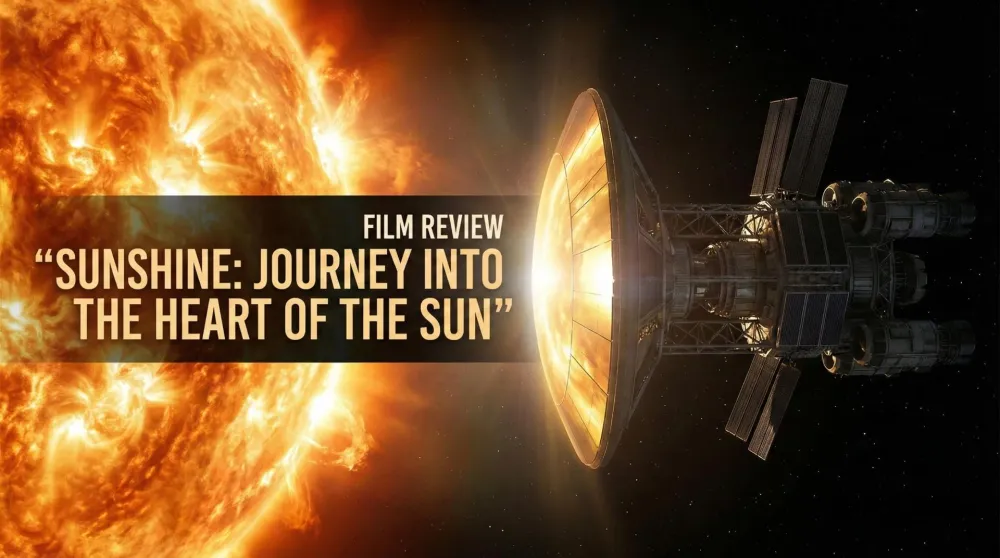
The design of the spacecraft is legendary. It features a massive heat shield of golden reflectors at the front, protecting the fragile living modules behind it. The Icarus II feels functional yet monumental—a temple built to face a god.
Visually, this film is a feast for HDR lovers. When the shields reflect the sun, the screen practically explodes with light. Boyle uses color—gold, orange, and deep blue—to mirror the psychological state of the crew. Every frame of this movie feels like a painting, making it a “genial” choice for showing off a high-end display.
| Character | Role | The 'Dad' Rating |
|---|---|---|
| Robert Capa | The Physicist | 9/10 - Must ignite the bomb and keeps his cool. |
| Mace | The Engineer | 10/10 - Does what needs to be done without sentimentality. |
| Corazon | The Botanist | 8/10 - Michelle Yeoh maintains the ship's 'lungs'—the oxygen garden. |
| Kaneda | The Captain | 9/10 - Leads the crew with dignity into the inevitable. |
3. The home theater workout: An acoustic glow
The sound of Sunshine is just as vital as the imagery. It utilizes dynamic range and silence to tell a story of cosmic isolation.
- The Silence of Space: Boyle uses silence effectively to make the vacuum of space feel tangible and oppressive.
- The Soundtrack: The score by John Murphy and Underworld is one of the best in sci-fi history. It builds a melancholy yet epic mood that carries the emotional weight of the mission.
4. The shift: When light becomes Madness
Without spoiling too much, the final third of the movie undergoes a significant genre shift. What starts as a “Hard Sci-Fi” drama becomes a psychological slasher-thriller. This is exactly why the film earns a 3.5/5—it’s a divisive choice that many fans still debate today.
However, even in this chaos, Boyle never loses visual control. The theme of human hubris—the idea of getting too close to the sun—is carried to its logical (and terrifying) end. It’s a bold finale that separates Sunshine from standard Hollywood disaster tropes.
5. The survival lesson: The power of focus
What can we learn from Sunshine? While knowledge and preparation are vital, ultimately, the will to take the final step is what saves the world. Capa isn’t a fighter, but his mental focus is his ultimate weapon.
For the dads in our community, it’s a film that reminds us that we sometimes have to look into the blinding light to appreciate the warmth of the home we left behind. It’s a hypnotic journey that will stay in your mind long after the credits roll.
6. Danny Boyle’s genre-bending gamble
Sunshine is the work of one of cinema’s most restless directors. Danny Boyle had already hopped genres with abandon — heroin drama (Trainspotting), zombie horror (28 Days Later), and soon-to-come feel-good crowd-pleaser (Slumdog Millionaire) — and here he turned his eye to hard sci-fi. The result has Boyle’s fingerprints all over it: kinetic visuals, an immersive electronic-orchestral score (the now-iconic “Adagio in D Minor” debuted here), and a willingness to follow his ideas somewhere genuinely uncomfortable. To ground the science, he brought on physicist Brian Cox as a consultant, lending the oxygen-depletion and gravity sequences real credibility even as the premise stays fantastical.
The cast is a fascinating time capsule, too. This is Cillian Murphy years before his Oscar-winning turn in Oppenheimer, and Chris Evans the year before Captain America made him a superhero icon — both doing grounded, sweaty, fearful work here. Rose Byrne, Michelle Yeoh, and Hiroyuki Sanada round out a genuinely international ensemble. Watching it now, with hindsight on those careers, adds an extra layer of interest to an already rich film.
7. A flawed visual masterpiece
The single most-debated thing about Sunshine is its third act, when the meticulous hard-sci-fi drama abruptly becomes something closer to a psychological slasher film. It’s the reason the movie splits audiences and critics down the middle, and it’s the main thing keeping it at a 3.5/5 rather than higher in our rankings. Some find the shift a thrilling, hubris-themed escalation; others feel it betrays the cerebral film that preceded it. Both views are defensible, and you should know the swerve is coming before you press play.
But even those frustrated by the finale tend to agree on one thing: Sunshine is a staggering audio-visual achievement. The design of the Icarus II, the way Boyle weaponizes light and silence, and that unforgettable score make it one of the great sci-fi sensory experiences — a genuine reference disc for testing a high-end display and sound system. It’s a gorgeous, ambitious, imperfect film, and that combination makes it well worth a watch for any serious genre fan. It aims for the sun and, even when it stumbles, the view is spectacular.
Pros
- Staggering, reference-quality visuals and use of light
- An iconic, evocative score (John Murphy and Underworld)
- A fascinating pre-fame cast: Cillian Murphy and Chris Evans
- Brian Cox–consulted physics grounds the cerebral first two acts
- Bold, ambitious, and genuinely unlike other space disaster films
Cons
- The divisive third-act 'slasher' shift loses many viewers
- R-rated and intense — not a family watch
- Cerebral and slow-building for action-hungry audiences
The final verdict
Sunshine is a mandatory 3.5/5 experience. It is visually revolutionary, acoustically perfect, and narratively daring. Even if the finale isn’t for everyone, it remains a milestone of modern sci-fi. Grab a blanket (it gets cold in deep space) and enjoy this trip into the heart of our existence.
Who is it for? This is the disaster movie for sci-fi devotees who prize atmosphere, ideas, and visual splendor over conventional action — and who don’t mind a polarizing finale. If you love cerebral, mood-driven space films and you’ve got a home theater worth showing off, Sunshine is essential, flaws and all. It’s an R-rated, psychologically intense watch, so it’s strictly an adults-only affair, not a family pick. Go in for the journey rather than the destination, brace for that third-act swerve, and you’ll find one of the most beautiful and daring sci-fi films of its era.
There’s also a lovely thematic resonance for the Dadnology crowd buried in the premise. Sunshine is, at its core, a film about a small group of people sacrificing everything so that the next generation might live to see another sunrise — quite literally, in this case, the rekindling of the sun itself. That idea of quiet, selfless sacrifice for a future you may not be part of runs through so many of the best films in our rankings, from Deep Impact to Armageddon, and Sunshine renders it more beautifully than almost any of them. It’s a reminder that even the most cerebral, art-house corner of the disaster genre can hit the same primal, paternal nerve as the loudest blockbuster. For the right viewer, it lingers for days — a strange, golden, melancholy dream of a film that, like the sun itself, is impossible to look at directly for too long, yet impossible to forget. Few films in the genre aim this high, and even fewer leave you thinking this hard about your place in the universe.
📺 Movie night sorted: thousands of films and shows are streaming on Prime Video — free for 30 days. Worth a look before you buy the disc.
Related Dadnology review: The Core Review
Why is the ship called Icarus II?
Is the soundtrack famous elsewhere?
How scientific is the film?
Keep this in your inbox
One email a week: what we actually watched, built and reviewed — the stuff worth a dad's time. No hype, no daily spam.
Dadnology Weekly
One email a week: the LEGO, gaming and movie news worth a dad's time — plus what we actually reviewed. No hype, no daily spam.
Disclaimer: This review and its visuals were created with the help of AI. Some links may be affiliate links – we may earn a commission if you make a purchase, at no extra cost to you.
Current deals in Movies & TV
Verified live discounts tracked on Amazon
![The Legend of Korra — The Complete Series [Blu-ray]](https://m.media-amazon.com/images/I/51+1TXyb7aL._SL500_.jpg)
Movies & TV · Tested by Dadnology
The Legend of Korra — The Complete Series [Blu-ray]
4.5/5“A new Avatar, a modern city, a masked revolution”Read our review
Movies & TV · Tested by Dadnology
Zack Snyder's Justice League (4K Ultra HD)
4/5“Four hours. One vision. This is the film.”Read our review
Movies & TV · Tested by Dadnology
Space Jam (4K Ultra HD + Digital)
4/5“It's gonna be a whole new ball game”Read our reviewYou might also like
Dante’s Peak: Why this 90s volcano classic is the ultimate lesson in geological peril
Dante’s Peak is a 4/5 blast of nostalgia and heat. It perfectly captures the 'slow-burn' dread of a natural disaster before exploding into a chaotic, ash-drenched escape. With Pierce Brosnan bringing peak charisma and some of the best practical miniature work of the decade, it remains the king of the volcano sub-genre.
The Impossible: Why this heartbreaking true story is the gold standard for tsunami cinema
The Impossible is a 4/5 emotional juggernaut. It features one of the most terrifyingly realistic disaster sequences ever filmed, followed by a deeply moving exploration of human resilience. With incredible performances and a focus on the 'impossible' odds of survival, it is a mandatory, albeit difficult, watch.
The 10 best natural disaster movies of all time: The Dadnology elite
A perfect 5/5 collection. If you only have time for the legends, start here. This list features the most visceral sound design, the most heartbreaking sacrifices, and the best 'Dad-trucks' ever put on screen. These aren't just movies; they are experiences.