
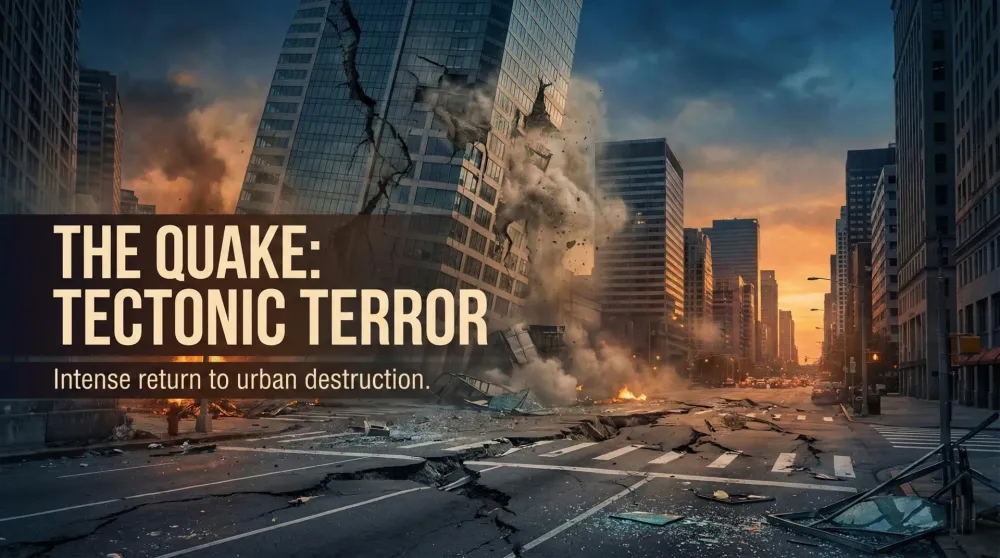
The Quake review: Norway's intense and claustrophobic return to tectonic terror
A review of the 2018 Norwegian hit The Quake. A bone-shaking, intense look at urban destruction and survival.
This post contains affiliate links. We may earn a commission if you make a purchase, at no extra cost to you. As an Amazon Associate, Dadnology earns from qualifying purchases.
🌪️ This review is part of the Top 30 Natural Disaster Movies – see where every disaster movie lands in our definitive ranking.
At Dadnology, we appreciate a sequel that doesn’t just copy the original. The Quake is a standout because it changes the stakes from a “nature” problem to an “urban” nightmare. It’s less about the water and more about the concrete.
Released in 2018, The Quake (or Skjelvet) brought back our favorite “Expert Dad,” Kristian Eikjord. But this time, he’s a man living on the edge of a breakdown. It’s a movie that proves lightning (or tectonic plates) can indeed strike twice, provided you’re prepared for a darker, more somber tone.
1. The haunted dad: Kristian’s PTSD
Kristoffer Joner returns as Kristian, and he looks like he hasn’t slept since the events of The Wave in 2015. He’s separated from his wife, living alone in a dark house covered in seismic charts. He is the Dadnology “Cassandra”—the man who sees the truth but is ignored because of his past trauma.
This is a deeper look at the disaster hero. He isn’t out there being “The Rock”; he’s a man terrified that he can’t save his family again. When he heads to Oslo to warn them, his desperation is palpable. Watching him try to reconnect with his daughter while the ground starts to move is the emotional engine that drives the film, even when the pacing feels a bit slow in the first hour.
2. Vertical terror: The Plaza Hotel sequence
The final act of The Quake is set almost entirely in and around a high-rise hotel in Oslo. As the skyscraper begins to lean and collapse, director John Andreas Andersen creates some of the most effective “vertical” tension in modern cinema.
The sequence in the glass elevator and the scene where characters have to crawl across a floor that is suddenly at a 45-degree angle are absolute nail-biters. It captures the “Rule of Instability”—the feeling that even the strongest structures are just glass and cards when the earth moves. For anyone with a fear of heights, this section is genuinely hard to watch.
| Character | Role | The 'Dad' Rating |
|---|---|---|
| Kristian Eikjord | Geologist / Broken Hero | 10/10 - His obsession is his curse and his family's only hope. |
| Idun Eikjord | The Strong Wife | 9/10 - Working in the city, she has to face the terror head-on. |
| Julia Eikjord | The Daughter | 10/10 - Her bond with her father is the heart of the rescue mission. |
| Konrad Lindblom | The Scientist Friend | 8/10 - His death is the catalyst that proves Kristian was right. |
3. Atmospheric authority: Testing the sound of the shift
If you have a high-end sound system or a dedicated subwoofer like the SVS SB-1000 Pro, The Quake is a legendary test for your gear.
- The Low End: The initial tremor and the eventual ‘Big One’ are designed to move the air in your room. It’s a deep, sustained rumble that will test your sub’s excursion and distortion.
- The Atmosphere: The sound of the building ‘groaning’—the metal twisting and the concrete cracking—is a masterclass in foley work. A good Atmos setup will make those sounds feel like they are coming from the very structure of your house.
4. Practical vs. Digital: The Norwegian touch
What makes The Quake earn its spot on our list is the tactile quality of the destruction. Like its predecessor, the film uses a mix of incredible CGI and massive practical sets. When the hotel room tilts, you can feel the weight of it.
The film operates on the “Rule of Consequence”. Every movement has weight, and every fall is dangerous. It avoids the ‘action-hero’ invincibility of Hollywood, showing Kristian as a man who is physically and mentally pushed to his limit. It makes the eventual survival feel earned rather than scripted, which is a hallmark of Scandinavian disaster cinema.
5. The survival lesson: The weight of knowledge
Watching The Quake is a reminder that being prepared isn’t just about kits and supplies—it’s about paying attention to the signs. It celebrates the “scientist dad” while acknowledging the toll that such a heavy responsibility can take on a family.
For a dad, it’s a lesson in persistence. Even when everyone thinks he’s crazy, Kristian stays true to the data because he knows the stakes. It earns its 3.5/5 because it’s a slower, more emotional burn than some of the higher-rated films on our list, but its final act is a mandatory experience for disaster fans.
6. Scandinavian disaster done right
The Quake is part of a quietly excellent trend: the rise of the Norwegian disaster movie. Following the surprise international success of The Wave (2015), Norway proved it could do the genre as well as Hollywood — and arguably better in one key respect. Where American blockbusters tend toward maximalist spectacle and indestructible heroes, the Scandinavian approach is grounded, restrained, and human-scaled. The destruction is just as impressive (the practical, tilting hotel sets here are extraordinary), but the people inside it are recognizably ordinary, frightened, and fallible. It’s disaster cinema with the volume turned down on the bombast and up on the dread.
That sensibility is the franchise’s secret weapon, and it’s anchored by continuity most disaster films don’t bother with. Kristoffer Joner returns as Kristian, and The Quake takes the bold step of treating the events of the first film as genuine, lingering trauma. This Kristian isn’t a swaggering action hero ready for round two; he’s a haunted, isolated man whose PTSD has cost him his marriage. Building a sequel around a protagonist’s psychological scars rather than just a bigger disaster is a genuinely mature choice, and it gives the film an emotional weight its Hollywood counterparts rarely attempt.
7. A worthy, bleaker sequel
Does The Quake match The Wave? It’s close, and which you prefer largely comes down to taste. The Wave is leaner and more relentless once its tsunami hits; The Quake is slower to build but arguably more ambitious, trading the open fjords for the vertigo-inducing claustrophobia of a collapsing Oslo high-rise. That final act — the leaning skyscraper, the glass elevator, the 45-degree floors — is a masterclass in vertical tension that genuinely rivals anything in the genre. If you can get through the deliberate first hour, the payoff is enormous.
The 3.5/5 reflects that trade-off honestly: this is a slower, heavier, more emotionally taxing watch than the popcorn spectacles higher on our list, and it’s very much a “one-and-done” experience for most viewers rather than a comfort rewatch. But for fans who value grounded realism, genuine stakes, and a disaster hero who feels like an actual person, The Quake is essential. It’s proof that the genre still has fresh, intelligent things to say when filmmakers treat it seriously.
Pros
- A genuinely mature sequel built around real, lingering trauma
- An extraordinary, vertigo-inducing collapsing-skyscraper finale
- Grounded, human-scaled Scandinavian realism over Hollywood bombast
- Kristoffer Joner's haunted, committed lead performance
- Reference-grade rumble and structural-groan sound design
Cons
- A slow, deliberate first hour before the payoff
- Bleak and emotionally taxing — very much a 'one-watch' film
- Subtitled, which some casual viewers may resist
The final verdict
The Quake is an intense, vertical thriller that delivers bone-shaking realism. It trades the wide fjords for a high-altitude urban nightmare, making it a worthy follow-up to The Wave. While the emotional weight makes it a “one-watch” film for many, the technical execution is undeniable.
Who is it for? This is the disaster movie for viewers who prefer grounded, character-driven European realism over Hollywood spectacle — the same crowd that appreciates the restraint of Everest or Greenland. If you don’t mind subtitles and a slow build, and you want a sequel that’s genuinely about something (trauma, persistence, the cost of being right), The Quake delivers a knockout final act. It’s a teens-and-up watch given the intense peril, and best saved for a focused evening rather than casual background viewing. Pair it with The Wave for a superb Norwegian disaster double bill that puts most Hollywood efforts to shame. It’s a quiet reminder that the genre doesn’t always need a bigger explosion — sometimes it just needs a director brave enough to slow down, make us care, and then pull the floor out from under us. When The Quake finally lets its skyscraper fall, you’ll feel every inch of the drop — and you’ll understand why Norway, not Hollywood, has quietly become one of the most reliable sources of intelligent disaster cinema.
📺 Movie night sorted: thousands of films and shows are streaming on Prime Video — free for 30 days. Worth a look before you buy the disc.
Is The Quake a direct sequel to The Wave?
Why is it a 3.5/5 instead of a 5/5?
Is the elevator scene real?
Keep this in your inbox
One email a week: what we actually watched, built and reviewed — the stuff worth a dad's time. No hype, no daily spam.
Dadnology Weekly
One email a week: the LEGO, gaming and movie news worth a dad's time — plus what we actually reviewed. No hype, no daily spam.
Disclaimer: This review and its visuals were created with the help of AI. Some links may be affiliate links – we may earn a commission if you make a purchase, at no extra cost to you.
Current deals in Movies & TV
Verified live discounts tracked on Amazon
![The Legend of Korra — The Complete Series [Blu-ray]](https://m.media-amazon.com/images/I/51+1TXyb7aL._SL500_.jpg)
Movies & TV · Tested by Dadnology
The Legend of Korra — The Complete Series [Blu-ray]
4.5/5“A new Avatar, a modern city, a masked revolution”Read our review
Movies & TV · Tested by Dadnology
Zack Snyder's Justice League (4K Ultra HD)
4/5“Four hours. One vision. This is the film.”Read our review
Movies & TV · Tested by Dadnology
Space Jam (4K Ultra HD + Digital)
4/5“It's gonna be a whole new ball game”Read our reviewYou might also like
San Andreas: Why Dwayne Johnson’s earthquake epic is the ultimate 4/5 popcorn spectacle
San Andreas is a 4/5 explosion of pure cinematic fun. It trades scientific realism for massive scale and 'The Rock's' undeniable charisma. With some of the most impressive earthquake sequences ever filmed and a heart-pounding tsunami finale, it is a mandatory watch for anyone who loves a good old-fashioned disaster blockbuster.
Dante’s Peak: Why this 90s volcano classic is the ultimate lesson in geological peril
Dante’s Peak is a 4/5 blast of nostalgia and heat. It perfectly captures the 'slow-burn' dread of a natural disaster before exploding into a chaotic, ash-drenched escape. With Pierce Brosnan bringing peak charisma and some of the best practical miniature work of the decade, it remains the king of the volcano sub-genre.
The tectonic terror collection: Earthquakes, volcanoes, and the moving ground
An explosive 4/5 category. Tectonic disaster films offer some of the best 'vertical' tension in cinema. These films are the ultimate test for your subwoofer and your nerves. If you like your movies loud and grounded in geological peril, start here.