
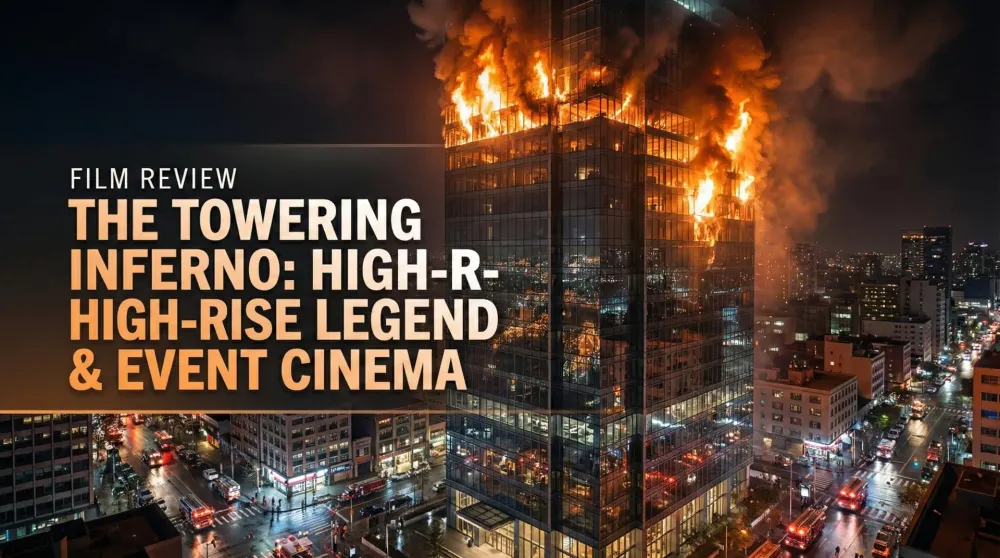
The Towering Inferno review: The high-rise legend that defined event cinema
A review of the 1974 classic The Towering Inferno. A star-studded race against the flames in the world's tallest building.
This post contains affiliate links. We may earn a commission if you make a purchase, at no extra cost to you. As an Amazon Associate, Dadnology earns from qualifying purchases.
🌪️ This review is part of the Top 30 Natural Disaster Movies – see where every disaster movie lands in our definitive ranking.
At Dadnology, we love a movie that respects the professionals. The Towering Inferno is a legend because it doesn’t just show a disaster—it shows the technical process of trying to stop it.
Released in 1974, it was the first ever co-production between major studios (Warner Bros. and 20th Century Fox) because the project was simply too big for one house to handle. It stands as a 3.5/5 giant on our list—a mandatory watch for its star power and practical scale.
1. The dynamic duo: O’Hallorhan and Doug
The movie works because of the mutual respect between Steve McQueen (Chief O’Hallorhan) and Paul Newman (Doug Roberts). Doug is the architect who designed the building, while O’Hallorhan is the fire chief who has to deal with the sabotage caused by corporate corner-cutting.
This is the Dadnology “Competence Goal.” Neither man wastes time on blame; they immediately get to work. McQueen brings a gritty, no-nonsense authority to the chief, famously insisting on doing his own stunts. Newman provides the moral weight, playing a man watching his dream become a graveyard. Their chemistry is the anchor of this three-hour epic.
2. Practical spectacle: 70s firepower
What earns The Towering Inferno its spot on our list is the unrivaled stunt work. In an era before digital effects, seeing a man on fire meant a stuntman was actually on fire. The production utilized over 50 sets, several of which were actually burned to the ground for the final sequences.
The Water Tank Finale is one of the most famous endings in cinema history. To douse the flames, they have to blow the massive water tanks at the summit. On a high-quality display, the sheer volume of water rushing through the sets is staggering. It captures the “Rule of Weight”—water and fire are treated as physical, heavy elements that have real consequences for the characters.
| Character | Role | The 'Dad' Rating |
|---|---|---|
| Chief O'Hallorhan | Fire Chief / Legend | 11/10 - Does the job, saves the day, and looks cool in a helmet. |
| Doug Roberts | Architect / The Mind | 10/10 - Takes responsibility and stays to help. |
| Susan Franklin | The Lead | 9/10 - Faye Dunaway brings grace and grit to the chaos. |
| James Duncan | The Builder | 4/10 - William Holden as the guy who let greed win. |
3. The home theater workout: Roar and rumble
For a film from 1974, the sound design on the remastered Blu-ray is remarkably effective for modern setups.
- The Low End: The sound of the initial gas explosion and the eventual thundering rush of the water tanks provide excellent low-frequency tests for your subwoofers.
- Atmospheric Pressure: The constant crackling of fire and the mechanical groans of the elevators create a surround-sound environment of constant peril. Floor-standing speakers like the Sony SS-CS3 help give the fire the “size” it needs.
4. The survival lesson: Infrastructure and integrity
The Towering Inferno is the ultimate cautionary tale about cutting corners. It teaches us that no matter how beautiful the building, it’s only as good as the wiring behind the walls. For a dad, it’s a reminder to always check the basics—infrastructure matters.
The film celebrates the “Code of the Professional.” It shows that when things go wrong, clear communication and expert knowledge are the only things that save lives. It earns its 3.5/5 because while it’s a long watch, it is a masterclass in building tension and respecting the people who do the hard work of safety.
5. Legacy: The blueprint for the high-rise thriller
Watching this today, you can see the DNA of Die Hard, Skyscraper, and every other high-rise thriller that followed. It set the bar for how to handle an ensemble cast and how to make a building feel like a living, breathing antagonist.
For the Dadnology crew, it’s a “Genial” classic that belongs in the foundation of your collection. It asks a question every father has thought about in a skyscraper: “What would I do if the only way down was through the fire?”
6. The birth of the all-star disaster epic
To understand The Towering Inferno, you have to understand Irwin Allen — the producer dubbed the “Master of Disaster,” who essentially invented the 1970s disaster-epic template. Two years after his smash hit The Poseidon Adventure, Allen topped himself with this one, and in doing so codified the formula every disaster movie since has followed: take a confined setting, fill it with a sprawling cast of recognizable stars (each with their own little subplot), introduce a catastrophe, and let the all-star ensemble get picked off one dramatic set piece at a time. It was “event cinema” before the term existed.
The film’s behind-the-scenes story is as legendary as the movie itself. It was the first-ever co-production between rival studios Warner Bros. and 20th Century Fox, because the source material (two competing novels) and the sheer budget were too big for one studio alone. The Steve McQueen–Paul Newman rivalry over top billing was so fierce that the credits use a famous staggered, diagonal layout so each star could be read as “first.” And the result wasn’t just a box-office juggernaut — it earned eight Academy Award nominations and won three, a level of prestige disaster movies almost never reach. This is the genre at its most ambitious and respectable.
7. A 50-year-old blueprint that still burns
What’s remarkable is how well The Towering Inferno holds up half a century on. In an age of weightless CGI, its commitment to practical effects gives it a tactile danger modern blockbusters can’t replicate — when you see flames and rushing water, you’re seeing real flames and real water tearing through real sets (several of which were genuinely burned down). That physical weight is exactly why it still grips, even at a hefty 165 minutes.
Its influence is everywhere, too. Watch it today and you’ll spot the DNA of Die Hard, Skyscraper, and every “trapped in a burning building” thriller since. The film’s central message — that corporate corner-cutting on safety has a body count — remains depressingly relevant, and its respect for the firefighters and professionals doing the dangerous work feels right at home in the Dadnology canon. It’s long, it’s old-fashioned, and it’s occasionally cheesy in that earnest 70s way, but it earns its 3.5/5 as a genuine cornerstone of the genre. They simply don’t build them — or burn them — like this anymore.
Pros
- Jaw-dropping, genuinely dangerous practical fire and water effects
- Legendary star pairing of Steve McQueen and Paul Newman
- The blueprint for every high-rise thriller since (Die Hard included)
- A still-relevant message about cutting corners on safety
- Oscar-winning craft; the disaster epic at its most prestigious
Cons
- A hefty 165-minute runtime with many subplots
- Some dated, earnest 70s melodrama and dialogue
- The ensemble-subplot structure slows the momentum at times
The final verdict
The Towering Inferno is a standout of classic disaster cinema. It brings together the greatest stars of its era for a technical showcase that still holds up 50 years later. It is the definitive story of human survival against the odds, and it earns its spot on our list with fiery authority.
Who is it for? This is the disaster movie for fans of classic, practical-effects filmmaking who appreciate where the whole genre came from. If you love old-school star power, real stunts, and slow-building tension over CGI spectacle — or you simply want to show the kids what a “disaster epic” meant before computers — it’s essential viewing. At a PG rating it’s one of the more family-friendly entries on our list (more peril than gore), though its three-hour length is a commitment best suited to a rainy-weekend afternoon. A monumental, foundational classic that still burns bright after 50 years.
It’s worth appreciating, too, just how much of modern blockbuster grammar this film quietly invented. The “ticking clock” structure, the cross-cutting between multiple imperiled groups, the noble rescue worker as action hero, the corporate villain whose greed causes the catastrophe — these are now such standard ingredients that we barely notice them, but The Towering Inferno was assembling the recipe in real time. For a dad introducing the next generation to the roots of the movies they already love, there’s genuine pleasure in pointing at the screen and saying “this is where all of that came from.” Five decades of imitators have made bigger, louder, and shinier fires, but few have matched the sheer craftsmanship and human stakes of the original blaze.
📺 Movie night sorted: thousands of films and shows are streaming on Prime Video — free for 30 days. Worth a look before you buy the disc.
What is the Glass Tower based on?
Did the stars really fight over who was first?
Why is the movie so long?
Keep this in your inbox
One email a week: what we actually watched, built and reviewed — the stuff worth a dad's time. No hype, no daily spam.
Dadnology Weekly
One email a week: the LEGO, gaming and movie news worth a dad's time — plus what we actually reviewed. No hype, no daily spam.
Disclaimer: This review and its visuals were created with the help of AI. Some links may be affiliate links – we may earn a commission if you make a purchase, at no extra cost to you.
Current deals in Movies & TV
Verified live discounts tracked on Amazon
![The Legend of Korra — The Complete Series [Blu-ray]](https://m.media-amazon.com/images/I/51+1TXyb7aL._SL500_.jpg)
Movies & TV · Tested by Dadnology
The Legend of Korra — The Complete Series [Blu-ray]
4.5/5“A new Avatar, a modern city, a masked revolution”Read our review
Movies & TV · Tested by Dadnology
Zack Snyder's Justice League (4K Ultra HD)
4/5“Four hours. One vision. This is the film.”Read our review
Movies & TV · Tested by Dadnology
Space Jam (4K Ultra HD + Digital)
4/5“It's gonna be a whole new ball game”Read our reviewYou might also like
Dante’s Peak: Why this 90s volcano classic is the ultimate lesson in geological peril
Dante’s Peak is a 4/5 blast of nostalgia and heat. It perfectly captures the 'slow-burn' dread of a natural disaster before exploding into a chaotic, ash-drenched escape. With Pierce Brosnan bringing peak charisma and some of the best practical miniature work of the decade, it remains the king of the volcano sub-genre.
The Impossible: Why this heartbreaking true story is the gold standard for tsunami cinema
The Impossible is a 4/5 emotional juggernaut. It features one of the most terrifyingly realistic disaster sequences ever filmed, followed by a deeply moving exploration of human resilience. With incredible performances and a focus on the 'impossible' odds of survival, it is a mandatory, albeit difficult, watch.
The 10 best natural disaster movies of all time: The Dadnology elite
A perfect 5/5 collection. If you only have time for the legends, start here. This list features the most visceral sound design, the most heartbreaking sacrifices, and the best 'Dad-trucks' ever put on screen. These aren't just movies; they are experiences.