
Star Wars Tales anthology – All three series reviewed
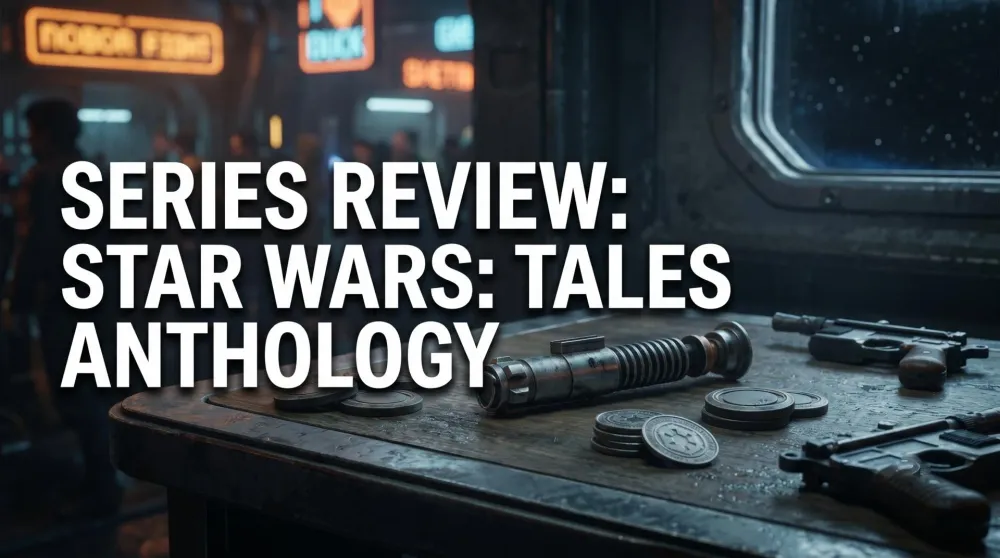
The complete Star Wars Tales anthology: Tales of the Jedi, Tales of the Empire and Tales of the Underworld reviewed. The best-kept secrets in animated Star Wars.
This post contains affiliate links. We may earn a commission if you make a purchase, at no extra cost to you. As an Amazon Associate, Dadnology earns from qualifying purchases.
The best-kept secret in animated Star Wars
🎨 This hub is part of our Star Wars Animated Hub — Clone Wars, Rebels, The Bad Batch and Maul, the best Star Wars storytelling there is.
There is a version of the Star Wars animated conversation where the Tales anthology does not get mentioned until someone has already worked through The Clone Wars, Rebels, The Bad Batch, and both Ahsoka series. And that is exactly the problem, because by the time most viewers arrive at these three collections of shorts — Tales of the Jedi, Tales of the Empire, Tales of the Underworld — they have been watching Star Wars animation for years and are in danger of treating the anthology as dessert rather than a main course.
Here is the reframe: the Tales anthology is not dessert. It is Dave Filoni at his most economical and precise, telling enormous stories in fifteen minutes per short and trusting his audience to bring the context that makes those stories land. The whole trilogy amounts to about four and a half hours of television. In those four and a half hours, Filoni covers Ahsoka’s origins and survival, Dooku’s fall to the dark side, Morgan Elsbeth’s rise as an Imperial power broker, Barriss Offee’s redemption, and the full moral range of Star Wars criminal operators — from Hondo Ohnaka’s principled piracy to Cad Bane’s cold professionalism.
The anthology format is not a compromise. For these stories, it is the right tool.
Series content
Explore all articles, reviews, and guides in this series.
Why short-form anthology is the right format for side characters
The central insight of the Tales anthology is that some of Star Wars’ most interesting characters are not interesting enough — or not positioned correctly — to carry a full series, but are far too rich to leave as background colour in someone else’s story.
Count Dooku’s fall to the dark side is one of the most consequential events in Star Wars, and yet the prequel films gave it approximately ninety seconds of screen time and a confusing conversation between him and Yoda. The Clone Wars expanded his role but never fully explored the idealism that curdled into tyranny. Tales of the Jedi gives him three fifteen-minute shorts and uses them to tell the most coherent, emotionally satisfying account of his fall the franchise has managed. Not because three shorts is the right length for a character arc — but because three focused, precise shorts are more powerful than a meandering season that loses the thread.
The same logic applies to every character in the trilogy. Ahsoka’s Order 66 survival, the moment that defines everything she becomes afterward, does not need eight episodes. It needs one extraordinary fifteen-minute short, and that is exactly what it gets. Barriss Offee’s redemption arc — for a character who had been a betrayer for over a decade of real-world Star Wars storytelling — is told across three shorts and lands with genuine emotional force because the format demands economy and economy produces precision.
Hondo Ohnaka and Cad Bane, both beloved Clone Wars characters, do not need full series (Hondo in particular risks diminishing returns at extended length). What they need is exactly what Tales of the Underworld gives them: concentrated bursts of full-magnificence, each short doing the character justice without exhausting what makes them special.
The three shows: What each brings
The Tales trilogy works as a complete portrait of the Star Wars galaxy from three complementary angles.
Tales of the Jedi (2022): The idealists
The first anthology explores Force-users at the edge of the Jedi Order — one holding the light against impossible odds, one losing it step by step. Ahsoka’s arc moves from her birth through her Clone Wars years to the survival of the galaxy’s darkest hour. Dooku’s arc moves from principled Jedi to Sith Lord in a tragedy that finally makes his prequel-era villainy make sense. Together, they ask what the Jedi Order does to its members — what it saves and what it sacrifices.
Rating: 4.5/5. The most emotionally precise entry in the trilogy.
Tales of the Empire (2024): The survivors
The second anthology turns the camera on life under Imperial rule. Morgan Elsbeth’s rise from a Nightsister orphan to a cold, calculating Imperial power broker gives the Ahsoka series’ villain a tragic backstory that deepens everything around her. Barriss Offee’s path through the Inquisitorius toward redemption rescues one of the franchise’s most controversial figures from permanent villain status. The Empire is the backdrop for both arcs, and what it does to people — how it hardens some and breaks others — is the shared thesis.
Rating: 4.5/5. The darkest and arguably most visually stunning entry.
Tales of the Underworld (2025): The operators
The third anthology steps away from Force users entirely and into the grey zones where Star Wars has always been most interesting. Hondo Ohnaka’s piratical pragmatism and Cad Bane’s cold professional excellence represent two very different criminal philosophies, both portrayed with full conviction. Less emotionally heavy than its siblings, more consistently entertaining, and the most accessible entry for viewers with less Star Wars background.
Rating: 4/5. The most fun of the three, and the right completion of the set.
Watch order and prerequisites
The Tales anthology is not an entry point into Star Wars animation — it is a companion piece that rewards prior investment. The full recommended approach:
The Clone Wars is the essential foundation for all three. Without Clone Wars, Ahsoka’s Order 66 short carries a fraction of its weight. Without Clone Wars, Dooku’s fall lacks the character establishment that gives it meaning. Without Clone Wars, Hondo Ohnaka and Cad Bane are strangers rather than beloved returning figures.
Rebels significantly enriches the Tales of the Empire experience — Morgan Elsbeth’s obsession with Grand Admiral Thrawn only makes sense in the context of Thrawn’s appearance in Rebels, and Barriss Offee’s redemption is richer for understanding what the Inquisitors were doing in that era.
Tales of the Underworld is the most standalone, but even here the Clone Wars background transforms what might read as entertaining strangers into beloved characters getting long-overdue spotlight moments.
The recommended sequence for the full experience: The Clone Wars, then Rebels, then Tales of the Jedi, then Tales of the Empire, then the Ahsoka series, then Tales of the Underworld. At that point, the anthology trilogy plays as the fully earned, richly connected companion it was designed to be.
Pros
- Three anthologies, each roughly 90 minutes — the most accessible time investment in Star Wars animation
- Dave Filoni at his most economical: huge stories told with genuine precision
- Covers Force-users, Imperial survivors, and criminal operators — a complete portrait of the galaxy
- Provides essential backstory for major characters in the Ahsoka series and Clone Wars
- The anthology format lets characters shine without the diminishing returns of a full series
- Tales of the Underworld completes the set with genuine wit and the galaxy's best pirate
Cons
- Not an entry point — requires prior animated Star Wars investment for full impact
- Each anthology is only 90 minutes — leaves you wanting more of characters who deserve it
- Tales of the Underworld sits a notch below its siblings on emotional weight
Build the saga: the Tales shows trace the Jedi-and-Sith character web — the LEGO Yoda Bust (75438) review is a fitting brick centrepiece for it.
The verdict: Four hours that earn their place
The Star Wars Tales anthology is what happens when a director who knows these characters deeply is given a format that rewards precision over scale. Three collections of shorts, each roughly 90 minutes, each more focused and more emotionally satisfying than most full streaming series manage in ten episodes.
Ahsoka’s survival of Order 66. Dooku’s tragic fall. Barriss Offee’s redemption. Hondo Ohnaka at full magnificent piratical brilliance. Cad Bane cold and precise. Together, they form a portrait of the Star Wars galaxy that the main shows — for all their scale — cannot quite achieve.
The collective rating is a 9. Not because every short is perfect, but because the anthology as a whole is one of the finest bodies of work in the animated Star Wars catalogue, and because four and a half hours is such a small commitment for everything it delivers.
The Final Word: Do the Clone Wars homework first. Then watch all three, in order, ideally in a single weekend. It is worth it.
Frequently asked questions
What is the Star Wars Tales anthology?
What order should I watch the Tales series?
Do I need to watch Clone Wars before Tales of the Jedi?
Are the Tales shorts canon?
Which Tales anthology is the best?
Keep this in your inbox
One email a week: what we actually watched, built and reviewed — the stuff worth a dad's time. No hype, no daily spam.
Dadnology Weekly
One email a week: the LEGO, gaming and movie news worth a dad's time — plus what we actually reviewed. No hype, no daily spam.
Disclaimer: This review and its visuals were created with the help of AI. Some links may be affiliate links – we may earn a commission if you make a purchase, at no extra cost to you.
Current deals in Movies & TV
Verified live discounts tracked on Amazon
![The Legend of Korra — The Complete Series [Blu-ray]](https://m.media-amazon.com/images/I/51+1TXyb7aL._SL500_.jpg)
Movies & TV · Tested by Dadnology
The Legend of Korra — The Complete Series [Blu-ray]
4.5/5“A new Avatar, a modern city, a masked revolution”Read our review
Movies & TV · Tested by Dadnology
Zack Snyder's Justice League (4K Ultra HD)
4/5“Four hours. One vision. This is the film.”Read our review
Movies & TV · Tested by Dadnology