
Jurassic Park (Novel) – The science thriller that changed everything
Before the blockbuster movie, there was the novel. Michael Crichton's masterpiece is a darker, deeper dive into chaos theory and genetic power.
This post contains affiliate links. We may earn a commission if you make a purchase, at no extra cost to you. As an Amazon Associate, Dadnology earns from qualifying purchases.
A masterpiece of science and terror: An in-depth review of Michael Crichton’s Jurassic Park
More than a movie, a literary landmark
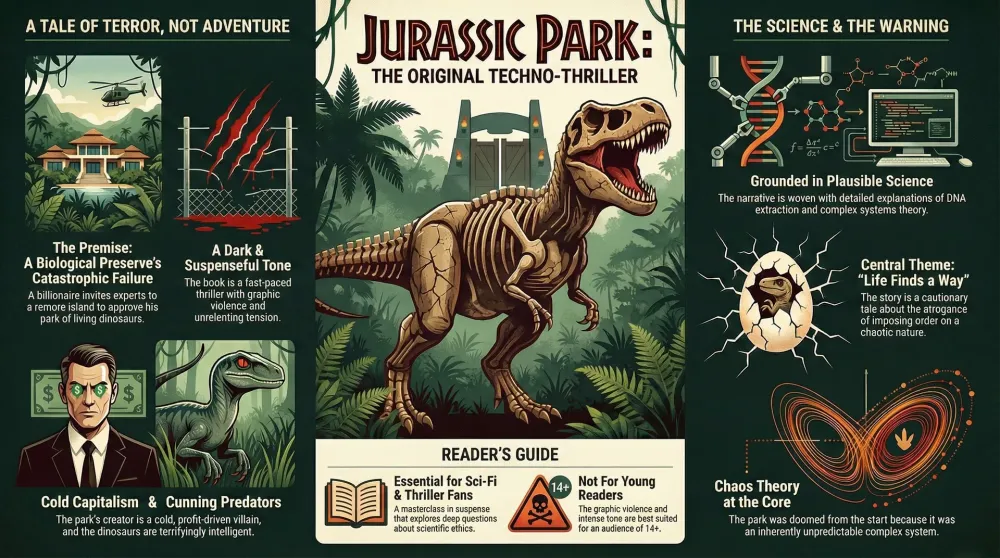
For millions, the name Jurassic Park conjures images of wonder, adventure, and John Williams’ soaring score. But before it was a cinematic titan, it was a foundational work of science fiction—Michael Crichton’s 1990 novel. To have only seen the film is to know only half the story. The novel is not a tale of wonder, but a dark, terrifying techno-thriller built on a stark warning about the breathtaking arrogance of humanity’s attempts to control nature. It is a dense, impeccably researched, and relentlessly paced examination of chaos, hubris, and survival. More than just the blueprint for a blockbuster, Crichton’s novel is a masterpiece of the genre, deserving of nothing less than a perfect 5/5 rating.
This review will explore the profound narrative and thematic departures that establish the novel as a darker, smarter, and altogether more harrowing experience.
A beast of a different color: Deconstructing the narrative differences
Understanding the novel’s distinct narrative is of strategic importance. The changes from its cinematic adaptation are not minor plot tweaks; they are fundamental shifts in tone, character, and theme that create a more intellectually rigorous and viscerally frightening experience. Where the film offers adventure, the novel delivers pure terror.
The core premise of an eccentric billionaire inviting experts to preview a biological preserve remains, but its execution is brutally different:
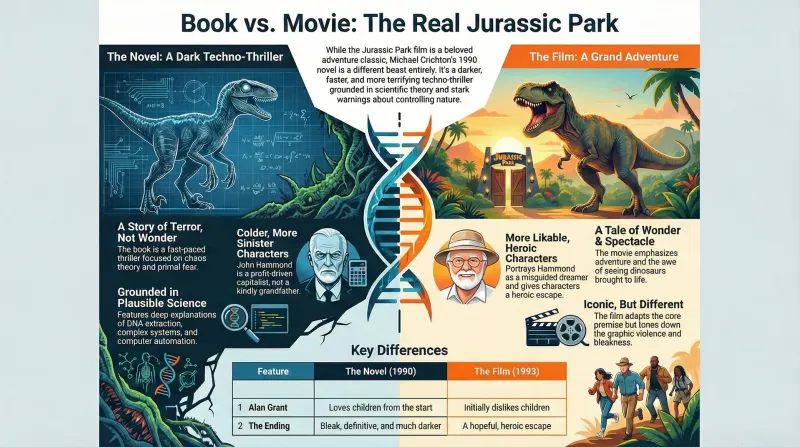
- The Park’s Vision: John Hammond, far from being a misguided, kindly grandfather, is a cold capitalist whose obsession with his creation eclipses any concern for the people within it. His pride is paramount, and human casualties are viewed as unfortunate glitches in his perfect, revenue-generating system. This grounds the disaster not in naive ambition, but in a chillingly detached corporate greed.
- The Hero’s Heart: In one of the most striking inversions, paleontologist Alan Grant actually loves kids. His character is warm and protective from the outset, removing the film’s character arc but establishing him as a more immediate and empathetic anchor amidst the chaos.
- The Nature of the Dinosaurs: Crichton’s dinosaurs are not simply movie monsters; they are monstrous animals, rendered with terrifying biological realism. The T-Rex is a relentless hunter, and the Velociraptors are cunning, vicious, and terrifyingly intelligent creatures that hunt with chilling coordination. They are products of a chaotic system, not theme park attractions.
- The Unflinching Reality: The novel does not shy away from the bloody reality of what happens when humans become prey. The violence is graphic, and deaths are described in gruesome detail. Crichton’s unflinching prose forces the reader to confront the brutal consequences of the park’s failure, amplifying the horror far beyond cinematic suggestion.
- The Bleaker Conclusion: Without revealing specifics, the novel’s ending is far bleaker and more definitive than the film’s heroic escape. It reinforces the book’s central cautionary message, leaving the reader with a lingering sense of dread and the profound understanding that some forces, once unleashed, cannot be easily contained.
This brutal realism is no mere flourish; it is the necessary consequence of the scientific hubris Crichton meticulously builds at the novel’s core.
| Feature | Novel (1990) | Movie (1993) |
|---|---|---|
| Tone | Dark, violent techno-thriller with horror elements | Awe-inspiring adventure with moments of tension |
| John Hammond | A cold, profit-driven capitalist willing to sacrifice people | A misguided but charming visionary who loves his grandkids |
| The Ending | The island is firebombed by the Costa Rican air force; the destruction is total | The survivors escape by helicopter; the island is left to nature |
| Velociraptors | Hyper-intelligent, nocturnal monsters that gnaw through cages | Scary but ultimately defeated by the T-Rex |
| Ian Malcolm | Bedridden for half the book, delivering long philosophical lectures | Injured but remains the charismatic voice of reason |
The science of a thriller: Chaos Theory and genetic hubris
The enduring power of Jurassic Park comes from its intellectual core. It is a true “techno-thriller,” a genre Crichton helped define by masterfully blending cutting-edge science with narrative suspense. This fusion of rigorous theory and primal fear elevates the novel far beyond a simple monster story.
Crichton did his homework, and it shows. Detailed explanations of DNA extraction from prehistoric amber, complex computer automation, and systems theory are woven seamlessly into the plot. The science feels plausible and grounded, giving the park’s creation an unnerving sense of possibility that makes its collapse all the more terrifying.
At the heart of the novel is chaos theory, personified by the mathematician Ian Malcolm. His extensive monologues, far more central and philosophically developed than in the film, are not academic diversions; they are the narrative’s prophetic heartbeat. They serve as the scientific prediction of the park’s inevitable failure, arguing that any attempt to impose rigid, predictable order on a complex biological system is doomed from the start.
This leads to the book’s central thesis: “Life finds a way.” The park’s collapse is not merely the result of human error in the form of Dennis Nedry’s corporate sabotage. It is the inherent, unavoidable consequence of trying to control a chaotic system. Nature, in all its unpredictable glory, was always going to break free. The disaster was not an accident; it was an inevitability.
This intellectual framework is not merely theoretical; it provides the terrifying logic for the masterclass in suspense that Crichton unleashes upon the reader.
A masterclass in suspense
Beyond its scientific credibility, Jurassic Park is a masterfully constructed thriller. Crichton’s prose is fast-paced and relentless, building an atmosphere of unrelenting tension from the moment the first cracks in the system appear. The narrative engine is finely tuned, accelerating steadily toward its terrifying climax.
The deeper character development, particularly for the fatalistic Malcolm and the chillingly detached Hammond, raises the emotional stakes. These are not archetypes; they are complex individuals whose philosophies and flaws directly contribute to the catastrophe. Furthermore, the novel contains iconic scenes of suspense and terror that were never adapted for the screen—most notably a harrowing river raft attack—offering a fresh and even more frightening experience for those only familiar with the film. For any reader, it is a masterclass in how to build and sustain suspense.
This intensity, however, means the novel is not an experience for every reader.
A necessary warning: This is not a book for children
It must be stated clearly: this novel is not for young children. Given its graphic content and psychological intensity, it is best recommended for an audience of 14 and older who can handle mature themes.
This warning is justified by the gruesome and graphically detailed deaths and the unrelenting tension that permeates the story. However, for the appropriate audience of older teens and adults, the book serves as an excellent tool for discussing the ethics of science and technology. It raises profound questions about the “could vs. should” dilemma, a conversation that has only become more relevant in the modern era of AI and CRISPR gene editing.
Pros
- Incredible scientific detail that feels grounded and real
- Fast-paced, relentless suspense
- Deeper, more complex character development
- A thought-provoking and enduring examination of scientific ethics
Cons
- Graphic content and psychological intensity not suitable for children
- Gruesome and graphically detailed deaths
From the screen to the shelf: Crichton’s novel birthed the whole franchise — put its star predator on your shelf with the LEGO Jurassic World T. rex Skull (76964) review.
Final verdict: An essential landmark of science fiction
Michael Crichton’s Jurassic Park stands on its own as a landmark achievement, a darker, sharper, and more terrifying experience than its celebrated film adaptation. It is a singular work that uniquely combined cutting-edge science with primal fear, creating a techno-thriller that is as intellectually stimulating as it is pulse-pounding. It examines the arrogance of our species with a critical and unforgiving eye, leaving an indelible mark on the reader.
The novel’s core strengths make it a timeless and powerful work:
- Incredible scientific detail that feels grounded and real
- Fast-paced, relentless suspense
- Deeper, more complex character development
- A thought-provoking and enduring examination of scientific ethics
It is essential reading for sci-fi fans, thriller lovers, and anyone who wants to see the true face of Jurassic Park.
Rating: 5/5
🎧 Rather listen than read? Audiobooks are how busy dads actually finish books — start a free 30-day Audible trial and turn your commute into reading time.
The adaptation: our Jurassic Park (1993) movie review.
Related Dadnology review: Mattel Jurassic World Rebirth Power Devour T-Rex
📌 FAQ – Frequently asked questions
Is the book better than the movie?
Is the book scary?
Is there a sequel?
Keep this in your inbox
One email a week: what we actually watched, built and reviewed — the stuff worth a dad's time. No hype, no daily spam.
Dadnology Weekly
One email a week: the LEGO, gaming and movie news worth a dad's time — plus what we actually reviewed. No hype, no daily spam.
Disclaimer: This review and its visuals were created with the help of AI. Some links may be affiliate links – we may earn a commission if you make a purchase, at no extra cost to you.
Current deals in Books & media
Verified live discounts tracked on Amazon
Books & media · Tested by Dadnology
The Expanse: Dragon Tooth (Graphic Novel)
4.5/5“Bridging the void”Read our review
Books & media · Tested by Dadnology
The Art of The Legend of Vox Machina (Hardcover)
5/5“D&D-virginity meets fantasy chaos — and it's perfect.”Read our review
Books & media · Tested by Dadnology
The Hobbit Illustrated by the Author (Special Edition, Sprayed Edges)
5/5“A perfect page-Turner you'll want to read aloud”Read our reviewYou might also like
Two Apex Predators: Novel vs. Movie analysis
An essential analysis for fans of the franchise. This article breaks down the fascinating divergent evolution of Jurassic Park, comparing the intellectual rigor of the book with the cinematic revolution of the movie.
New movies & shows coming in September 2026: Our top picks
September 2026 is the strongest streaming month of the year so far. The Mandalorian and Grogu hits Disney+ two days into the month, both Spider-Man sequels land two days after that, Slow Horses returns for a sixth season, and the first Reacher spin-off finally arrives. Add the entire Rocky and Creed run plus Deep Impact on Paramount+ and LEGO ONE PIECE closing out the month, and there is a genuine reason to open the TV guide.
Is Jurassic Park OK for kids? A parent's age guide to every film & show
Jurassic Park is PG-13 and earns it. For most kids the honest starting age is 10-11 for the original film, and the animated Netflix shows are the far better on-ramp from around 7. The kitchen scene is the one to plan around.