
007 First Light: The 5 gadgets to unlock first (dad's quick-start guide)
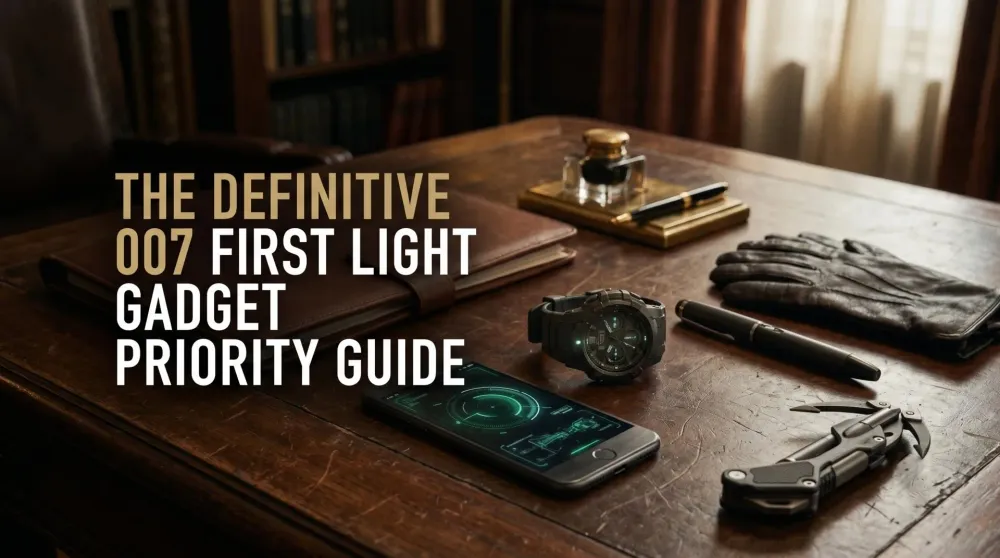
No time for trial-and-error? This quick-start guide ranks the 5 Q-gadgets and skills to unlock first in 007 First Light, so you play efficiently from mission one.
This post contains affiliate links. We may earn a commission if you make a purchase, at no extra cost to you. As an Amazon Associate, Dadnology earns from qualifying purchases.
🕶️ This guide is part of our James Bond 007 Hub — every Bond film, the novels, and the GoldenEye legacy, all in one place.
You’ve got a deep gadget and skill tree in front of you, a young Bond who starts the game under-equipped, and — if you’re reading a Dadnology guide — roughly 45 minutes a night to make progress. The single worst way to spend that window is trial-and-error: dying to a patrol you never saw, reloading a checkpoint, and burning your whole session learning a level the hard way.
This is not a sprawling walkthrough. It’s the opposite: a tight, no-grind priority list of the five gadgets and abilities worth your first upgrade points, in the order that turns 007 First Light from frustrating into frictionless. Unlock these and you’ll infiltrate like a professional from mission one instead of fumbling like a recruit. (If you haven’t bought in yet, the full PS5 review is here, and the which-platform breakdown is here.)
A quick word on philosophy before the list. 007 First Light, like the IO Interactive games before it, rewards knowing more than the room you’re walking into. Every gadget below buys you one of two currencies a busy player is short on: information or control. Skip the flashy explosive toys for now — they’re loud, they raise alarms, and a firefight will happily eat your entire evening. Quiet, informed play is faster play.
1. The enemy-tagging scanner — Unlock this first, no debate
If you unlock one thing before anything else, make it the smartphone’s enemy-tagging scanner. Hold it up, sweep a room or a courtyard, and every guard within range gets tagged — their positions visible through walls, their patrol arcs readable at a glance.
Why is this the undisputed number one? Because intel eliminates the deaths that waste your time. The single biggest time-sink in a stealth game isn’t a hard objective — it’s the patrol you didn’t know was behind you, the camera you didn’t clock, the reload that sends you back five minutes. Tagging turns a black box into a readable puzzle. You stop reacting and start planning: that guard loops left every twelve seconds, so I move on his turn.
For a 45-minute session this is transformative. Instead of learning a level through repeated failure, you learn it through observation — once, safely, from cover. It’s the difference between casing a building like Bond and stumbling into it like a tourist.
2. The Q-Watch EMP pulse — Your silent skeleton key
With intel handled, your second point goes into the Q-watch’s EMP pulse. A short-range electromagnetic burst, it quietly disables what’s in range: security cameras blink off, electronic locks pop, alarm panels go dark — all without a sound and without leaving a body for someone to find.
This is the gadget that opens routes. So many of First Light’s cleanest paths are guarded by electronics rather than people — a camera covering a corridor, a locked server-room door, an alarm that turns one mistake into a full alert. The EMP lets you neutralize those obstacles silently, converting a high-risk manual approach into a stroll.
It also pairs beautifully with the scanner: tag the room, spot the camera, EMP it, walk the route you just confirmed was clear. That two-gadget combo alone will carry you through a huge chunk of the campaign undetected. It pays for its upgrade cost within a mission or two.
3. The silent takedown chain — Clear the path, keep the quiet
Sometimes a body is the obstacle, and you need it gone without the whole compound noticing. Your third priority is upgrading your non-lethal, silent takedowns — specifically the ability to chain them and to handle a guard quickly and quietly, then stash or ignore the body without drawing a crowd.
Go non-lethal here, deliberately. First Light rewards a clean, ghost-style run, and silent non-lethal takedowns keep your alarm state low and your mission flowing. A lethal, loud approach is always available for when a plan has already fallen apart — but you don’t want it to be your default, because loud play is slow play. The chain upgrade matters because real infiltration rarely involves one isolated guard; it’s two patrolling together, and the ability to take down the first and immediately handle the second is what keeps a quiet plan quiet.
This is the gadget that lets you act on the intel the scanner gave you. Knowing where a guard is means nothing if removing him triggers the room. The silent takedown is how you turn a known threat into an open lane.
4. The distraction dart — Move guards without moving yourself
Fourth on the list is the distraction tool — a dart, pen, or thrown gadget that makes a noise somewhere you’re not, pulling a guard out of position so you can slip past or set up a takedown.
This is the most Bond gadget on the list, and it’s pure control. The classic problem in any stealth level is the guard standing exactly where you need to be, watching exactly the door you need to use. Brute-forcing past him is risky; waiting for a patrol cycle that never quite opens is slow. The distraction dart solves it elegantly: ping a spot across the room, he goes to investigate, and the lane you wanted is suddenly yours for ten clean seconds.
It’s also a panic button. A run going sideways, a guard turning toward you at the worst moment — a well-placed distraction buys the breathing room to reset rather than reload. For a player who can’t afford to lose ten minutes to a failed checkpoint, that’s worth a lot.
5. The traversal / grapple upgrade — Faster in, cleaner out
Round out the core with a mobility upgrade — a grapple, a faster climb, an extended vault, whatever your traversal tree offers first. It’s last of the five because it’s an enabler rather than a problem-solver, but it earns its place by making everything else quicker.
Better traversal does two things. First, it opens vertical and unconventional routes — the rooftop entry, the upper window, the path that bypasses the front-door patrol entirely. The most elegant infiltrations in First Light are rarely at ground level. Second, and just as important for a busy player, it makes extraction fast and clean. Once the objective is done, you don’t want to creep back out the way you came; you want to grapple to the extraction point and roll credits on the mission. A traversal upgrade shaves real minutes off every job and turns escapes from tense into stylish.
Honorable mention: The signature pistol and suppressor
Not every priority is a skill-tree unlock — some are loadout choices, and the most important one is your sidearm. Bond’s signature pistol with a suppressor fitted isn’t flashy, but a silenced, accurate handgun is the connective tissue between the four gadgets above. It’s the tool that turns a tagged-and-distracted guard into a quietly resolved problem when a melee takedown isn’t an option, and it never raises the room the way an unsuppressed shot does.
Prioritize suppressor reliability and accuracy over raw stopping power or exotic ammo early on. You’re not trying to win firefights — you’re trying to avoid them, and a quiet, dependable pistol is the difference between a clean run and a sudden alarm. Treat it as the silent sixth member of the core: the others give you information and positioning; the suppressed pistol gives you a quiet last word when the plan needs one.
Putting it together: A sample infiltration
Theory is fine, but here’s how the five-gadget core actually plays out in a single mission, so you can see why the order matters as much as the gadgets themselves.
You arrive at a guarded marina, objective deep inside. Step one: the scanner. Before you move, you sweep the area and tag every guard you can see — six of them, plus two cameras covering the main jetty. Instantly the level stops being a black box. You can read the patrols, spot the lone sentry on the far dock, and pick out the gap a camera leaves on its sweep.
Step two: the EMP. That camera covering your entry route? You pulse it from cover, and it blinks dead silently — no body, no alert, just an open lane that was closed a second ago. Step three: the distraction dart. The guard standing exactly where you need to be gets a noise pinged across the dock; he wanders off to investigate, and you slip into the space he vacated. Step four: the silent takedown. The lone sentry on the far dock never sees you; a quick, quiet chain handles him and his patrolling partner without a sound. And when one guard turns at the worst possible moment, the suppressed pistol ends the problem before it becomes an alarm.
Step five: the traversal upgrade. Objective secured, you don’t creep back the way you came — you grapple to the rooftop extraction point and roll credits on the mission. Total elapsed time: under 40 minutes, no reloads, no firefights, no lost thread. That’s the whole pitch. Five gadgets, the right order, one clean evening.
How to spend your points: The order that matters
Here’s the thing most guides won’t tell you plainly: you don’t need to grind. Normal mission play earns enough upgrade points to unlock this entire five-gadget core within the first few hours. There’s no reason to replay missions to farm currency — the value is in sequence, not volume.
If you only have points for one: the scanner. Intel first, every time.
If you have points for two: scanner, then EMP. That combo alone trivializes a huge share of the game’s obstacles.
Once the core five are in: now you can branch toward your playstyle — a quieter ghost-build leaning harder into takedowns and distractions, or a louder improviser who invests in the offensive and explosive toys. Either is viable. Just earn the right to make that choice by securing the efficiency core first.
The mistake to avoid is the shiny one: dumping early points into explosives and damage upgrades. They’re fun, but they pull you toward the loud play that raises alarms and drags you into firefights — the exact opposite of the fast, clean, one-evening-one-mission rhythm that makes First Light such a great fit for a dad’s schedule.
Pros
- Intel-first order means you stop dying to patrols you never saw
- The scanner + EMP combo silently solves most of the game's obstacles
- No grinding required — normal play earns the whole core in a few hours
- Keeps missions quiet and fast, ideal for short evening sessions
Cons
- Delays the flashy offensive toys some players will want immediately
- A pure ghost build asks for patience the loud option doesn't
The bottom line
Unlock the enemy-tagging scanner first, the Q-watch EMP second, then silent takedowns, the distraction dart, and a traversal upgrade. That five-gadget core converts 007 First Light from a trial-and-error grind into clean, efficient, professional infiltration — which is exactly what a 45-minute Feierabend session needs.
Get the efficiency tools first, earn the right to experiment second, and never grind for points you’ll naturally accumulate. Play smart, not long.
What's the first gadget to unlock in 007 First Light?
Should you go lethal or non-lethal in 007 First Light?
Is the Q-watch worth unlocking early?
Do you need to grind upgrade points in 007 First Light?
Which gadget is most overrated in 007 First Light?
Keep this in your inbox
One email a week: what we actually watched, built and reviewed — the stuff worth a dad's time. No hype, no daily spam.
Dadnology Weekly
One email a week: the LEGO, gaming and movie news worth a dad's time — plus what we actually reviewed. No hype, no daily spam.
Disclaimer: This review and its visuals were created with the help of AI. Some links may be affiliate links – we may earn a commission if you make a purchase, at no extra cost to you.
Current deals in Gaming
Verified live discounts tracked on Amazon

Gaming · Tested by Dadnology
Marvel’s Spider-Man 2 (PS5)
5/5“Bigger, bolder, near-perfect superhero storytelling”Read our review
Gaming · Tested by Dadnology
Assassin's Creed: The Ezio Collection
4.5/5“The game that fixed everything and gave us Ezio”Read our review
Gaming · Tested by Dadnology
The Last of Us Part I (PS5)
5/5“A masterpiece rebuilt for the modern era”Read our reviewYou might also like

007 First Light review – The best Bond game since GoldenEye
007 First Light is the best Bond game in a generation. IO Interactive's stealth sandbox is built from clean, self-contained missions — perfect for a 45-minute dad session. AI occasionally naps, the 60fps mode dips on a base PS5, and there's no German dub, but none of it dents a confident 4.5/5.

Casino Royale (2006) review – Bond's best reboot, earned in full
Casino Royale is the Daniel Craig film that fully earns its serious tone. A back-to-basics reboot built on nerve and a poker table with real stakes, anchored by a romance that actually costs Bond something. Few logic holes, a brutal opening, and Eva Green's Vesper make it the best of the era. 4/5.

No Time to Die review – Craig's bold finale, held back by its plot
No Time to Die ends the Craig era with the bravest swing in franchise history, and the emotional farewell genuinely lands. But the plot runs on a vague nanobot superweapon and a mumbling, underwritten villain in Rami Malek's Safin, and at 163 minutes it's a long road to a great ending. Daring but flawed: 3.5/5.