
No Time to Die review – Craig's bold finale, held back by its plot
Daniel Craig's farewell takes a genuinely brave swing with its ending — but a hazy villain and nanobot-bioweapon plot keep it from sticking the landing. A 3.5/5.
This post contains affiliate links. We may earn a commission if you make a purchase, at no extra cost to you. As an Amazon Associate, Dadnology earns from qualifying purchases.
🕶️ This review is part of the The James Bond Multiverse – explore how 007 First Light ties into the Bond films.
When No Time to Die (2021) finally arrived after a year of pandemic delays, it carried the weight of an entire era on its shoulders. This was Daniel Craig’s farewell after 15 years, and it had to do something no Bond film in nearly six decades had dared. I’ll give it full marks for courage: it takes the single bravest swing in franchise history, and the emotional landing genuinely got me. I just wish the two-and-a-half hours of plot leading there were as strong as the destination.
That’s the central tension of Craig’s send-off. As an ending, it’s daring and moving and unlike anything the series has done. As a thriller, it runs on a frustratingly vague nanobot superweapon and a villain whose plan I still can’t fully explain. For a series that asks to be taken seriously, the machinery matters — and here it’s the weakest link in an otherwise heartfelt finale. A bold, flawed 3.5/5.
The ambition is everywhere. So, unfortunately, is the bloat — and a script that never quite figures out its villain.
Narrative architecture: A farewell worth the risk
The emotional engine is, for the first time, genuinely domestic. This is a Bond film about a man trying to leave the life behind — for Madeleine, and for something the franchise has never let Bond have. That’s a brave, resonant idea, and it’s where the film earns its keep.
The plot itself is where things fray. A retired Bond is pulled back in when a bioweapon called Heracles — nanobots coded to individual DNA — falls into the hands of Safin, a scarred terrorist with a grudge against Spectre and vague designs on mass death. The weapon is a clever hook in theory and a hand-wave in practice; the more the film explains Heracles, the less it makes sense. And Safin’s actual goal never crystallizes beyond “menace.”
But the personal story lands. As a dad, the final act hit me harder than I expected — it reframes Bond’s entire arc around what a person will sacrifice for the people they love. Without spoiling it: the film breaks the franchise’s most sacred rule, and that courage is the single best decision it makes. The destination is worth the trip, even when the trip drags.
| What Works | What Doesn't | |
|---|---|---|
| The ending | The bravest in franchise history | — |
| Emotion | A genuinely moving farewell | Takes 163 minutes to get there |
| Villain | Rami Malek is a capable actor | Safin is underwritten and vague |
| The weapon | A novel DNA-targeting hook | Falls apart the more it's explained |
| Action | Two standout long takes | Some anonymous mid-film stretches |
What the contrast reveals: No Time to Die is a film whose emotional ambitions outrun its plotting. The heart is in the right place; the spy mechanics around it are the shakiest of the era.
The craft: Ambition on a grand scale
Fukunaga was a bold hire, and his visual ambition shows. The film looks expensive and moves with real confidence, even when the script meanders.
It delivers two genuinely great action sequences:
- The Matera opening: A pre-titles chase through an Italian hill town, climaxing with the Aston Martin DB5 unloading its gatling guns in a 360-degree spin. A franchise highlight.
- The stairwell long take: A continuous-feeling shootout up through Safin’s lair, fluid and tense — Fukunaga’s True Detective instincts on full display.
- The misty forest ambush: A moodier, atmospheric set piece that shows range beyond the bombast.
When the film leans on craft over plot, it soars. The problem is the connective tissue — and a villain who never gives that craft a worthy target.
The format benchmark: A commit-the-evening watch
At 163 minutes, this is not a casual weeknight Bond. It’s the one that asks for the whole evening — and rewards a proper setup if you give it one.
- 4K showcase: The Matera chase and the island finale are visual high points in 4K HDR.
- Sound: Hans Zimmer’s swelling score and the explosive climax give a home cinema real work to do.
- Dad Alert: Block out the full evening and watch the final act in the dark. The emotional ending lands far harder without a phone in your hand or a kid wandering in.
For the send-off it represents, it’s worth the commitment — just know you’re committing.
The sonic signature: Billie Eilish and a returning maestro
Hans Zimmer takes over scoring and leans into the franchise’s history, while the title song became a record-breaker.
- “No Time to Die”: Billie Eilish’s hushed, melancholy theme made her the youngest artist to record a Bond song, and it won the Oscar — a moody, fitting overture for a farewell.
- Zimmer’s score: He weaves in Louis Armstrong’s “We Have All the Time in the World” from 1969’s On Her Majesty’s Secret Service, a deep-cut callback that pays off beautifully in the finale.
- Emotional engineering: The score does heavy lifting in the final act, and it’s where the film’s music is at its most effective.
Legacy and where it ranks
The hardest question about No Time to Die isn’t whether it’s good — it’s whether its ending earns forgiveness for everything around it. Because that finale is the boldest decision in sixty years of Bond, and it genuinely recontextualizes Craig’s entire run. Start at Casino Royale and watch all five in order, and No Time to Die stops being a standalone thriller and becomes the closing chapter of one continuous story about a man learning, finally, what he’s willing to lose for love. On those terms, the send-off is unimpeachable.
The trouble is the 163 minutes you sit through to reach it. Strip the ending away and you have the era’s shakiest spy plot: a villain whose plan I genuinely cannot summarize, a superweapon that dissolves under any scrutiny, and a mid-film stretch that sags under its own runtime. Where Casino Royale’s plot was load-bearing, No Time to Die’s is scaffolding — there only to get you to the emotional payoff. It works because of its destination, not its journey, and that’s a fragile kind of success.
So where does it rank? For me, comfortably in the middle of the era: above the overstretched Spectre, below the tighter Skyfall, and well behind the two films that bookended Craig’s debut. As a piece of franchise courage, though, it stands alone — no other Bond film would dare what this one does in its final act. If you’ve followed Craig’s Bond from the beginning, that bravery makes it essential, flaws and all. Just don’t go in expecting the plot to honor the seriousness the ending so clearly takes for granted. It’s a great farewell wearing a mediocre thriller, and your mileage will depend on how much the farewell means to you.
Pros
- The bravest, most emotionally daring finale in the entire franchise
- The Matera opening and the stairwell long take are standout action sequences
- Fukunaga brings real visual ambition and scale
- A genuinely moving send-off for Daniel Craig's 15-year run
Cons
- Rami Malek's Safin is underwritten — his plan and motivation stay frustratingly vague
- The Heracles nanobot weapon falls apart the more the film tries to explain it
- At 163 minutes it's the longest Bond ever and feels it in the mid-film stretches
- The serious tone can't fully paper over a plot built on hand-wavy science
Conclusion: A daring ending worth the Bumpy road
No Time to Die is the hardest Craig film to score, because it’s two things at once: a shaky thriller and a brave, beautiful farewell. The villain underwhelms, the weapon makes no sense, and the runtime tests your patience — and yet the ending is so bold, so committed, that it nearly redeems the lot.
I respect it more than I love it. It takes the kind of swing the franchise almost never allows, and for that alone it’s essential viewing for anyone who followed Craig’s Bond from Casino Royale onward. Just don’t expect the plot to hold up the way the emotion does.
The Final Word: A flawed thriller with the franchise’s bravest ending — worth watching for the send-off, even as the plot wobbles all the way there.
📺 Movie night sorted: thousands of films and shows are streaming on Prime Video — free for 30 days. Worth a look before you buy the disc.
Related Dadnology review: Spectre (2015) Review – A Stylish Bond Undone by Its Own Retcon
Is No Time to Die worth watching?
How does No Time to Die end?
Who is the villain in No Time to Die?
Who directed No Time to Die?
Is No Time to Die suitable for kids?
Keep this in your inbox
One email a week: what we actually watched, built and reviewed — the stuff worth a dad's time. No hype, no daily spam.
Dadnology Weekly
One email a week: the LEGO, gaming and movie news worth a dad's time — plus what we actually reviewed. No hype, no daily spam.
Disclaimer: This review and its visuals were created with the help of AI. Some links may be affiliate links – we may earn a commission if you make a purchase, at no extra cost to you.
Current deals in Movies & TV
Verified live discounts tracked on Amazon
![The Legend of Korra — The Complete Series [Blu-ray]](https://m.media-amazon.com/images/I/51+1TXyb7aL._SL500_.jpg)
Movies & TV · Tested by Dadnology
The Legend of Korra — The Complete Series [Blu-ray]
4.5/5“A new Avatar, a modern city, a masked revolution”Read our review
Movies & TV · Tested by Dadnology
Zack Snyder's Justice League (4K Ultra HD)
4/5“Four hours. One vision. This is the film.”Read our review
Movies & TV · Tested by Dadnology
Space Jam (4K Ultra HD + Digital)
4/5“It's gonna be a whole new ball game”Read our reviewYou might also like
Casino Royale (2006) review – Bond's best reboot, earned in full
Casino Royale is the Daniel Craig film that fully earns its serious tone. A back-to-basics reboot built on nerve and a poker table with real stakes, anchored by a romance that actually costs Bond something. Few logic holes, a brutal opening, and Eva Green's Vesper make it the best of the era. 4/5.
Quantum of Solace review – Bond's underrated revenge sequel
Quantum of Solace is the era's black sheep, and unfairly so. The only true direct sequel in the franchise, it's a lean 106-minute revenge picture about a grieving Bond. The editing is choppy and the eco-villain plot is thin, but the emotional core is honest and the brevity is a virtue. An underrated 4/5.
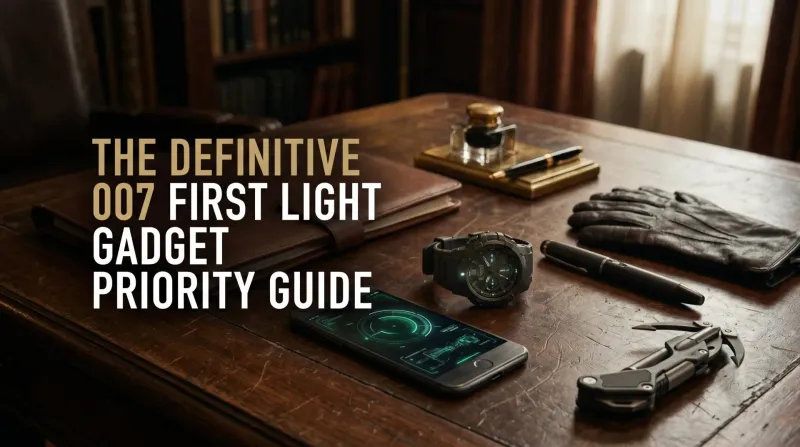
007 First Light: The 5 gadgets to unlock first (dad's quick-start guide)
Unlock the enemy-tagging scanner first, the Q-watch EMP second, then silent-takedown chains, the distraction dart, and a traversal upgrade. That five-gadget core turns 007 First Light from trial-and-error into clean, efficient infiltration — exactly what a 45-minute session needs.