
From the N64 to 2026: Does 007 First Light beat GoldenEye?
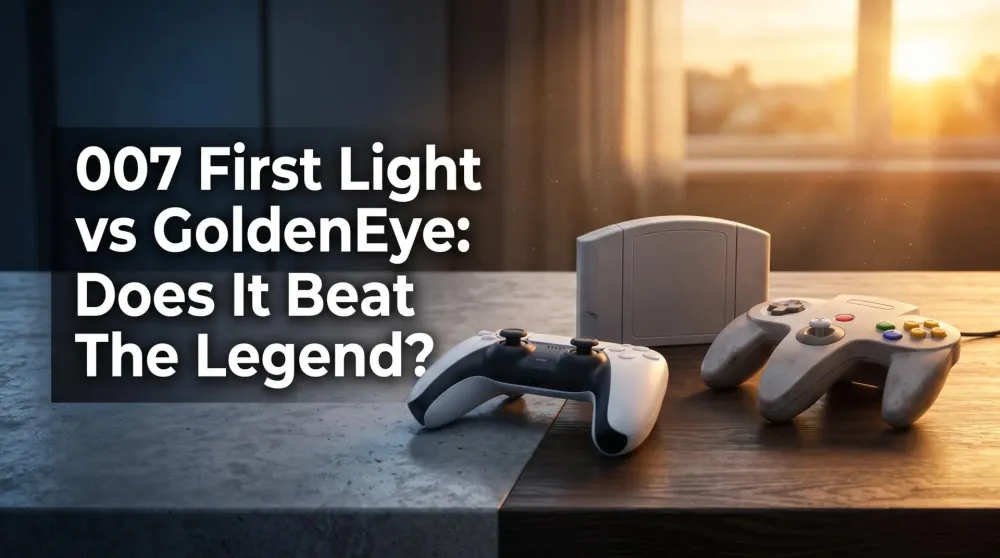
From N64 splitscreen and the Temple map to a modern stealth sandbox — we ask whether 007 First Light finally lives up to the GoldenEye legend so many of us grew up on.
This post contains affiliate links. We may earn a commission if you make a purchase, at no extra cost to you. As an Amazon Associate, Dadnology earns from qualifying purchases.
TL;DR – The honest verdict
🕶️ This guide is part of our James Bond 007 Hub — every Bond film, the novels, and the GoldenEye legacy, all in one place.
Some games you remember. GoldenEye on the Nintendo 64 is one we lived inside. For a whole generation of dads, that grey cartridge wasn’t a purchase — it was an era: floor-sitting, couch-cushion-fort, four-controllers-and-a-multitap evenings that ran until somebody’s parents pulled the plug. So when IO Interactive’s 007 First Light arrived in 2026 carrying the weight of that memory, the only honest question to ask was the one we’d been quietly asking for twenty-five years: has anyone finally done Bond justice again?
The church of splitscreen: Why GoldenEye mattered
To understand the stakes, you have to remember what GoldenEye actually was. In 1997 it did something that sounds impossible now: it made a console first-person shooter feel essential, and then it almost accidentally invented the most important multiplayer ritual of a generation.
The single-player campaign was genuinely clever for its time — objective-based stealth-ish missions, difficulty tiers that added goals rather than just bullet sponges, a sense that you were a spy with a job rather than a marine with a body count. But the campaign was the appetizer. The main course was four people crammed onto one sofa, staring at a quarter of a tube TV each, screen-watching shamelessly and lying about it.
And the arenas were scripture. The Temple — tight stone corridors, perfect chokepoints, that one spawn everyone fought over — was the ultimate proving ground. We played it two-deep, three-deep, four-deep, and the geometry of that map is still mapped into my thumbs. Then there was License to Kill mode: every hit lethal, one shot decides everything, the tension cranked to a level no graphical upgrade has ever matched. A whole evening could hinge on a single corner. We argued, we cheated, we laughed until it hurt. That wasn’t a game feature. That was a childhood.
That’s the bar First Light has to clear — not a technical bar, an emotional one. And it’s important to be honest up front: in one specific way, it simply can’t.
What First Light can’t give back
There is no splitscreen. There is no Temple. There is no four-controller chaos. 007 First Light is a single-player game, full stop — a game you play alone, after the kids are down, in the quiet. (We get into exactly how well it fits that schedule in the full PS5 review.)
For GoldenEye veterans, that’s a real loss, and I won’t pretend otherwise. The thing that made GoldenEye GoldenEye — the social, competitive, screen-watching couch ritual — isn’t on the menu, and no part of First Light tries to replicate it. If what you wanted was four mates and a License to Kill match in 4K, this is not that game, and nothing released in years has been.
But here’s the twist that makes this comparison interesting rather than depressing: we’re not the same players anymore, and we don’t have the same lives. The four-controller Friday night isn’t gone because games stopped making it — it’s gone because we have bedtimes to enforce and 45 minutes to ourselves if we’re lucky. And measured against that reality, First Light gives back something GoldenEye never could.
What First Light does that GoldenEye never could
Strip away the nostalgia and judge the two as single-player games, and it isn’t close: First Light is the far richer experience, and the first solo Bond game in decades that earns the comparison at all.
Where GoldenEye’s stealth was an illusion of choice — alarms, guards, a mostly-linear path — First Light is a true stealth sandbox in the IO Interactive tradition. Every mission is a puzzle box with genuine multiple solutions: ghost it unseen, tag and outmaneuver the patrols, or blow it open into a firefight when the plan collapses. The young-Bond origin story is told with real craft, the gadgets feel like spy tools rather than gimmicks (we ranked the five worth unlocking first here), and the whole thing is built — almost miraculously — around short, self-contained missions that respect a grown-up’s fractured schedule.
That last point is the quiet revolution. GoldenEye’s brilliance demanded a room full of people and a free evening. First Light’s brilliance fits into the gap between bedtime and exhaustion. One is the game of who we were; the other is the game for who we are. And as a piece of single-player design, the 2026 game is simply better — smarter systems, deeper choice, a story worth following.
So — Has IO Interactive done the legend justice?
Yes. With an asterisk, but yes.
IO Interactive didn’t beat GoldenEye by remaking it. They couldn’t, and wisely didn’t try — there’s no nostalgia-bait Temple remake, no bolted-on splitscreen to tick a box. Instead they did the harder, better thing: they made the first Bond game since 1997 that nails the feeling of being 007 rather than just handing you his gun. The legend finally has a worthy heir. It just happens to be a different kind of game — single-player where GoldenEye was social, deliberate where GoldenEye was chaotic, modern where GoldenEye was foundational.
So we hold both. GoldenEye stays untouchable as a memory and as the multiplayer night that made many of us gamers in the first place. First Light takes the crown as the best game to wear the 007 badge in a generation. Asking which is “better” is like asking whether your childhood home or your current one is better — they’re answering different questions, decades apart.
Pros
- First Light is the best single-player Bond game since GoldenEye — deeper, smarter, more polished
- A true stealth sandbox with genuine route choice, not just an alarm-and-guard illusion
- Short, self-contained missions fit a grown-up schedule GoldenEye never had to consider
- Nails the feeling of being Bond without leaning on cheap nostalgia bait
Cons
- No splitscreen, no Temple, no four-controller chaos — the GoldenEye magic it can't return
- Single-player only, so it scratches a different itch than the social couch ritual we remember
The bottom line
If you’ve spent twenty-five years waiting for a Bond game worthy of the GoldenEye name, stop waiting: 007 First Light is it. It’s the best solo 007 game in a generation and the first to earn the comparison at all.
Just know what it is and isn’t. It can’t give you back the splitscreen Friday nights — nothing can. What it gives instead is a brilliant, grown-up Bond fantasy sized perfectly for the life you have now. The legend has its heir. The childhood keeps its crown. Both can be true.
Our full 007 First Light coverage appears below — the in-depth PS5 review and the supporting guides.
Is 007 First Light better than GoldenEye?
Why was GoldenEye on the N64 so important?
Does 007 First Light have splitscreen multiplayer?
What made the GoldenEye Temple level and License to Kill mode special?
Keep this in your inbox
One email a week: what we actually watched, built and reviewed — the stuff worth a dad's time. No hype, no daily spam.
Dadnology Weekly
One email a week: the LEGO, gaming and movie news worth a dad's time — plus what we actually reviewed. No hype, no daily spam.
Disclaimer: This review and its visuals were created with the help of AI. Some links may be affiliate links – we may earn a commission if you make a purchase, at no extra cost to you.
Current deals in Gaming
Verified live discounts tracked on Amazon

Gaming · Tested by Dadnology
Marvel’s Spider-Man 2 (PS5)
5/5“Bigger, bolder, near-perfect superhero storytelling”Read our review
Gaming · Tested by Dadnology
Assassin's Creed: The Ezio Collection
4.5/5“The game that fixed everything and gave us Ezio”Read our review
Gaming · Tested by Dadnology