
GTA Vice City review: The 80s neon masterpiece that gave a series its soul
GTA Vice City is my all-time favourite Grand Theft Auto and a perfect 5 — 1986 neon Miami, Tommy Vercetti, and the best soundtrack gaming ever had.
This post contains affiliate links. We may earn a commission if you make a purchase, at no extra cost to you. As an Amazon Associate, Dadnology earns from qualifying purchases.
The game that gave a series its soul
🚗 This review is part of our GTA Hub — every mainline GTA ranked, the GTA 6 countdown, and the honest parents’ guide.
I’ll put my cards on the table immediately: Grand Theft Auto: Vice City is my favourite GTA of all time, and it has held that crown for over twenty years without a serious challenger.
If you’ve read my full Grand Theft Auto series ranking, you already know where this lands — number one, no hesitation. But Vice City deserves more than a paragraph in a retrospective. It deserves its own review, because what Rockstar pulled off here in 2002 wasn’t just a good GTA. It was the moment the series stopped being a clever technical experiment and became something you could feel.
GTA III, a year earlier, had proved the 3D open world worked. It was a landmark, one of the most important games ever made. But it was also a little cold — a grey, rainy Liberty City that impressed you more than it moved you. Then Vice City arrived, took that exact same engine, and poured a soul into it. The result is, to this day, the most intoxicating atmosphere I’ve ever experienced in a video game.
It’s a confident, unapologetic 5/5 — and to be crystal clear up front, Vice City is rated M for Mature. This is grown-up entertainment, played after the kids are down.
1986: Welcome to Vice City
The whole thing opens with a synth sting and a sun-drenched skyline, and you’re already gone.
Vice City is Rockstar’s pitch-perfect love letter to 1980s Miami — a neon-soaked, pastel-suited, palm-lined fever dream lifted straight out of Scarface and Miami Vice. Pink and teal sunsets bleed across the water. Mansions line the beaches. Cocaine cowboys cruise down Ocean Drive in convertibles the colour of a sherbet lemon. Every single block drips with period detail, from the boxy cars to the boomboxes to the questionable fashion choices.
What makes it work isn’t technical fidelity — by today’s standards the visuals are blocky and the draw distance is generous with the fog. What makes it work is commitment to a vibe. Rockstar didn’t just build a city; they built a mood, and they sustained it across every street corner, every radio jingle, every NPC barking in a thick accent. You don’t play Vice City so much as you live inside an 80s crime movie for a few dozen hours.
Two decades later, no open world has ever made me feel a time and a place this completely. Not one.
Tommy Vercetti: A made man building an Empire
At the centre of it all is Tommy Vercetti, and he is the best thing that had ever happened to a GTA protagonist up to that point.
Fresh out of prison after fifteen years inside, Tommy is sent to Vice City to handle a drug deal that immediately goes sideways. The money is gone, the product is gone, and Tommy is left stranded in a strange city owing a very dangerous man a great deal of cash. The entire game is Tommy clawing his way up from that hole — not just surviving, but building a criminal empire from nothing, one business, one rival, one betrayal at a time.
What sells it is the casting. Tommy is voiced by Ray Liotta, fresh off Goodfellas, and he brings genuine movie-star menace and charm to the role. This was a big deal in 2002 — a real Hollywood actor headlining a video game, delivering a performance with actual weight. Tommy isn’t a blank avatar; he’s a character with swagger, a temper, and ambition you can feel. When he takes over a property, buys a mansion, or muscles out a rival, the empire feels like yours.
GTA III had a silent protagonist. Vice City gave us a guy. That single change — a voice, a face, a personality — is a huge part of why this game has a soul where its predecessor had only a blueprint.
The greatest soundtrack in gaming history
I will fight anyone on this one. The Vice City soundtrack is the greatest licensed soundtrack in gaming history, full stop.
Rockstar licensed an enormous catalogue of real 1980s music and spread it across themed radio stations — synth-pop, new wave, hard rock, hair metal, pop, electro, and more. Each station has its own personality, its own DJ patter, its own perfect run of tracks. Driving across the causeway at sunset with the right station blaring out of a stolen convertible is, genuinely, one of the purest joys gaming has ever given me. I have stolen cars I didn’t need just to keep a song going.
This is where the magic compounds. The neon city is gorgeous on its own. Tommy’s story has momentum on its own. But layer that soundtrack over both, and the whole thing becomes transcendent — a feedback loop of atmosphere where the music makes the city more alive and the city makes the music hit harder. Every other GTA, on some level, has been chasing this exact feeling ever since. Vice City just had it, completely and effortlessly, on the first try.
To this day, certain 80s tracks instantly teleport me back to a younger version of myself, controller in hand, sun going down over a pretend Miami. That’s not nostalgia talking. That’s design.
The missions, the mayhem, and the Empire
Beneath the vibe is a genuinely great GTA, structured around Tommy’s rise.
The mission design was ambitious for its time. Beyond the standard escort-and-shoot fare, Vice City threw in helicopter sequences, RC vehicle challenges, mall shootouts, and one infamously brutal remote-control chopper mission that has tested the patience of every player who ever lived. The variety kept things fresh across a campaign that, for a 2002 game, was generously long.
The standout addition, though, was asset acquisition. As Tommy climbs, he starts buying businesses — a film studio, a strip club, a taxi firm, an ice cream van front, a printing works. Each property unlocks its own mini-arc of missions and then generates passive income you collect by physically driving over to pick it up. It’s a simple loop, but it makes the empire tangible. You’re not just doing jobs for other people anymore; you’re a kingpin with holdings, and the city slowly bends to your will. For a 2002 design, that sense of ownership was genuinely novel and remains satisfying today.
Honest nitpicks — Yes, even for a 10
Here’s the thing about a perfect score: a 10 means “perfect for what it set out to do,” not “flawless object.” Vice City set out to make you feel like the king of 1986 Miami, and it nails that completely. But it’s a 2002 game, and pretending otherwise would be dishonest — so let’s be honest.
The on-foot combat is clumsy. Aiming is loose, the lock-on is temperamental, and any mission that asks you to win a sustained gunfight on foot can become an exercise in frustration. Shooting from cover, as a concept, barely exists. By modern standards it feels stiff.
The mission checkpointing is brutally dated. Fail a long, multi-stage mission near the end and you’re often booted all the way back to the start — and sometimes all the way back across the city to even retry it. That remote-control helicopter mission I mentioned has ended marriages. There’s no quicksave mid-mission, no generous restart, none of the quality-of-life scaffolding we take for granted now.
And the driving and physics show their age — cars handle like bars of soap on ice, pedestrians and traffic behave erratically, and the occasional jank can break the spell. None of this is a surprise for a game from 2002. None of it dents the vibe for a second. But if you’re coming to it fresh from a modern Rockstar game, go in knowing the mechanics are a product of their era. The atmosphere is timeless; the controls are very much not.
👨 The dad angle — Why this one hits harder now
Let me be clear about the obvious first: Vice City is not a family game. It’s rated M for Mature, and it earns it — violence, strong language, sexual themes, the works. This is a solo, after-the-kids-are-asleep game, played with a drink and an hour to yourself. It is not a watch-along and it is not for the back seat.
But for a dad specifically, there’s something here that goes beyond the nostalgia. Replaying Vice City now, in my late 30s, the soundtrack does something a younger me couldn’t have appreciated: it instantly drops me back into a specific moment of my own life. These games grow with you. The pure, uncomplicated joy of cruising a neon city with great music playing — no notifications, no responsibilities, just vibe — is a genuinely restorative thing when the rest of your day was spent refereeing toddlers.
On time investment, Vice City is perfect for the time-poor dad. It’s mission-based and pause-friendly — you can knock out a mission or two in a 40-minute window and feel like you got somewhere. There’s no 60-hour Red Dead commitment here. And honestly, half the time I’m not even doing missions; I’m just driving around with the radio on, which is exactly the point.
On the right setup: this is one game where I’d argue audio matters more than visuals. The graphics are dated; the soundtrack is forever. Play it through a proper headset or a decent sound system and let those 80s tracks fill the room. That’s how Vice City was always meant to be experienced.
Pros
- The most intoxicating atmosphere in gaming — 1986 neon Miami, perfectly realised
- The greatest licensed soundtrack ever assembled, spread across brilliant themed radio stations
- Tommy Vercetti and Ray Liotta give the series its first real protagonist with swagger and weight
- Empire-building via asset acquisition makes your criminal rise feel genuinely tangible
- Mission-based, pause-friendly pacing that suits the time-poor dad perfectly
Cons
- Clumsy 2002 on-foot combat — loose aiming and temperamental lock-on
- Brutally dated mission checkpointing with no mid-mission saves (looking at you, RC chopper)
- Driving physics and pedestrian AI show their age and can occasionally break the spell
Final verdict — 80s Miami perfection
Grand Theft Auto: Vice City is the high point of pure atmosphere in the entire medium. GTA III proved the 3D open world worked; Vice City gave it a soul — a neon-drenched 1986 Miami, a real protagonist in Tommy Vercetti, and a soundtrack that defined a generation and still gives me goosebumps two decades on.
The mechanics are unmistakably from 2002 — the combat is clumsy, the checkpointing is merciless, the cars handle like soap. But a 10 means perfect for what it set out to do, and what Vice City set out to do was make you feel like the king of an 80s crime movie. On that, it succeeds more completely than any game before or since. It’s my favourite GTA, it gave the whole series its soul, and it earns a confident, unhesitating 5/5.
Final Rating: 5/5 — The Neon-Soaked Soul of Grand Theft Auto
Related Dadnology review: GTA San Andreas Review: The Most Ambitious PS2-Era Grand Theft Auto
What’s next in the series?
We’ve torn up 1986 Miami in a stolen convertible with the radio cranked. Ready to see how it stacks up against the rest of the franchise?
Keep going: Read the full Grand Theft Auto series ranking to see exactly why Vice City sits at number one — above GTA IV’s story and GTA V’s peerless sandbox.
FAQ: The Vice City questions
Is GTA Vice City worth playing today?
Why is the GTA Vice City soundtrack so famous?
Who voices Tommy Vercetti in GTA Vice City?
How do I play GTA Vice City on a modern console?
Is GTA Vice City appropriate for kids?
Keep this in your inbox
One email a week: what we actually watched, built and reviewed — the stuff worth a dad's time. No hype, no daily spam.
Dadnology Weekly
One email a week: the LEGO, gaming and movie news worth a dad's time — plus what we actually reviewed. No hype, no daily spam.
Disclaimer: This review and its visuals were created with the help of AI. Some links may be affiliate links – we may earn a commission if you make a purchase, at no extra cost to you.
Current deals in Gaming
Verified live discounts tracked on Amazon

Gaming · Tested by Dadnology
Halo: The Master Chief Collection (Xbox Series X|S)
4.5/5“No Spartan armor, no shields, just a rookie and a rainy city at night.”Read our reviewPrice as of Oct 15, 09:11 PM UTC

Gaming · Tested by Dadnology
Marvel’s Spider-Man 2 (PS5)
5/5“Bigger, bolder, near-perfect superhero storytelling”Read our review
Gaming · Tested by Dadnology
The Last of Us Part I (PS5)
5/5“A masterpiece rebuilt for the modern era”Read our reviewYou might also like
GTA San Andreas review: The most ambitious PS2-era Grand Theft Auto
An honest 4.5/5. San Andreas is the most ambitious, content-stuffed GTA of the PS2 era, with CJ's story of family and betrayal at its heart. The cost of all that scope is a game that's rough, bloated, and occasionally tedious, but unmatched for sheer value.
Grand Theft Auto (1997) review: Where the biggest sandbox in gaming began
An honest 3.5. Grand Theft Auto (1997) is a crude top-down relic with fiddly controls and brutal difficulty, but its chaotic sandbox attitude lit the fuse for an entire genre.
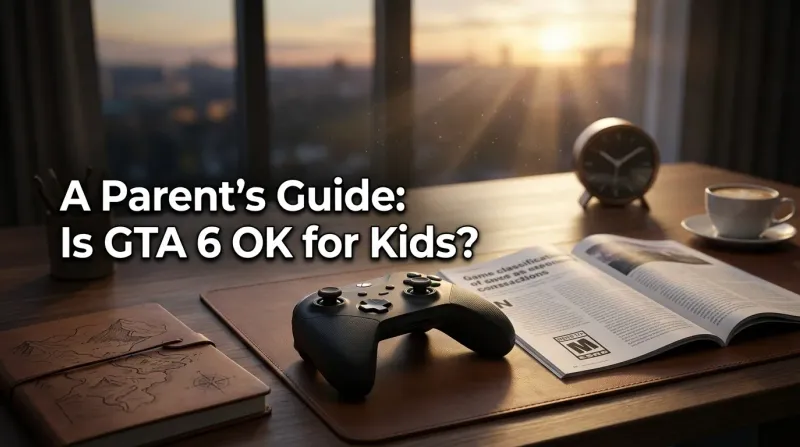
Is GTA 6 OK for kids? A dad's honest age-rating guide
No, GTA 6 is not OK for kids — the Mature 17+ rating is earned, not cautious. For older teens it's a family-by-family judgment call, and the online mode is a bigger factor than the story. Here's the full picture, the controls that help, and the alternatives that don't feel like a consolation prize.