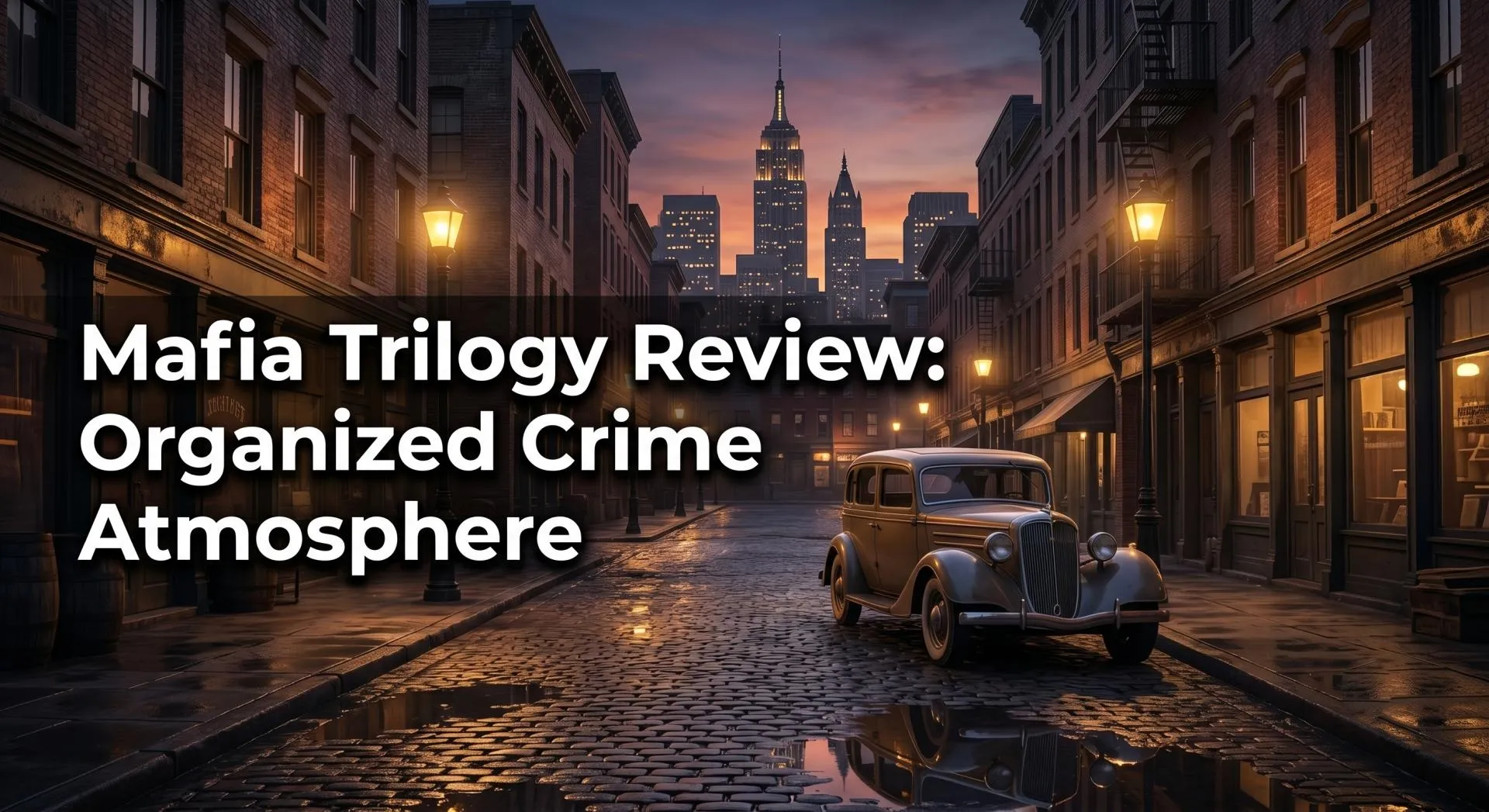
Mafia Trilogy Review: Three Eras of Organized Crime, One Killer Atmosphere
Our combined review of the Mafia Trilogy plus the excellent 2025 prequel. Three decades of organized crime carried by mood, story, and era over open-world systems.

This post contains affiliate links. We may earn a commission if you make a purchase, at no extra cost to you. As an Amazon Associate, Dadnology earns from qualifying purchases.
A Series Built on Mood, Not Map Markers
Let me be honest up front, the way I’d tell a mate over a beer once the kids are finally asleep: the Mafia series has never been the most mechanically impressive thing on the shelf. It doesn’t have the systems depth of a Rockstar epic or the open-world density of a modern blockbuster. What it has instead is something rarer and, frankly, harder to fake — atmosphere. The kind of period-crime mood that makes you want to keep the controller in your hands not because there’s a checklist to clear, but because you genuinely want to spend another hour in that world wearing that suit.
That’s the whole pitch. The Mafia games are mood pieces dressed as action games, and across four entries now, that mood is the consistent star. The era detail, the story beats, the way each game commits completely to its decade — that’s what carries the series. The open-world systems are along for the ride, and sometimes they drag. Which is exactly why this is an 4/5 and not higher: the settings and stories shine, but the trilogy is uneven, and we’re not going to pretend otherwise.
This is a combined look at the whole journey — the Mafia Trilogy (Mafia: Definitive Edition, Mafia II, Mafia III) plus the newest and, for my money, best entry, the 2025 prequel Mafia: The Old Country. Grab a coffee. We’re going for a drive.
AdMafia: Trilogy (opens in a new tab)
All three classic entries — Mafia: Definitive Edition, Mafia II, and Mafia III — in one package. The best way to experience the full period-crime saga.

Mafia: Definitive Edition — 1930s Lost Heaven, Still the Benchmark
The first game, fully remade as Mafia: Definitive Edition, drops you into 1930s Lost Heaven as cab driver Tommy Angelo, who gets pulled into the Salieri crime family more or less by accident and spends the rest of the game learning what that bargain actually costs. It’s a Prohibition-era period piece, and it knows it.
What makes it work isn’t the driving model or the gunplay — both are perfectly fine, occasionally a touch stiff. It’s the commitment to the era. The cars wheeze and rattle the way 1930s cars should. The city is grimy in a deliberate, art-directed way, all rain-slicked cobbles and warm yellow streetlights. The famous racetrack mission is still here, still tense. And the story is the most focused in the whole trilogy — a tight gangster tragedy with a beginning, middle, and a gut-punch end, told without the padding that would later bloat its sequels.
If you’ve never touched the series, this is where you start. It’s the cleanest expression of what Mafia is trying to be: a playable crime film with a real ending.
Mafia II — Post-War America Looks Incredible, Pacing Stumbles
Mafia II jumps forward to a 1940s-into-1950s America, following Vito Scaletta home from the war and into a life of crime in Empire Bay. And the look of this thing — even years on, the post-war Americana is gorgeous. Snow piling up on parked Cadillacs. Diners glowing in the dark. A licensed soundtrack of period swing and early rock that makes simply driving across town feel like a montage from a film you half-remember loving.
The setting is, again, the headline act. The problem is the pacing. Mafia II front-loads its best material and then, in the back half, starts to sag. Chapters that should hit hard instead feel like they’re treading water, and the open world around the story is mostly window dressing — beautiful window dressing, but there’s not much to do in it beyond drive between mission markers. It’s the entry where the gap between “incredible setting” and “thin systems” is widest.
Still worth it? Absolutely. You play Mafia II for the mood and the Vito-and-Joe friendship at its core, not for what the map offers. Just go in knowing the second half doesn’t quite keep the promise the first half makes.
AdPlayStation 5 Console (opens in a new tab)
The cleanest way to run the remastered trilogy and The Old Country with stable performance and fast loading between chapters.
Mafia III — 1968 New Bordeaux: A Brilliant World That Repeats Itself
Mafia III is the most fascinating entry to talk about, because it contains both the series’ single best backdrop and its single biggest structural flaw, side by side.
The backdrop: 1968 New Bordeaux, a stand-in for New Orleans, dripping with bayou humidity, civil-rights-era tension, and one of the best licensed soundtracks ever assembled — Creedence, the Stones, period soul, all of it. You play Lincoln Clay, a Black Vietnam vet tearing down the local mob after a betrayal, and the story and its themes are genuinely the most ambitious thing the series has attempted. When Mafia III leans into its narrative and its sense of place, it’s spectacular.
The flaw: the open world gets repetitive. The game’s loop — take over a district by hitting the same handful of activities, then repeat in the next district — wears thin well before the credits. You feel the systems straining to fill a map that the story doesn’t need filled. It’s the clearest example in the whole series of open-world busywork dragging down a great setting and a great story. If Mafia III had been half as long and twice as focused, it’d be remembered as a high point. Instead it’s the entry you love in spite of its structure.
Mafia: The Old Country — The Newest Entry Is the Best One
Here’s the part I most want to land, because it surprised me: the newest Mafia is genuinely great. The 2025 prequel, Mafia: The Old Country, is set in early-1900s Sicily, and it’s the freshest, most confident the series has felt in years — a proper return to form.
Why does it work so well? Because it learned the right lesson from its own trilogy. The Old Country looks at Mafia III’s sprawling, repetitive open world and quietly walks the other way. It’s focused and largely linear, a tightly directed story that trusts its setting and its characters instead of padding the runtime with district-takeover busywork. The Sicilian hill country — the olive groves, the dust, the old-world honor codes and blood feuds that the American games only ever referenced — is rendered with the best period atmosphere the franchise has ever produced. This is the origin of the whole Mafia mythology, and the game treats it with the weight that deserves.
It’s the proof that this series is at its best when it stops trying to be an open-world game and commits fully to being a playable period-crime drama. If the trilogy is an uneven 8, The Old Country on its own punches above that — it’s the high point, and the reason I’m more optimistic about Mafia’s future than I’ve been in a decade.
AdMafia: The Old Country (opens in a new tab)
The 2025 prequel set in early-1900s Sicily. Focused, linear, and the freshest high point of the entire series.
The Comparison — Four Eras, One Throughline
| Entry | Era & Setting | Open World | Story Focus | The Verdict |
|---|---|---|---|---|
| Mafia: Definitive Edition | 1930s Lost Heaven | Compact, atmospheric | Tight & complete | Best starting point |
| Mafia II | 1940s-50s Empire Bay | Pretty but thin | Strong start, saggy back half | Mood over substance |
| Mafia III | 1968 New Bordeaux | Large but repetitive | Most ambitious themes | Great world, padded loop |
| Mafia: The Old Country | Early-1900s Sicily | Linear & focused | Confident & directed | The new high point |
The throughline is obvious once you’ve played them back to back: the settings never miss. Every single Mafia game nails its era. What wobbles is the structure wrapped around that setting — and the clearest trend is that the series gets better the more it trusts a focused story over a sprawling map. Definitive Edition (focused) and The Old Country (linear) are the strongest; Mafia III (sprawling) is the one that most undercuts its own brilliance.
The Dad Angle — Why This Series Fits a Time-Poor Schedule
Here’s the genuinely practical case for the Mafia series as a dad: it’s a collection of stories with endings. Unlike the endless live-service treadmills and 200-hour open worlds that demand you clear your calendar, each Mafia game is a self-contained crime film you can actually finish. You can knock out a chapter in a 45-minute window after bedtime and feel like you made progress, because the structure is mission-to-mission rather than icon-to-icon.
The atmosphere is also a big part of the appeal at this stage of life. There’s something about settling into a beautifully art-directed period world — the music, the cars, the rain, the suits — that’s just relaxing in a way twitchy multiplayer never is. It’s the gaming equivalent of putting on a great gangster film, except you’re driving the car. For dads who grew up on The Godfather and Goodfellas, the series speaks your language fluently.
The honest caveat: this is firmly M-rated, after-the-kids-are-asleep territory. The violence is intense, the language is strong, and the themes are adult throughout every entry. This is not a watch-along game like a Spider-Man swing-fest. It’s a late-night, headphones-on, one-chapter-at-a-time experience — which, conveniently, is exactly the kind of gaming a dad’s schedule allows anyway.
If you’re cherry-picking with limited time: play Mafia: Definitive Edition for the foundation, then jump straight to The Old Country for the best the series has to offer. Mafia II and III are worth it for the settings if you fall in love, but those two are the essential pair.
Setup Notes — How to Best Experience the Series
You don’t need a monster rig to enjoy these games, but a couple of things genuinely elevate the experience. A decent TV or monitor with good contrast does a lot of work here, because so much of the Mafia mood lives in dim interiors, night driving, and those warm period lighting setups. The rain-slicked streets of Lost Heaven and the New Bordeaux bayou nights look dramatically better on a screen that handles dark scenes well.
The other thing that matters more than usual: audio. The licensed soundtracks across the series — especially Mafia II’s post-war swing and Mafia III’s astonishing 1960s playlist — are central to the whole experience. A decent pair of headphones or a soundbar turns the driving sections from filler into the best part of the game. This is a series where I’d happily just cruise around listening to the radio, and on the right setup, you will too.
On hardware: the remastered trilogy runs cleanly on a PlayStation 5, with fast loading between chapters that respects your limited play windows, and The Old Country was built with current hardware in mind. If you’re picking a platform fresh, that’s the painless route.
Pros
- World-class period atmosphere across four distinct eras — the settings never miss
- Self-contained stories with real endings, perfect for a time-poor schedule
- Some of the best licensed soundtracks in gaming, especially Mafia III's 1960s playlist
- Mafia: Definitive Edition is a tight, focused crime tragedy and a great entry point
- The 2025 prequel The Old Country is a focused, confident return to form and the new high point
Cons
- Mafia III's open world is repetitive — district-takeover busywork drags down a great setting and story
- Mafia II's pacing dips noticeably in its back half
- Open-world systems are consistently thinner than the production values around them
- Strictly M-rated — no family co-op or watch-along potential here
The Final Verdict: Mood Wins, Even When the Map Doesn’t
The Mafia series is a masterclass in atmosphere wrapped around an uneven set of games. From 1930s Lost Heaven to post-war Empire Bay to 1968 New Bordeaux and now early-1900s Sicily, the settings, the stories, and the era-perfect mood are the reason to play — and they’re consistently terrific.
What holds the trilogy back from a higher score is the unevenness: Mafia III’s open world repeats itself, Mafia II’s pacing sags, and the systems never quite match the production values. But the newest entry, The Old Country, points the way forward by doing exactly what this series does best — committing fully to a focused, story-driven period-crime drama. It’s the best the franchise has ever been.
For a dad who loves a great gangster film and wants to drive the car this time, the Mafia series is an easy recommendation — eyes open about its flaws.
Final Rating: 4/5 — Terrific Settings, Uneven Worlds, One Great Prequel
Related Dadnology review: Quantum Break Review: Remedy’s Bold Time-Bending Experiment
What’s Next in the Living Novel
We’ve worn the fedora and driven the period Cadillacs. Next up in our story-driven action hall of fame, we keep chasing the games that treat their worlds like novels.
Ready for more? Explore the rest of our Living Novel Hall of Fame to find your next great adventure.
FAQ: The Mafia Questions
Which Mafia game is best to start with?
Is Mafia: The Old Country worth it?
Do I need to play the Mafia games in order?
Is the Mafia Trilogy good for kids?
Why only a 4 if the settings are so good?
Keep this in your inbox
One email a week: what we actually watched, built and reviewed — the stuff worth a dad's time. No hype, no daily spam.
Dadnology Weekly
One email a week: the LEGO, gaming and movie news worth a dad's time — plus what we actually reviewed. No hype, no daily spam.
Disclaimer: This review and its visuals were created with the help of AI. Some links may be affiliate links – we may earn a commission if you make a purchase, at no extra cost to you.