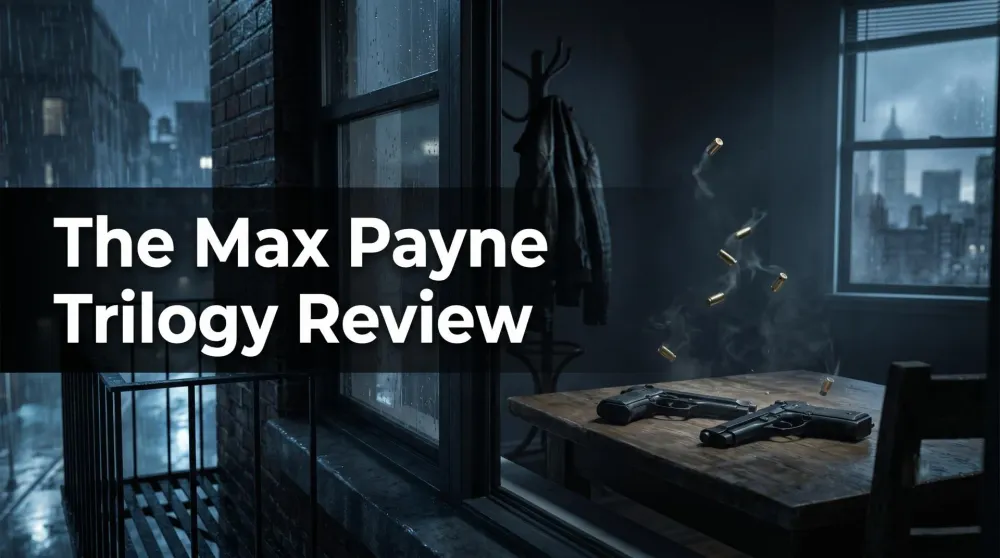
The Max Payne Trilogy review: Bullet time, noir York City, and the poetic architecture of revenge.
Our tribute to the Max Payne saga. Why the first two classics and the gritty third chapter form the ultimate 5/5 journey into the heart of darkness.
This post contains affiliate links. We may earn a commission if you make a purchase, at no extra cost to you. As an Amazon Associate, Dadnology earns from qualifying purchases.
🥃 The smell of gunpowder and rain: A 5/5 introduction
There is a feeling you only get when you press that shift key for the first time in Max Payne. Time slows to a syrupy crawl. You dive through a doorway, dual Berettas bucking in your hands, watching the individual trails of bullets slide through the air. You aren’t just playing an action game; you are playing The Matrix. You are living through a John Woo film.
At Dadnology, we rate the Max Payne trilogy as a 5/5 masterpiece. For many of us, playing the first two games back in the early 2000s was a formative gaming experience. It was the first time we saw a game take itself seriously as a “Living Novel”—using graphic novel panels, hard-boiled narration, and a grim, snowy atmosphere to tell a story of total loss.
While the third entry shifted the tone significantly, the collective weight of Sam Fisher’s… wait, wrong Sam… Max Payne’s journey is undeniable. It is a series that captures the poetry of violence. Over the next few chapters, we will explore the snowy streets of New York, the tragic romance of The Fall of Max Payne, and why we are still waiting for the 2026/27 remakes to bring this legend back to the modern era.
❄️ Noir York City: The absolute classics (MP 1 & 2)
The first two games, developed by Remedy Entertainment and written by the legendary Sam Lake, are untouchable. They aren’t just games; they are a mood. They captured a specific kind of early-2000s “cool” that combined the aesthetic of The Matrix with the grim cynicism of 1940s noir.
Max Payne (2001): The birth of bullet time
When Max Payne arrived, it was mind-blowing. The central gimmick—Bullet Time—wasn’t just a visual trick; it was a fundamental shift in how we perceived action. It allowed for a level of precision and cinematic flair that was completely new.
But it was the story that kept us hooked. Max, a man who returns home to find his wife and baby murdered by junkies on a new drug called Valkyr, is a protagonist defined by his grief. The narrative is delivered through comic book panels with voiceovers that sound like “velvet chocolate cake.” It was cheesy, over-the-top, and absolutely perfect. Who could forget Max’s “constipated” face—actually the face of Sam Lake himself? It gave the game a unique, almost juvenile charm that felt deeply personal.
Max Payne 2: The Fall of Max Payne (2003)
If the first game was a revenge flick, the second was a Tragic Romance. The Fall of Max Payne refined everything. The graphics were a massive leap forward, the “constipation” face was replaced by professional actors, and the inclusion of Mona Sax added a layer of fatalistic love that remains one of the best in gaming.
The introduction of the Havok Physics Engine was revolutionary. Seeing boxes fly, lamps sway, and bodies tumble realistically in slow motion added a layer of “Weight” to the gunplay. It felt more professional, more polished, and more cinematic. For many, this is the peak of the series—a tight, 8-hour experience that never wastes a second.
🇧🇷 The sun-soaked nightmare: Max Payne 3
When Rockstar Games took over for the third entry in 2012, the fans were nervous. We moved from the snow of New York to the sweltering heat of São Paulo. The comic book panels were replaced by glitchy, cinematic cutscenes. Max was older, balder, and more alcoholic than ever.
A different kind of greatness
While Max Payne 3 lost some of the “Poetic Noir” of the first two, it gained the most refined third-person shooting mechanics in history. The weight of the character, the way he interacts with the environment, and the sheer brutality of the gunplay are 5/5.
Max is no longer a superhero; he is a man who struggles to get back up after a dive. The animation system, where Max’s limbs react to the terrain as he falls, is still industry-leading even in 2026. It is a darker, more realistic take on the character—one that focuses on his inability to die and his struggle to find a reason to live. It may not be as “iconic” as the first two, but as an action game, it is nearly flawless.
🕹️ The mechanics of the “Matrix”
The reason we love Max Payne is the Bullet Time. It is the ultimate expression of the “Cinematic Action-Adventure” pillar.
The slow-motion symphony
Bullet Time turns a chaotic shootout into a tactical dance.
- The Shoot-Dodge: Diving through the air allows you to stay in slow motion until you hit the ground. It is the most “Matrix” thing you can do in gaming.
- The Visuals: Seeing the heat haze from the barrels, the individual shell casings spinning through the air, and the way the camera tracks the final bullet of a shootout provides a level of satisfaction that is rare in modern shooters.
The graphic novel narration
The way Max describes his world is iconic. “The past is a puzzle, like a broken mirror. As you piece it together, you cut yourself.” This kind of writing is what makes it a “Living Novel.” You aren’t just moving to the next room to shoot more guys; you are listening to a man narrate his own descent into hell. It gives the action a weight and a purpose that a generic shooter lacks.
| Feature | Max Payne 1 | Max Payne 2 | Max Payne 3 |
|---|---|---|---|
| Vibe | Classic Noir / Revenge | Tragic Romance / Polish | Gritty Action / Redemption |
| Setting | Snowy NYC | Rainy NYC | São Paulo Favelas |
| Narrative Style | Graphic Novel Panels | Graphic Novel / High Fidelity | Glitch-Cinematics |
| Gunplay Feel | Fast & Nimble | Fluid & Physics-Heavy | Heavy & Brutal |
| Rating | 5/5 | 5/5 | 4.5/5 |
📺 Technical brilliance: Why it’s still worth playing
Even in 2026, the Max Payne trilogy is worth your time.
1. The Xbox/PC Legacy: Thanks to backwards compatibility on Xbox Series X and the incredible scalability of the PC versions, these games look surprisingly clean. Max Payne 3 in 4K/60fps is still a technical marvel that puts many modern games to shame. 2. The Upcoming Remakes: Remedy and Rockstar are currently working on a Remake of Max Payne 1 & 2 as a single package using the Control and Alan Wake 2 engine. This is the ultimate “Next-Gen” promise for the series. We will soon see those snowy New York streets with full Path-Tracing and modern physics. In the meantime, the easiest way to revisit Max’s world is the 2008 Max Payne film. 3. Sound and Atmosphere: The iconic cello theme is one of the most recognizable in gaming. The sound of the heartbeat during Bullet Time and the gravelly voice of James McCaffrey (Rest in Peace) provide a level of immersion that doesn’t age.
🧔 The Dadnology perspective: The “no-nonsense” action
As Dads, we love Max Payne because it is a “Pure” experience.
⏱️ Respect for the schedule
The first two games are short—about 8 to 10 hours each. You can finish one in a few late-night sessions. There are no open-world chores, no crafting menus, and no skill trees to manage. It is a linear, high-octane journey that respects your time. You boot it up, you shoot some bad guys in slow motion, you listen to a bit of poetry, and you feel like a badass.
🧔 The relatability of the “tired man”
As we get older, we relate more to the “Max” of the third game. He’s tired. His back hurts. He’s just trying to get through the day. There is a specific kind of “Dad-fantasy” in being the most competent person in the room despite being completely exhausted. Max doesn’t have superpowers; he just has grit and a refusal to stay down.
🎥 The Matrix nostalgia
For those of us who grew up in the late 90s and early 2000s, The Matrix was a cultural reset. Max Payne allowed us to live that movie. Re-playing it today isn’t just about the game; it’s about recapturing that feeling of wonder we had when we first saw a bullet move in slow motion.
📈 Deep dive: The legacy of Sam lake
We cannot talk about the first two games without mentioning Sam Lake. He is the man who gave Max his face, his voice, and his soul. Lake’s writing is what elevated Max Payne from a simple shooter to a cultural landmark.
His use of metaphor and his willingness to break the fourth wall (the dream sequences in the first game are legendary) showed that action games could be weird, artistic, and deeply psychological. This “Remedy DNA” can be traced all the way through Alan Wake and Control. When you play Max Payne, you are witnessing the birth of a specific kind of gaming authorship. It is a “Living Novel” in the truest sense of the word.
🎧 The voices of the void
The voice acting in this trilogy is 5/5. The late James McCaffrey delivered a performance that defined a generation. His voice is the sound of the noir genre. The way he delivers lines like, “I was a butterfly on a pin,” with a mixture of irony and despair, is what gives the game its staying power. Even in the third game, where the setting changed, McCaffrey’s voice remained the tether that kept us connected to Max.
Pros
- Bullet Time and the shoot-dodge still make every firefight feel like a John Woo film
- Sam Lake's hard-boiled graphic-novel narration is timeless 'Living Novel' writing
- Max Payne 3 has some of the most refined gunplay and physics ever made
- Short, linear, no-filler campaigns that respect a tired dad's schedule
- James McCaffrey's gravelly voice work gives the whole saga its noir soul
Cons
- The original two games show their age in stiff movement and brutal difficulty spikes
- Max Payne 3 drops the comic-panel noir tone and adds long, unskippable cutscenes
- Licensing issues leave Max Payne 2 and 3 unplayable on PS5 in 2026
The final verdict: An absolute 5/5 legacy
The Max Payne Trilogy is one of the greatest achievements in gaming history.
It is the definitive cinematic action-adventure. The first two entries are masterpieces of atmosphere and noir storytelling that haven’t aged a day in terms of their “Soul.” The third entry provides a brutal, technical climax to the character’s journey. Whether you are diving through a frozen window in a New York tenement or fighting your way through a Brazilian airport, the games never lose their grip on the player.
It is a 5/5 series that captures a specific feeling of cinematic power that we are still chasing today. We are waiting for the remakes, we are waiting for a successor, but most of all, we are just happy we got to take the ride. Max Payne is a legend, and his story is mandatory for every gamer.
Final Rating: 5/5 — The Unchallenged King of Cinematic Noir
❓ FAQ: Everything a fugitive needs to know
Should I play the originals or wait for the remakes?
Is Max Payne 3 really that different?
How hard are the games?
Can I play them on PS5?
What’s next for the Living Novel?
We’ve survived the slow-motion gunfights and the noir-soaked streets of New York. Now, we’re shifting gears from the bullet-time revenge of Max Payne to an even darker, more emotional journey. We’re moving from the lone wolf to a pair of survivors trying to find hope in a world that has lost its mind. Get your bricks and bottles ready; we are reviewing The Last of Us Part I & II.
Keep this in your inbox
One email a week: what we actually watched, built and reviewed — the stuff worth a dad's time. No hype, no daily spam.
Dadnology Weekly
One email a week: the LEGO, gaming and movie news worth a dad's time — plus what we actually reviewed. No hype, no daily spam.
Disclaimer: This review and its visuals were created with the help of AI. Some links may be affiliate links – we may earn a commission if you make a purchase, at no extra cost to you.
Current deals in Gaming
Verified live discounts tracked on Amazon

Gaming · Tested by Dadnology
Marvel’s Spider-Man 2 (PS5)
5/5“Bigger, bolder, near-perfect superhero storytelling”Read our review
Gaming · Tested by Dadnology
Assassin's Creed: The Ezio Collection
4.5/5“The game that fixed everything and gave us Ezio”Read our review
Gaming · Tested by Dadnology