
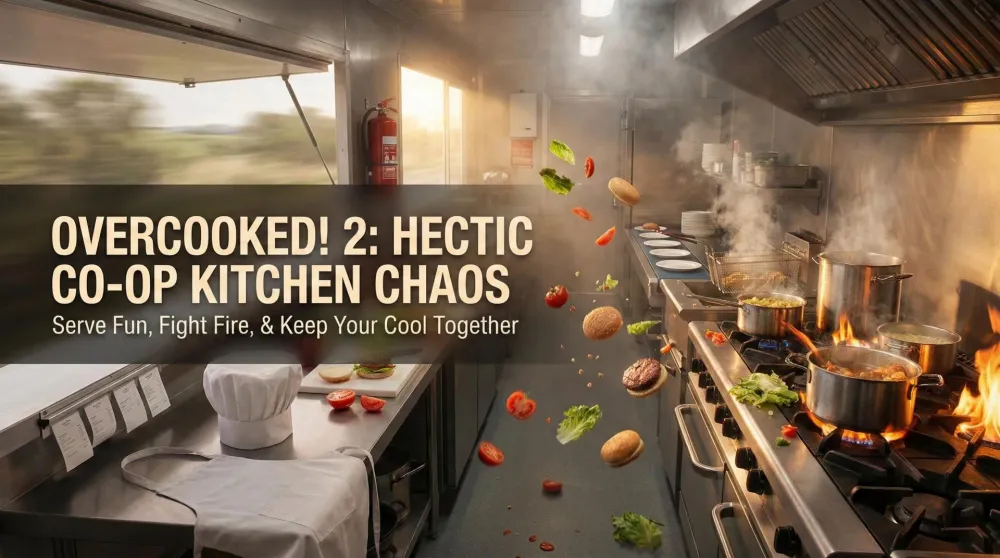
Overcooked! 2 – Hectic co-op chaos that always serves fun
The ultimate party-co-op: easy to learn, hilariously hard to master, and endlessly replayable across Switch, PlayStation, and Xbox.
This post contains affiliate links. We may earn a commission if you make a purchase, at no extra cost to you. As an Amazon Associate, Dadnology earns from qualifying purchases.
🎮 Introduction
🎮 This review is part of our Best Family Co-Op Games ranking – the couch games that actually work with kids.
Some co-op games are about precision. Overcooked! 2 is about communication under pressure—and it’s hysterical. In a world where kitchens float, collapse, and split across moving trucks, success comes from a chorus of quick callouts: “Onions left!”, “Plate please!”, “Fire extinguisher now!”, “Three… two… serve!” The story—a goofy campaign about battling the Unbread—exists to string together new kitchen gimmicks, but the heart is the team rhythm you develop as chaos scales.
We’ve played it across platforms (Switch, PlayStation, Xbox) and across years. With two players—dad and kid—the design shines: simple inputs, short levels, and a tight score chase that respects the time you actually have on a weeknight. With more players, it turns into a party: louder, messier, often funnier. Either way, it’s the rare co-op game that teaches soft skills while delivering belly laughs: role clarity, speaking concisely, recovering from mistakes, and ending the night on a high-five.
🧩 The recipe for chaos (and why it works)
Overcooked! 2 reduces cooking to legible verbs—chop, cook, combine, serve, wash—then weaponizes the kitchen:
- Shifting layouts force route planning.
- Conveyor belts & portals rewire your mental map.
- Environmental hazards (fire, wind, darkness) demand backup plans.
- Order timers pressure decisions: serve good enough now or perfect later?
For families, the genius is cognitive compression. Anyone can move, pick up, and chop within seconds; the challenge lives in coordination. Kids get to be heroes by owning a single verb (“I’m the chopper!”) while adults flex across gaps as runners or floaters. The game is generous about recoveries—drop a dish? Grab another ingredient and keep the line moving. You learn to fail forward.
👥 Two-player sweet spot (and scaling to four)
With two players, the kitchen becomes a dance floor. Roles are clear, and collisions are rare enough to feel funny rather than fatal. We like to split by zones (front-of-house plating vs. back-of-house prep) or by verbs (cook/plate vs. chop/wash). The “runner” crosses zones, ferrying ingredients and plates as layouts break apart.
With three or four, embrace micro-roles or chaos will win:
- Expediter: calls the next two orders, prioritizes plates.
- Grill master: watches pans only—no distractions.
- Prep cook: chops and stages mise en place near handoff points.
- Dish & plate: washes, plates, and fires orders on countdown.
Add a simple rule: “Freeze on countdown.” When someone calls “Serve in three… two… one,” everyone gives the line space. That single habit saves countless bump-outs at the window.
🧠 Communication loops that win
Overcooked! 2 rewards short, specific language. Our best loops look like this:
- Declare ownership early: “I’m pans and plates; you’re prep and dishes.”
- Call shortages as soon as you notice them: “Need tomato prep in 10.”
- Count down shared actions: “Throw tortilla—three… two… now.”
- Broadcast risks: “Top left pan smoking!” “Fire spreading right!”
- Reset calmly: “Trash that; start fresh.”
Kids internalize the pattern shockingly fast. By world 3, my daughter was expediting like a pro: reading tickets, parking plates where I’d land, and counting down throws over gaps.
🍽️ Level variety & gimmicks (campaign highlights)
The campaign’s kitchens escalate delightfully:
- Raft kitchens sway and reconfigure lanes—watch the gap before you sprint with soup.
- Balloon stages split you across cabins; ingredients arrive by conveyor at awkward intervals.
- Interlocking trucks drift apart on highways, turning tosses into mandatory skills.
- Wizard schools use teleporters and moving bookshelves; you’ll mark portals out loud: “Blue to fryer!”
- Sushi belts & steamers introduce multi-step dishes that enforce prep discipline.
Each world asks you to learn another “kitchen language.” Alone, that’s a puzzle. Together, it’s a conversation you get better at every night.
🔧 Difficulty & accessibility
Overcooked! 2 is approachable but not toothless. If younger players struggle:
- Lower the star goal for progression; you can always return for three stars.
- Lock roles and forbid cross-talk verbs (the prep cook doesn’t touch pans).
- Use the dash sparingly—collisions cost more time than you gain by sprinting.
- Stage ingredients near pans/steamers so the cook’s path is short and safe.
- Practice throws in safe corners before relying on them across gaps.
There’s also Assist Mode (in the All You Can Eat edition) that extends timers and prevents order expiration; if you have access to that version, it’s a great ramp for kids.
🕒 Perfect for short sessions
Levels run 2–3 minutes. In 20 minutes, you can:
- Warm up on a known kitchen for a quick star.
- Push a new level for progression.
- Replay once for optimization.
That rhythm fits school nights and keeps tension joyful, not exhausting. It also invites iterative learning: one change per run (swap roles, stage earlier, count throws) usually nets a star increase. Few co-op games reward micro-improvement this cleanly.
🔥 Panic management: What to do when everything’s on fire
It will happen. Here’s the playbook:
- One grabs the extinguisher, the other salvages plates away from flames.
- Trash burning pans instantly—don’t cling to sunk costs.
- Restage mise en place away from danger; re-establish the line.
- Call a 10-second reset: “Stop; new onion soup in left, tomato in right; three… two… go.”
Teaching kids that resets are normal turns disasters into laughs. The score rarely hinges on a single dish; it hinges on returning to flow.
🎯 Scoring & three-star strategy
- Chain serves in ticket order for bonus tips; avoid out-of-sequence plates.
- Stage plates with the common base (e.g., tortillas, buns) to reduce assembly time.
- Use idle seconds for dishwashing; never let the sink fill.
- Prioritize fastest dishes when timers are tight; one quick serve can save a star.
- Count down the final ten seconds to avoid serving an incomplete dish at T-0.
Make the score a shared goal, not a blame ledger. Celebrate star jumps, then screenshot your kitchen like a crime scene and annotate what to change next run. Kids love the forensic vibe.
🧭 Platforms: Switch vs. PlayStation vs. Xbox
We’ve played on all three. Switch is the king of spontaneity—Joy-Con pop-off co-op at a moment’s notice, portable for road trips or kitchen-table sessions. PlayStation/Xbox offer crisper performance and snappier loads on newer hardware, which helps during back-to-back retries. Controllers are preference: DualSense haptics add a pleasant thrum; Xbox’s heft feels great for long marathons. Content parity is strong, so choose where your players are.
👨👧 Our father–child co-op notes
Overcooked! 2 has given us many hours of shared concentration and silliness. What worked best:
- Role cards (verbal): “You’re Prep; I’m Cook/Plate.”
- Two-order vision: always say the next two dishes out loud.
- Positive corrections: “Tomato first, then onion” beats “Wrong!”
- End on a win: replay the kitchen you just learned and bank the star.
It’s one of the few games where a kid’s leadership (as expediter!) naturally blossoms. Watching that happen is half the reward.
If you’re on Switch, this is also one of the better portable co-op options for car or train journeys — two Joy-Cons and a folded kickstand turn a 40-minute trip into three starred kitchens and a renewed appreciation for whoever’s doing the dishes at home. And unlike most games that “have a co-op mode,” Overcooked! 2 was designed as a co-op game first, which means revisiting it after months away doesn’t require a re-tutorial — you pick up roles, call the orders, and you’re back in flow within a single level.
🧪 House rules that keep it friendly
- No dashing in doorways.
- The expediter never cooks. (Eyes on tickets.)
- Touch your verb, not mine. (Prevents “help” that breaks flow.)
- Praise the save. (Extinguisher heroes get emotes.)
Simple, memorable, and shockingly effective.
🎼 Sound, feedback & readability
Audio cues are work signals: chopping ticks, pan sizzles, burn alarms, ticket dings. Teach kids to listen as much as watch—if a pan squeals, someone pivots. Visual UI is clean: order icons, timers, and plate outlines communicate state at a glance. The art sells readability over realism: ingredients are chunky, colors are bold, and kitchens exaggerate lanes to telegraph safe paths.
🧱 Weak spots (small but real)
- With four players, body collisions can spike frustration without house rules.
- Some late gimmicks (moving belts + portals + steamers) can overwhelm younger kids—use Assist Mode or lower star goals temporarily.
- Online with strangers is chaotic; Overcooked! 2 blooms with voice and people you know.
None of these dents the core: with intentional roles and callouts, it’s a smile machine.
🗺️ What to play after Overcooked! 2
If Overcooked! 2 has become your family’s communication ritual, you’re ready for more. Here’s where the best co-op games take you next:
If you loved the chaos and short sessions: Overcooked! All You Can Eat bundles both games plus all DLC in one package — useful if you want Assist Mode and every kitchen without hunting down expansions. PlateUp! (PC and Switch) is the deeper evolution: restaurant management plus the same communication loop, but sessions run longer.
If you loved the teamwork and want something with more story: It Takes Two is the gold standard for two-player narrative co-op. The pace is slower, the emotional depth is real, and the mechanics change every chapter. Best for families with older kids (10+) and a longer session window.
If you want more party energy: Moving Out is pure slapstick co-op with zero kitchen stress — you’re movers hurling furniture. Hilariously forgiving and perfect in short bursts. Lovers in a Dangerous Spacetime is excellent for a step up in action co-op.
If you want to graduate the communication skills: Among Us is the logical next step for families who’ve built shorthand. The game is about reading people and information rather than timing, but the verbal agility you built in Overcooked! transfers directly.
The best thing Overcooked! 2 did was teach your family to talk while playing. That skill unlocks almost every co-op game on every platform.
Pros
- Brilliant communication-first co-op that scales from two to party nights
- Short, high-energy levels perfect for family schedules
- Simple inputs; deep coordination and optimization
- Great platform coverage (Switch/PS/Xbox) with strong performance
- Endlessly replayable with star chases and DLC kitchens
Cons
- Four-player traffic jams without house rules
- Late-game gimmicks can overwhelm younger players
- Story is a thin wrapper—purely a co-op score chase
🗣️ Conclusion
Overcooked! 2 turns kitchens into classrooms for teamwork—and the lessons are wrapped in laughter. The campaign’s variety, the two-player rhythm, and the constant “one more run” energy make it a fixture in our co-op rotation. We’ve logged many hours across platforms and still find new efficiencies and in-jokes every session. The story is window dressing; the co-op is the meal. For families who love couch chaos with real communication, it’s a hearty 4.5/5 — grab it on Switch if it will live on the sofa, or PlayStation if that is where the family already plays.
📌 FAQ – Frequently asked questions
Is Overcooked! 2 good with just two players?
How kid-friendly is it?
Which platform should we pick?
Any quick tips for three stars?
Keep this in your inbox
One email a week: what we actually watched, built and reviewed — the stuff worth a dad's time. No hype, no daily spam.
Dadnology Weekly
One email a week: the LEGO, gaming and movie news worth a dad's time — plus what we actually reviewed. No hype, no daily spam.
Disclaimer: This review and its visuals were created with the help of AI. Some links may be affiliate links – we may earn a commission if you make a purchase, at no extra cost to you.
Current deals in Gaming
Verified live discounts tracked on Amazon

Gaming · Tested by Dadnology
Marvel’s Spider-Man 2 (PS5)
5/5“Bigger, bolder, near-perfect superhero storytelling”Read our review
Gaming · Tested by Dadnology
Assassin's Creed: The Ezio Collection
4.5/5“The game that fixed everything and gave us Ezio”Read our review
Gaming · Tested by Dadnology
The Last of Us Part I (PS5)
5/5“A masterpiece rebuilt for the modern era”Read our reviewYou might also like

Split Fiction – The co-op sequel that demands true teamwork
Split Fiction nails genuine two-player cooperation and quickly became a favorite on our PlayStation 5. It never coasts, swapping mechanics each chapter and insisting on timing, communication, and simultaneous actions. Level 4, Final Dawn, is brilliant: one red, one blue, with color-matched blasters and targets only the matching player can hit, forcing synchronized routes and counted double-shots. The story is fine, but the play is phenomenal. We still prefer It Takes Two by a whisker; this is a joyful 5/5.

Marvel’s Spider-Man: Miles Morales (PS5) – Heart, style, and swinging brilliance
A near-perfect Spider-Man experience: dazzling swing physics, expressive Venom combat, and a wintery New York that begs to be explored. The story is heartfelt and propulsive—you always want one more mission—and PS5 features add real feel. As a dad with limited time, this was the rare game I 100% completed happily. If you love story-driven action, you need this on your shelf. For us, it’s a joyous, confident 5/5 and a clear PS5 system seller.
Best co-op games to play with your kids – A dad's guide
Our definitive family co-op list celebrates games that bring people together – the inventive brilliance of *It Takes Two* and *Split Fiction*, and the timeless joy of Nintendo classics. Whether you’re laughing, shouting, or high-fiving, these are the titles that turn game nights into family memories.