
Split Fiction – The co-op sequel that demands true teamwork
Hazelight’s follow-up to *It Takes Two* doubles down on synchronized co-op. Fresh mechanics each chapter, generous checkpoints, and set pieces that demand teamwork make it perfect for family game nights.
This post contains affiliate links. We may earn a commission if you make a purchase, at no extra cost to you. As an Amazon Associate, Dadnology earns from qualifying purchases.
🎮 Introduction
🎮 This review is part of our Best Family Co-Op Games ranking – the couch games that actually work with kids.
Sequels are tricky—especially when your predecessor is widely considered the gold standard for couch co-op. Split Fiction doesn’t flinch. It evolves the ideas we loved without repeating them. From the first puzzle to the last set piece, Hazelight’s new adventure treats cooperation not as a feature, but as the genre. You aren’t two heroes sharing a game; you are a single machine with two hearts.
We played on PlayStation 5, and it immediately felt tuned for the couch: responsive controls, quick reloads, subtle haptics, and a presentation that keeps both players equally in focus. As a dad who finished It Takes Two with my daughter, I wondered whether anything could recapture that blend of laughter, discovery, and meaningful challenge. Split Fiction answers with a confident, joyful yes. It is tighter, trickier, and more deliberate—less about toys and more about teamwork. We shouted “wait!” and “now!” more than any game in recent memory, and every successful sync felt like a high-five across the room.
🧩 Story & theme – Two perspectives, one truth
Hazelight’s scripts are about people and the way play reveals them. Split Fiction follows two protagonists whose lives have drifted apart, not through crisis but routine. A strange rift splits reality into parallel layers, each colored by a different perspective. To stitch things back together, the duo must cross viewpoints, trade abilities, and act in synchrony.
The metaphor is tidy and warm. Dialogue sets the tone; mechanics do the heavy lifting. The one criticism: the tale never digs as deeply as it could. It’s sweet, coherent, and sometimes touching, yet clearly secondary to the magnificent clockwork of the levels. That’s fine—the game knows where its heart is: in the duet of player decisions.
🛠️ Co-op design – Collaboration or bust
Many “co-op” games let one skilled player carry the other. Split Fiction refuses. Almost every challenge requires simultaneous action, mutual timing, and complementary roles. Buttons hold for one player while platforms extend for the other; rotating gears align only if both analog sticks move in symmetrical arcs; enemies fall to combos neither character can perform solo.
Abilities change each chapter, and with them the vocabulary of cooperation. One moment you’re tethered by a dynamic rope that tightens under strain; the next you’re manipulating sound waves that push or pull objects depending on pitch. Roles rotate so each player experiences leadership and support. The design teaches you to speak in verbs—hold, swap, anchor, echo, mirror—and composes those verbs into duets.
Checkpoints are generous and reloads instant, inviting experimentation. Difficulty curves fairly: early puzzles teach timing in forgiving spaces; later encounters demand precision without cruelty. We failed often but rarely felt stuck—the hallmark of thoughtful family design.
🎭 Chapter variety – New rules, new rhythms
Every chapter introduces a mechanical theme, a visual motif, and a cooperative twist. A few favorites:
- Paper City folds environments like origami and asks for shared rotations.
- Echo Conservatory turns instruments into machinery, with harmonized inputs.
- Gravity Bazaar flips gravity room by room as you counterbalance each other.
- Final Dawn (Level 4) weaponizes color and synchronization in a brilliant set piece.
Relentless reinvention means nothing outstays its welcome.
🔵🔴 Level 4 deep dive – Final dawn (blue vs. Red)
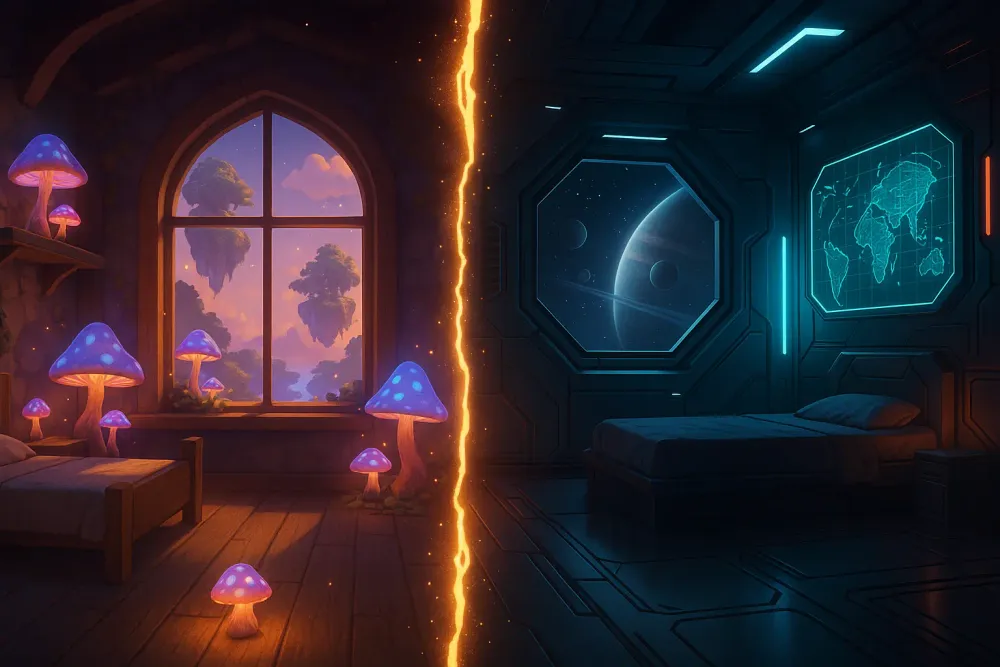
You asked specifically about Level 4, and it deserves the spotlight. Final Dawn paints the world in two complementary lanes: one player is Blue, the other is Red. Each carries a color-coded blaster; targets, switches, shields, and barriers exist in Red or Blue—and only the matching player can affect them.
This chapter demands constant callouts and counted timing:
- Color targets: Blue breaks blue plates, Red clears red seals. Progress often requires simultaneous shots that open mirrored routes.
- Cover swaps: Mobile color shields block incoming fire from the opposite hue; you trade cover rhythmically (“three, two, one—push!”).
- Synchronized bridges: Twin bridges activate only when both color switches are hit within the same beat.
- Boss finale: A core alternates Red/Blue phases. The non-matching player peels adds and breaks barriers while the partner lands precise core hits—then you swap.
We loved it because nobody carries: both are indispensable. It feels like a tactical dance—clear roles, constant handoffs, and that electric moment when a perfectly timed double-shot opens an entire lane.
🎮 Controls, feel, and fair challenge (PS5)
On PS5 the controls feel razor-clean. Haptics communicate fine states: light resistance when color shields cross; a satisfying click on simultaneous switch hits; a gentle pulse when a target is active for you. Movement is springy, jumps are precise, and contextual actions snap without stickiness.
Crucially, the game communicates responsibility. When we missed a sequence, we always knew why: timing off, line missed, or the wrong color engaged. Clear failure states make retries energizing, not demoralizing. For kids, input leniency and wider timing windows can be toggled granularly—helpful without diluting the design.
🧠 Puzzle language – Teaching without talking
The best co-op puzzles teach through doing. Early rooms quietly demonstrate rules: a target pulses only in “your” color, a dual switch glows bright only when both hits land on beat, a soft metronome tick invites counting aloud. Later, the game chains this grammar—hold, shift, double, rotate, release—and because you’ve internalized the basics, complexity feels natural, not obstructive.
We developed a family shorthand: “Blue bridges,” “Red covers,” “double on three,” “swap color—now.” It’s like learning a choreography together.
👨👧👦 A dad-and-daughter perspective
Family co-op lives or dies on communication. Split Fiction demands it—in the best sense. Missions require simultaneity and purpose: “You open, I secure.” “Blue left, Red right.” “Two, one—fire!” Because of that, support actions feel as heroic as frontline moments. My daughter and I traded responsibilities chapter by chapter. When she led, I listened to her count; when I led, she shielded my route. We ended sessions feeling like a team, not just two people sharing a screen.
The difficulty hits the family sweet spot: challenging, never cruel. Quick resets keep flow high; chapter checkpoints make it easy to stop after a win and resume fresh the next night.
🎨 Art, sound, and presentation
Visually, Split Fiction prioritizes clear silhouettes and saturated accents that preserve readability in two-player chaos. Materials shift chapter to chapter—paper, chrome, neon, glass—yet palettes stay coherent. In Final Dawn, color is not just style, it’s system: Red/Blue cues are instantly legible, and HUD icons reflect your current state.
Audio coaches subtly: layers audibly lock when your actions sync; gentle dissonance appears when you drift apart. On PS5, the DualSense speaker adds tiny “click” and “ping” cues that help with timing without cluttering the mix.
⚙️ Performance, options, and Practicalities
Technically polished: short load times, stable frame rates, seamless transitions, and robust online sessions. The options menu is family-friendly: subtitle scaling, color-vision palettes, brightness profiles, couch vs. headset audio mixes, and per-player input remaps. Assists are finely scoped—smooth specific spikes in timing, aiming, or platforming rather than flipping a catch-all easy mode.
Friend Pass returns for inviting another household. Cross-progression saves arguments about who’s hosting the save file.
🔁 Replay value – Second seats, new sheets
Because roles and abilities rotate, a second run genuinely feels different. If you shot the Red route in Final Dawn the first time, try Blue: sightlines, cover points, and priorities shift. Optional challenge rooms push the core ideas to their limit. Mini-games—rhythm duels, tether races, color courses—make perfect best-of-three snacks before bedtime.
🧱 Where it falls short (a little)
Honest note: the story is fine, not unforgettable. The metaphors land, but the emotional peak sits a hair below It Takes Two. A couple late sequences ask for nearly frame-perfect doubles; with leniency toggles they’re manageable, but younger kids may need a few attempts. Finally, one or two mini-games feel like sketches beside the main campaign. None of it dents the core achievement: cooperation stays consistently joyful.
💰 Platforms, friend pass & unbeatable value
Here’s the practical magic that makes Split Fiction such an easy recommendation: the Friend Pass. Just like It Takes Two before it, only one person needs to actually own the game — your co-op partner can download a free companion client and play the entire campaign with you. For a family, that’s enormous: one purchase entertains two people from start to finish, with no second copy required. It also works for online play with a friend who doesn’t own it, and the game even supports cross-play between platforms.
And those platforms are plentiful: Split Fiction launched across PS5, Xbox Series X|S, PC, and Nintendo Switch 2, so whatever’s under your TV, you’re covered (we played on PS5 and it’s superb there). At a single full-price purchase that covers two players for a 12–16 hour campaign — plus replay value and challenge rooms — the cost-per-hour-of-shared-fun is among the best in gaming.
It’s worth noting the pedigree, too: this is the work of Josef Fares and Hazelight Studios, the co-op specialists who don’t make anything but two-player games, and Split Fiction arrived to rapturous reviews and major Game of the Year buzz — cementing Hazelight as the undisputed kings of the genre. When you buy it, you’re getting the current state of the art in cooperative design from the only studio fully dedicated to it. For the price of one game that two can play, it’s close to an essential purchase for any co-op-loving household.
🏆 Why it belongs in “best co-op games for dads & families”
Because it’s built for us. Sessions can be short yet satisfying; failures reset fast; assists respect the challenge; and the game treats support as co-heroic. It invites conversation, celebrates problem-solving, and turns timing into trust. If you value games that strengthen family rhythms—listening, counting, encouraging—Split Fiction is a gift.
In a direct comparison, we still prefer It Takes Two by a whisker—nostalgia counts, and its emotional arc hits harder. But minute to minute, Split Fiction is every bit as clever, often trickier, and constantly surprising. It’s the rare sequel that understands what we loved and asks for even better teamwork.
Pros
- Relentlessly inventive co-op mechanics; both roles are indispensable
- Final Dawn (Level 4): color-coded blasters/targets enforce true synchronization
- Strong accessibility settings and fair checkpoints; ideal for families
- Chapter-by-chapter mechanic rotation keeps the flow fresh
- Excellent feel on PS5: haptics, fast loads, clear readability
Cons
- Story is solid but less affecting than It Takes Two
- A few late sequences require very precise timing
- Some mini-games feel slight beside the main campaign
🗣️ Conclusion
Split Fiction is exactly what we hoped for after It Takes Two: sharper puzzles, a bolder co-op vocabulary, and a crystal-clear belief that two people together can do impossible things. It’s challenging without cruelty, playful without filler, generous without condescension. As a dad-and-kid experience, it sparks conversation, trust, and plenty of high-fives. We still rank It Takes Two a touch higher emotionally—but this is an instant classic for family co-op nights, on PS5, Xbox or Switch 2.
📌 FAQ – Frequently asked questions
Is *Split Fiction* good for kids?
Do both players always have meaningful roles?
How long is the campaign?
What makes Level 4, Final Dawn, special?
Keep this in your inbox
One email a week: what we actually watched, built and reviewed — the stuff worth a dad's time. No hype, no daily spam.
Dadnology Weekly
One email a week: the LEGO, gaming and movie news worth a dad's time — plus what we actually reviewed. No hype, no daily spam.
Disclaimer: This review and its visuals were created with the help of AI. Some links may be affiliate links – we may earn a commission if you make a purchase, at no extra cost to you.
Current deals in Gaming
Verified live discounts tracked on Amazon

Gaming · Tested by Dadnology
Marvel’s Spider-Man 2 (PS5)
5/5“Bigger, bolder, near-perfect superhero storytelling”Read our review
Gaming · Tested by Dadnology
Assassin's Creed: The Ezio Collection
4.5/5“The game that fixed everything and gave us Ezio”Read our review
Gaming · Tested by Dadnology
The Last of Us Part I (PS5)
5/5“A masterpiece rebuilt for the modern era”Read our reviewYou might also like
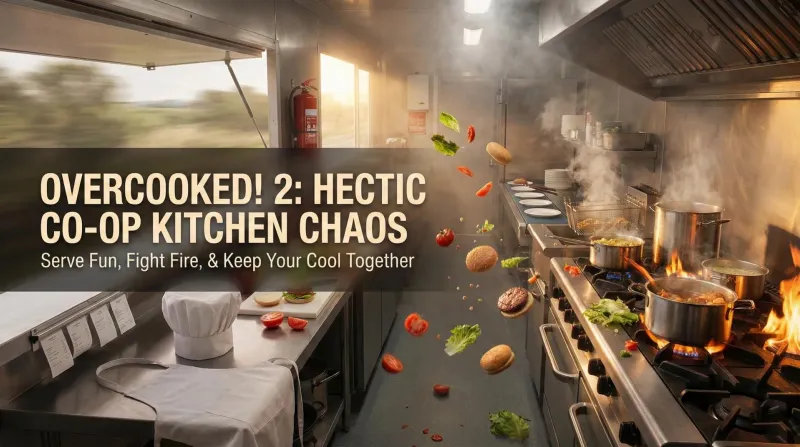
Overcooked! 2 – Hectic co-op chaos that always serves fun
We’ve poured many evenings into Overcooked! 2 and still shout “Order up!” like it’s new. It shines with two players and scales to chaotic parties, turning teamwork—roles, callouts, timing—into pure fun. The story is secondary, but the campaign’s variety and clever gimmicks keep sessions fresh. It’s easy for kids to grasp, hard to perfect, and perfect for short bursts. Across Switch, PlayStation, and Xbox, it’s a reliable co-op classic. Our verdict: a delicious, frantic 4.5/5.
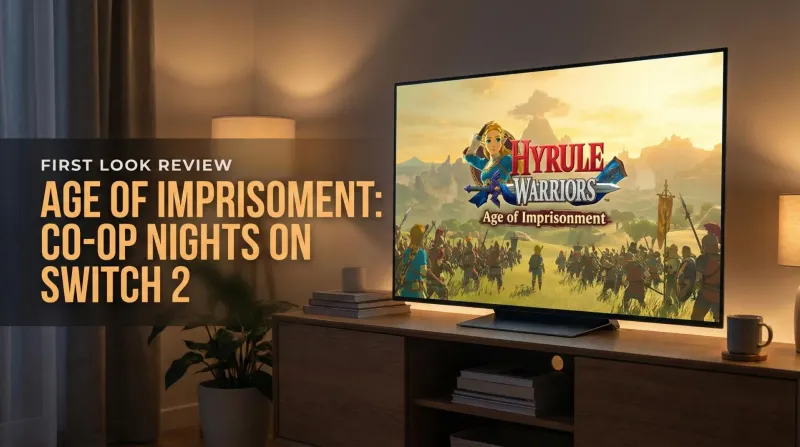
Hyrule Warriors: Age of Imprisonment – First Look for co-op nights on Switch 2
Our First Look says: it’s more of what works. Age of Imprisonment doubles down on breezy, Zelda-flavored crowd combat and quick progress pop-ups that suit a busy parent schedule. With local co-op, you’ll clear lanes, sync specials, and flip the map in 20–30 minutes. It rarely surprises, but it consistently entertains, especially if you love the BOTW/TotK era. As a fresh Switch 2 blockbuster, it’s an easy weeknight pick—turn your brain off, count down “now!”, and watch a fortress fall.
Best co-op games to play with your kids – A dad's guide
Our definitive family co-op list celebrates games that bring people together – the inventive brilliance of *It Takes Two* and *Split Fiction*, and the timeless joy of Nintendo classics. Whether you’re laughing, shouting, or high-fiving, these are the titles that turn game nights into family memories.