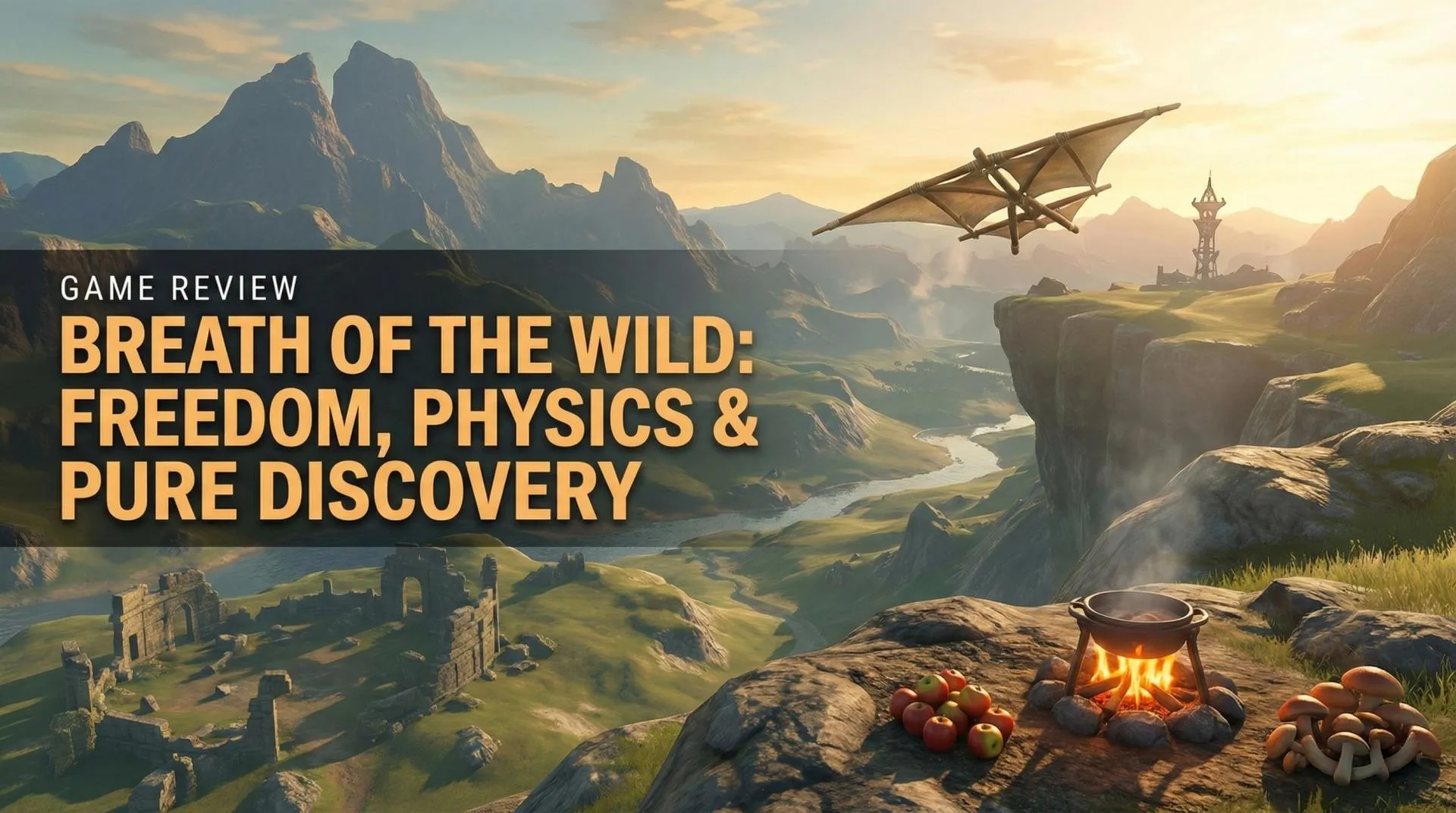
The Zelda Wild Saga: Hyrule’s Rebirth, emergent wonders, and the poetry of play.
A deep-dive into the Switch-era of Zelda. Why Breath of the Wild and Tears of the Kingdom redefined storytelling through total player agency.
This post contains affiliate links. We may earn a commission if you make a purchase, at no extra cost to you. As an Amazon Associate, Dadnology earns from qualifying purchases.
🍃 The discovery of silence: A 5/5 introduction
🗡️ This review is part of our The Legend of Zelda Hub — every mainline game reviewed and rated, plus the movie news and the LEGO Zelda sets.
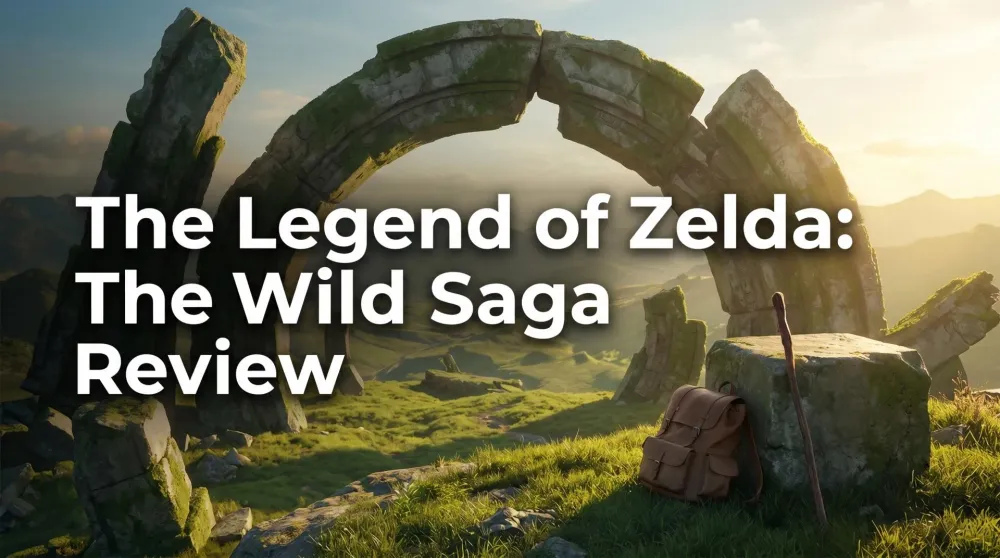
There is a singular, crystalline moment that every player of the Wild Saga carries with them forever. Link emerges from the dark, cold Cave of Resurrection, the camera sweeps across the vast, sun-drenched Great Plateau, and a minimalist, haunting piano theme swells in the background. In that instant, it becomes clear: this is not a game that intends to hold your hand. It is an invitation to inhabit a world.
At Dadnology, we’ve often debated whether a game can truly be a “Living Novel” if it lacks traditional, hour-long cutscenes or a script the size of a Tolstoy epic. The answer provided by directors Hidemaro Fujibayashi and Eiji Aonuma is a resounding “Yes.” The history of Hyrule isn’t told to you; it is discovered by you. It is the story of a world recovering from an apocalypse, and a hero whose greatest attribute isn’t his master sword, but his curiosity.
The combination of The Legend of Zelda: Breath of the Wild (BotW) and Tears of the Kingdom (TotK) represents the most significant evolution of the third-person action-adventure since Ocarina of Time. It is a 5/5 experience that proves freedom is the most powerful narrative tool a developer possesses. Over the next 2,000 words, we will break down why this saga is the pinnacle of systemic storytelling and the ultimate “Dad-escape.”
🌍 Hyrule as the protagonist: A world that breathes
In most open-world games, the environment is a backdrop—a stage for the actors. In the Wild Saga, Hyrule is the main character. Nintendo pioneered the “Open Air” philosophy, where every sightline is a promise. If you see a mountain in the distance, you can not only go there; you can climb every inch of it.
🏛️ The geography of melancholy (BotW)
In Breath of the Wild, Hyrule is a beautiful cemetery. The ruins of the Temple of Time, the rusted husks of Guardians scattered across the fields—everywhere you look, you feel a sense of “Archaeological Awe.” As a Dad, you often find yourself just standing by Lake Hylia, watching the sunset. The game respects silence. It doesn’t force an objective marker down your throat; it lets you feel the weight of a century of solitude.
🌌 The vertical expansion (TotK)
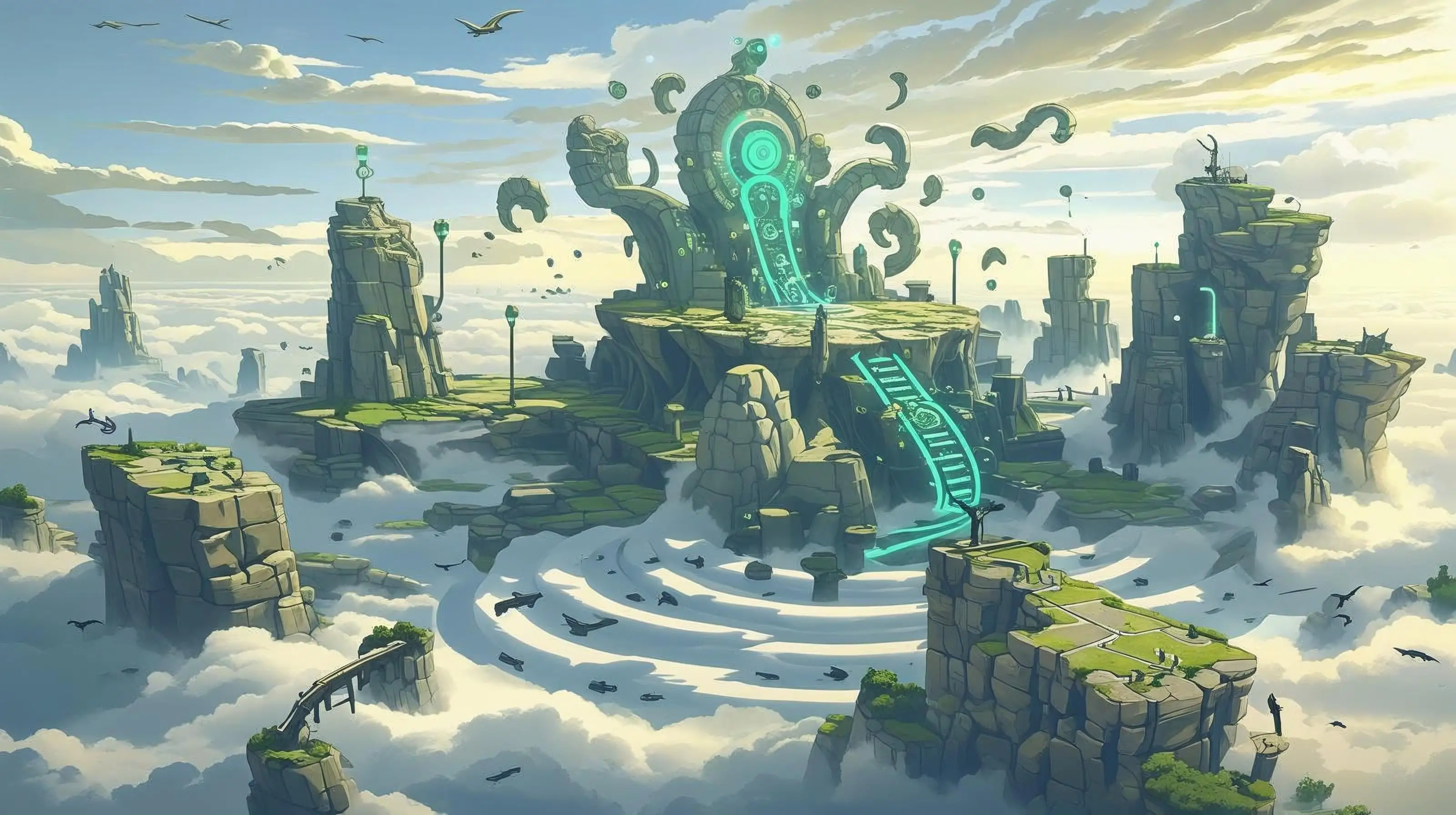
Tears of the Kingdom takes this established world and unfolds it like a pop-up book. We now have three layers: the Sky Islands, the Surface, and the Depths. While the sky offers a feeling of lightness and ethereal wonder, the Depths provide a claustrophobic, survival-horror experience. This contrast ensures that even after 200 hours in BotW, the familiar map of Hyrule feels dangerous, new, and vertically staggering.
🧪 The systemic revolution: Physics and chemistry
What separates this saga from Spider-Man or Uncharted is the complete absence of “scripts” in the world. If a bridge collapses in Uncharted, it’s because the director wanted a cinematic moment. In Zelda, the bridge collapses because you shot a fire arrow at a red barrel, which ignited a nearby rope, which was under tension due to the weight of a Moblin.
🧲 The chemistry engine
Nintendo created a world that follows logical, physical rules. This is what we call “Systemic Gameplay”:
- Fire: Burns wood, creates updrafts, melts ice, and spreads through dry grass.
- Electricity: Conducts through metal and water (a deadly lesson to learn during a thunderstorm!).
- Cold: Freezes water into walkable platforms and turns enemies into ice blocks.
🏗️ Ultrahand: Engineering for the modern dad
In Tears of the Kingdom, this systemic approach reaches its zenith with the Ultrahand. You can literally glue anything to anything. Want to build a tank? A hoverbike? A giant flamethrower-wielding robot? You can.
For the Dadnology community, this is the ultimate “Dad-playground.” it awakens the inner engineer. You’ll find yourself spending 45 minutes building a complex bridge over a ravine just to see if the physics hold. It is the digital equivalent of building LEGO sets on the living room floor—except the results can breathe fire. It’s a masterclass in problem-solving that rewards your intelligence over your button-mashing skills.
| System | Breath of the Wild | Tears of the Kingdom | Dad-Rating |
|---|---|---|---|
| Movement | Climb & Glide | Fly & Build Vehicles | 10/10 - Pure Freedom |
| Puzzle Design | Static Shrines | Open-Ended Solutions | 9/10 - Rewarding IQ |
| Combat | Resource Management | Fuse System (Synergy) | 10/10 - Endless Variety |
| Atmosphere | Melancholic/Quiet | Epic/Heroic | 10/10 - Masterful Pacing |
🎭 A story told in fragments: The narrative heart
The critique that Zelda “doesn’t have a story” is fundamentally flawed. The Wild Saga utilizes Environmental Storytelling in its purest form.
📸 The memories (BotW)
Because Link lost his memory, we find the story through “Recovered Memories.” These short, emotional vignettes show a Princess Zelda struggling with her destiny and a group of Champions who felt like a family. It’s a tragedy about failure. You arrive 100 years too late to the party, and your job is to pick up the pieces. This makes the eventual victory feel earned, not just scripted.
🐉 The dragon’s tears (TotK)
In Tears of the Kingdom, the narrative becomes significantly more epic. The history of Hyrule’s founding and the ultimate sacrifice of Zelda are heart-wrenching. When you finally understand what the “tears” truly represent, it’s a narrative gut-punch that rivals the best moments of The Last of Us. It is a story about the long game—about how hope can survive for millennia if someone is willing to carry the torch.
🎮 A technical miracle on aging hardware
Let’s address the elephant in the room: the Nintendo Switch hardware is, in 2026, a relic. And yet, what Nintendo has achieved here defies logic.
🎨 Art direction over pixel density
Nintendo proves that excellent Art Direction (Studio Ghibli meets Impressionism) is more timeless than 4K textures. The way the light hits the autumn leaves in Akkala or the way a storm rolls over the Faron rainforest is more beautiful than many ray-tracing demos. It’s about the feeling of a place, not the polygon count.
⚡ The Impossible physics
It is a technical miracle that Tears of the Kingdom runs as well as it does. The ability to dive from the sky through a cloud layer down to the surface, and then drop into a hole into the Depths—all without a single loading screen—is a feat of optimization that puts billion-dollar PC ports to shame. The physics engine alone is a “Black Box” of development magic that other studios are still trying to deconstruct.
🧔 The Dadnology perspective: The ultimate respect for time
As Dads, our free time is a precious commodity. We have 20 minutes before a meeting or an hour after the kids go to bed.
⏱️ The king of the standby mode
The Switch is the greatest device for fathers. Click the power button to sleep, click it again to wake up—you are exactly where you left off. Zelda supports this perfectly. You can set a goal: “In this session, I will solve just one Shrine.” Or, “I’m just going to gather some hearty radishes for a meal.”
👨👦 Educational “watch-along”
Zelda is one of the few games on this list you can play with your kids on your lap. More than that, kids are often better “engineers” than we are. I’ve seen my son suggest using an Octo-balloon to lift a platform I was stuck on. It’s a collaborative problem-solving experience that builds bonds. It’s non-toxic, imaginative, and purely magical.
💾 No artificial grind
Zelda respects your time because there is no traditional “Leveling Up.” You don’t get stronger because a number goes up; you get stronger because you understand the world better. You learn how to cook, how to use the wind, and where to find the best materials. This is the most honest “Return on Investment” for our gaming hours.
🏹 The weapon durability debate: A dad’s defense
Yes, weapons break. In Breath of the Wild, this was a point of contention for many. But in the context of a “Living Novel,” it is a brilliant decision. It prevents you from becoming a “one-trick pony.” It forces you to engage with the world. You aren’t an invincible god with an infinite sword; you are a survivor.
In Tears of the Kingdom, this was perfected through the Fuse system. Now, a broken weapon is just a base for a new idea. Glue a boulder to a stick and you have a hammer. Glue a rocket to a shield and you have a jetpack. Nintendo took a point of frustration and turned it into a creative engine. It turns every combat encounter into a “What do I have in my pockets?” riddle.
🔊 The soundscape of the wild
The audio design in this saga is reference-quality. Instead of a bombastic orchestra constantly blaring in your ears, you hear the crunch of footsteps on different terrains, the distant rumble of thunder, and the rustle of leaves. The music is “reactive”—a lonely cello or a jazzy piano improvisation that kicks in only when something interesting happens. It creates an immense sense of immersion. When you use the 8BitDo Ultimate Controller, you feel the subtle haptic feedback of a bowstring being pulled, adding a tactile layer to the auditory brilliance.
🗺️ The epilogue of exploration
When you finish Tears of the Kingdom, you don’t just feel like you’ve “beaten a game.” You feel like you’ve completed a journey. You know the geography of Hyrule as well as your own neighborhood. You remember the time you got caught in a blizzard in the Hebra mountains and barely survived by lighting a torch. You remember the feeling of finally reaching the top of a Sky Island and looking down at the world you’ve spent 100 hours saving.
This is the “Living Novel” at its peak. It’s not about following a script; it’s about the stories you created. The time you tried to fly a wing over a mountain and ran out of battery, only to glide down into a hidden grove you never would have found otherwise. Those are the stories that stick with you.
Build it: the wild era’s defining build is the LEGO Zelda Great Deku Tree review.
The final verdict: A monument to the medium
The Zelda Wild Saga is the quintessence of what video games can be. It is less a “playable movie” like Uncharted and more a “collaborative poem.”
Breath of the Wild taught us how to wonder at the world again. Tears of the Kingdom taught us how to wonder at our own ingenuity. Together, they form an epic that belongs in every gamer’s “Hall of Fame.” These are games you don’t play just to finish; you play them to exist within them. For every Dad who wants to recapture the magic of discovery, who wants a game that respects his time and rewards his brain, there is no substitute.
Final Rating: 5/5 — The Ultimate Manifesto of Freedom
Related Dadnology review: Metroid Prime 4: Beyond – First Look on Switch 2 (and Switch 1)
❓ FAQ: Everything an explorer needs to know
Should I play Breath of the Wild before Tears of the Kingdom?
Is the game too difficult for a casual Dad?
How many hours should I expect to invest?
Are there classic dungeons like in the old Zelda games?
What’s next for the Living Novel?
We’ve charted the wilds of Hyrule and mastered the laws of physics. But the call of adventure doesn’t end in fantasy realms. Next, we’re lacing up the boots of an icon who was raiding temples long before Link ever left his cave. We look at the woman who defined the third-person action genre for a generation. Get ready for the survivalist: We are diving into the Tomb Raider Survivor Trilogy.
Keep this in your inbox
One email a week: what we actually watched, built and reviewed — the stuff worth a dad's time. No hype, no daily spam.
Dadnology Weekly
One email a week: the LEGO, gaming and movie news worth a dad's time — plus what we actually reviewed. No hype, no daily spam.
Disclaimer: This review and its visuals were created with the help of AI. Some links may be affiliate links – we may earn a commission if you make a purchase, at no extra cost to you.
Current deals in Gaming
Verified live discounts tracked on Amazon

Gaming · Tested by Dadnology
Marvel’s Spider-Man 2 (PS5)
5/5“Bigger, bolder, near-perfect superhero storytelling”Read our review
Gaming · Tested by Dadnology
Assassin's Creed: The Ezio Collection
4.5/5“The game that fixed everything and gave us Ezio”Read our review
Gaming · Tested by Dadnology