
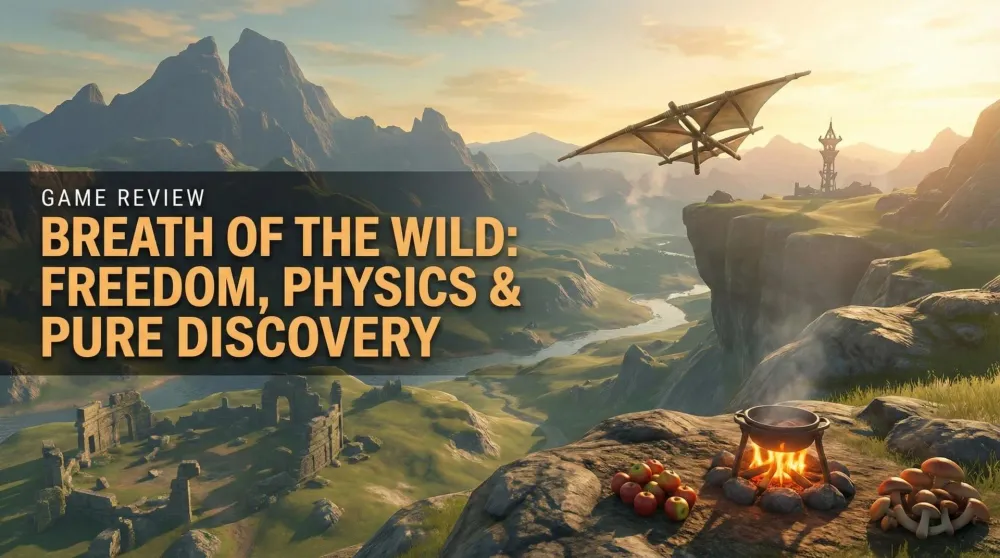
The Legend of Zelda: Breath of the Wild – Freedom, physics, and pure discovery
Zelda reinvented: a physics-driven sandbox where weather, elements, and creativity power truly open-ended play.
This post contains affiliate links. We may earn a commission if you make a purchase, at no extra cost to you. As an Amazon Associate, Dadnology earns from qualifying purchases.
🎮 Introduction
🗡️ This review is part of the The Zelda Wild Saga – play Breath of the Wild and Tears of the Kingdom in order.
When Breath of the Wild was unveiled, I’ll admit I was skeptical. Losing the classic dungeon–item cadence felt like sacrilege. Then I started playing—and every worry evaporated. Hyrule didn’t just get bigger; it became coherent. Wind pushes fire; rain smothers it; metal attracts lightning; updrafts lift gliders; bombs and physics solve as many “puzzles” as keys ever did. It’s the rare open world that trusts players to be clever and rewards them for it. I spent countless hours wandering, tinkering, and telling my own tiny stories—one cliff, one storm, one campfire at a time.
For families, that trust is magic. Kids try wild ideas; parents smile as the world says, “Yes, that works.” And today, revisiting on Switch 2 enhances the experience—snappier loads, steadier feel—without changing the soul that made it special.
🌍 Hyrule without fences
From the first vista on the Great Plateau, BOTW whispers a simple rule: If you can see it, you can probably reach it. Climb almost anything, chart your own routes, and scan for points of interest by shape, smoke, and motion rather than map icons. That one decision—universal climbing with stamina—turns the landscape into a puzzle box. Peaks are not walls; they’re invitations.
For dads playing in short evening slices, that openness matters. You don’t need a quest marker to feel purposeful. Pick a ridge. Chase a dragon’s shadow. Glide to a suspicious ruin. Progress can be curiosity-led, not checklist-led.
🧪 A physics & chemistry playground
The genius of BOTW is its systemic consistency. Elements interact logically, enabling emergent solutions:
- Fire & Wind: Grass burns into updrafts; fan them with Korok Leaves to launch yourself.
- Electricity & Metal: Drop metal weapons to bridge circuits or bait lightning safely away.
- Ice & Water: Freeze rafts with Cryonis to cross rivers or pop ice under enemies’ feet.
- Momentum: Stasis a boulder, stack charged hits, and ride the kinetic release across a chasm.
This isn’t cosmetic cleverness; it’s a toolbox. The world responds the way you think it should, which empowers experimentation. Failures teach. Successes feel like yours.
🧭 Shrines: Bite-size brilliance
Instead of monolithic dungeons, BOTW scatters Shrines—micro-dungeons that test single ideas: magnetism lines, ballistics, motion puzzles, electricity routing, launch physics, combat trials. As a parent, I love Shrine pacing. A single Shrine fits a 15–20 minute window. You can finish one between dinner and bedtime, earn a Spirit Orb toward hearts/stamina, and save anywhere. It’s the ideal loop for family evenings.
And because Shrines emphasize concepts over keys, kids quickly internalize verbs—freeze, push, lift, launch—then remix them outdoors. The world becomes the “big Shrine.”
⚔️ Combat: Improvisation over loadouts
Weapon durability is controversial, but it nudges improvisation. You rotate spears, swords, boomerangs, and elemental rods; you kite enemies into hazards; you Perfect Dodge for flurry rushes; you bomb from above; you surf shields in chaos and laugh when it works. Fights aren’t about grinding gear scores; they’re about reading situations.
Teaching kids to observe tells (a Hinox eye blink, a Lynel shoulder dip) becomes a shared vocabulary—“Wait… now!”—and when a plan lands, the victory belongs to both of you.
🌦️ Weather: A real system, not a skybox
Weather isn’t backdrop; it’s mechanic. Rain cancels easy climbing but opens stealth approaches and rain-powered strategies. Storms force metal management or turn the field into a lightning weapon if you set it up. Heat and cold demand cooking, elixirs, or clever outfits. The result isn’t busywork; it’s adventure texture. Hyrule feels alive because it can ruin a plan—and gift you a better one.
🍳 Cooking & preparation
Cooking is light survival with creative dividends. Mix buffs (speed, stealth, attack up) into short, meaningful timers; teach kids cause and effect with a cauldron and a goofy jingle. It’s also an elegant difficulty slider: if something’s hard, prepare smarter. No menus of perks—just ingredients, curiosity, and the world’s feedback.
🗺️ Exploration: Seeing is the quest
BOTW replaces many waypoints with landmark-led exploration. Towers reveal topography, not icons, so you’re reading the land like a hiker: river bends, plateaus, shadowed valleys. You mark your own pins—dragons’ routes, suspicious ruins, labyrinth corners. The act of observing becomes progress, and the map grows with you, not at you.
🧩 Creative freedom: Stories we tell ourselves
Some favorite family micro-stories:
- A single Octo balloon, a stasised rock, and a lucky gust turned into a flying mine over a Bokoblin fort.
- We laid metal weapons to reroute lightning through a Moblin duo while we hid under a wooden awning, cackling.
- A badly timed rainstorm wrecked our climb—so we cooked stealth meals and crawled through grass to steal a Lynel’s bow instead.
None of these were scripted. BOTW authorizes nonsense—and often rewards it.
🛠️ Progression & pace
Hearts vs. stamina is a meaningful choice: combat confidence or exploration reach. Armor sets grant toys (stealth, swim speed, heat/cold resistance). Side quests are often breadcrumbs to systems—photo compendiums, stable circuits, horse taming, labyrinths. You progress even on “unproductive” nights because knowledge is upgrade #1.
👨👧 Dad & kid: Why it works for families
- Session-friendly: Shrines and short routes let you play meaningfully in 20–30 minutes.
- Coaching without railroading: You can help with ideas while letting kids execute.
- Safe failure: Autosaves and generous checkpoints keep experiments low-stress.
- Creativity payoff: Kids see physics “truths” stick—fire spreads because wind, not because a quest said so.
Even solo, BOTW becomes a shared conversation: “Did you try…?” turns into tonight’s plan.
🗡️ The expansion pass: More Hyrule, harder Hyrule
Worth knowing before you buy: Breath of the Wild has a two-part Expansion Pass that’s well worth the investment if the base game sinks its hooks in, and it’s bundled into some editions. The first pack, The Master Trials, adds Master Mode — a tougher difficulty where enemies regenerate health and float on sky platforms, turning Hyrule into a genuine test for veterans who’ve outgrown the standard challenge. It also adds Trial of the Sword (a gauntlet of combat rooms that fully powers up the Master Sword) and the brilliant Hero’s Path mode, which traces your last 200 hours of movement on the map — a fascinating, oddly emotional record of your personal journey across Hyrule.
The second pack, The Champions’ Ballad, is the meatier one: a full new questline that deepens the four Champions’ backstories, a clutch of fresh shrines, the motorbike-like Master Cycle Zero as a reward, and some of the toughest combat trials in the game. For a family, the Champions’ Ballad is the closest BOTW gets to a classic, structured Zelda dungeon experience, which makes it a satisfying “main course” once kids have found their feet in the open world.
Is it essential? No — the base game is already a complete masterpiece. But if Breath of the Wild becomes a household staple (and it tends to), the Expansion Pass extends its life considerably and gives skilled players a reason to climb back into the saddle. It’s the rare DLC that respects both the lore and your time, and Hero’s Path alone is worth a look just to marvel at how far you’ve wandered.
🧱 Critiques (small but real)
- Weapon durability can feel punitive at first; it settles once you embrace improvisation.
- Rain climbing frustration is genuine; plan routes, cook stamina/anti-slip food, or wait out storms at a campfire.
- Sparse story beats between great moments; this Zelda is experiential first, narrative second.
None of these dim the core achievement: a world that trusts you.
🚀 Switch 2 compatibility & improvements
Playing on Switch 2 doesn’t remake the game, but it sharpens it in the ways that matter to busy families:
- Faster load times: Snappier boots, quick reloads after experiments gone sideways.
- More stable performance: Smoother traversal in busy zones; fewer dips during large effects storms.
- Cleaner image: A clearer picture in handheld and docked play, making distant landmarks and Shrine silhouettes easier to read.
The net effect: BOTW’s wander-and-tinker cadence feels silkier, which encourages more experimentation per session. It’s still the same masterpiece—just less friction between ideas and attempts.
🧭 Legacy & the 3D Zelda crown
For me, Ocarina of Time remains the quintessential 3D Zelda—the moment Zelda learned to sing in three dimensions. But Breath of the Wild matches it by re-teaching us how to play. Where Ocarina defined structure, BOTW defined possibility. One is a symphony with movements; the other is a jazz session where you’re on stage. Different virtues, same greatness. I happily call them co-champions.
💡 Tips for parents starting fresh
- Upgrade stamina early if exploration calls to you; hearts if kids prefer fighting.
- Carry wood + flint to set campfires and manage time/weather.
- Use markers generously—dragon arcs, ore veins, tough camps to revisit.
- Cook purposefully (speed for climbs, stealth for raids, attack for bosses).
- Teach verbs, not routes: “What could Stasis do here?” beats “Go left.”
Pros
- Coherent physics and chemistry systems that reward creativity
- Climb-anything exploration and landmark-led discovery
- Shrine structure perfect for short, meaningful sessions
- Emergent combat that prizes observation over grind
- Switch 2 boosts: faster loads, steadier feel, cleaner image
Cons
- Weapon durability divides players until improvisation clicks
- Rain can stall climbs without prep or patience
- Story cadence is lighter than classic dungeon Zeldas
From the game to the shelf: the Great Deku Tree presides over Korok Forest — build the 2-in-1 with the LEGO Zelda Great Deku Tree review.
🗣️ Conclusion
Breath of the Wild didn’t just refresh Zelda; it refreshed how we think about open worlds. It trusts your curiosity, pays off experimentation, and turns Hyrule into a living lab where weather, elements, and physics make sense. I went in skeptical—left convinced. On Switch 2, the experience tightens further, inviting still more “what if?” moments after work or before bed. For me, it now shares the 3D crown with Ocarina of Time: two masterpieces, two philosophies, one timeless adventure.
For a family deciding where to spend their money, the calculus is simple: Breath of the Wild is the purest, cheapest entry into one of gaming’s greatest worlds, perfect for short bursts and shared “did you try…?” experimentation, and now smoother than ever on Switch 2. If your household only buys one Zelda, the richer Tears of the Kingdom edges it for sheer feature count — but BotW remains the cleaner first taste of that climb-anything magic, and the Expansion Pass keeps it alive for years. Either way, this is essential, generation-spanning gaming that turns a quiet evening into a shared adventure. A genuine all-time classic, and the game we’d point to first when someone asks what video games can really be.
📌 FAQ – Frequently asked questions
Is Breath of the Wild good for short sessions?
What’s the biggest difference versus classic Zelda?
Does Switch 2 improve the experience?
Is weapon durability a deal-breaker?
Keep this in your inbox
One email a week: what we actually watched, built and reviewed — the stuff worth a dad's time. No hype, no daily spam.
Dadnology Weekly
One email a week: the LEGO, gaming and movie news worth a dad's time — plus what we actually reviewed. No hype, no daily spam.
Disclaimer: This review and its visuals were created with the help of AI. Some links may be affiliate links – we may earn a commission if you make a purchase, at no extra cost to you.
Current deals in Gaming
Verified live discounts tracked on Amazon

Gaming · Tested by Dadnology
Marvel’s Spider-Man 2 (PS5)
5/5“Bigger, bolder, near-perfect superhero storytelling”Read our review
Gaming · Tested by Dadnology
Assassin's Creed: The Ezio Collection
4.5/5“The game that fixed everything and gave us Ezio”Read our review
Gaming · Tested by Dadnology
The Last of Us Part I (PS5)
5/5“A masterpiece rebuilt for the modern era”Read our reviewYou might also like
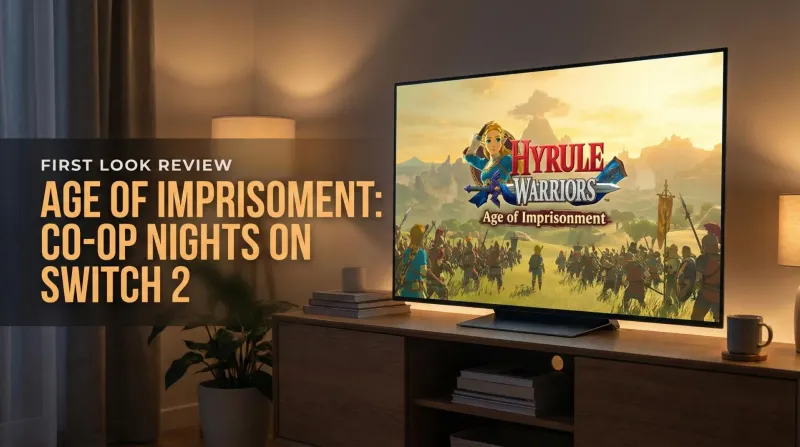
Hyrule Warriors: Age of Imprisonment – First Look for co-op nights on Switch 2
Our First Look says: it’s more of what works. Age of Imprisonment doubles down on breezy, Zelda-flavored crowd combat and quick progress pop-ups that suit a busy parent schedule. With local co-op, you’ll clear lanes, sync specials, and flip the map in 20–30 minutes. It rarely surprises, but it consistently entertains, especially if you love the BOTW/TotK era. As a fresh Switch 2 blockbuster, it’s an easy weeknight pick—turn your brain off, count down “now!”, and watch a fortress fall.

The Legend of Zelda (NES) review: Where it all began
The original Legend of Zelda is one of the most important games ever made: an open world before open worlds existed, built on curiosity, secrets and trust in the player. It is cryptic in places, but it has aged far better than it has any right to. Played on the Game & Watch it is pure, distilled wonder. A 5/5 and the foundation of everything.
GTA 6 or Ocarina of Time: Two weeks apart, one budget
The Ocarina of Time remake lands November 5, GTA 6 on November 19. Two weeks, two very different players in the same house, one budget.