
Halo factions explained: Covenant, flood & Forerunners
A clear, spoiler-light guide to Halo's factions. Who the Covenant, the Flood, the Forerunners, and the Banished are — and why they matter to the saga's story.
This post contains affiliate links. We may earn a commission if you make a purchase, at no extra cost to you. As an Amazon Associate, Dadnology earns from qualifying purchases.
🌌 The powers that shape the saga
🪖 This guide is part of the Halo Universe Hub – your complete map of Master Chief’s saga.
You can absolutely enjoy Halo as a pure shooter — the gunplay carries it. But the reason the saga endures, the reason its lore is spoken of in the same breath as Star Wars, is the factions: a handful of powerful forces whose beliefs, hungers, and ancient secrets drive the entire story. Understand them, and Halo transforms from “great sci-fi shooter” into a genuinely epic tale about religion, extinction, and a mystery a hundred thousand years in the making.
At Dadnology we are going to explain the four factions that matter most — the Covenant, the Flood, the Forerunners, and the modern Banished — in clear, spoiler-light terms. No lore degree required. By the end, your next walk onto a ring will carry the weight it was always meant to.
🛐 The Covenant: A holy war against humanity
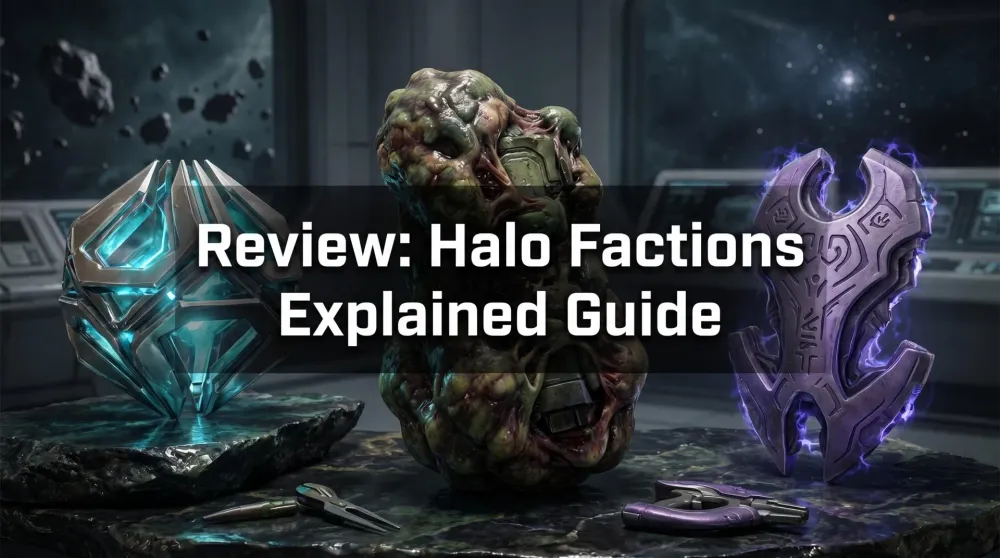
The Covenant are the primary enemy of the original trilogy, and the first faction every player meets. They are not a single species but a theocratic alliance of several alien races, bound together by a shared religion and ruled by leaders called the Prophets.
Their faith is built on the Forerunners (more on them below), whom the Covenant worship as gods. They believe the Halo rings are sacred objects that will trigger a “Great Journey” — a transcendence to godhood — when activated. The problem for us: the Covenant discover that humanity is connected to the Forerunners in a way that threatens this belief, and rather than accept it, the Prophets declare humans heretics and launch a genocidal holy war to wipe us out. That is the war you are fighting in Halo: Combat Evolved, Halo 2, and Halo 3.
The Covenant’s member species are the faction’s personality. Grunts are the cannon-fodder comic relief; Elites are the noble warrior caste (one of whom becomes the heroic Arbiter); Brutes are the savage muscle that rises to power in Halo 2 and 3; Jackals are the snipers and skirmishers; Hunters are the colossal living tanks. The genius of Halo 2 is that it shows you the Covenant from the inside via the Arbiter, turning a faceless enemy into a tragic, fractured civilization.
🦠 The Flood: The threat the Rings were built for
For the first half of Combat Evolved, you think the Covenant are the worst thing in the galaxy. Then you meet the Flood, and the entire story changes.
The Flood are a parasitic life form — a ravenous, infectious organism that takes over living hosts, reanimates their bodies as grotesque combat forms, and consumes everything in its path to spread. They are not soldiers with a cause; they are a plague with a hunger, a galaxy-ending threat that grows exponentially and cannot be reasoned with. Their introduction in the level “343 Guilty Spark” is one of gaming’s great tonal pivots, dropping a triumphant war story into outright body-horror.
Here is the crucial lore twist that ties everything together: the Halo rings were not built as weapons against the Covenant or humanity. They were built to stop the Flood. And the way they stop it is horrifying — which brings us to the Forerunners.
🏛️ The Forerunners: The gods who fired the Rings
The Forerunners are the ancient, vanished super-civilization at the heart of all Halo mystery. A hundred thousand years before the games, they were the dominant power in the galaxy — technologically godlike builders whose ruins and artifacts (including the Halo rings themselves) litter the universe and inspire the Covenant’s entire religion.
Their tragedy is the saga’s foundational myth. Faced with a Flood outbreak they could not defeat by force, the Forerunners built the Halo Array — a network of ring-shaped superweapons — as a last resort. When activated, the rings fire a pulse that kills all sentient life in the galaxy, starving the Flood of the hosts it needs to survive. To save the galaxy, the Forerunners chose to wipe it clean, sacrificing themselves and everything else, then vanished. They left behind a single safeguard: the promise that life would be reseeded, and that humanity — designated the “Reclaimers” — would one day inherit their mantle.
This is why the rings are so dangerous, why the Covenant’s worship is so misguided, and why Master Chief activating or not activating a ring is the central stakes of the whole series. The 343-era games (Halo 4 onward) dive deepest into the Forerunner mystery, introducing surviving Forerunner threats and the Chief’s role as the Reclaimer.
🪓 The Banished: The modern saga’s new threat
The classic three factions define the original trilogy, but the modern games introduced a fourth that now drives the current story: the Banished.
The Banished are a brutal mercenary warband — a faction of Covenant deserters, outcasts, and opportunists who broke away from the old religion and built their own army around strength rather than faith. They are led by Atriox, a colossal Brute warlord and one of the most genuinely intimidating villains the series has produced, a figure who survived doing the impossible: openly defying the Covenant and living.
First introduced in the strategy game Halo Wars 2, the Banished went on to become the main enemy faction of Halo Infinite, where they have seized the ring of Zeta Halo — which makes Infinite the one game to play if the Banished are the faction that grabbed you. They matter because they give the modern saga a fresh antagonist that is not tied to the old Covenant religion — meaner, more pragmatic, and more personal. If you want to understand Halo Infinite’s villains properly, Halo Wars 2 is where their story begins.
🧭 Why this all matters
Put the four together and the shape of the whole saga snaps into focus. The Forerunners built the rings to stop the Flood by sacrificing the galaxy. Aeons later, the Covenant misread those rings as holy and waged a genocidal war on humanity — the Forerunners’ true heirs — to protect a lie. Master Chief stands at the center of it: a human super-soldier, the Reclaimer, fighting the Covenant, containing the Flood, and unraveling the Forerunner mystery. And in the modern era, the Banished carry the torch as a new, religion-free threat.
That is the engine that makes Halo more than a shooter. Every firefight is a small part of a story about gods, extinction, faith, and inheritance. You do not need to know any of it to enjoy blasting Grunts — but once you do, the saga hits with the weight of genuinely great science fiction. The cheapest way to see all of it in sequence is the Master Chief Collection, which holds six of the games in one box. For the full play-by-play of which game tells which part, see our Halo play order guide and the timeline on the Halo Universe Hub.
🪖 The UNSC: Humanity’s stand
We have covered the enemies, but the saga’s fourth great power is the one you fight for: the UNSC — the United Nations Space Command, humanity’s military. They are the soldiers, the marines, the warships, and the scientists holding the line against extinction, and Master Chief is their ultimate weapon.
Two pillars of the UNSC matter most. First, the SPARTAN program — the secret project that took children, trained them mercilessly, and augmented them into super-soldiers like the Chief. It is humanity’s edge against the Covenant, and also one of the saga’s darker moral threads (the games and especially the novels never let you forget the cost of how the Spartans were made). Second, Cortana, the brilliant AI who partners with the Chief and carries much of the story’s heart. Understanding that the UNSC is outgunned and outnumbered — that humanity is genuinely losing this war for most of the saga — is what gives every victory its weight. You are not a conquering army. You are the last line.
🤖 The Prometheans and the Forerunner threat
One more faction is worth knowing for the modern games: the Prometheans. When 343 Industries took over with Halo 4, they introduced these robotic Forerunner constructs — ancient war machines, some of them made from converted humans, awakened to serve a surviving Forerunner villain. They are the enemy that signals the saga’s shift from the Covenant war to the deeper Forerunner mystery.
The Prometheans matter thematically because they make the Forerunners an active threat rather than just ancient history. For most of the original trilogy, the Forerunners are a vanished god-race you learn about through ruins and lore. The Reclaimer saga brings their legacy roaring back to life, forcing Master Chief to confront the builders of the rings directly. It is the franchise widening its scope from “a war against aliens” to “humanity’s place in a hundred-thousand-year-old cosmic story” — and the Prometheans are the foot soldiers of that pivot.
🧩 How the factions stack up
If you want the one-glance summary to keep in your head as you play:
- UNSC / Humanity — who you fight for; outnumbered, augmented, the Forerunners’ true heirs.
- The Covenant — the religious alien alliance trying to exterminate you over a holy lie.
- The Flood — the parasite that ends galaxies; the reason the rings exist.
- The Forerunners — the vanished gods who built the rings and chose humanity to inherit their mantle.
- The Prometheans — the Forerunners’ war machines, the modern saga’s new threat.
- The Banished — Atriox’s religion-free warband; the enemy of the current era.
Hold those six in mind and every cutscene, every codex entry, every enemy you meet slots neatly into the bigger picture.
And that is really the gift of understanding Halo’s factions: it turns a great shooter into a genuinely great story. Once you grasp that the Covenant’s war is built on a lie, that the rings are a desperate weapon against a galaxy-ending plague, and that humanity is the secret heir to a vanished god-race, the stakes of every mission deepen. The next time you fire the magnum at a Grunt or watch a ring rise over the horizon, you will feel the weight of a hundred-thousand-year saga behind it. If this whetted your appetite, the best next steps are to play it yourself — start with our play order guide — or to go deeper still with the novels via our Halo books reading order, where the lore runs deeper than any game could show.
❓ FAQ: Halo’s factions
Who are the Covenant in Halo?
What is the Flood in Halo?
Who are the Forerunners?
Who are the Banished in Halo?
Do I need to understand the factions to enjoy Halo?
Related Dadnology reviews: Retro Halo: Playing the Original Xbox in Co-op in 2026 · Halo Split-Screen & Co-op Guide: Play the Whole Saga Together
Keep this in your inbox
One email a week: what we actually watched, built and reviewed — the stuff worth a dad's time. No hype, no daily spam.
Dadnology Weekly
One email a week: the LEGO, gaming and movie news worth a dad's time — plus what we actually reviewed. No hype, no daily spam.
Disclaimer: This review and its visuals were created with the help of AI. Some links may be affiliate links – we may earn a commission if you make a purchase, at no extra cost to you.
Current deals in Gaming
Verified live discounts tracked on Amazon

Gaming · Tested by Dadnology
Marvel’s Spider-Man 2 (PS5)
5/5“Bigger, bolder, near-perfect superhero storytelling”Read our reviewPrice as of Oct 26, 09:11 PM UTC

Gaming · Tested by Dadnology
The Last of Us Part I (PS5)
5/5“A masterpiece rebuilt for the modern era”Read our review
Gaming · Tested by Dadnology
Assassin's Creed: The Ezio Collection
4.5/5“The game that fixed everything and gave us Ezio”Read our reviewYou might also like
Halo books reading order: The complete novel guide (2026)
The complete Halo books reading order. Where to start, the essential Eric Nylund trilogy, and how 30+ novels map onto the games — for new and returning readers.

The best deal in gaming: Halo MCC on Xbox Series X (2026)
Why the Master Chief Collection is the first game to install on a new Xbox Series X: 4K, 120fps, Quick Resume, and six games on Game Pass. The best deal in gaming.
Halo Wars 2 review – The strategy sequel that bridges to Infinite
A 4/5 that refines the best console RTS and matters more to the saga than any spin-off should. Halo Wars 2 sharpens the original's brilliant controls, wraps them in stunning cutscenes, and introduces Atriox and the Banished — the villains who go on to anchor Halo Infinite. The card-based Blitz mode is a clever twist, and the Spirit of Fire's story finally continues. A smaller scope keeps it from greatness, but it punches above its weight.