
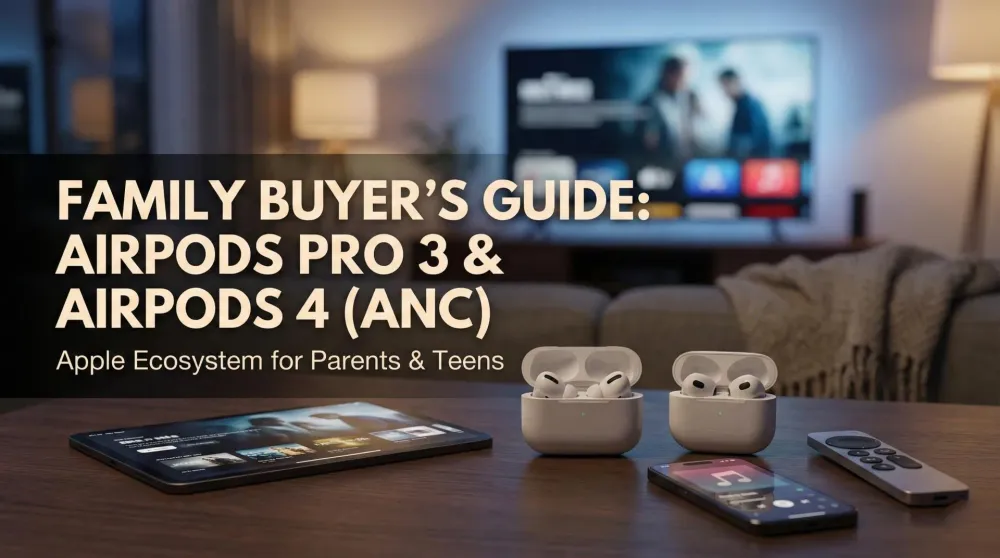
Why we bought AirPods Pro 3 and AirPods 4 (ANC) – A family buyer's guide for Black Friday & Christmas 2025
We scanned the earbud market (Sony, Bose, Beats, and more) and still chose two: AirPods Pro 3 for dad-level ANC and features, and AirPods 4 (ANC) for our teen—affordable, comfy, and effortless with iPhone, iPad, and Apple TV.
This post contains affiliate links. We may earn a commission if you make a purchase, at no extra cost to you. As an Amazon Associate, Dadnology earns from qualifying purchases.
Editor’s note: We haven’t hands-on tested every single earbud model. Our picks reflect our own family use with Apple gear plus detailed research and owner feedback. Prices shift quickly around Black Friday/Christmas.
Our brief: Two earbuds, two roles, zero friction
We set out to cover two real people in one home:
- Parent (me): wants the strongest Apple ANC, Adaptive awareness for hearing voices, customizable fit, rock-solid calls, and late-night Apple TV watching without waking anyone.
- Teen: wants great sound, real ANC at a friendlier price, all-day comfort, and instant pairing with iPhone/iPad for music and shows.
Plenty of earbuds sound great — Sony, Bose, Beats, Nothing — but Apple-only features kept mattering most day to day: iCloud pairing and automatic switching, Find My, Spatial Audio, Siri integration, and quality-of-life details like the head-nod call answer on Pro 3. These aren’t features you notice when you’re reading spec sheets. They’re features you notice on the seventh consecutive day of use when you realize you haven’t touched Bluetooth settings once.
This guide explains how we got there — what we looked at, what we ruled out, and why the Apple-first answer made sense for a household that runs almost entirely on Apple hardware.
How we compared the market
We scored each contender on what families actually do, not what spec sheets highlight:
- Late-night Apple TV (keep the house asleep while you finish the show)
- iPad streaming (study breaks, travel, homework background music)
- Chores and commutes (ANC that genuinely lowers the noise floor, not just takes the edge off)
- Calls with hands busy (cooking, doing the school run, carrying groceries)
- Comfort for hours (not just 15-minute demo magic — real extended wear)
- Ecosystem friction (how often do you have to touch Bluetooth settings? The target is never)
Sony WF-1000XM5 can edge out AirPods in raw ANC measurements. Bose QuietComfort Ultra Earbuds have superb comfort. Both sound excellent. But the Apple-first polish — pair once, switch everywhere automatically, features that surface where you actually live — kept tipping the scale. When you’ve spent a week manually managing Bluetooth connections on a Sony across iPhone, iPad, and Apple TV, you start putting a real price on the frictionless version.
The honest version of our comparison: if your household runs on a mix of Android, Windows, and Apple, the calculus changes and Sony or Bose make more sense. If you’re all-in on Apple, the choice becomes significantly easier.
Pick 1: AirPods Pro 3 — The no-compromise parent pick
The AirPods Pro 3 are the most feature-complete earbuds Apple has built, and for parents who use audio as a sanity-preservation tool, the combination of features is genuinely hard to match elsewhere in the Apple ecosystem.
Active Noise Cancellation: It’s the best ANC Apple has shipped. In practical terms: vacuum cleaners become background ambience, office open-plan noise disappears, and flights become tolerable rather than exhausting. It’s not quite Sony-level in raw dB reduction on very low frequencies, but the overall quieting effect in real family environments — school runs, busy kitchens, open offices — is excellent and reliable.
Adaptive Transparency: This is the feature that makes Pro 3 specifically suited for parents. Adaptive mode doesn’t just pass through ambient sound — it intelligently amplifies voices while suppressing mechanical noise and sudden loud events. You can hold a conversation with your partner, hear if a child calls from another room, or catch a question from a colleague, all without taking the buds out. It changes how AirPods integrate into daily parenting rather than requiring you to constantly remove them.
Customizable Fit (Silicone Tips): Four tip sizes plus a fit test mean you get an actual seal, not an approximation. The seal matters for ANC effectiveness and for bass response. If you’ve found previous AirPods Pro physically uncomfortable, the H2 chip’s fit detection combined with the updated tip geometry is meaningfully better.
Head-Nod Call Answer: Nod to accept a call. Shake to decline. When your hands are full — carrying grocery bags, managing a stroller, mid-workout — this is exactly the kind of detail that earns its place in a parenting toolkit.
Apple TV and Spatial Audio: The automatic handoff to Apple TV for late-night movie watching is reliable and nearly instant. Spatial Audio with dynamic head tracking on Dolby Atmos content creates a genuine home cinema experience without waking the house. This is the use case that originally sold us.
Real-World ANC by Scenario: The ANC behaves differently depending on where you are, and it’s worth breaking this down honestly. In an open-plan office, Pro 3 is the closest thing to a “do not disturb” sign that actually works — keyboard clatter and ambient conversation drop to near-silence. On a commute (bus, train, or underground), the lower-frequency rumble gets significantly attenuated, which is where cheaper ANC implementations fall apart. But the scenario that surprised us most: late-night TV after the kids are in bed. You wouldn’t think you need ANC at 10pm in a quiet house, but the combination of light ambient noise reduction and Spatial Audio creates a genuinely immersive experience that makes Apple TV feel like it was designed specifically for this moment — because it arguably was.
Hearing Health Features (the Undersold Pitch): The H2 chip in Pro 3 includes hearing aid-grade features that Apple has steadily improved: the ability to amplify voices in your environment, real-time noise level monitoring, and the option to set custom listening levels. For parents in their late 30s and 40s — the core Dadnology audience — this isn’t abstract. If you’ve ever stood at a school pickup in a noisy environment straining to hear what someone’s saying, Pro 3’s amplified transparency mode genuinely helps. Apple doesn’t shout about this in marketing because it feels adjacent to medical territory, but it’s one of the most practically useful things these earbuds do.
Transparency Mode as a Family Tool: Standard transparency passes through sound. Adaptive Transparency does something more useful: it lets voices through while dampening mechanical noise and protecting your hearing from sudden loud events (a car horn, a dropped pan). In practical parenting terms, this means you can wear Pro 3 during work at home, have your music or podcast running, and still hear your name called from upstairs or the doorbell without removing the earbuds. It’s the difference between earbuds that block you off from family life and ones that integrate with it.
Conversation Awareness: This feature doesn’t get enough attention. When you start talking — actually talking, not just clearing your throat — Pro 3 automatically lowers the audio volume and switches to transparency mode so you can have a natural conversation. Then when you stop, it fades back in. In theory this sounds annoying (will it trigger constantly?). In practice it works well enough that after a few weeks you stop thinking about it. For parents who spend the day in and out of conversations — colleagues, kids, partner — it removes a dozen tiny earbud removal moments per day. That’s not a small thing.
Fit After Three Months: The ear tip system with fit test stays secure. We’ve used these on walks, occasional light runs, and during commutes — the tips don’t shift. The medium tips work for most adults; if you’re between sizes, the fit test in Settings gives you a genuine read rather than guesswork. This is an area where previous AirPods Pro generations were noticeably inconsistent, and it’s been meaningfully improved.
Best fit: Parents, frequent travelers, anyone who needs maximum quiet and wants Apple’s full feature set.
👉 Read our full review: AirPods Pro 3 Review
Pick 2: AirPods 4 (ANC) — The value sweet spot for teens
The AirPods 4 (ANC) occupy a specific and well-defined position in the lineup: real noise cancellation, all-day comfort, and effortless Apple integration at a price point that doesn’t require a difficult family conversation about spending.
Real ANC, Not a Marketing Promise: The ANC in AirPods 4 is genuine — not the token noise reduction Apple shipped in earlier non-Pro models. It won’t match Pro 3 in a direct comparison, but the gap in real-world use (commuting, studying, blocking out domestic noise during streaming) is smaller than the price difference might suggest. For a teen who primarily uses earbuds at home and on the school run, AirPods 4 ANC provides meaningful quiet.
One-Size Comfort That Actually Works: The tipless design is polarizing in reviews, but in extended daily use for our teenager — 4+ hours a day in many cases — the fit held. The design is genuinely lighter than any silicone-tip model, and the lack of ear canal insertion makes it comfortable for users who find in-ear earbuds intrusive over long sessions. This is the biggest practical differentiator from Pro 3 for users who physically prefer an open-ear feel.
Effortless Apple Pairing and Switching: Every benefit of iCloud pairing applies here: set up once on iPhone, instantly available on iPad, Apple Watch, and Apple TV without manual switching. For a teenager with three Apple devices, this matters more than any spec on the box.
Sound Quality for Streaming: The tuning is balanced and clear, with enough bass presence for pop and hip-hop without the artificially boosted low-end that makes some “consumer” earbuds fatiguing. Vocal clarity is particularly good — important for podcasts, YouTube, and video calls. The H2 chip brings meaningful improvements in audio processing compared to the H1 generation.
The In-Ear vs. Open-Ear Design Distinction: This is actually the more important differentiator than the price gap, and it’s underplayed in most reviews. Some people fundamentally dislike silicone tips. It’s not about the sound — it’s about the sensation of having something creating a seal in your ear canal for hours at a time. Ear fatigue is real, and for users who work from home with earbuds in most of the day, the cumulative discomfort of a sealed fit is a legitimate reason to choose AirPods 4 over Pro 3 regardless of budget. The open design also means a degree of passive ambient awareness that parents at home actually need — you can hear what’s happening in the house without switching modes.
The ANC Gap Is Smaller Than You’d Expect: The H2 chip that powers Pro 3 is also in AirPods 4 ANC, and Apple has done a reasonable job closing the gap at the processing level. The real difference shows up at the extremes: aircraft cabins, very loud commutes, or sustained industrial noise. In casual settings — home office background noise, a café, a teenager’s bedroom with a sibling arguing in the hallway — the AirPods 4 ANC performance is genuinely comparable to Pro 3. The price difference buys you better performance at the loud end of the spectrum, not uniformly better ANC across all environments.
Who Actually Grabs Which Pair: After both models were in the house for a month, a clear pattern emerged. The Pro 3 become the default for any situation involving a commute, travel, or a work call where you need to focus without interruption. The AirPods 4 become the grab-and-go pair for around the house, casual streaming, or anything where you want music without isolation. This sorting happened organically, not by decree. The use cases separated themselves.
The Value Calculation: At its price point, AirPods 4 ANC competes directly with Sony’s lower-tier and mid-range offerings. The Sony WF-C700N and similar models offer comparable or slightly stronger raw ANC in a similar price band, and they’re excellent for Android or mixed households. For an iPhone-first user, AirPods 4 ANC’s seamless pairing, instant switching, and Find My integration shift the value calculation substantially in Apple’s favour. You’re not just paying for hardware — you’re paying for the half-second of friction that disappears every time you pick up your iPad instead of your phone.
Best fit: Teens, students, anyone who wants Apple’s ecosystem polish at a friendlier price or prefers a tipless fit.
👉 Read our full review: AirPods 4 Review
Why not…? Quick notes on the alternatives
- Sony WF-1000XM5: Class-leading ANC measurements and excellent sound quality. The ecosystem friction across iPhone/iPad/Apple TV is real and persistent. Great choice for Android or mixed-platform households. For all-Apple families, the daily convenience gap is harder to ignore.
- Bose QuietComfort Ultra Earbuds: Superb comfort and strong ANC. The CustomTune calibration is genuinely impressive. Same cross-device switching limitations as Sony for Apple households.
- Beats Fit Pro: The H1 chip gives it Apple-class pairing and switching. Wing tips make it genuinely sport-secure in a way AirPods aren’t. We preferred Pro 3 for ANC depth and Adaptive mode, but Beats Fit Pro is an underrated pick for active parents who need secure fit during workouts.
- Nothing Ear and Nothing Ear (a): Excellent value, interesting hardware design, and competitive sound. The companion app adds functionality the base AirPods 4 lack. The Apple ecosystem integration remains limited compared to Apple-native hardware.
Short version: if you run a mixed-platform household, the Sony or Bose answer makes legitimate sense. For families living in Apple’s world, the switching, Find My, Siri, and TV integration make AirPods hard to displace on purely practical grounds.
Use-case map: Pick by scenario
| Scenario | Pick |
|---|---|
| Late-night Apple TV movies | Pro 3 isolate better, AirPods 4 also work |
| iPad marathons and study sessions | AirPods 4 win for all-day comfort |
| Chores and household noise | Pro 3 provide more hush |
| School runs and commutes | Pro 3 Adaptive keeps voices natural |
| Flights and serious noise environments | Pro 3 (clear choice) |
| Hate silicone tips in-ear | AirPods 4 (tipless design) |
| Tight budget | AirPods 4 ANC delivers the essentials |
| Active sport use | Beats Fit Pro (wing tips for secure fit) |
Battery life in real use
Both models deliver approximately 6 hours per charge with ANC active — slightly longer with ANC off. The charging case extends total to around 30 hours for Pro 3 and similar for AirPods 4. Both support fast charging through the case (a short charge adds meaningful listening time quickly). MagSafe and USB-C charging are available on both.
In a family context, the battery question is really about daily sustainability rather than marathon sessions. Both handle a full day of use — school day for a teen, work day for a parent — without needing a recharge mid-day. The case becomes a charging habit rather than an urgent necessity.
Black Friday and Christmas 2025 tips
- Check both models: Pro 3 occasionally dip close to AirPods 4 ANC pricing during major promotional events. If the price gap narrows to under €30, the Pro 3 feature set becomes an easy call.
- Case details: prefer USB-C and MagSafe-enabled cases for charging convenience. The Lightning case era is over.
- Bundles: iPad or Apple TV combined with AirPods can provide stacked value for family setups. Check Apple’s own gifting bundles alongside third-party retailers.
- Refurbished: Apple Certified Refurbished AirPods Pro are indistinguishable from new in everyday use and come with the same warranty. Worth checking availability before paying full retail.
📅 Three months later: Honest wear notes
Three months is long enough to know whether a product earns its place in daily life or gets relegated to a drawer. Both pairs are still in active use. Here’s what three months of actual wear taught us that unboxing coverage doesn’t.
Fit Durability (Pro 3 Tips): The silicone ear tips hold their shape and grip well. At three months, no degradation we can measure. Apple sells replacement ear tip packs separately, which is reassuring as a long-term ownership fact rather than an immediate concern — we haven’t needed them yet. The medium tips that shipped with the unit are still the ones in use. If you’re doing daily wear with sweat exposure (workouts, warm commutes), the tips may need replacing earlier; for office and commute use, they’re holding fine.
Case Wear: The AirPods Pro 3 case accumulates pocket lint around the Lightning port area and picks up minor cosmetic marks over time. Nothing surprising for a device that lives in a jeans pocket. The functional seals and hinge remain tight. This is entirely aesthetic — the case charges fine, the lid snaps cleanly, and the earbuds seat correctly every time. But if you’re the type who keeps gear pristine, budget for a case cover.
Battery at Three Months: Both pairs still hit their rated battery life. No measurable degradation at this point, which is consistent with lithium battery behaviour over a short period. The Pro 3 ANC drain is real — running ANC continuously does noticeably shorten the session compared to ANC off, and compared to the Pro 2 in sustained listening situations, the Pro 3 is slightly less efficient with ANC active (the stronger noise cancellation comes at a cost). For most use cases, 6 hours with ANC on is enough. For flights, the case becomes part of the plan.
Personalized Spatial Audio: This requires scanning your ears with an iPhone camera — a process that takes about 30 seconds and initially feels like something from a 2012 futurism demo. At launch it felt like a gimmick. After three months, it genuinely isn’t. There’s a point, maybe four to six weeks in, where your brain calibrates to the head-tracked 3D positioning and starts noticing when it’s absent. On Dolby Atmos content via Apple TV, the effect is legitimately impressive in a way that’s hard to describe without it sounding like marketing copy. It’s not magic. It’s just noticeably better than not having it.
The AirPods 4 Assessment at Three Months: One household member’s honest summary after the first week: “I keep forgetting they’re in, which is either a terrible design flaw or the highest compliment I can give a pair of earbuds.” Three months in, that remains the operative review. They disappear. There’s no pressure, no fatigue, no reminder that you’re wearing something. For eight-hour work-from-home days, that’s the thing that matters most.
👨👩👧 The family headphone ecosystem: What actually gets used
The theoretical use-case map (Pro 3 for commute and travel, AirPods 4 for home office and casual use) turned out to be largely correct, but the reality has a few wrinkles worth sharing.
Theory vs. Reality: The Pro 3 almost never get used at home during the day. The full ANC that makes them essential for commuting is excessive for a home office — you don’t want to be that isolated when children are around. The AirPods 4 ended up being the home-default pair more often than expected, even for the person who owns the Pro 3. They get grabbed for morning routines, for cooking, for background podcasts — any context where partial awareness matters more than maximum quiet.
Kids and AirPods: Children can use AirPods (with volume limits enforced via Screen Time on the linked iPhone or through Family Sharing), but fit is a legitimate consideration. The Pro 3 ear tips require the right size — small tips are frequently needed for younger users, and the fit test matters more, not less. The AirPods 4 open design sidesteps this entirely: no sizing, no seal, no pressure. For younger teens who find sealed earbuds uncomfortable or want to remain aware of their surroundings, the open design is a genuine practical advantage rather than a Pro 3 compromise.
Was Buying Both Worth It? The honest answer is yes — but with a caveat. The use cases separated cleanly after about a month of daily use, and we stopped debating which pair to reach for. That clarity has value. But if budget forces a single choice, the Pro 3 is the one to have. It can do the home-office casual role adequately (just use transparency mode); the AirPods 4 cannot do the commute-and-travel role as well. The Pro 3 is the more complete tool. The AirPods 4 is the more comfortable one. If you’re not locked into the Apple ecosystem, our best wireless earbuds for dads guide covers the cross-platform alternatives.
Pros
- Both models offer effortless iCloud pairing and automatic switching across all Apple devices
- AirPods Pro 3 Adaptive Transparency is genuinely useful for parents who need to stay aware
- AirPods 4 tipless design delivers all-day comfort that in-ear models can't match for some users
- Find My integration works reliably — a real benefit in family households
- Late-night Apple TV pairing is fast, stable, and supports Spatial Audio with Atmos content
- Both models pair with Apple TV without manual Bluetooth management
Cons
- Raw ANC performance trails Sony and Bose at equivalent price points
- AirPods 4 tipless fit won't suit users who need a sealed in-ear for maximum noise isolation
- Apple ecosystem lock-in is the premise — neither model works well in Android/Windows households
- Both models are at their best only within Apple's ecosystem — limited cross-platform value
Family verdict
Two earbuds, two roles, one cohesive family setup. AirPods Pro 3 give parents pro-grade quiet, smarter awareness, and a fully customizable fit. AirPods 4 (ANC) give teens real noise cancelling, comfortable all-day wear, and the same Apple-easy life at a friendlier price. Together, they cover everything a family does with earbuds — and neither requires a Bluetooth settings intervention.
Bottom line
If your home runs on Apple and you want zero-friction listening, this duo is a direct hit: AirPods Pro 3 for the parent who needs max quiet, Adaptive awareness, and the full feature set; AirPods 4 (ANC) for the teen who needs comfort, value, and simplicity. Buy once, be satisfied.
📌 FAQ
Do AirPods Pro 3 sound better than AirPods 4?
Will AirPods 4 be comfy without silicone tips?
Are there better ANC earbuds than AirPods?
How long does the battery last on each model?
Where can I read your full reviews?
Keep this in your inbox
One email a week: what we actually watched, built and reviewed — the stuff worth a dad's time. No hype, no daily spam.
Dadnology Weekly
One email a week: the LEGO, gaming and movie news worth a dad's time — plus what we actually reviewed. No hype, no daily spam.
Disclaimer: This review and its visuals were created with the help of AI. Some links may be affiliate links – we may earn a commission if you make a purchase, at no extra cost to you.
Current deals in Tech & gadgets
Verified live discounts tracked on Amazon
Tech & gadgets · Tested by Dadnology
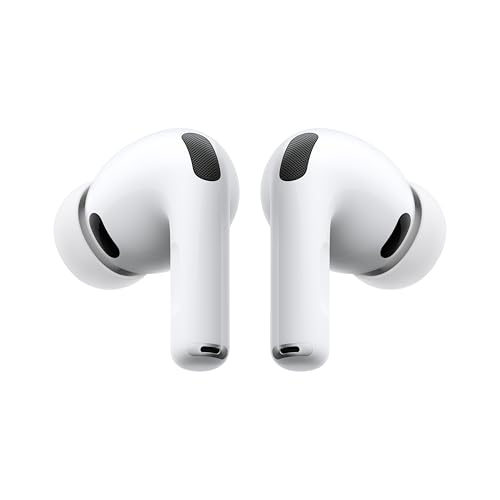
Apple AirPods Pro (3rd generation)
5/5“The best noise-cancelling earbuds for Apple families”Read our review
Tech & gadgets · Tested by Dadnology
Samsung T7 Shield 2TB
5/5“Small, fast, and genuinely hard to break”Read our review
You might also like

Nikon on sale: Buy the Z8, think twice about the Z6 II
The Z8, Z6II and Z5 all drop in price on sale days. Which one is worth it, from someone who owns a Z8 and shot a Z5 for years, plus the storage to go with it.

Dragon Ball in order: Two essentials, nothing you have to skip
The Dragon Ball watch order for dads: the two essentials, where GT, Super, the films and Daima fit, and a rating for every series and movie.

Prime Big Deal days October 2026: What a dad should actually buy
Amazon's October sale runs 6-7 October 2026. Here is what a dad should buy, what to skip, and how to plan the two days without falling for decoy discounts.