
Star Wars: Episode III - Revenge of the Sith (2005)
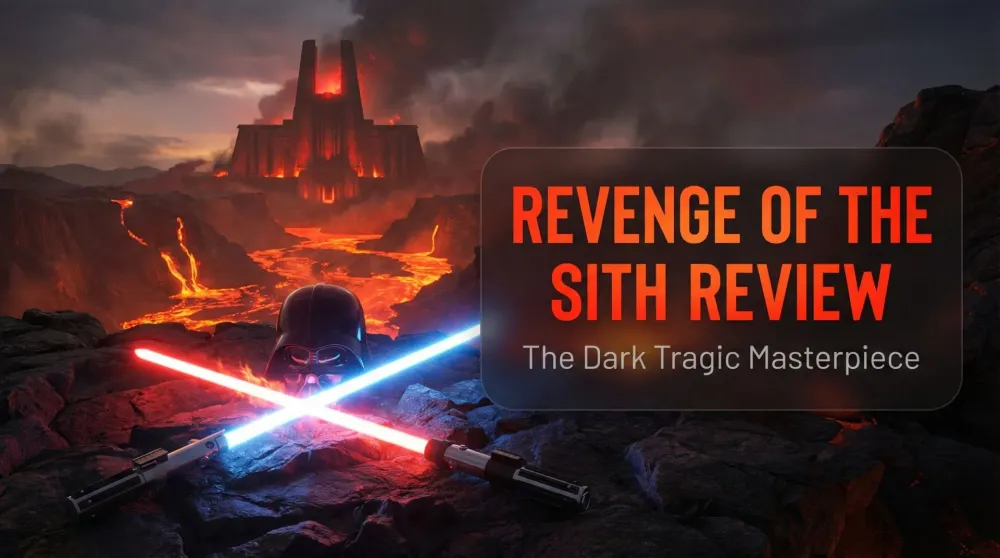
The dark, tragic masterpiece of the Prequel Trilogy. Anakin's fall is heartbreaking, the action is relentless, and the emotional payoff is immense.
This post contains affiliate links. We may earn a commission if you make a purchase, at no extra cost to you. As an Amazon Associate, Dadnology earns from qualifying purchases.
🎬 Introduction
🎬 This review is part of our Star Wars Live-Action Hub — the Skywalker Saga film by film, Episodes I through IX, in the recommended watch order.
Revenge of the Sith opens with a drum beat of war. Two Jedi starfighters dive in unison over the curve of Coruscant into a chaotic, massive space battle. No political opening crawl, no slow buildup. We are in the thick of it. This energy carries through the entire film. Released in 2005, this was the grand finale of the Prequels, and George Lucas clearly wanted to leave nothing on the table.
For a Dad who grew up with the Originals, this movie is the missing link. It answers the questions: How did the Jedi fall? What is the Clone Wars? Who is the mother of Luke and Leia? But more than that, it is an emotional rollercoaster. It is a tragedy in the classical sense—a hero with a fatal flaw (fear of loss) is manipulated into destroying everything he loves.
If you have watched The Clone Wars animated series (and we highly recommend you do), this movie hits different. The camaraderie between Obi-Wan and Anakin at the start feels earned. The betrayal feels sharper. Cross-over scenes add context that elevates the film from a sci-fi blockbuster to a character study. It is the strongest entry of the first trilogy, hands down.
For our movie/TV series hub, see Star Wars Skywalker Series Watch Order & Guide.
🧠 Story & themes
The war is ending, but the trap is springing. General Grievous is on the run, Count Dooku is eliminated early (in a shocking scene), and Anakin is reunited with Padmé, who is pregnant. But Anakin is plagued by visions of her dying in childbirth. Palpatine, revealing himself as the Sith Lord Sidious, offers Anakin the one thing the Jedi cannot: the power to save her.
The theme here is fear vs. letting go. Yoda tells Anakin, “Train yourself to let go of everything you fear to lose.” It’s sound spiritual advice, but terrible advice for a panicked husband. Palpatine exploits this. He turns Anakin’s love into possession.
Betrayal is the other major theme. Order 66—the command given to the Clones to kill their Jedi generals—is one of the most heartbreaking sequences in cinema. Seeing these soldiers, who we’ve come to see as heroes (especially in the cartoon), turn on their friends without hesitation is chilling. It marks the death of the Republic and the birth of the Empire.
The political commentary is sharp here too. “So this is how liberty dies… with thunderous applause.” The film shows how fear drives a society to accept authoritarianism for the sake of “security.”
💀 Order 66 — The most devastating sequence in Star Wars
Palpatine utters two words and a civilization ends. What follows is a masterclass in montage editing: we cut rapidly between locations, watching Jedi after Jedi fall to the soldiers they’ve fought beside for years. In a lesser film, this would be spectacle. Here it’s grief.
The reason it lands so hard is the weight of everything before it. Even without The Clone Wars series, you’ve spent three films seeing these Clone Troopers as heroes — armored, loyal, competent. And then, in a fraction of a second, that loyalty is overwritten by a chip in their skull. No hesitation. No doubt. The horror isn’t the violence; it’s the mechanical obedience. The Republic, betrayed by its own army.
For dads watching this with older kids, Order 66 often triggers a conversation more valuable than most films ever manage: about following orders without thinking, about whether good people bear responsibility for what systems turn them into, about the cost of loyalty that asks no questions. Yoda vs. the 501st in the jungle is brief, but it carries the weight of a whole civilization going dark in less than three minutes of screen time. Arguably the best sequence in the entire saga.
🎭 Characters & performances
Ian McDiarmid as Palpatine is having the time of his life. He plays the kindly grandfather figure and the cackling, scarred monster with equal relish. The opera scene, where he seduces Anakin with the tale of Darth Plagueis the Wise, is arguably the best dialogue scene in the Prequels. It’s quiet, intimate, and sinister.
Hayden Christensen finally gets to sink his teeth into the darkness. His physical acting as he transitions to Vader—the hood up, the yellow eyes, the march into the Jedi Temple—is terrifying. The scene on Mustafar, where he screams “I hate you!” at Obi-Wan, is raw and real.
Ewan McGregor delivers a heartbreaking performance. He isn’t just fighting an enemy; he’s fighting his brother. His final speech—“You were the Chosen One!”—is delivered with such pain that it echoes through the saga. It’s the emotional anchor of the film.
Samuel L. Jackson as Mace Windu gets a badass exit (even if he went out the window). His confrontation with Palpatine shows just how close the Jedi came to saving the day, and how their own dogma blinded them.
🎨 Visual style, animation & audio
The visual storytelling is at its peak. The contrast between the cold, metallic blue of the Jedi Temple and the fiery, hellish red of Mustafar perfectly mirrors the conflict. The Mustafar Duel is the longest lightsaber fight in the series, but it feels necessary. It’s an endurance test, a brawl between two men who know each other’s every move.
General Grievous is a marvel of CGI and practical effects. A wheezing, four-armed cyborg who hunts Jedi for sport? Cool factor: 5/5.
John Williams delivers again with “Battle of the Heroes.” It’s a tragic counterpart to “Duel of the Fates.” It’s slower, sadder, emphasizing the loss rather than the excitement.
The Birth of Vader scene—the mask lowering, the first mechanical breath—is pure cinema history. The sound design links the man to the machine instantly.
👨👧 The dad perspective
Runtime: 2 hours 20 minutes. It moves fast. There is very little downtime.
Suitability: 🛑 WARNING. This is rated PG-13 for a reason. It is DARK.
- Violence: Anakin burns alive. We see his skin crisping. It is graphic. Anakin kills “younglings” (kids). We don’t see the act, but we see him ignite the saber in a room full of children.
- Order 66: Montages of Jedi being shot down. It’s sad and violent.
- Intensity: The tone is heavy. There is no happy ending here. The bad guys win.
Watching with Kids: I would not show this to a kid under 10 unless they are very resilient. My 8-year-old found the burning scene traumatizing. This is the “grown-up” Star Wars movie.
Talking Points: Consequences. Anakin thought he was doing the right thing to save his wife, but he ended up causing her death. It’s a lesson about how our choices define us, and how the ends do not justify the means. Also, a good talk about how sometimes, good people (the Clones) can be made to do bad things if they don’t think for themselves.
The aging curve: Twenty years on, Revenge of the Sith has quietly become one of the most rewatched entries in the saga — not the most technically polished, but the one that hits hardest on repeat viewings. If you watched it in 2005 with no Clone Wars context, rewatch it now with a kid who has seen the animated series. The opening banter between Obi-Wan and Anakin lands entirely differently when you know what they’ve been through together. The tragedy deepens in proportion to the backstory you bring to it. That’s rare in blockbuster cinema: a film that gets better the more its extended universe grows.
Pros
- The emotional payoff of the entire trilogy lands perfectly
- Obi-Wan vs. Anakin is the most emotional fight in the saga
- Ian McDiarmid is perfect as the Emperor
- The opening space battle is visually spectacular
- Order 66 is a gut-punch that stays with you
Cons
- The dialogue still has some clunky moments ('No, it is because I am so in love with you')
- Padmé's death ('dying of a broken heart') feels a bit weak for her character
- General Grievous is a bit of a villain-of-the-week compared to the rest
From the screen to the shelf: the Venator cruiser carries the Republic through Revenge of the Sith — and our LEGO Venator-Class Attack Cruiser (75441) review covers the brick flagship of the Clone Wars.
🗣️ Conclusion
A powerful, dark, and necessary conclusion to the prequel era. It sheds the childish tone of Episode I for a Greek tragedy in space. While it breaks your heart, it sets the stage for the hope of the Original Trilogy. The best of the prequels and a top-tier Star Wars film.
📺 Movie night sorted: thousands of films and shows are streaming on Prime Video — free for 30 days. Worth a look before you buy the disc.
📌 FAQ — Frequently asked questions
Is it really that dark?
Does it connect well to A New Hope?
What about the 'Noooooo' scene?
Do I need to see the first two prequels to understand this?
Why didn't the Jedi sense Order 66 coming?
Keep this in your inbox
One email a week: what we actually watched, built and reviewed — the stuff worth a dad's time. No hype, no daily spam.
Dadnology Weekly
One email a week: the LEGO, gaming and movie news worth a dad's time — plus what we actually reviewed. No hype, no daily spam.
Disclaimer: This review and its visuals were created with the help of AI. Some links may be affiliate links – we may earn a commission if you make a purchase, at no extra cost to you.
Current deals in Movies & TV
Verified live discounts tracked on Amazon
![The Legend of Korra — The Complete Series [Blu-ray]](https://m.media-amazon.com/images/I/51+1TXyb7aL._SL500_.jpg)
Movies & TV · Tested by Dadnology
The Legend of Korra — The Complete Series [Blu-ray]
4.5/5“A new Avatar, a modern city, a masked revolution”Read our review
Movies & TV · Tested by Dadnology
Zack Snyder's Justice League (4K Ultra HD)
4/5“Four hours. One vision. This is the film.”Read our review
Movies & TV · Tested by Dadnology
Space Jam (4K Ultra HD + Digital)
4/5“It's gonna be a whole new ball game”Read our reviewYou might also like
Star Wars: Episode I - The Phantom Menace (1999)
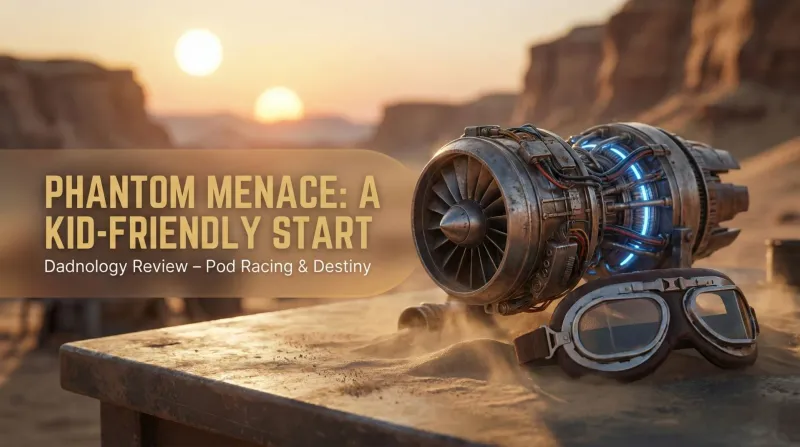
A solid, if flawed, start to the saga. The political dialogue drags, but the action sequences—especially the Maul duel—are legendary. It introduces the world well and is arguably the most kid-friendly live-action Star Wars. Worth it for the music alone. **Rating: 3.5/5.**
Star Wars: Episode II - Attack of the Clones (2002)
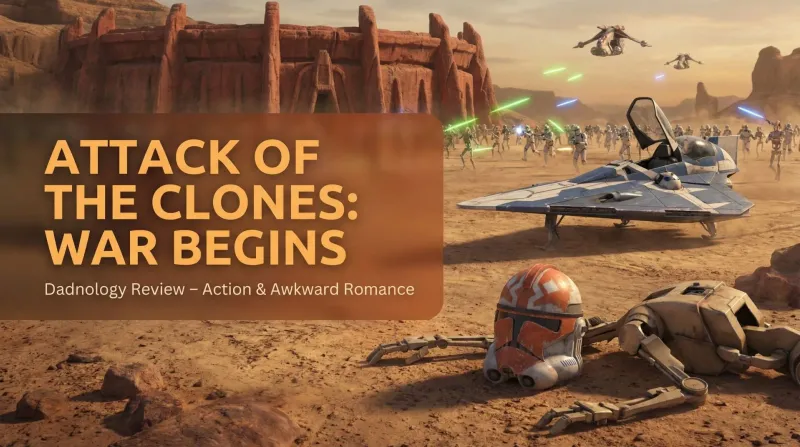
A mixed bag. The detective story is fun, and the Battle of Geonosis is a spectacle, but the romance dialogue is painful. However, if you watch the Clone Wars animated series, this movie becomes infinitely better as a prologue. Essential for the lore, fun for the action. **Rating: 3.5/5.**
The Mandalorian – A perfect dad story in space
The Mandalorian is Star Wars at its most honest about what it is really about. Not chosen ones or epic destinies. A man and a small creature who chose each other and refused to stop. Season 1 and 2 are exceptional. Season 3 is good. The whole is irreplaceable. 4/5.