
NVIDIA RTX Spark: The iPhone Moment for Windows PCs
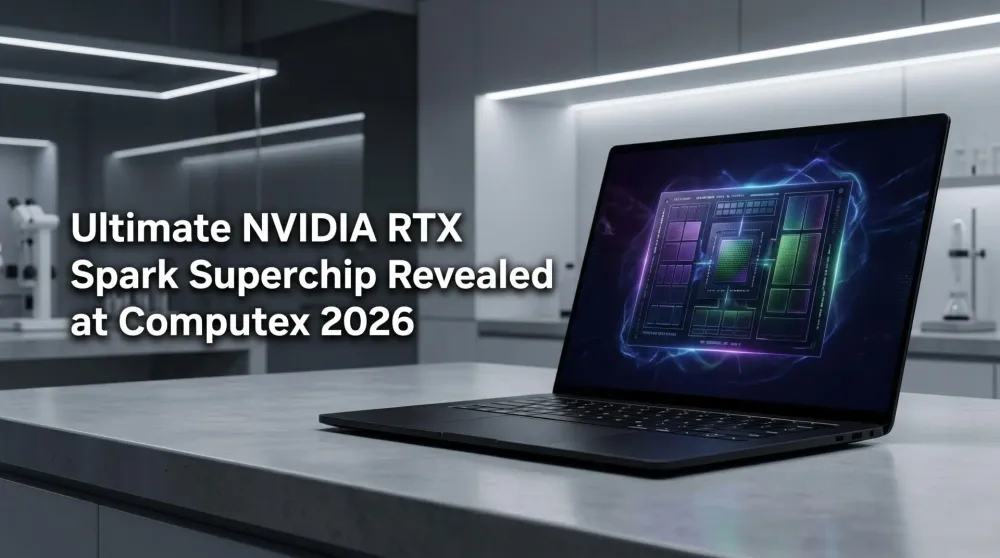
NVIDIA's RTX Spark superchip combines ARM efficiency with Blackwell GPU power and 128 GB shared memory — the biggest PC architecture shift in a decade, and it is coming for Mac.
This post contains affiliate links. We may earn a commission if you make a purchase, at no extra cost to you. As an Amazon Associate, Dadnology earns from qualifying purchases.
The PC Just Had Its iPhone Moment
The PC just had its iPhone moment. And this time, it did not come from Apple.
At Computex 2026, Jensen Huang stepped on stage and unveiled the RTX Spark — a superchip fusing an ARM CPU, a Blackwell GPU, and up to 128 GB of unified memory onto a single die. It is the architecture Apple has been exploiting for four years on the Mac. NVIDIA just brought it to Windows. And they added something Apple can never have: CUDA — the AI software ecosystem the entire machine-learning world runs on.
This is not incremental. This is a category shift. Possibly the biggest one in PC hardware since the original Apple M1 made x86 look slow and thirsty in 2020.
Make no mistake: this is the most important PC architecture announcement since Apple M1. If NVIDIA executes, this chip eliminates the trade-off that has defined Windows laptops for decades — you either had performance or portability, battery life or GPU power. RTX Spark is built to end that argument.
ARM Meets Blackwell: The Formula Apple Proved Works
The reason Apple Silicon feels fundamentally different from every Windows laptop you have used is not marketing — it is architecture. Apple fused CPU, GPU, and memory onto one die and made them share the same pool of ultra-fast RAM. No bottleneck between chip and memory. No discrete GPU burning a separate power budget. No forced choice between cool-and-quiet and actually-useful.
NVIDIA is applying that same formula — and then going further:
- ARM architecture: Dramatically more power-efficient than x86 designs from Intel or AMD. The reason a MacBook Pro runs cool, silent, and productive for twelve hours straight without a fan audible above a whisper.
- Blackwell GPU on the same chip: Not a bolted-on discrete card — the GPU is part of the die, sharing the same high-bandwidth memory pool as the CPU. No transfer bottleneck. No power budget split.
- Up to 128 GB unified memory: Your 4K timeline and your local AI model and your game engine all pull from the same massive, fast pool simultaneously.
The practical result: a laptop thin enough to slide into a shoulder bag that can cut 12K footage, run AAA games at high settings, power a 70B AI model locally, and still get through a full working day on one charge. That combination has never existed on Windows. Not at this form factor. Not without a power brick the size of a small shoebox.
AdApple MacBook Pro M5 (opens in a new tab)
The gold standard of thin-and-light workstation performance. RTX Spark's declared target — and the benchmark every upcoming RTX Spark laptop will be measured against.

CUDA: The Weapon Apple Will Never Have
Here is where RTX Spark does something Apple Silicon genuinely cannot match — and why this announcement matters beyond raw spec numbers.
Apple Silicon is excellent hardware. But in the AI world, NVIDIA’s CUDA platform is the only serious option. Every major model — Llama, Gemma, Mistral, Flux, Stable Diffusion, Whisper — is optimized first, sometimes exclusively, for CUDA. Running these on Apple’s Metal framework is possible, but it is a second-class experience: slower, patchier, and often broken the moment a new model architecture drops. The AI community writes for CUDA because NVIDIA owns the data centers everyone trains on.
RTX Spark puts that ecosystem in a backpack. Jensen Huang cited 1 Petaflop of AI performance on-device — data-center territory, running locally, with your documents and prompts never leaving your machine. For anyone running local LLMs, image generation, video processing, or the kind of AI-driven workflow that used to require a cloud subscription, this changes the math entirely.
Local AI is not just a privacy win. It is a speed win. A cost win. And with RTX Spark, finally a portability win too.
AdASUS Dual GeForce RTX 5060 8GB GDDR7 OC (opens in a new tab)
Current-gen Blackwell GPU power in a desktop card. RTX Spark brings the same GPU architecture to a laptop chip — no PCIe slot, no desktop tower required.
What RTX Spark Is Coming For
This is the fun part. RTX Spark is not entering a vacuum — it is aiming directly at three product categories that have owned their respective markets:
The Mac mini — the compact silent desktop everyone recommends because it is fast, efficient, and takes up roughly the space of a thick paperback. RTX Spark laptops threaten to match that proposition while adding portability and a Blackwell GPU that the M4 cannot touch for CUDA-dependent workloads.
The MacBook Pro — the undisputed benchmark for thin-and-light workstation performance. Apple’s efficiency advantage has been the main reason Windows power users have been quietly migrating to Mac since 2021. RTX Spark is built to close that gap and reopen the Windows conversation.
The ASUS GeForce RTX 5060 — the current standard for serious Blackwell GPU performance on Windows. But to run one, you need a full desktop setup: tower, motherboard, power supply. RTX Spark is built to bring that same Blackwell GPU class into a thin laptop chassis, no PCIe slot required.
If you are sitting on an ageing Intel gaming laptop or a thick workstation notebook and wondering whether to upgrade now — wait. What is coming in Fall 2026 is a genuine generational leap, not a spec bump dressed up with a new sticker.
AdApple Mac mini (2024, M4 Pro) (opens in a new tab)
The compact silent powerhouse RTX Spark is coming for on the Windows side. Still the king of efficient desktop computing — but the challenger is on its way.
From Clicking to Asking: The Platform Shift Behind the Chip
The most telling moment of Huang’s Computex presentation was not the chip reveal — it was the framing that came with it. “For 40 years, you have been clicking on apps. Click. Type. With RTX Spark, you ask — and the PC does the work.”
This is not hype for the sake of a keynote. It is a genuine description of where the PC platform is heading. Windows is evolving from a system that launches apps into a platform where AI agents handle tasks autonomously in the background: research, scheduling, content creation, document management. Your PC becoming the junior colleague who never sleeps and never asks for the last biscuit.
The key word is local. Agents that run in the cloud are expensive and slow. Agents that run on a 1-Petaflop chip in your bag — on your data, with your models, with zero latency to a server — are a different proposition altogether. RTX Spark is built for exactly this. The hardware is finally catching up to what the software wants to do.
What to Expect in Fall 2026
ASUS, Dell, Lenovo, and Microsoft have all committed to RTX Spark hardware. Pricing remains unconfirmed, but expect the flagship tier to push well above €2,000 — with a more accessible entry point that will still make you flinch briefly before you click. The real questions, which no spec sheet can answer: thermal management under sustained creative workloads, battery life doing actual work rather than idle benchmarks, and whether CUDA compatibility in consumer Windows drivers is as seamless as it is in NVIDIA’s data-center stack.
We will put a unit through its paces — editing sessions, gaming weekends, a week working from the kitchen table with a toddler explaining loudly why the laptop should be used for cartoons instead — the moment review hardware is in hand.
Dadnology Take
RTX Spark is the real deal. Not because NVIDIA said so on a stage, but because the architecture logic is sound — it is exactly what Apple proved works, plus the CUDA ecosystem Apple will never have. A thin Windows laptop that is genuinely fast, genuinely quiet, runs all day, and handles serious local AI without phoning home: that machine has not existed until now. Fall 2026 is going to be a fascinating few months for anyone even remotely considering a new primary machine. Watch the reviews when they drop. Watch the thermals. Watch the battery numbers under real load. But also: start getting excited. This is the next big thing.
Related Dadnology review: our Apple Mac mini (M4) review covers the tiny-desktop competitor the RTX Spark is aimed squarely at.
FAQ
When will NVIDIA RTX Spark laptops be available?
How does NVIDIA RTX Spark compare to Apple Silicon?
Is an RTX Spark laptop worth buying over a MacBook Pro?
What is the difference between RTX Spark and a regular RTX laptop?
Keep this in your inbox
One email a week: what we actually watched, built and reviewed — the stuff worth a dad's time. No hype, no daily spam.
Dadnology Weekly
One email a week: the LEGO, gaming and movie news worth a dad's time — plus what we actually reviewed. No hype, no daily spam.
Disclaimer: This review and its visuals were created with the help of AI. Some links may be affiliate links – we may earn a commission if you make a purchase, at no extra cost to you.
You might also like
Dadnology Week 24: Halo Returns, Zelda OoT & a New Siri
Two childhood-defining games came back in one week: Halo: Combat Evolved and Zelda: Ocarina of Time, both rebuilt for modern hardware. Add a new Siri, a transparent 25th-anniversary Xbox, and a loaded family movie calendar, and Week 24 is the most nostalgic week of the year so far.

Dadnology Week 40: Witcher 3 Is Free, Plus a Two-Day Prime Sale
A free 150-hour RPG, a two-day sale with plenty of decoys, and a $179.99 Shenron that costs less than the leaks said. Read the Witcher answer before your teenager asks, and the sale plan before Tuesday.
What to Play This Week: Gears of War: E-Day, Epic Mickey: Rebrushed
This week: Gears of War: E-Day on day-one Game Pass, a free Switch 2 upgrade for Epic Mickey, and Ghost of Tsushima from the backlog.