
The Dark Knight Trilogy – Nolan's Batman masterwork guide
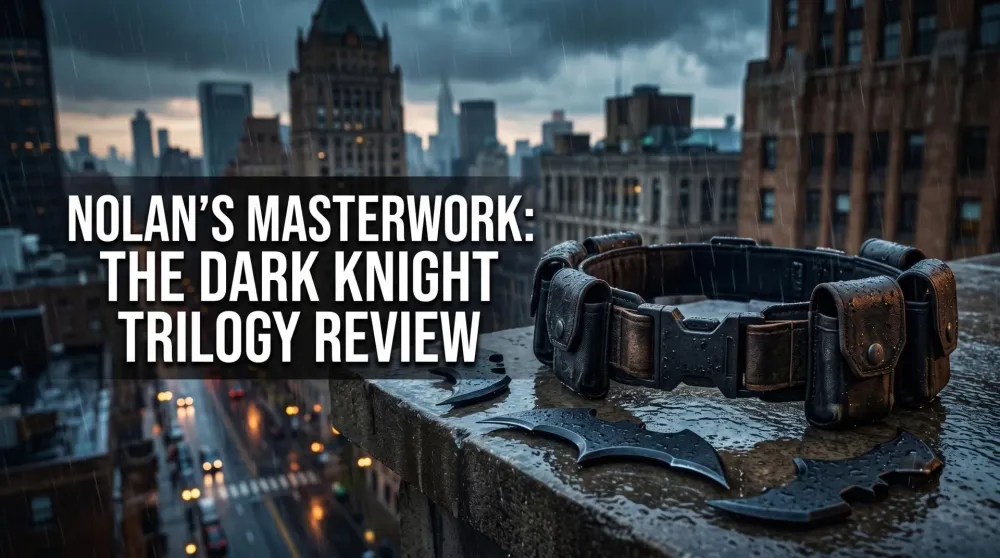
Christopher Nolan's three Batman films — Batman Begins (5/5), The Dark Knight (4.5/5), The Dark Knight Rises (4/5) — are the greatest sustained achievement in DC cinema. The complete guide.
This post contains affiliate links. We may earn a commission if you make a purchase, at no extra cost to you. As an Amazon Associate, Dadnology earns from qualifying purchases.
🦇 This hub is part of our DC Universe Hub — the Nolan Trilogy, the old DCEU, the new DCU, the Elseworlds films, and the Batman Arkham games.
The standard everything else is measured against
Christopher Nolan made three Batman films between 2005 and 2012. They constitute the most sustained creative achievement in superhero cinema, and the benchmark against which every DC and Marvel film that followed was implicitly measured, whether or not it acknowledged the comparison.
The ambition was clear from the first film: rebuild the Batman mythology from scratch, remove the iconography and the camp and the rubber nipples, and ask what this story would actually mean if it happened in something resembling the real world. Fear. Identity. The cost of symbols. The specific damage of growing up with grief that has no outlet and no explanation.
I have watched Batman Begins multiple times, in the cinema and in home cinema. I watched The Dark Knight twice in the cinema when it came out. These are not films I revisit out of nostalgia; they are films that get better with every viewing, because they are built with the kind of structural precision that only becomes fully visible once you know where the story is going.
The short verdict: with certainty, the best DC cinema ever made. The trilogy that set the template that everyone since has been trying to match.
Series content
Explore all articles, reviews, and guides in this series.
The three films: The arc
Batman Begins (2005) — 5/5: The perfect foundation
The one superhero origin story that genuinely needed to be told in a non-linear structure, because the psychology of Bruce Wayne only makes sense once you understand both where he started and what built him. Christopher Nolan takes Bruce from the well — the childhood fall, the bats, the primal fear that everything after is a response to — through Asia, through the League of Shadows, to Gotham, and turns an origin story into a psychological portrait.
Christian Bale’s three-way performance. Michael Caine’s Alfred as the definitive cinematic Alfred. Liam Neeson’s Ducard as the warm mentor who is also the threat. Cillian Murphy’s Scarecrow as the institutional corruption made literal. Hans Zimmer and James Newton Howard inventing the sonic identity of a franchise.
Nothing I would change. A 5/5 that earns every point.
The Dark Knight (2008) — 4.5/5: The genre-defining achievement
Heath Ledger died before this film was released. The posthumous Oscar for Best Supporting Actor was accurate, not honorary. His Joker is a complete reinvention of the character — a principle of chaos stripped of all psychology the film will confirm, rendered in a physical performance that no other actor in the genre has come close to replicating.
The Dark Knight is the most sophisticated argument the superhero genre has made. It uses the Batman mythology to ask real questions about justice, vigilantism, and the cost of holding an ethical line, with the specific moral precision of someone who has thought through every implication. Aaron Eckhart’s Harvey Dent arc — the idealist broken by the Joker’s specific experiment — is the film’s thesis delivered through the second-best performance in the cast.
A 9 rather than a 10 because Batman Begins is more perfectly executed. The distinction is in the final thirty minutes, not the first hundred and twenty.
The Dark Knight Rises (2012) — 4/5: The right ending
Set eight years after The Dark Knight, the trilogy’s conclusion requires both prior films to land correctly. Tom Hardy’s Bane is the best physical villain in the trilogy — the sewer fight is the most honest Batman action sequence Nolan made, because it removes every advantage and shows what happens when Batman fights someone who is simply better. Anne Hathaway’s Selina Kyle is the trilogy’s best female role. And the pit sequence — Bruce making the rope-free leap after understanding what fear is actually for — is the most precise thematic payoff in three films.
The ending is earned across seven years of filmmaking. Alfred’s vision from The Dark Knight becomes the final frame. The trilogy closes the way it should.
Why this is the best DC cinema
The Dark Knight Trilogy works because Nolan committed to a single creative vision across three films and maintained that commitment without compromise. The Batman mythology is used as a vehicle for a sustained argument about fear, identity, justice, and the specific cost of being a symbol in a broken world. Every film is doing the same thematic work at a different phase of the argument.
What separates the trilogy from the franchises that followed is craft at the granular level. Every scene in Batman Begins is doing at least two things simultaneously. The Ra’s al Ghul reveal earns its weight because every scene with Ducard was building toward it without announcing itself. The Joker’s specific tactics in The Dark Knight are internally coherent — the ferry, the hospitals, the interrogation room — because Nolan has thought through what a principled chaos agent would actually do. The pit sequence in The Dark Knight Rises lands because fear has been the trilogy’s central concern since Bruce fell in the well in 2005.
Watch guide
Essential — watch all three in order:
- Batman Begins (2005) — Foundation. 140 minutes. The origin, the fear theme, the Ra’s al Ghul revelation. Required before everything else.
- The Dark Knight (2008) — Peak. 152 minutes. Heath Ledger. Harvey Dent. The ferry. Watch this knowing everything Batman Begins established.
- The Dark Knight Rises (2012) — Conclusion. 164 minutes. Bane. The pit. The ending. Watch this knowing both films before it.
Total runtime: Just under eight hours.
For families: PG-13 throughout, on the harder edge. Batman Begins and The Dark Knight Rises are the most accessible. The Dark Knight is the most intense — the Joker’s sequences are genuinely disturbing for younger viewers. Suitable for teenagers who can engage with the thematic content; the films reward maturity and reward rewatch.
The Dadnology verdict: Still the standard
In 2026, with hundreds of superhero films produced since Batman Begins, the question of whether the Nolan trilogy has been surpassed has a clear answer: in three films, across a continuous arc, with consistent creative vision and craft at every level — no. Nothing in DC or Marvel cinema has matched what Nolan built here as a sustained achievement.
The individual peaks are debatable: The Dark Knight may have no single peer as a movie. But as a trilogy — as three films working as a single argument, building to a single payoff, landing the ending correctly — it remains the benchmark.
All three Dark Knight Trilogy films are reviewed individually below.
Build it: the trilogy’s car is the Tumbler — build it (with Joker and Two-Face) via the LEGO DC Tumbler vs. Two-Face and The Joker (76303) review.
Related Dadnology review: The Dark Knight Rises (2012) Review – The Worthy Finale
What order should I watch the Dark Knight Trilogy?
Is the Dark Knight Trilogy connected to the DCEU or the new DC Universe?
Which film in the Dark Knight Trilogy is best?
Is the Dark Knight Trilogy suitable for kids?
How long is the Dark Knight Trilogy in total?
Keep this in your inbox
One email a week: what we actually watched, built and reviewed — the stuff worth a dad's time. No hype, no daily spam.
Dadnology Weekly
One email a week: the LEGO, gaming and movie news worth a dad's time — plus what we actually reviewed. No hype, no daily spam.
Disclaimer: This review and its visuals were created with the help of AI. Some links may be affiliate links – we may earn a commission if you make a purchase, at no extra cost to you.
Current deals in Movies & TV
Verified live discounts tracked on Amazon
![The Legend of Korra — The Complete Series [Blu-ray]](https://m.media-amazon.com/images/I/51+1TXyb7aL._SL500_.jpg)
Movies & TV · Tested by Dadnology
The Legend of Korra — The Complete Series [Blu-ray]
4.5/5“A new Avatar, a modern city, a masked revolution”Read our review
Movies & TV · Tested by Dadnology
Zack Snyder's Justice League (4K Ultra HD)
4/5“Four hours. One vision. This is the film.”Read our review
Movies & TV · Tested by Dadnology