
DC Elseworlds – The Batman and Joker universe guide
DC Elseworlds covers standalone DC projects outside the main continuity. Matt Reeves' Gotham (The Batman, The Penguin) and Todd Phillips' Joker universe — all reviewed here.
This post contains affiliate links. We may earn a commission if you make a purchase, at no extra cost to you. As an Amazon Associate, Dadnology earns from qualifying purchases.
🦇 This hub is part of our DC Universe Hub — the Nolan Trilogy, the old DCEU, the new DCU, the Elseworlds films, and the Batman Arkham games.
The most interesting experiment in DC cinema
The DC Extended Universe spent a decade asking what would happen if DC tried to build a Marvel-style connected franchise. The answer, across sixteen films, was: sometimes brilliantly, mostly inconsistently, and eventually not at all. James Gunn’s new DC Universe is now attempting a more controlled version of the same project.
DC Elseworlds is something different. It is the answer to a question the franchise has been circling for years: what happens if you give a filmmaker complete creative freedom with a DC character, remove the franchise obligations, and let them make the film they actually want to make?
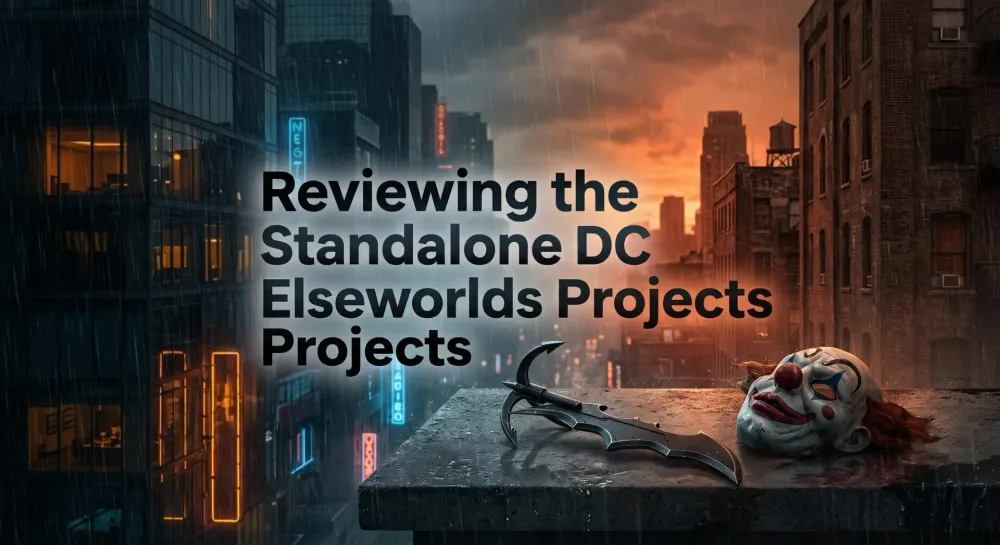
The Batman (2022) and Joker (2019) are the two proof-of-concept answers. Neither looks remotely like a superhero film. Neither needs to connect to anything. Both arrive with a directorial voice so specific that the DC mythology functions as costume rather than constraint.
The results, as you will find in the reviews below, are uneven. But the approach is the most creatively interesting thing DC Studios has done in a decade, and it deserves credit for the ambition even when the execution falls short.
Series content
Explore all articles, reviews, and guides in this series.

Matt Reeves’ Gotham: Crime drama as superhero cinema
The Batman (2022) and The Penguin (2024) constitute a complete creative vision of Gotham as a functioning — or rather, dysfunctioning — American city. Matt Reeves and his collaborators built a Gotham that has specific infrastructure, specific corruption, specific geography, and specific social fault lines. It is a city with history, not just a backdrop.
The Batman (2022) — 3.5/5: The foundation
The Batman reorients the character: detective first, puncher second. Robert Pattinson’s Year Two Bruce Wayne is still working out whether Batman is a symbol or a deterrent, and the film’s procedural investigation of the Riddler’s attacks on Gotham’s political class is genuine noir craftsmanship. Greig Fraser’s cinematography — the same lens work he brought to Dune — creates a Gotham of amber neon and real darkness.
The film earns most of its 176 minutes and does not earn all of them. The third act pivots from tight procedural to wider conspiracy and loses some momentum in the transition. More crucially: two years later, watching The Penguin made me want to revisit The Batman because I couldn’t reliably reconstruct its plot. A technically excellent film that is somehow harder to hold onto than it should be.
The Penguin (2024) — 4/5: The world made real
Where The Batman builds a world, The Penguin inhabits it. Eight HBO episodes following Oz Cobb — the mid-level Falcone soldier glimpsed briefly in the film — through the power vacuum created by the Riddler’s flood. Colin Farrell’s transformation is complete: four hours of prosthetics per day, and a performance of working-class resentment and strategic intelligence that ranks among the best on television in 2024.
Cristin Milioti as Sofia Falcone is the genuine discovery — a character who could have been a standard mob villain and becomes instead a fully realised portrait of inherited trauma. Episode five, almost entirely from her perspective, is one of the best single episodes of television that year.
The Penguin does something rare: it reveals that the most interesting story in the parent film was always the supporting character’s. The Matt Reeves Gotham works better as crime drama than as superhero action, and this series proves it.
Todd Phillips’ Joker universe: Character study in DC clothing
Joker (2019) and Joker: Folie a Deux (2024) are the most explicitly auteur DC projects ever made. Todd Phillips and Joaquin Phoenix used the DC Joker character as the vehicle for a Scorsese-inflected examination of institutional abandonment and the mythology of transgression. The first film is exceptional. The second is a genuine disappointment.
Joker (2019) — 4/5: The DC film with no interest in being a DC film
Todd Phillips made a character study that happens to be wearing DC mythology as a costume. Arthur Fleck is not the Joker of the comics — he is a specific portrait of what a city produces when it abandons its most vulnerable residents. Joaquin Phoenix won the Academy Award for Best Actor. Hildur Gudnadottir won for Best Original Score. The film grossed over a billion dollars. None of those facts are the surprise. The surprise is how carefully made it is.
The Scorsese architecture — Taxi Driver’s city-as-antagonist atmosphere, The King of Comedy’s delusional entertainer and his celebrity target — gives the film structural discipline that its surface chaos conceals. Every scene does double duty. Everything pays off.
Joker: Folie a Deux (2024) — 2.5/5: The jukebox musical that broke the spell
When the sequel to one of DC’s most acclaimed films grosses $58 million against a $200 million budget and receives a 31% on Rotten Tomatoes, something went wrong. What went wrong is visible in the film: Todd Phillips made a jukebox musical sequel to a Scorsese-inflected character study.
Joaquin Phoenix is still fully committed. The legal procedural elements — Arthur Fleck on trial, the defence of diminished responsibility, the Joker mythology growing in the public consciousness — are genuinely interesting when the film allows them to exist. But every time those elements get interesting, the film cuts to a song.
The musical format is not inherently wrong. It is the wrong tool for this specific project, used without the craft to make it work for the material.
How to watch DC Elseworlds
Matt Reeves’ Gotham:
- The Batman (2022) — foundation, three hours, slow start, strong middle, acceptable end
- The Penguin (2024) — the payoff, eight episodes, the world made real
Todd Phillips’ Joker:
- Joker (2019) — essential, standalone, excellent
- Joker: Folie a Deux (2024) — optional, only if you want to form your own view
The two universes are completely separate. You can watch Joker without The Batman. You can watch The Penguin without either Joker film. There are no narrative connections.
What connects them is the creative principle: give a filmmaker a DC character, remove the franchise obligations, and see what happens. For Matt Reeves, the result is a Gotham that functions as a complete fictional world. For Todd Phillips, it is an interrogation of what DC mythology actually means — an interrogation that worked brilliantly once and misfired the second time.
The Dadnology verdict: Worth the experiment
DC Elseworlds is a bet that auteur cinema and comic book IP can coexist without one compromising the other. The evidence from four projects is: sometimes. The Batman and Joker are both films with a point of view, a visual grammar, and a creative ambition that the main DC franchise rarely matches. The Penguin is television that stands alongside the best crime drama of 2024 in any genre. Joker: Folie a Deux is a cautionary tale about what happens when the sequel to a precise, committed film arrives without the precision or the commitment.
The experiment is worth continuing. The results, when they work, are exactly what the label promises: DC stories with genuine creative freedom, made by filmmakers who have something to say.
All four DC Elseworlds projects are reviewed individually below.
Related Dadnology series hubs: Sin City for more mature comic-book noir, or The Legend of Vox Machina for after-bedtime animated fantasy.
Related Dadnology reviews: Joker (2019) Review: Phoenix Burns Down the Room · Joker: Folie a Deux (2024) Review – Misfire at Arkham · The Penguin (2024) Review: Colin Farrell Owns Every Scene
What is DC Elseworlds?
What order should I watch DC Elseworlds?
Is DC Elseworlds connected to the main DCU?
Which DC Elseworlds project is best?
Are DC Elseworlds films suitable for kids?
Keep this in your inbox
One email a week: what we actually watched, built and reviewed — the stuff worth a dad's time. No hype, no daily spam.
Dadnology Weekly
One email a week: the LEGO, gaming and movie news worth a dad's time — plus what we actually reviewed. No hype, no daily spam.
Disclaimer: This review and its visuals were created with the help of AI. Some links may be affiliate links – we may earn a commission if you make a purchase, at no extra cost to you.
Current deals in Movies & TV
Verified live discounts tracked on Amazon
![The Legend of Korra — The Complete Series [Blu-ray]](https://m.media-amazon.com/images/I/51+1TXyb7aL._SL500_.jpg)
Movies & TV · Tested by Dadnology
The Legend of Korra — The Complete Series [Blu-ray]
4.5/5“A new Avatar, a modern city, a masked revolution”Read our review
Movies & TV · Tested by Dadnology
Zack Snyder's Justice League (4K Ultra HD)
4/5“Four hours. One vision. This is the film.”Read our review
Movies & TV · Tested by Dadnology