
Sin City – The complete film series hub
All Sin City films ranked and reviewed. Rodriguez and Miller's living graphic novel — the most visually distinctive crime franchise in cinema history.
This post contains affiliate links. We may earn a commission if you make a purchase, at no extra cost to you. As an Amazon Associate, Dadnology earns from qualifying purchases.
Basin City: Where the shadows have teeth
In 2005, Robert Rodriguez and Frank Miller proved something the film industry had always suspected but never fully tested: a graphic novel didn’t need to be adapted — it could be translated. Not reimagined for a new medium. Not updated for contemporary tastes. Translated, panel by panel, directly onto screen, preserving the compositions, the ink-wash shadows, the moral atmosphere, the selective flashes of colour in a monochrome world.
The result was Sin City — one of the most visually distinctive films ever made by a major studio, and the foundation of a franchise built on the single most recognisable aesthetic in modern crime cinema.
Basin City is a fictional place, but it operates by rules that feel grimly coherent: the powerful are corrupt without exception, the beautiful are lethal without apology, and the few people operating by a code of honour are doing so against every structural incentive available. It’s a place where honour is the most dangerous character trait you can possess, and men who have it pay for it in full. This is the moral universe Miller built across his graphic novels, and Rodriguez brought it to screen with complete fidelity.
Series content
Explore all articles, reviews, and guides in this series.
The visual language: What makes Sin City unique
The Sin City aesthetic isn’t a filter applied to normal filmmaking — it’s a production methodology built from the ground up to replicate a specific visual style. Understanding how it was made is part of understanding why it hits the way it does.
Rodriguez shot both films entirely against green screen, with Miller present throughout as co-director. Every environment was constructed digitally in post-production, matching Miller’s original panel compositions with obsessive precision. The base image was then desaturated to high-contrast monochrome, with specific elements — a character’s signature attribute, the colour of blood, the jaundiced yellow of a villain — selectively reintroduced in vivid colour.
The result is a world that reads like a moral map. The selective colour isn’t decorative — it’s meaningful. Goldie’s golden hair marks her as something worth protecting. Senator Roark Jr.’s yellow skin marks him as something inhuman. The red of violence signals consequence. You are always reading the image on two levels simultaneously: the story being told and the moral weight attached to every visual element.
Why it works for noir specifically
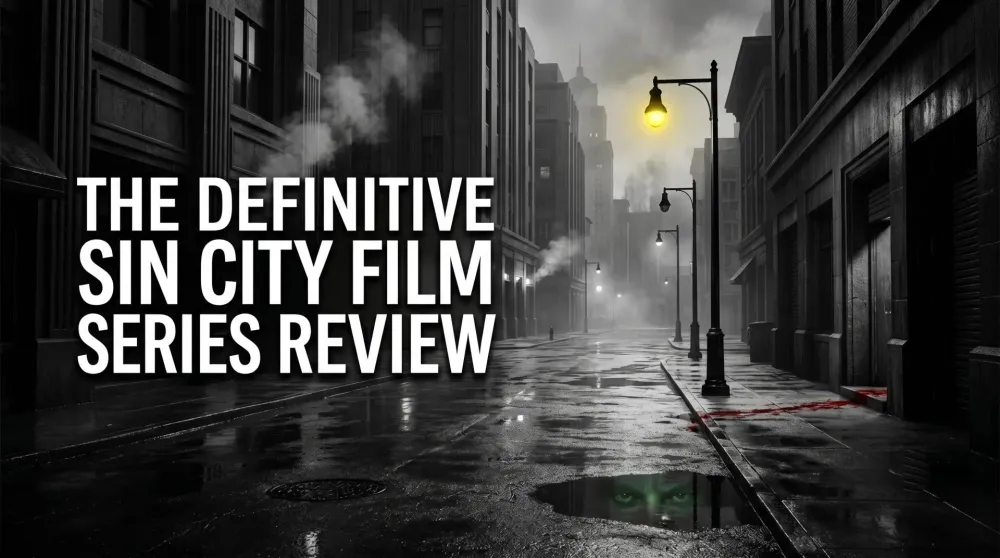
High-contrast black-and-white has been the language of noir since the 1940s — the deep shadows, the lone streetlamp, the rain-slicked alley. Miller understood that constraint could become style, and Rodriguez understood that digitally controlled contrast could be absolute in a way analogue film never achieved. The whites in Sin City are white. The blacks are black. There is no grain, no softness, no cinematic compromise. It’s noir’s visual logic taken to its logical extreme.
The selective colour pays off the promise of that extreme approach. In a world of pure black and white, a single red rose or a pair of green eyes lands like a slap. You don’t just notice it — you feel it.
The stories: Frank Miller’s moral universe
Both films are anthologies, drawing from Miller’s multi-volume graphic novel series published from 1991 onwards. The anthology structure is load-bearing for the franchise: Basin City is too morally dense to sustain a single narrative. Instead, it’s explored through overlapping perspectives — different men, different codes, different consequences, all operating in the same corrupt ecosystem.
The men of Basin City
Miller’s male characters follow a specific archetype: the man with a code in a world without one. Marv, Dwight, Hartigan — these are not good men in any conventional sense. They are violent, morally compromised, and operating by personal honour systems that wouldn’t survive legal scrutiny. But in Basin City, where every institution is rotten, personal honour is the only available moral currency.
This resonates in a specific way for dads. There is something in Miller’s moral universe — the idea of a man who does the right thing at maximum personal cost, with no expectation of recognition or reward — that maps onto a particular version of fatherhood. Not the Instagram version. The version at 3am when the easy choice is available and you make the harder one anyway.
The women of Basin City
The women of Sin City operate with more agency than the surface-level noir aesthetics suggest. The prostitutes of Old Town govern themselves, police their own streets, and conduct their own foreign policy with Basin City’s corrupt power structures. Ava Lord uses every weapon available to her in a world designed to leave her weaponless. Nancy Callahan carries her damage into action rather than paralysis.
Miller’s moral universe isn’t simple. The femmes fatale are lethal because the world gave them no other viable option. That’s not an apologia — it’s an observation, and it gives the franchise more texture than a simpler telling would allow.
How to watch: The format guide
Both Sin City films are OLED films. The visual language depends entirely on true blacks and razor-crisp whites. On a display with poor black levels, the whole approach collapses — you lose the depth, the contrast, the moral chiaroscuro. On a proper OLED in a dark room, you’re watching what the films were built to deliver.
- 4K Blu-ray on OLED: The correct format. Buy both, watch both on the same night, lights off.
- Apple Vision Pro: Genuinely excellent for both films. The digitally composited environments have a spatial depth that the headset renders beautifully, and the intimate scale of the noir scenes sits well within the field of view.
- Streaming: Acceptable but not optimal. The compression artefacts in high-contrast areas can be visible, which slightly undermines the visual precision.
One practical note for dads: both films are 18+ with extreme violence and adult content throughout. These are specifically not films to have on while the kids are moving through the room. Plan accordingly.
The franchise verdict
Sin City stands as one of cinema’s genuine visual experiments — a film that tested whether a graphic novel’s specific aesthetic could survive translation to a moving image at full commercial scale. The answer, emphatically, was yes. The 2005 original is a landmark. The 2014 sequel is a worthy if uneven companion.
A third film has been discussed over the years, but the commercial failure of A Dame to Kill For — $13.8 million against a $65 million budget — closed that door definitively. The two films we have are complete: two full seasons of Basin City, enough to understand the world and its rules, told by the people who created them.
All Sin City films reviewed and ranked are listed below.
Related Dadnology series hubs: DC Elseworlds for more standalone comic-book darkness, or Tulsa King for a crime story on the small screen instead.
Related Dadnology review: Sin City (2005) Review: The Living Graphic Novel That Changed Cinema
What is the best Sin City film to start with?
What order should I watch the Sin City films?
How many Sin City films are there?
Are the Sin City films suitable for kids?
Do the Sin City films follow the graphic novels closely?
Keep this in your inbox
One email a week: what we actually watched, built and reviewed — the stuff worth a dad's time. No hype, no daily spam.
Dadnology Weekly
One email a week: the LEGO, gaming and movie news worth a dad's time — plus what we actually reviewed. No hype, no daily spam.
Disclaimer: This review and its visuals were created with the help of AI. Some links may be affiliate links – we may earn a commission if you make a purchase, at no extra cost to you.
Current deals in Movies & TV
Verified live discounts tracked on Amazon
![The Legend of Korra — The Complete Series [Blu-ray]](https://m.media-amazon.com/images/I/51+1TXyb7aL._SL500_.jpg)
Movies & TV · Tested by Dadnology
The Legend of Korra — The Complete Series [Blu-ray]
4.5/5“A new Avatar, a modern city, a masked revolution”Read our review
Movies & TV · Tested by Dadnology
Zack Snyder's Justice League (4K Ultra HD)
4/5“Four hours. One vision. This is the film.”Read our review
Movies & TV · Tested by Dadnology