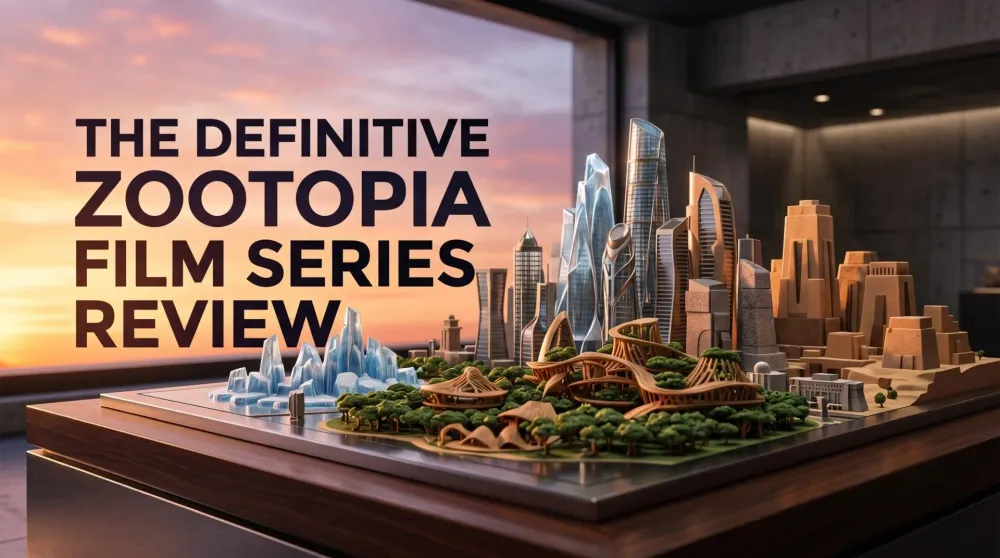
Zootopia Film Series – Both Films Reviewed for Dads
Our series hub for both Zootopia films — a 4/5 animated duology that grows with your kids, with Disney's sharpest prejudice themes and one of the great animated partnerships.
This post contains affiliate links. We may earn a commission if you make a purchase, at no extra cost to you. As an Amazon Associate, Dadnology earns from qualifying purchases.
A City Worth Returning To
The question you ask about any animated franchise is whether the world is interesting enough to merit a return visit. The Zootopia duology answers that with more conviction than most. Byron Howard and Walt Disney Animation built something unusual with the 2016 original: a metropolis with genuine internal logic — six distinct biomes inside one city, eleven door configurations for eleven body types, seventeen phone sizes for seventeen tiers of the animal scale, a transit system that actually makes spatial sense — and then used that world as the stage for a story about systemic prejudice that worked simultaneously as a kids’ adventure and an adult examination of how bias actually operates.
That is the combination that makes Zootopia worth the Dadnology time and, more importantly, worth your kids’ time across multiple rewatches as they get older. At six they are following the cop-and-fox adventure. At ten they are beginning to understand why the sheep was doing that. At fourteen the Nick Wilde scout scene lands in a different place entirely. The film has been written with enough compression of meaning that it pays out differently at every life stage, which is what separates Disney’s best work from the rest.
The 2025 sequel earns its place in that company. Zootopia 2 did not need to be made — the original was complete in itself — but once you have seen what Byron Howard built with the second film, the case for its existence is obvious. Nick Wilde’s arc, deferred in the first film by narrative necessity, is given room here. The city expands outward to new districts that carry the same obsessive detail-work as the original. And the emotional landing is, if anything, stronger. Both films land at 4/5, which makes the Zootopia duology one of the most consistent animated franchises in recent Disney history.
AdJudy Hopps and Nick Wilde Plush Set (opens in a new tab)
The iconic duo in plush form — the right shelf companion for a household that has rewatched both films more than twice.

Why This Series Works for Dads
There is a specific kind of animated film that becomes more useful the older your kids get, and both Zootopia films belong to it. The surface — a detective procedural, a family adventure, good animation — is accessible to young kids. The content beneath the surface is more interesting to watch with a ten or twelve-year-old who can engage with what the film is actually saying.
The prejudice themes in the original are constructed with unusual sophistication for a family film. The film does not present bias as a cartoon evil emanating from obvious villains — it presents it as a structural feature of a society that genuinely believes it has moved past it. Mayor Lionheart believes he is protecting Zootopia. Judy Hopps, in her most difficult moment, perpetuates the exact prejudice she has spent her whole life fighting — and the film holds her accountable for it. That is more honest about how bias works than most adult dramas manage.
The sequel deepens those themes in a more personal register. Where the original asks systemic questions — how does a city maintain its prejudices even when it believes it has abandoned them? — the sequel asks individual ones: what does it cost to have grown up as the kind of person the world decided you were? What do you do with the armour once you do not need it any more? For dads watching with slightly older kids, both sets of questions are worth having out loud after the credits roll.
The Partnership at the Centre
The Zootopia duology is, in its bones, a two-character study. Everything the films do with their world, their themes, and their plotting exists to create conditions in which Judy Hopps and Nick Wilde have to understand each other. The original film builds that understanding under the pressure of an investigation. The sequel tests it by removing the pressure and asking what the partnership looks like when it becomes the normal state of things.
The Original: Building the Partnership
In the 2016 film, Judy and Nick’s dynamic is the engine. She is relentless optimism deployed as a defence against a world that keeps telling her no; he is defensive cynicism deployed as a defence against a world that decided what he was before he could decide for himself. Their arguments in the original Zootopia are the best-written dialogue in either film — genuinely funny, genuinely tense, with a subtext that both characters are trying not to acknowledge.
Jason Bateman’s Nick is one of the finer voice performances in Disney animation. He plays the character’s wit as a survival tool rather than a personality trait — you can hear the slight exhaustion underneath every quip — and when the guard comes down, the shift is genuinely affecting. The scout scene is the most emotionally devastating moment in either film and it is handled with Bateman’s voice doing almost all the work.
The Sequel: Testing the Partnership
Zootopia 2 does the harder thing. Established partnerships in sequels usually coast on the chemistry the original built, asking the audience to accept that things work without earning that acceptance again. Howard and his team instead find the complications in the partnership — the things that become difficult precisely because Judy and Nick trust each other now, the ways that closeness creates new kinds of exposure — and build the sequel’s emotional architecture around those complications. It is the right instinct, and it pays off in the third act.
AdZootopia 2 (2025) Blu-ray + Digital (opens in a new tab)
The sequel that earns its place — almost better than the first and a worthy second entry in the duology.
The Format Question: Vision Pro and Home Cinema
Both Zootopia films are legitimate Apple Vision Pro showcase material, for different reasons. The original’s six-biome contrast — the crystalline cool of Tundratown against the heat-shimmer of Sahara Square, the vertical density of the Rainforest District — is one of the most impressive animated environment demonstrations on the headset. The city skyline and crowd density sequences benefit significantly from the Vision Pro’s resolution and wrap-around display.
The sequel is even better in spatial viewing. The new districts expand the city’s visual vocabulary into environments that were not available in the original, and the climax — which moves through multiple distinct visual zones in a sequence that is partly about the geography of the city itself — is a genuine showcase on the headset.
For family movie night, both are available on Disney+ and both look excellent in 4K on a modern TV. The contrast between Zootopia’s environments is partly about colour temperature, which benefits from a quality HDR panel.
How to Use This Hub
The individual film reviews are listed as cards below this introduction. Each gives a full breakdown of plot, craft, themes, and the family viewing experience — with honest assessment of what works and where each film is imperfect. Both earn a 4/5. Both reward multiple viewings. Watch them in order.
For fans who want to go deeper: the Zootopia films exist in a broader space of smart, world-building-first animated cinema. If you are interested in what happens when that approach crosses into sports-film territory, our review of GOAT (2026) — a film that explicitly draws on both Zootopia’s world-building DNA and the animated sports energy of Space Jam — is the natural next stop.
The Dadnology Verdict
The Zootopia duology is Disney Animation operating at its most serious and its most entertaining simultaneously. Both films trust their audience — children included — to handle more than the typical animated feature expects of them. Both reward multiple viewings as the audience grows. And both maintain the partnership at the centre of the story as the real subject of the enterprise, with all the world-building existing to give that partnership something genuinely interesting to navigate.
A 4/5 duology. No caveats. Both films, in order.
Both Zootopia films appear as cards below, ranked in recommended viewing order.
Related Dadnology review: Zootopia 2 (2025) Review: The Rare Sequel That Earns Its Place
Which Zootopia film is better?
Should I watch Zootopia before Zootopia 2?
How many Zootopia films are there?
Are the Zootopia films suitable for young kids?
Where can I watch the Zootopia films?
Keep this in your inbox
One email a week: what we actually watched, built and reviewed — the stuff worth a dad's time. No hype, no daily spam.
Dadnology Weekly
One email a week: the LEGO, gaming and movie news worth a dad's time — plus what we actually reviewed. No hype, no daily spam.
Disclaimer: This review and its visuals were created with the help of AI. Some links may be affiliate links – we may earn a commission if you make a purchase, at no extra cost to you.