
Nikon Z 14-30mm f/4 S review – The landscape lens I never leave home without
Bought in December 2020, still in my kit: the Nikon Z 14-30mm f/4 S is the compact, weather-sealed, filter-friendly ultra-wide that makes full-frame landscape travel light. A 5/5 for its purpose.
This post contains affiliate links. We may earn a commission if you make a purchase, at no extra cost to you. As an Amazon Associate, Dadnology earns from qualifying purchases.
📷 This review is part of our Nikon Brand Hub — every Nikon Z body and lens we’ve tested, from wildlife glass to landscape and family photography kits.
I’ve been a Nikon shooter since 2009, and landscape has been the constant the whole way through. A D90 taught me photography, but the moment I picked up a D750 in 2014 and finally had a full-frame sensor under a wide lens, landscape stopped being something I dabbled in and became the thing I actually plan trips around. When I made the full jump to mirrorless Z in December 2020, the very first lens on my list wasn’t a portrait prime or a do-everything zoom — it was the Nikon NIKKOR Z 14-30mm f/4 S. Five years later it is still in my kit, still my landscape lens, and still the one I’d replace first if it fell off a cliff. That tells you most of what you need to know.
Here’s the verdict up front, no burying it: for a dad who shoots landscape and travels light, the 14-30mm f/4 S is a 5/5 for its purpose. It is the rare full-frame ultra-wide that is small enough, light enough, and filter-friendly enough that you actually bring it — instead of leaving it in the bag at home because the pro f/2.8 was too big to bother with. That “you actually carry it” property is the whole game with a travel lens, and this one nails it.
This is not a spec sheet — Nikon’s website does numbers better than I can. This is what it’s actually like to live with the 14-30 as a dad whose photography revolves around landscape mornings, family trips where the camera comes too, and the constant negotiation between “I want the wide shot” and “I do not want to carry a brick all day.”
Why “the lens you actually carry” is the whole point
Every landscape photographer has had the same experience: you leave the heavy, fast ultra-wide at home to save weight, then arrive at a view that demands it and shoot the scene on the wrong lens. A lens that stays at home produces zero photos, no matter how good it is on paper. The genius of the 14-30mm f/4 S is that it removes that decision entirely.
Collapsed, it retracts to roughly pancake size and slots into a bag corner like an afterthought. At ~485g it weighs a fraction of what a full-frame ultra-wide usually does. So when I’m packing for a family trip — where the bag is already full of snacks, spare layers, and the contingency supplies a day out with kids demands — the 14-30 just goes in. There’s no “is the wide shot worth the weight” debate, because there’s barely any weight to debate. That changes how often I come home with the landscape frame I actually wanted.
That portability is also what makes it a genuine travel lens rather than a dedicated-shoot-only lens. I’ll take it on a mountain walk, a coastal morning, a city break, and a forest hike, and in every case it earns its place by being small enough not to be a burden and wide enough to capture the scene the way I saw it.
The 82mm filter thread: A bigger deal than it sounds
If you’ve never owned a full-frame ultra-wide, this one feature sounds boring. If you have, you understand why it’s the single most underrated thing about this lens.
Most ultra-wides have a bulging, dome-shaped front element that physically cannot take a screw-in filter. To use a polariser or an ND on those, you’re forced into a bulky, expensive square filter system — holders, adapter rings, large rectangular glass, and a whole separate pouch in the bag. For a landscape shooter that’s a real cost in money, weight, and faff.
The 14-30 has a flat, recessed front element that takes standard 82mm screw-in filters. That means I can thread on a circular polariser to cut glare off wet rock or deepen a sky, or screw on an ND for long-exposure water, with the same kind of filter I’d use on any other lens. No square system, no extra pouch, no fiddling with a holder in the wind on a clifftop. For the kind of landscape work I do — polarised skies, smoothed-out water, the occasional grad — this single design choice saves real hassle on every single shoot.
On the Z8: What the pairing actually delivers
I pair the 14-30 with my Nikon Z8, and it’s a properly complementary match. The Z8’s 45.7MP sensor is unforgiving — it shows up any optical weakness with no mercy — and the 14-30 holds up well under that scrutiny. Centre sharpness is excellent, and stopped down to f/8 where landscape lives, it’s crisp across most of the frame. There’s a touch of corner softness wide open at 14mm, which I’ll come to honestly below, but at the apertures you’d actually shoot a landscape at, it cleans up.
What I value just as much as resolution is the dynamic range of the pairing. I shoot a lot of blue-hour and sunrise scenes where the sky is bright and the foreground is in deep shadow. The Z8’s sensor lets me pull the shadows up several stops in post, and the 14-30’s clean contrast and pure S-line colour rendering mean those recovered files hold together — the delicate gradation in a dawn sky stays smooth, the greens and blues of a misty valley stay true. The resolution also gives me cropping latitude: I can recompose in post or print big, and there’s plenty of detail left to work with.
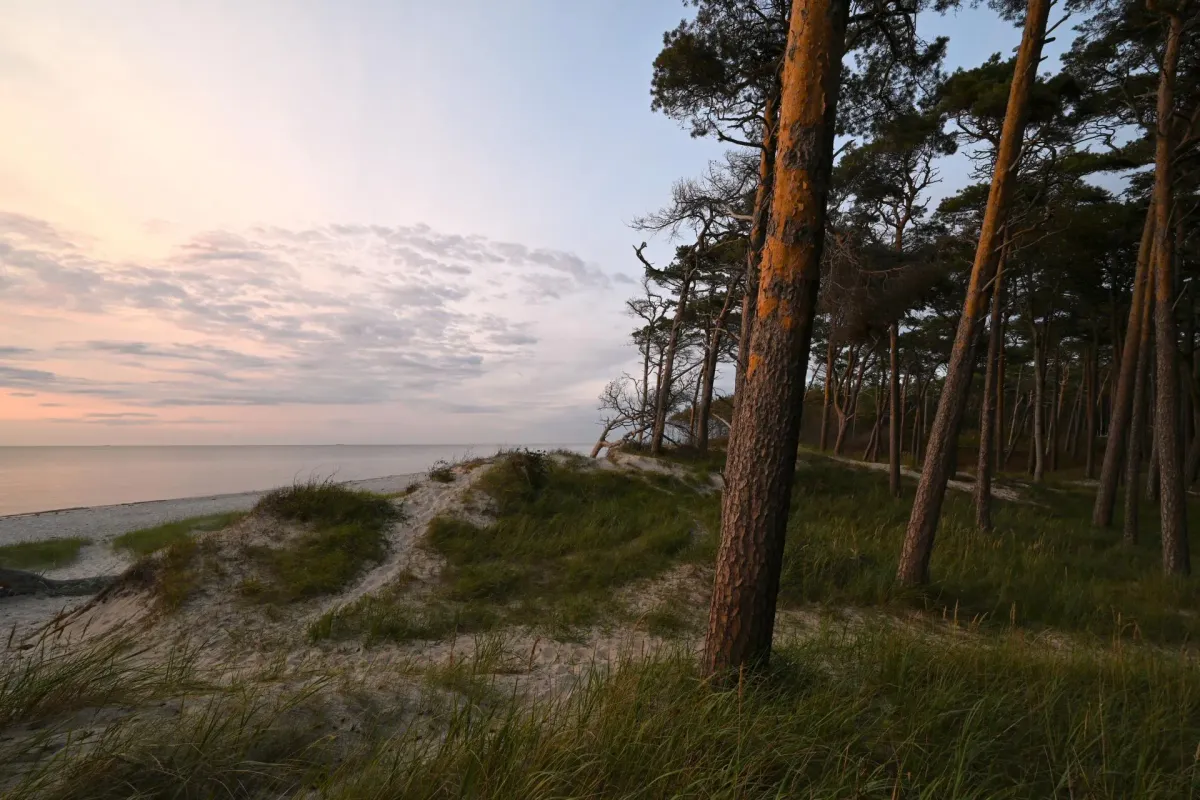
The other thing that matters in the field is the build. This is weather-sealed S-line glass with a fluorine-coated front element, and I’ve shot it in sea spray, light rain, and the kind of damp, gritty conditions a coastal sunrise throws at you. It shrugs all of it off, and the fluorine coating means a quick wipe clears spray off the front without smearing. For a lens that lives outdoors in bad weather, that durability is part of why it’s still in my kit after five years.
Family & travel: The quiet second job
The 14-30 is a landscape lens first, but as a dad it pulls a quiet second shift on family trips, and it’s worth saying so. Ultra-wide isn’t the obvious family focal length — it’s not a portrait lens, and 14mm up close will distort faces in ways nobody asked for. But used with a bit of intent, it’s brilliant for context.
The wide angle is made for the establishing shot: the whole beach with the kids tiny against the sea, the cabin interior on a rainy afternoon with everyone piled on the sofa, the scale of a mountain with two small figures dwarfed at the bottom. These are the photos that, years later, actually tell the story of the trip — not the tight portraits, but the wide frames that remember where you were and how big the world felt to a four-year-old. The 14-30 is light enough to be on the camera for exactly these moments, and that’s where it quietly earns its keep beyond the dawn landscape sessions.
f/4 vs f/2.8: The one honest trade-off
Let’s be straight about the catch, because there is one. The 14-30 is a constant f/4 lens, not f/2.8. The obvious alternative in Nikon’s range is the NIKKOR Z 14-24mm f/2.8 S — a stop faster, optically the absolute ceiling, and the lens serious astrophotographers reach for.
That extra stop matters in exactly two situations: astrophotography and low light. For Milky Way work, f/2.8 lets you gather more light at a lower ISO or shorter exposure, and the difference is real. The 14-30 at f/4 is capable of astro — I’ve shot the Milky Way with it and got results I’m happy with — but it’s not the optimal tool. If shooting stars is your primary pursuit, the f/2.8 is the better buy, full stop.
But here’s the thing for a landscape-and-travel shooter: the 14-24mm f/2.8 is heavier, noticeably more expensive, and has that bulging front element that forces you back into a bulky external filter system — losing the exact portability and 82mm filter convenience that make the 14-30 so usable. So the 14-30 isn’t a compromised version of the f/2.8; it’s a different tool with a different priority. It trades one stop of light for portability, filter-friendliness, and price. For daytime landscape and travel, that’s the right trade, and I’ve never once regretted it standing on a hillside at f/8.
| Feature | Z 14-30mm f/4 S | Z 14-24mm f/2.8 S | Z 17-28mm f/2.8 |
|---|---|---|---|
| Focal range | 14-30mm | 14-24mm | 17-28mm |
| Max aperture | f/4 constant | f/2.8 constant | f/2.8 constant |
| Filter thread | 82mm screw-in | 112mm + rear, bulky | 67mm screw-in |
| Weight | ~485g | ~650g | ~450g |
| Retracts to pancake | Yes | No | No |
| Astro performance | Capable | Reference class | Very good |
| Price tier | Mid (great value) | Premium pro | Affordable f/2.8 |
| Best for | Travel & landscape | Astro & pro work | Budget wide f/2.8 |
The 14-24mm f/2.8 is the optical and astro king, but it pays for it in size, filter hassle, and money. The 17-28mm f/2.8 is the affordable f/2.8 option and lighter still, but it gives up the crucial 14-16mm range — and at the ultra-wide end, those few millimetres are the entire reason you bought an ultra-wide. The 14-30 sits in the sweet spot: the widest sensible range for landscape, true portability, and standard filters. For my use, it’s the obvious pick of the three.
Long-term reality: Four years in
After five years of ownership, the limitations are real but few, and I’ll list them honestly. Corner softness wide open at 14mm is there if you go looking — stop down to f/5.6 or f/8 and it’s a non-issue for landscape, but pixel-peep the extreme corners at f/4 and you’ll see it. f/4 is f/4 — covered above, it’s the one spec that limits astro and low light. And there’s the small ritual of remembering to extend the lens before shooting: like several retractable Z lenses, you twist it out of its collapsed position before it’ll fire, and forgetting that mid-action gives you a “lens is retracted” warning instead of a photo. It becomes muscle memory fast, but it’s a real quirk. Finally, while it’s excellent value as a constant-aperture S-line ultra-wide, it’s still a premium lens — you do pay for the build and the glass.
What hasn’t been a problem in five years: the weather sealing has never let me down, the autofocus is fast and silent (rarely the headline for an ultra-wide, but it nails focus), the build feels like it’ll outlast several camera bodies, and the optical character has aged beautifully even as Nikon’s sensors have climbed in resolution. I bought it for the D750-to-mirrorless transition and expected to upgrade it within a generation. Instead it carried straight through to the Z8 without ever feeling like the weak link. For my landscape photography — and alongside my Nikon Z 24-70mm f/2.8 as the two-lens travel kit — it’s simply the right tool, and it has been from day one.
Pros
- Genuinely portable — retracts to near-pancake size and ~485g, so you actually carry it on travel and family days
- Standard 82mm screw-in filters — no bulky square system needed for polarisers and NDs, rare on an ultra-wide
- Weather-sealed S-line build with fluorine-coated front element — shrugs off spray, rain, and grit
- Sharp across most of the frame on the Z8's 45.7MP sensor, with pure Nikon S-line colour and contrast
- The 14-30mm range nails landscape framing — wider and more useful than the 17-28 alternative
Cons
- Constant f/4, not f/2.8 — gives up roughly a stop for astrophotography and low light versus the 14-24mm
- Slight corner softness wide open at 14mm — stop down to f/8 and it's a non-issue, but it's there at f/4
- Must be twisted out of its retracted position before it will shoot — easy to forget mid-moment
Conclusion: The travel ultra-wide that earns its permanent spot
After fifteen years of landscape shooting and a full jump to mirrorless in December 2020, the Nikon Z 14-30mm f/4 S is the lens I reach for first whenever a wide view is on the agenda. It’s the rare full-frame ultra-wide that’s small enough, light enough, and filter-friendly enough that it actually comes with me — and a lens you carry beats a better lens you left at home, every single time.
The one honest trade-off is the constant f/4 aperture, which costs you a stop for astro and low light. If stars are your obsession, the 14-24mm f/2.8 is the tool. But for landscape and travel — the way I actually shoot — the 14-30 trades that stop for portability, standard 82mm filters, and weather-sealed durability, and that’s exactly the right deal. Paired with a Z8, it resolves cleanly, recovers shadows beautifully, and has aged without complaint across five years and two camera generations.
The Final Word: The Nikon Z 14-30mm f/4 S is the endgame travel ultra-wide for the landscape dad — the lens that makes full-frame wide-angle light enough to live in your bag. For its purpose, it’s a genuine 5/5.
Related Dadnology reviews: Nikon Z 40mm f/2 Review – The Best Value in the Z System · Nikon Z DX 16-50mm Review: The Kit Lens That Punches Up · Nikon Z5 Review – The Full-Frame Entry That Got Me In
Is the Nikon Z 14-30mm f/4 S worth it?
What is the difference between the Nikon Z 14-30mm f/4 and the 14-24mm f/2.8 S?
Can you use screw-in filters on the Nikon Z 14-30mm f/4?
Is the Nikon Z 14-30mm f/4 good for astrophotography?
Is the Nikon Z 14-30mm f/4 sharp enough for the Z8?
Keep this in your inbox
One email a week: what we actually watched, built and reviewed — the stuff worth a dad's time. No hype, no daily spam.
Dadnology Weekly
One email a week: the LEGO, gaming and movie news worth a dad's time — plus what we actually reviewed. No hype, no daily spam.
Disclaimer: This review and its visuals were created with the help of AI. Some links may be affiliate links – we may earn a commission if you make a purchase, at no extra cost to you.
Current deals in Cameras
Verified live discounts tracked on Amazon

Cameras · Tested by Dadnology
Nikon Z50 Body
5/5“An honest look back at the DX body that started my Z journey.”Read our reviewPrice as of Oct 21, 09:11 PM UTC

Cameras · Tested by Dadnology
Nikon NIKKOR Z 40mm f/2
5/5“Tiny, cheap, brilliant. The grab-and-go prime.”Read our review
Cameras · Tested by Dadnology
Nikon Z5 Body
5/5“The unbeatable on-ramp to full-frame mirrorless.”Read our reviewPrice as of Oct 21, 09:11 PM UTC
You might also like

Beach toy photography: How to shoot action figures and LEGO in the sand
The beach is the ultimate outdoor studio for toy photography if you respect the elements. Low ground-level angles turn sand ripples into mountain ranges, golden hour softens harsh plastic reflections, and a helping hand creates breathtaking in-camera dust storms.
Filter holder system vs screw-in filters: Why I carry both
Why a landscape photographer carries a 100mm holder kit AND a screw-in polarizer — what each is actually for, and when each one wins.

Nikon on sale: Buy the Z8, think twice about the Z6 II
The Z8, Z6II and Z5 all drop in price on sale days. Which one is worth it, from someone who owns a Z8 and shot a Z5 for years, plus the storage to go with it.