
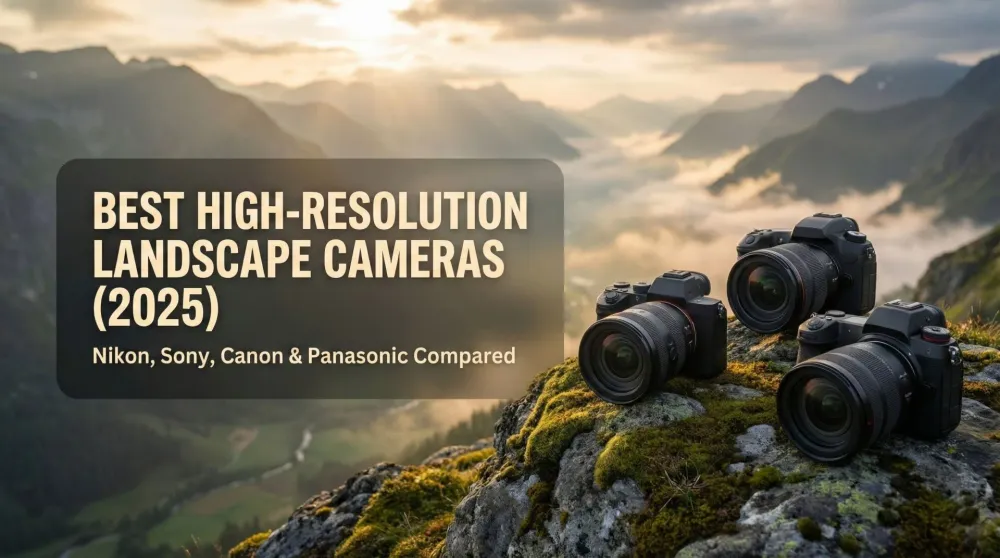
Best high-resolution full-frame cameras for landscape photography (2025) – Nikon, Sony, canon & Panasonic compared
Want to take your landscape photos far beyond smartphone quality? We compare the best high-resolution full-frame cameras for landscape photographers in 2025, with a dad-friendly focus on combining serious sunrise shoots and family travel.
This post contains affiliate links. We may earn a commission if you make a purchase, at no extra cost to you. As an Amazon Associate, Dadnology earns from qualifying purchases.
Editor’s note: We shoot Nikon and have long-term experience with the Z system. For pure landscape work, the Nikon Z7 II is our personal recommendation. That said, the Sony, Canon, and Panasonic cameras in this guide are all excellent tools – the right choice depends on your system, budget, and how much you value resolution versus versatility.
🏞️ Landscape photography as a dad-friendly superpower
Landscape photography can be one of the most family-friendly serious hobbies you can pick up as a parent:
- You shoot sunrise while everyone still sleeps.
- You shoot sunset and blue hour when the kids are winding down back at the apartment or hotel.
- You spend the daytime hiking, swimming, and exploring with your family – scouting compositions along the way.
If you’re already the parent who naturally wakes up early at the vacation house, a high-resolution landscape camera is basically a quiet superpower. You get your creative time without stealing hours from the family program.
And if you want to bring home large, detailed prints from those trips – something you can actually hang on the wall – then a high-resolution full-frame body is where the real fun begins.
📸 Why high resolution & dynamic range matter for landscapes
For landscape photography, a high-resolution sensor and strong dynamic range aren’t just about bragging rights. They directly affect what your final images look like:
- More megapixels = more detail & bigger prints: 45–61 MP files hold up beautifully for big canvas or metal prints and allow heavy cropping if you can’t get close enough to that mountain peak or lighthouse.
- Dynamic range = freedom in post: You can lift dark foregrounds, recover bright skies, and blend exposures without banding or ugly noise. Sunrise and sunset scenes become much more forgiving.
- Better tonal transitions: Fine detail in grass, rock textures, distant forests, and clouds all benefit from high resolution and clean files.
- Pixel-shift / multi-shot modes: For static scenes on a tripod, these can create ultra-high-resolution composites that rival medium format for massive prints.
You can shoot landscapes with any camera. But if your goal is ambitious, print-ready work, a high-res full-frame body is the natural next step.
🎯 Our main pick: Nikon Z7 II – The landscape-focused workhorse
For dedicated landscape photographers who don’t need a sports camera, the Nikon Z7 II (45.7 MP) hits a sweet spot:
- High resolution without going overboard into extreme file sizes.
- Excellent dynamic range for shadow recovery and sky control.
- 5-axis in-body stabilization for handheld shots and slower shutters.
- Weather-sealed body that can handle rain, coastal spray, and mountain dust.
- Dual card slots and reliable ergonomics for serious work.
And crucially: it’s significantly cheaper than Nikon’s Z8, while still giving landscape shooters almost everything they need.
Why the Z7 II is tuned for landscapes
If your main focus is landscape, seascape, cityscape, and travel scenery, the Z7 II plays directly into that niche:
- 45.7 MP full-frame sensor: Enough resolution for large fine-art prints and heavy crops, but not so extreme that every RAW file explodes your storage.
- Wide dynamic range at base ISO: Perfect for sunrise/sunset, backlit mountains, forests with bright sky patches, and high-contrast scenes.
- Refined color and tonality: Nikon’s color rendering and profiles give you a natural starting point for greens, blues, and skin tones when your family ends up in the frame.
- IBIS + good high-ISO performance: You can combine a tripod for serious work with handheld shots when you’re out with the kids and don’t want to carry the full kit.
- Weather sealing & build: The Z7 II feels safe in light rain, sea mist, and cold mornings. You still need to be sensible, but it’s built for real outdoor use.
If you rarely shoot sports or wildlife and mostly care about landscapes and family travel, the Z7 II gives you almost everything the Z8 does for your use case, at a noticeably lower cost and with lighter files.
🧳 A real-world Z7 II landscape kit for traveling dads
You don’t need a giant lens collection to build a powerful landscape kit around the Z7 II. Here’s a practical setup that works beautifully for trips with kids:
1) Nikon Z 14–30mm f/4 S – Ultra-wide travel landscape zoom
- 14–30mm on full frame covers ultra-wide vistas, dramatic foregrounds, and tight interiors.
- Constant f/4 aperture keeps size and weight manageable for hiking.
- Designed for filters – crucial for ND and polarizers on the road.
2) Nikon Z 24–120mm f/4 S – The do-everything travel lens
- Covers most of the day: city streets, family snapshots, compressed landscapes, detail shots.
- Constant f/4 keeps exposure predictable and quality high.
- Very sharp across the range, ideal for when you don’t want to swap lenses around kids and sand toys.
3) Optional: A small fast prime (e.g. Nikon Z 35mm f/1.8 S)
For low-light city scenes, environmental portraits of the family, and “storytelling” frames, a fast prime is still a wonderful addition.
🕒 How landscape photography fits around family life
One of the underrated strengths of landscape photography as a dad hobby is timing:
- Morning golden hour: You sneak out while the family sleeps, get your sunrise, and bring back fresh bread and epic photos.
- Blue hour and evening: When kids are tired and back at the apartment, you can head out with a tripod for long exposures, city lights, and reflections.
- Midday scouting with the family: Use hikes, beach walks, or sightseeing to scout compositions. Mark spots on your map app, then revisit them in better light.
The Z7 II’s weather sealing and battery life make it dependable in these windows. You don’t want your one morning of foggy magic ruined by gear failure.
⚖️ Why not just buy a Nikon Z8?
The Nikon Z8 is a phenomenal all-rounder – but for many landscape-focused shooters, it’s overkill:
- You pay for fast action AF and high fps that you may rarely use.
- File sizes and processing demands are higher.
- Body price is significantly higher, which might be better spent on lenses, a sturdy tripod, and travel.
If you mostly shoot landscapes, travel scenes, and the family in calmer moments, the Z7 II delivers what you actually need.
🔍 High-resolution rivals – Sony, canon & Panasonic
If you’re not locked into Nikon, there are excellent alternatives that also target landscape shooters.
Sony α7R V – The resolution & tech monster
The Sony α7R V is the newest high-resolution flagship in Sony’s R-line, built around a 61 MP full-frame sensor.
- Why landscape shooters love it: 61 MP of detail is incredible for huge prints. The dynamic range is excellent, and the Pixel-shift multi-shot mode allows for ultra-high-res composites.
- Trade-offs: It is often the most expensive option. 61 MP RAW files are heavy and demand fast computers.
- Best for: Landscape specialists who also want class-leading autofocus for wildlife and action.
Canon EOS R5 – High-resolution all-rounder with stellar IBIS
The Canon EOS R5 (45 MP) is often described as a “do-everything” high-res body that happens to be fantastic for landscapes.
- Landscape advantages: 45 MP sensor with great color. Super-strong IBIS (up to ~8 stops) allows for handheld twilight shots. Fully articulating screen helps with low-angle compositions.
- Trade-offs: RF lenses are excellent but often expensive.
- Best for: Photographers who want one camera to do almost everything: landscapes, portraits, weddings, wildlife, and high-end video.
Sony α7R IV – 61 MP resolution at better value
The Sony α7R IV is the previous-generation high-res body with the same 61 MP sensor as the R V.
- Why it’s still relevant: Identical resolution to the R V at a more attractive price. Excellent dynamic range.
- Where it trails: Autofocus and processing are one generation behind, but perfectly fine for landscapes.
- Best for: Shooters who want maximum resolution per dollar.
Panasonic Lumix S1R – Rugged high-res tool
The Panasonic Lumix S1R (47 MP) is a slightly older but still impressive high-resolution full-frame body.
- Landscape strengths: Excellent detail and dynamic range. A true “tank” build quality with robust weather sealing.
- Trade-offs: Heavier system overall. Lens ecosystem is smaller than the big three.
- Best for: Tripod-oriented photographers who value build quality above all else.
🧠 Practical tips for dad-landscape shooters
Whichever body you choose, a few habits help you get the most from it:
- Use a sturdy but travel-friendly tripod: Essential for blue hour and focus stacking – but pick one you’re actually willing to carry.
- Shoot at base ISO whenever possible: High-res sensors shine at ISO 64/100.
- Embrace focus stacking: With 45–61 MP files, you’ll often want near-far sharpness.
- Scout with your phone: Use family walks to spot compositions, then return at sunrise/sunset with the big camera.
🗣️ Which landscape camera should you actually buy?
If you’re a dad (or any enthusiast) who mainly wants landscapes + travel + some family shots, our order of recommendation looks like this:
- Nikon Z7 II: Best balance of high resolution, dynamic range, handling, and price for landscape-first shooters.
- Sony α7R V: The ultimate tool if you want maximum detail plus top-tier AF for wildlife.
- Canon EOS R5: Ideal if you want a high-res hybrid camera that does landscapes, portraits, and wildlife with equal confidence.
- Sony α7R IV: A value-oriented way to get 61 MP.
- Panasonic Lumix S1R: A robust option for tripod-oriented photographers.
Pick the body that matches how you actually shoot, then invest in one ultra-wide zoom, one mid-range zoom, and a sturdy tripod.
Related Dadnology guides: Best Mirrorless Cameras for Dads (2026 Buyer’s Guide) · Which Nikon Mirrorless Camera Should I Buy? (2025 Buyer’s Guide · Best Vlogging & Creator Cameras (2026 Buyer’s Guide)
📌 FAQ – High-resolution landscape cameras
Why do you recommend the Nikon Z7 II over the Nikon Z8 for landscapes?
Do I really need 45–61 MP for landscape photography?
Is full frame always better than APS-C for landscapes?
Which lens is more important for landscape – ultra-wide or mid-range zoom?
Should I consider medium format instead of high-resolution full frame?
Keep this in your inbox
One email a week: what we actually watched, built and reviewed — the stuff worth a dad's time. No hype, no daily spam.
Dadnology Weekly
One email a week: the LEGO, gaming and movie news worth a dad's time — plus what we actually reviewed. No hype, no daily spam.
Disclaimer: This review and its visuals were created with the help of AI. Some links may be affiliate links – we may earn a commission if you make a purchase, at no extra cost to you.
Current deals in Cameras
Verified live discounts tracked on Amazon

Cameras · Tested by Dadnology
Nikon Z8 Body
5/5“The Endgame body. No more compromises.”Read our reviewPrice as of Oct 17, 09:11 PM UTC

Cameras · Tested by Dadnology
Nikon Z5 Body
5/5“The unbeatable on-ramp to full-frame mirrorless.”Read our reviewPrice as of Oct 17, 09:11 PM UTC

You might also like

Nikon on sale: Buy the Z8, think twice about the Z6 II
The Z8, Z6II and Z5 all drop in price on sale days. Which one is worth it, from someone who owns a Z8 and shot a Z5 for years, plus the storage to go with it.
Nikon Z 70-200mm f/2.8 VR S vs VR S II: Which should you buy?
We've shot the original Nikon Z 70-200mm f/2.8 VR S for over five years and rate it a flat 5. Here's how it stacks up against the new VR S II - and which one you should actually buy.

Beach toy photography: How to shoot action figures and LEGO in the sand
The beach is the ultimate outdoor studio for toy photography if you respect the elements. Low ground-level angles turn sand ripples into mountain ranges, golden hour softens harsh plastic reflections, and a helping hand creates breathtaking in-camera dust storms.