
Nikon Z 70-200mm f/2.8 VR S review: The sideline hero
Five years in our kit and still the lens we reach for first. The Nikon Z 70-200mm f/2.8 VR S is the perfect fast telephoto for dads.

This post contains affiliate links. We may earn a commission if you make a purchase, at no extra cost to you. As an Amazon Associate, Dadnology earns from qualifying purchases.
🛠️ This review is part of the Best Tech for Dads – explore the gear that actually survives family life.
Some lenses you buy. This one you marry. I bought the NIKKOR Z 70-200mm f/2.8 VR S in December 2020, and in the five years since it has never once been the lens I regretted packing. Portraits in the garden, my son’s football matches in failing November light, a niece’s school play from the cheap seats, the occasional deer that wandered close enough to count — this is the lens that did all of it. If you want the verdict before the unboxing: it is a flat 5/5, the perfect fast telephoto, and the closest thing to a no-compromise tool I own.
That is not a word I throw around. I have been shooting Nikon since 2009 — a D90, then a D750 when I went full-frame in 2014, and since December 2020 a full Z kit. I rate gear by exactly one thing: fitness for purpose. A spec sheet means nothing if the lens fumbles the one shot that mattered. This lens has never fumbled.
A newer version now exists. Nikon has announced the NIKKOR Z 70-200mm f/2.8 VR S II, a lighter, faster-focusing successor. It does not change anything below — this lens is still a flat 5/5 for me — but if you are deciding between the two, our buying guide breaks down exactly who should pick which.
The portrait-and-sideline hero
Here is the frame that matters for a tech-dad: this is the lens that does two jobs better than anything else in the bag. At 85-135mm and f/2.8 it renders people the way you remember them, not the way a phone flattens them — creamy separation, a background that melts to colour, skin that looks like skin. Then at 200mm it pulls you onto the pitch from the touchline, freezing a kid mid-sprint without you ever stepping where you would block the view.
The optical formula is the kind of thing Nikon’s marketing department gets excited about and the rest of us only notice because the files are clean wide open. There is no “stop down to f/4 for sharpness” tax here. f/2.8 is the working aperture, edge to edge, and on a high-resolution body it resolves more than my eyes do at 100% crop. After five years I still occasionally zoom into a frame just to admire how little the lens gives up.
The other half of the story is autofocus. Paired with my Nikon Z8, this lens locks focus faster than I can decide on composition. Subject detection grabs an eye across a muddy field and tracks it through the whole run. I have shot maybe ten thousand frames of children doing unpredictable things, and the keeper rate is the highest of any setup I have ever used — film, DSLR, or mirrorless. That is the real reason it earns a 5: it removes the gear from the equation and leaves only whether I pressed the button at the right moment.
Living with 1.36 kilograms
Let us be honest about the weight, because the “no fluff” rule demands it. This is ~1360g of glass and metal. On a long day at a sports tournament, your right wrist files a complaint. On a Z8 the balance is genuinely good — the body has the heft to anchor it — but if you are coming from a 40mm pancake, the first outing is a shock. I keep a smaller prime (the lovely little 40mm f/2.0) in the bag for exactly the days I want to go light. This is not a casual walk-around lens. It is a deliberate-results lens.
But the weight is also where the toughness lives. Mine has been rained on, dust-blasted at a beach, and handed to a curious 4-year-old who treated it like a telescope. The weather sealing held, the zoom ring still has that perfectly damped resistance, and the OLED panel on the barrel still tells me focal length and depth of field at a glance. This is built to a professional standard, and after five years of real abuse it shows zero slop.
Why I trust this lens — The long road here
I did not arrive at this lens by reading a forum. I arrived by sixteen years of Nikon. The D90 taught me composition. The D750 in 2014 was my first taste of full-frame and the first time a 70-200 made sense in my hands. In December 2020 I made the full switch to mirrorless: the Z5 and Z50 (with the DX 16-50 as its kit lens), the 14-30 f/4 for landscapes, the 24-70 f/2.8 as the standard, this 70-200 f/2.8, and a TC-1.4x, all bought in one go, with most of the F-mount kit sold to fund it. I kept the D750 as a backup, and the same month I picked up a D500 with a 200-500mm specifically for birding — that pairing is where I properly learned the difference between “long enough” and “actually long enough,” a lesson that still shapes how I pair lenses today. The 40mm f/2 joined a few years later, in 2023, once I felt the gap for something smaller.
What I did not fully appreciate until the Z version was how much the native mount changes the experience. On the old F-mount glass via the FTZ adapter, autofocus was excellent but you always felt the translation layer. The native Z 70-200 is direct — focus motors that snap, communication with the body that never hesitates, and stabilisation that talks to the in-body system instead of working around it. In 2025 I added the Z8 and a Z50 II, plus the 180-600 for reach, and the 70-200 only got better with the Z8 underneath it. A lens that improves when the body around it improves is a lens that was built with headroom. That is rare, and it is a big part of why I rate it a 5 rather than a 9.
Real-world: A Saturday with the 70-200
A concrete picture, because specs lie and Saturdays don’t. A typical match-day morning: I shoot warm-ups at 70mm wide open to get the team in context, then zoom to 200mm to isolate my son the moment the whistle goes. The light is grey, the pitch is half-mud, and the action never stops — exactly the conditions that humble slower lenses. The f/2.8 keeps my shutter speed high enough to freeze a kicked ball, the VR keeps the panning shots clean, and subject-detection autofocus does the one thing I cannot do manually: track an unpredictable child across a frame for ninety minutes. By half-time I have more keepers than I would have shot in a whole afternoon on my old DSLR.
Then it changes hats. Same afternoon, a relative’s birthday indoors, terrible tungsten light. I drop to 85mm, open to f/2.8, and the lens turns a chaotic kitchen into flattering portraits with a background that dissolves. One lens, two completely different jobs, no compromise on either. That versatility — sport in the morning, portraits in the afternoon, both at professional quality — is the entire reason this lens lives in the bag while others rotate out.
Reach: Where the 70-200 stops and the 180-600 starts
Two hundred millimetres is a lot until a heron is sitting on the far bank. For the times an animal wanders close, this lens is brilliant — fast enough to catch a squirrel mid-leap, sharp enough to crop hard afterwards. And the Nikon Z TC-1.4x is a genuinely useful insurance policy: snap it on and you have a 98-280mm f/4 with almost no autofocus penalty. I keep one in a pocket permanently — the shot at the top of this page, sunbeams through the Lüneburg Heath at 120mm, f/11, 1/80s, was that exact combo: not a sideline shot, but the same compression that isolates a striker also stacks light shafts through heather at sunrise.
But for deliberate wildlife — birding, anything at distance — even 280mm is short, and pretending otherwise would be dishonest. That gap is precisely why I added the Nikon Z 180-600mm to the kit in 2025. If reach is what you are actually short of, buy that one first — the 70-200 is the better lens, but it will not solve a distance problem. The two are not rivals; they are a relay team. The 70-200 owns from the portrait studio to the front row of the action. The 180-600 owns everything past it. Knowing which to grab is half of being a useful photographer.
How it stacks up
If you are deciding between the obvious options, here is how the 70-200 sits against its nearest in-system alternative and the F-mount lens many of us upgraded from.
| Spec | Z 70-200mm f/2.8 VR S | Z 100-400mm f/4.5-5.6 VR S | F-mount 70-200mm FL ED VR |
|---|---|---|---|
| Aperture | Constant f/2.8 | Variable f/4.5-5.6 | Constant f/2.8 |
| Reach (bare) | 200mm | 400mm | 200mm |
| Low-light | Best in class | One stop slower | Excellent |
| Weight | ~1360g | ~1435g | ~1430g |
| AF on Z bodies | Native, instant | Native, instant | Via FTZ adapter |
| Best for | Portraits, sport, events | Reach + flexibility | Legacy DSLR kit |
The takeaway: if your priority is people, indoor sport, and the lowest light you can survive, nothing in the system beats the 70-200 f/2.8. If you mostly need distance and shoot in daylight, the 100-400 is the smarter buy. And if you are still on F-mount, the Z version is a clean generational step up — it adapts the old one fine via FTZ, but native is faster and lighter on the front.
The family verdict after five years
Run the dad-tech test: does it solve a real family problem, or create a new one? It solves the biggest one I had. Before this lens, the indoor school play and the floodlit football pitch produced a folder full of blurry, grainy disappointment. Now they produce keepers. My kids’ childhoods are documented sharply, in real light, with backgrounds that don’t distract — and that is worth more to me than any spec.
The only new problem it creates is the weight, and the only money complaint is the price, which is professional and you feel it. But I bought it once, in December 2020, and I have not wanted for a better telephoto since. That is the definition of fitness for purpose.
Pros
- Constant f/2.8 with class-leading low-light performance
- Tack-sharp wide open, edge to edge, on high-res bodies
- Near-instant autofocus with rock-solid subject tracking
- Genuinely tough weather-sealed build that survives kids and weather
- Pairs cleanly with the TC-1.4x for 280mm of reach
Cons
- Heavy at ~1360g; not a casual walk-around lens
- Professional price tag you will feel
- 200mm (even 280mm with the TC) is short for deliberate wildlife
- Tripod foot is fine but the Arca-compatibility debate annoys some
The NIKKOR Z 70-200mm f/2.8 VR S is the single best fast telephoto I have ever owned, and after five years in daily family service it has earned the rarest rating I give. It is heavy and it is expensive — but it does exactly what a fast telephoto should do, with zero compromise, every single time. For portraits, sport, and events, this is the lens.
Nikon has since released the Z 70-200mm f/2.8 VR S II, a lighter second-generation version. If you are buying today, it is the one to price up first; the original stays a proven choice while stock lasts.
Is the Nikon Z 70-200mm f/2.8 VR S worth it for a parent who mostly shoots their kids?
How much reach do you get with the Nikon Z TC-1.4x teleconverter?
Is 200mm long enough for wildlife and birds?
Is the Nikon Z 70-200mm f/2.8 too heavy for everyday family use?
Does the Nikon Z 70-200mm f/2.8 work well on the Nikon Z8?
Keep this in your inbox
One email a week: what we actually watched, built and reviewed — the stuff worth a dad's time. No hype, no daily spam.
Dadnology Weekly
One email a week: the LEGO, gaming and movie news worth a dad's time — plus what we actually reviewed. No hype, no daily spam.
Disclaimer: This review and its visuals were created with the help of AI. Some links may be affiliate links – we may earn a commission if you make a purchase, at no extra cost to you.
Current deals in Cameras
Verified live discounts tracked on Amazon

Cameras · Tested by Dadnology
Nikon Z50 Body
5/5“An honest look back at the DX body that started my Z journey.”Read our reviewPrice as of Oct 21, 09:11 PM UTC

Cameras · Tested by Dadnology
Nikon NIKKOR Z 40mm f/2
5/5“Tiny, cheap, brilliant. The grab-and-go prime.”Read our review
Cameras · Tested by Dadnology
Nikon Z5 Body
5/5“The unbeatable on-ramp to full-frame mirrorless.”Read our reviewPrice as of Oct 21, 09:11 PM UTC
You might also like
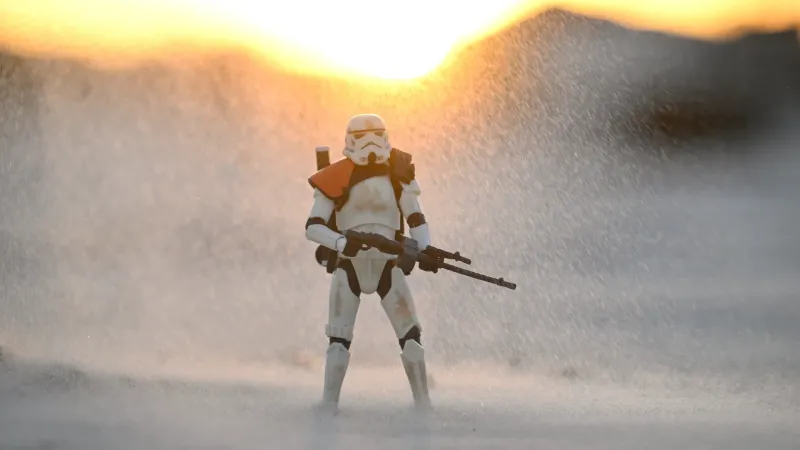
Beach toy photography: How to shoot action figures and LEGO in the sand
The beach is the ultimate outdoor studio for toy photography if you respect the elements. Low ground-level angles turn sand ripples into mountain ranges, golden hour softens harsh plastic reflections, and a helping hand creates breathtaking in-camera dust storms.

Filter holder system vs screw-in filters: Why I carry both
Why a landscape photographer carries a 100mm holder kit AND a screw-in polarizer — what each is actually for, and when each one wins.

Nikon on sale: Buy the Z8, think twice about the Z6 II
The Z8, Z6II and Z5 all drop in price on sale days. Which one is worth it, from someone who owns a Z8 and shot a Z5 for years, plus the storage to go with it.