
Hyrule Warriors: Age of Calamity – Switch-Off-Your-Brain Co-Op in Zelda’s World
Not a musou fan? Same. But in two-player co-op, Age of Calamity becomes a joyful, low-stress Zelda spin perfect for busy parents and kids.
This post contains affiliate links. We may earn a commission if you make a purchase, at no extra cost to you. As an Amazon Associate, Dadnology earns from qualifying purchases.
🎮 Introduction
🗡️ This review is part of our The Legend of Zelda Hub — every mainline game reviewed and rated, plus the movies and the LEGO Zelda sets, all in one place.
👨👩👧 It’s also one of our picks in The Best Zelda Games for Kids – find the right Hyrule adventure for your family.
I’m not naturally a hack-and-slash person. I love Zelda for exploration, dungeons, quiet wonder, and the feeling that every hill hides a story. Hyrule Warriors: Age of Calamity is not that kind of Zelda—it’s a musou, a big battlefield brawler where you mow through crowds and capture outposts. And yet, playing it locally in co-op with my daughter, it clicked. It became our “switch off the brain, grin, and conquer the map” game, a stress-relief loop wrapped in Zelda’s music and myth.
What made it work was how cleanly it fits busy family life. You can drop into a mission, play for 20–30 minutes, and feel like you accomplished something. There’s no agonizing puzzle to park halfway through, no cinema-length cutscene blocking bedtime, and no worry that a little one will derail a careful stealth plan. Instead, you get bright feedback: forts fall, bosses explode into loot, the map changes color, and a co-op buddy is always a few seconds away to save you from a bad dodge.
AdHyrule Warriors Age of Calamity [Digital Code] (opens in a new tab)
Hyrule Warriors: Age of Calamity is an action-packed hack-and-slash game developed for the Nintendo Switch. Set 100 years before the events of The Legend of Zelda: Breath of the Wild, it allows players to experience the Great Calamity firsthand.
![Hyrule Warriors Age of Calamity [Digital Code]](/placeholder-deals.webp)
🗺️ Timeline & Story Framing
Set a century before Breath of the Wild, Age of Calamity imagines the road to disaster—the alliances, the Champions, and the battles that preceded the fall. It is a what-if retelling, not strict canon. Think of it as a playable celebration of BOTW’s cast and aesthetics. For our family, that framing was perfect: our daughter recognized characters immediately, and the familiar places and themes made the action feel friendlier than a generic battlefield.
Narratively, you’ll hop between the Champions, Link, Zelda, and allies, with cutscenes that push a brisk, heroic tone. Because we didn’t aim for 100%, we appreciated that missions still felt meaningful in short stints. If you’re looking for sacred-text canon, temper expectations; if you want to visit BOTW’s world with momentum, this works.
🧱 The Musou Loop, Explained for Zelda Fans
The foundational loop is simple:
- Pick a mission.
- Capture outposts to swing map control.
- Respond to dynamic objectives (escort, defend, defeat minibosses).
- Topple a major threat and extract triumphantly.
Enemies fall by the dozens to light-and-heavy strings, aerial launchers, dodge-into-flurry counters, and special attacks you build by dealing damage. Bosses telegraph big swings with Stasis, Cryonis, Magnesis, or Remote Bomb icons—the Sheikah Slate returns as a universal interrupt tool that feels familiar to BOTW players. Bake in dodges for Perfect Flurry windows and you’re suddenly styling on Lynels like a Saturday-morning superhero.
For non-musou folks, the shock is how satisfying repetition can be when wrapped in strong art, sound, and reward pacing. You’re not solving a riddle; you’re mastering a rhythm. With two players, that rhythm becomes a duet.
👥 Couch Co-Op That Actually Feels Cooperative
Two-player split-screen lets you divide responsibilities cleanly. One of us handled roaming objectives (capturing distant outposts, escorting NPCs); the other anchored the main lane, deleting elites and holding the midpoint. Because you can fast-travel between forts and swap characters at rally points, you’re rarely stuck watching the other player have all the fun.
Our best moments came from improvisation: “You kite the Moblin; I’ll freeze the Wizzrobe and bomb the crowd,” or “You pop Stasis on the boss’s spin, I’ll dash in with a Flurry and dump the special.” The signal vocabulary is easy for kids—freeze, bomb, wait, go—which keeps co-op focused on action, not arguments.
🧙♀️ Roster & Movesets – Why Variety Beats Purism
Link is versatile, but the joy of Age of Calamity is character variety. Mipha’s liquid arcs cover space safely; Revali’s aerial control clears choke points; Daruk’s armored bursts bulldoze lanes; Urbosa’s charged lightning explodes elites. Impa, with her clone mechanics, becomes a DPS blender once kids learn to tag, duplicate, and detonate. Zelda’s Sheikah-Slate toolset rewards timing and area denial.
If you’re a dad teaching a younger player, try “lane clearer” + “duelist” pairings. Give the child a forgiving crowd-control character (Mipha, Daruk) and let the adult handle bosses (Link, Urbosa, Impa). Swap every few missions so both players taste victories in both roles.
📈 Progression That Pays Off in Short Sessions
Every mission spits out materials, weapons, and quest unlocks. Back at the map, you’ll spend resources to expand shops, open blacksmith services, and unlock combo strings or hearts for your roster. Because progress is modular—complete a quest, see a sticker pop on the world map—it’s perfect for 15-minute victories on weeknights. Even a failed mission yields drops you can use to improve weapons or purchase missing ingredients.
The blacksmith lets you fuse same-type weapons to raise levels and transfer desirable seals. We used it as a teaching tool: “Pick the spear with the passive you like, then feed the duplicates.” It’s visible, tactile progression that kids understand.
🎯 Difficulty, Accessibility & Kid-Friendliness
Musou games look chaotic, but Age of Calamity has forgiving fundamentals. You can drop the difficulty, grind a few side missions, or simply switch to a sturdier character when a boss feel spiky. Perfect Flurry windows are generous; specials and rods (fire/ice/lightning) bail you out when crowds swell.
For younger players, disable UI clutter, lower difficulty, and assign the map-runner role so they always have something productive to do. Split-screen halves the resolution budget, but the readability of effects and enemy telegraphs stays intact enough that kids can follow the action.
🎨 Presentation – Hyrule Through a Fireworks Lens
This is BOTW’s art direction, remixed for spectacle. Day-glow slashes, electric crescendos, and big camera sweeps make victories feel operatic. The music stitches familiar motifs into battle anthems; just hearing the Hyrule theme kick in as you flip a fort can carry a session all by itself.
The trade-off is frame-rate stability. On a base Switch, large clashes can stutter. It’s not a deal-breaker in co-op, where our focus is thrill, not perfect smoothness, but it’s noticeable. We adapted by prioritizing objectives (fewer enemies bunched up) and popping specials to thin the herd on demand.
🧭 Structure & Session Design for Parents
A mission is a complete episode. Before bedtime, we’d tackle one story node or two side requests, fuse a weapon, tap a few map quests, and stop. That loop created a reliable rhythm: play → progress → polish → pause. Nothing fragile broke if our attention window closed. Importantly, there’s always one more small thing to do—perfect for “five more minutes” that ends at ten, not midnight.
Because we didn’t chase 100%, Age of Calamity stayed fresh. We sampled characters, followed the main path, and left the ultra-grindy postgame for another day. In a family context, restraint is a feature.
🔁 Repetition vs. Flow – The Honest Balance
Yes, musou games repeat themselves. Outposts, captains, bosses—it’s a loop. What keeps Age of Calamity lively is texture: different hero kits, elemental counters, and Sheikah interrupts. Our sessions felt like short-form choreography rather than chores. When repetition crept in, we swapped roles, adjusted difficulty, or pursued a fresh character quest to shake up the feel.
Think of it as a combat playground with just enough objective pressure to keep you moving. If you need puzzles and exploration to feel satisfied, treat this as a side dish, not the main course.
🆚 How It Compares to Traditional Zelda
This is not dungeons and clever keys; it’s battles and bold strokes. But it borrows BOTW’s verbs—dodge, counter, element, glide—and reinterprets them for mass combat. The joy lands in different places: not in solving a shrine, but in syncing a Perfect Flurry together and deleting a Hinox in ten glorious seconds. For us, that difference was the point; it gave us a Zelda-flavored way to relax between heavier adventures.
👨👧 Our Co-Op Highlights
- Impa clone mayhem: Tag, duplicate, detonate—kids love the visible payoff.
- Outpost races: Split the map and see who flips flags faster; meet in the middle for the boss.
- Elemental duets: One freezes, one flurries; or one bombs armor while the other unloads a special.
- “Save me!” dashes: Nothing bonds like sprinting across the map to bail out your partner at one heart.
These tiny stories stacked up into the reason we kept returning even without finishing the campaign: the moment-to-moment co-op was the reward.
🧮 Who It’s For (and Not For)
Great for: Zelda fans who want an accessible co-op spin; parents seeking short, satisfying sessions; kids who love flashy feedback; players who enjoy progression checklists.
Probably not for: Purists craving classic dungeon design; performance hawks; anyone allergic to crowd-combat repetition.
We landed in the first camp: not musou people by taste, but happy co-op people by practice.
👨👧 Dad-and-Kid Co-Op Playbook
- Roles first: Assign “map runner” and “boss duelist,” then swap each mission.
- Count cues aloud: “Freeze—now!” “Dodge—now!” It builds timing and confidence.
- Bank specials: Save supers for bosses or danger bursts.
- Stop on a win: End after a captured outpost or story beat so the next night starts happy.
💰 Is It Worth Buying at This Point?
Age of Calamity launched in 2020, which means used and sale prices have dropped significantly. At current prices — often well under full retail — it’s an outstanding value. The Expansion Pass adds two content packs (Guardian of Remembrance and Pulse of the Ancients), though neither is essential for a first playthrough.
New players: if you loved Breath of the Wild and want more time in that world with action-oriented gameplay, this is an easy recommendation. The prequel story is lightweight, but the combat depth and co-op hours are genuinely excellent.
Returning fans with kids: the game holds up well for co-op play. If you have a child old enough to manage a controller (around 8+), revisiting it together is a genuinely fresh experience — their inexperience with musou games mirrors the discovery you felt on your first run.
Avoid if: you want traditional Zelda puzzle design or narrative depth on par with the mainline series. Age of Calamity is a spectacle-first action game wearing Hyrule’s clothes, and it’s better for knowing that going in.
Pros
- Easy to enjoy in 20–30 minute sessions
- Local split-screen co-op that actually shares responsibility
- Large roster with distinct, kid-friendly movesets
- BOTW-era art, music, and Sheikah tools feel familiar
- Progression and blacksmithing that reward short play windows
Cons
- Frame-rate dips in busy scenes, especially in co-op
- Repetition can creep in during long grinds
- Not for players craving puzzles or dungeon-style problem solving
🗣️ Conclusion
Hyrule Warriors: Age of Calamity isn’t traditional Zelda—and that’s okay. In our house, it became the couch-co-op palate cleanser: big wins, bright feedback, and low stress after a long day. Even as non-musou fans, we kept coming back for the teamwork—the “freeze now!” counters, the outpost races, the rescue dashes at one heart. If you want an accessible, BOTW-flavored co-op game for short parent-kid sessions on Switch, this is an easy recommendation.
Related Dadnology review: Hyrule Warriors: Age of Imprisonment
📌 FAQ – Frequently Asked Questions
Is there local co-op and how does it work?
Is it suitable for younger players?
Does it feel like Breath of the Wild?
Any performance concerns on Switch?
Keep this in your inbox
One email a week: what we actually watched, built and reviewed — the stuff worth a dad's time. No hype, no daily spam.
Dadnology Weekly
One email a week: the LEGO, gaming and movie news worth a dad's time — plus what we actually reviewed. No hype, no daily spam.
Disclaimer: This review and its visuals were created with the help of AI. Some links may be affiliate links – we may earn a commission if you make a purchase, at no extra cost to you.
You might also like
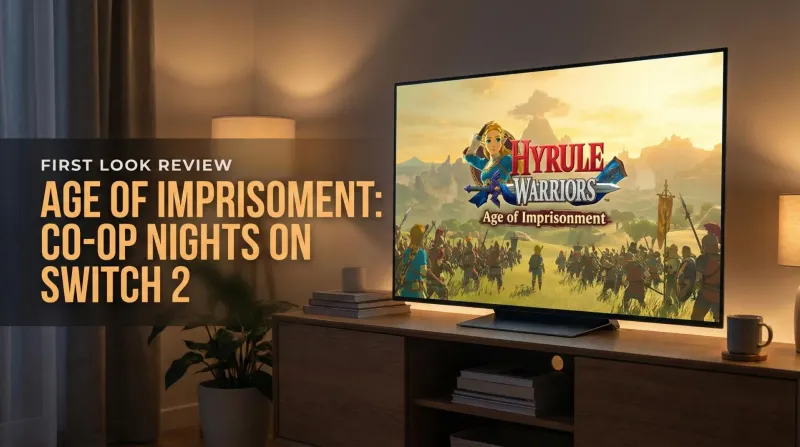
Hyrule Warriors: Age of Imprisonment – First Look for Co-Op Nights on Switch 2
Our First Look says: it’s more of what works. Age of Imprisonment doubles down on breezy, Zelda-flavored crowd combat and quick progress pop-ups that suit a busy parent schedule. With local co-op, you’ll clear lanes, sync specials, and flip the map in 20–30 minutes. It rarely surprises, but it consistently entertains, especially if you love the BOTW/TotK era. As a fresh Switch 2 blockbuster, it’s an easy weeknight pick—turn your brain off, count down “now!”, and watch a fortress fall.
The Legend of Zelda (NES) Review: Where It All Began
The original Legend of Zelda is one of the most important games ever made: an open world before open worlds existed, built on curiosity, secrets and trust in the player. It is cryptic in places, but it has aged far better than it has any right to. Played on the Game & Watch it is pure, distilled wonder. A 5/5 and the foundation of everything.
LEGO Zelda: Link & Epona Revealed, 1,750 Pieces
Nintendo's 40th Anniversary Zelda Direct revealed a third LEGO Zelda set: a brick-built Link riding Epona from Ocarina of Time, 1,750 pieces, spring 2027.