
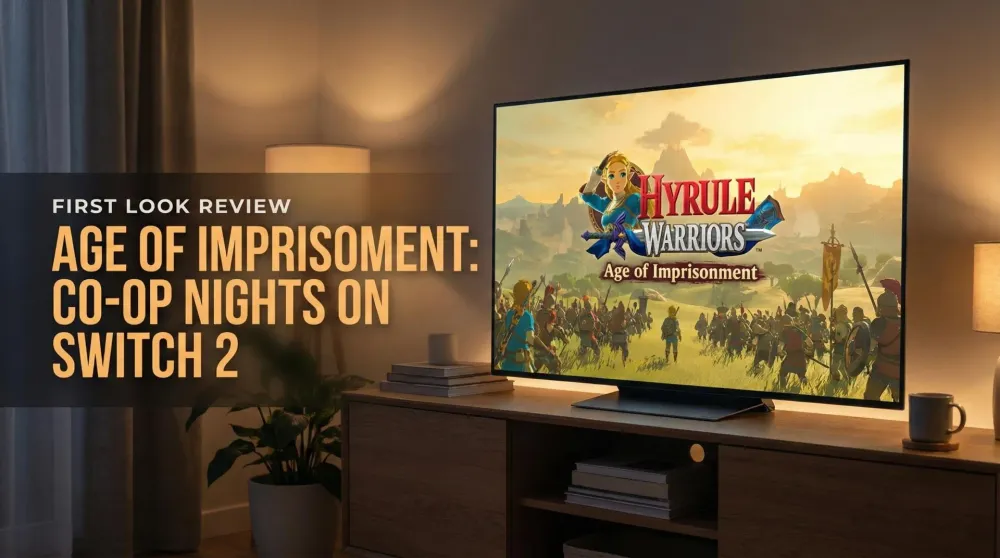
Hyrule Warriors: Age of Imprisonment – First Look for Co-Op Nights on Switch 2
Brand-new musou in the BOTW/TotK era: fast, flashy, and perfect for short two-player bursts. Not reinventing the formula—and doesn’t need to.
This post contains affiliate links. We may earn a commission if you make a purchase, at no extra cost to you. As an Amazon Associate, Dadnology earns from qualifying purchases.
🎮 Introduction
🗡️ This review is part of our The Legend of Zelda Hub — every mainline game reviewed and rated, plus the movies and the LEGO Zelda sets, all in one place.
New week, new reason to pick up the Switch 2 after bedtime. Hyrule Warriors: Age of Imprisonment arrives as the newest Zelda-flavored musou, and our early sessions delivered exactly what we hoped: fast, readable, co-op combat with big, celebratory feedback in the Breath of the Wild / Tears of the Kingdom era. This is a First Look—we haven’t completed the campaign—and yet it’s already slotted itself into our family routine as the “one mission before lights out” game.
If you’re a Zelda fan who doesn’t usually love hack-and-slash, that was me too. The draw here isn’t subtle puzzle-solving or shrine-style design; it’s the feel of momentum: capturing outposts, chaining cancels and Perfect Flurries, and shouting quick callouts as a boss telegraphs a punishable move. As a dad, I appreciate how it respects the windows I actually have: 20–30 minutes to unwind together without juggling a hundred systems.
AdBuy on Amazon (opens in a new tab)
Check out Buy on Amazon.

🗺️ Setting & Story Framing – The Sealing War, Up Close
Age of Imprisonment dives into the Sealing War, promising a perspective that sits near the mythic backbone of Hyrule’s cycles of calamity. Expect a heroic tone more than a lore dissertation: characters rally, armies clash, and familiar landmarks become arenas for crowd-based skirmishes. As with prior Hyrule Warriors entries, treat the narrative as a celebration of vibes rather than rigid canon. For families, that’s a feature: kids anchor on recognizable faces, and adults enjoy the thematic echoes of TotK without needing encyclopedic recall.
Cutscenes are brisk, stakes are big, and the mission pacing doesn’t strand you in talky lulls. For a First Look, that matters—short sessions still feel narratively “placed,” even when you only have room for a single encounter.
🧱 The Musou Loop, Re-Introduced for Switch-2 Families
If you skipped the last entry, here’s the rhythm:
- Select a mission node (story or side).
- Flip the map by capturing outposts and eliminating captains.
- Respond to dynamic objectives: defend, escort, intercept, or dismantle minibosses.
- Finish with a set-piece clash and a cascade of rewards.
The Sheikah-style counters return: enemy telegraphs light up with elemental or tool prompts; time a Stasis to freeze a boss windup, toss Remote Bombs to crack armor, or Cryonis to punish a charge. Layer in the musou staples—dodge-cancel into Perfect Flurry, weave light/heavy strings, and cash out with specials—and you’re in the groove inside minutes.
Crucially, progression is modular. Even if you wipe, you still collect materials and nudge sidequests forward. That makes each night feel productive.
👥 Local Co-Op – The Real Selling Point
Split-screen co-op is where Age of Imprisonment earns its keep. Our favorite structure remains “lane clearer + duelist.” One player roams to flip flags, clear camps, and keep objectives green; the other stalks elites and bosses, banking specials for decisive moments. Because fast-travel points multiply as you capture outposts, downtime is minimal—no one spends half a mission jogging across the map.
The kid-friendly vocabulary hasn’t changed and still works: “Freeze now!” “Bomb armor!” “Flurry window!” These simple calls build timing and partnership without becoming lectures. When in doubt, we count: “Three, two, one—special!” It’s amazing how often a synced burst deletes a problem.
🧙♀️ Roster & Kits – Variety Over Novelty
A First Look means we’ve only sampled a portion of the cast, but the pitch is familiar: distinct identities with flashy, readable tools. Expect a mix of lane controllers whose moves sweep broad arcs, and single-target duelists who melt elites with tighter strings and clone-style mechanics. We leaned on a forgiving crowd-control character for our younger player and saved the riskier duelists for whoever felt like main-lining bosses that night.
Is it revolutionary? No—and that’s fine. The joy is in expressive kits that reward learning a few tells and then cutting loose.
🎯 Difficulty & Accessibility – Forgiving Where It Counts
Age of Imprisonment’s early missions are welcoming. Lower difficulties keep crowd damage and boss spikes in check; Perfect Flurry windows are generous enough for kids to discover the timing; elemental rods and specials bail you out if a lane gets spicy. Between runs, you’ll pour resources into combo extensions, hearts, and blacksmith fusions—visible, tactile upgrades that make “one more mission” feel justified.
Parents’ tip: if a fight turns messy, reassign roles mid-mission. Have the child fast-travel to anchor a defense while the adult nukes the boss, then swap for the next encounter. Everyone gets a hero moment.
📈 Progression & The Map of “One More Thing”
Between battles, the world map fills with micro-quests, shop unlocks, training notes, and service upgrades. This design is essentially a to-do list parade, which sounds clinical until you realize how perfectly it fits family life. Ten free minutes? Feed duplicate weapons into your favorite kit, turn in a material set for a new combo, or open a vendor perk that makes the next mission smoother. Progress clicks forward even when you can’t commit to a full story node.
🎨 Presentation & Performance – Pretty, Punchy, Occasionally Pushy
The new entry keeps the BOTW/TotK visual language: painterly skies, luminous effects, and bold silhouettes that read even in chaos. On Switch 2, the opening hours look cleaner than we remember from older hardware—edges shimmer less, UI is crisper, and large-scale specials hold their spectacle.
Does it hold a perfect frame rate? Of course not—it’s still a musou with hundreds of enemies. In our First Look, the trade-offs were predictable but manageable: occasional dips during mass spawns or double-elite stacks. In co-op, that’s noticeable, yet not fatal; we compensate by thinning crowds with specials and prioritizing objective chains that avoid max clumping.
🆕 What’s New (Enough) vs. “More of the Same”
If you’re hunting for a mechanical revolution, you won’t find it in the opening hours. This is “more of what works”—fresh mission layouts, a different slice of the myth, and enough roster/weapon tweaks to keep discovery moving. For us, the question wasn’t “what’s new?” so much as “does it still sing in 30-minute co-op?” The answer is yes. Momentum plus cooperation is the magic, not novelty for novelty’s sake.
That said, Switch 2’s quality-of-life (load times, readability, input response) matters. When sessions are short, shaving friction is the difference between “we played” and “we almost played.”
👨👧 How We Actually Play It
Our rhythm:
- Choose one story node or two side tasks, depending on bedtime.
- Assign Roamer (child) and Duelist (parent) roles.
- Count key beats and bank specials for bosses or panic waves.
- Finish on a clean win—flip a fort, down a miniboss, or hit a story beat—so tomorrow starts on a high.
When repetition creeps in, we swap heroes to reset the feel. If attention wobbles, we chase a map unlock instead of forcing a long fight. The point is flow, not perfection.
🧮 Who It’s For (Right Now)
Great fit:
- Zelda fans who want action in that world without committing to epic sessions.
- Parents seeking quick, cooperative victories that still feel big.
- Kids who love flashy cause-and-effect and clear telegraphs they can learn to read.
Probably pass:
- Players craving puzzles, dungeons, or tight platforming.
- Performance purists who need unwavering frame pacing.
- Anyone allergic to musou repetition, no matter the IP.
From a First-Look vantage, Age of Imprisonment lands in the exact middle of our Venn diagram: Zelda vibes, simple co-op, reliable progress.
🧠 Tips for Smooth Family Sessions
- Roles > ego. Declare Roamer/Duelist and swap every mission.
- Count beats. “Three, two, one—freeze!” keeps timing clear.
- Use rods early. Don’t hoard; thinning waves smooths the frame rate and the vibe.
- Fuse the favorites. Feed dupes into a child’s comfort weapon; visible gains motivate.
- Stop after a win. Momentum tomorrow beats stubbornness tonight.
🆚 Compared to Age of Calamity (Early Feel)
Early hours feel closer to Calamity than apart: the same “map as task list” structure, similar interrupt/counter grammar, and that satisfying “we’re turning the tide” sensation as the minimap shifts color. The main difference is the Sealing War lens and Switch 2’s comfort upgrades. If you loved Calamity’s co-op cadence, this is essentially a new season with a fresh arc.
🏁 First-Look Verdict for Dads & Families
Is it essential? If you need classic Zelda, no. If you need co-op dopamine in Hyrule’s skin, absolutely. Age of Imprisonment doesn’t chase reinvention; it chases flow. It gives you just enough structure to feel heroic and just enough generosity to make short nights worth it. And as a new Switch 2 blockbuster, it’s exactly the kind of release that keeps the console’s family appeal humming between longer RPGs and prestige adventures.
💰 Is It Worth the Full-Price Ask?
At launch, Age of Imprisonment carries the price of a major Switch 2 release — a meaningful number for a musou title, a genre that historically skews toward mid-tier pricing. The honest assessment depends on where you’re coming from.
If you played Age of Calamity and loved it: this is an easy yes. The formula is refined, the Sealing War setting offers fresher ground than the BotW prequel, and Switch 2’s performance makes local co-op noticeably smoother. The content-to-cost ratio, once you factor in the Zelda setting’s longevity, is solid.
If you’re new to musou games: go in with clear expectations. Every mission is fundamentally “fight armies, capture objectives, defeat generals.” The variety comes from diverse rosters and escalating maps, not mechanical reinvention. If repetitive action loops are a hard no for you, this won’t convert you regardless of the Zelda branding.
For families specifically: the short missions, shared co-op objectives, and readable combat make it one of the best two-player options available on Switch 2 right now. As a stopgap between bigger releases — and a genuinely enjoyable one — it earns its place.
Pros
- Instantly readable, Zelda-flavored co-op with kid-friendly callouts
- Short, satisfying missions perfect for 20–30 minute sessions
- Map progression and blacksmithing make even brief nights productive
- Switch 2 QoL helps: faster loads, clearer UI, snappier feel
- BOTW/TotK era setting retains the magic without heavy homework
Cons
- Not a dramatic reinvention—very close to the previous entry
- Frame-rate dips in heavy spawns, especially in split-screen
- Repetition appears if you marathon long sessions
🗣️ Conclusion
As a First Look, Hyrule Warriors: Age of Imprisonment hits the note we wanted: comfort food action in a world we love, tuned for short, two-player wins on Switch 2. It doesn’t try to outsmart the formula; it just gets you to the good part faster—count the beat, pop a special, watch a fortress fall, high-five, sleep. If that’s your family rhythm, this is an easy add to the rotation—new, shiny, and satisfyingly familiar.
Buy Now(Ad)
📌 FAQ – Frequently Asked Questions
Is this a full review?
Does it bring big new mechanics?
Is local co-op still supported?
How does it run on Switch 2?
Keep this in your inbox
One email a week: what we actually watched, built and reviewed — the stuff worth a dad's time. No hype, no daily spam.
Dadnology Weekly
One email a week: the LEGO, gaming and movie news worth a dad's time — plus what we actually reviewed. No hype, no daily spam.
Disclaimer: This review and its visuals were created with the help of AI. Some links may be affiliate links – we may earn a commission if you make a purchase, at no extra cost to you.
You might also like
Hyrule Warriors: Age of Calamity – Switch-Off-Your-Brain Co-Op in Zelda’s World
Not usually a hack-and-slash fan, I still had a blast playing Age of Calamity in local co-op with my daughter. It’s turn-your-brain-off fun in a gorgeous Zelda wrapper: clearing forts, unleashing specials, and swapping heroes to cover the map. Sessions fit busy parent life, and the BOTW-era setting keeps the magic alive. Frame-rate hiccups appear in big fights, and repetition creeps in, but for couch co-op nights on Switch it’s a satisfying, stress-free pick with accessible difficulty and forgiving checkpoints.
The Legend of Zelda: Breath of the Wild – Freedom, Physics, and Pure Discovery
Years later, Breath of the Wild still feels miraculous: a cohesive physics world where rain, wind, electricity, fire, and gravity let you solve problems any way you imagine. I was skeptical at reveal, but playing erased every doubt. It’s perfectly balanced, endlessly explorable, and generous to creativity—ideal for parents who steal time in bursts. On Switch 2, faster loads and steadier performance sweeten it further. Ocarina of Time remains my top 3D Zelda—now happily tied with Breath of the Wild.

LEGO Zelda: Link & Epona Revealed, 1,750 Pieces
Nintendo's 40th Anniversary Zelda Direct revealed a third LEGO Zelda set: a brick-built Link riding Epona from Ocarina of Time, 1,750 pieces, spring 2027.