
Best Dash Cams for Family Cars (2026 Buyer's Guide)
Our dad-tested guide to the best dash cams for family cars in 2026: from simple front cams to 4K front-and-rear systems. Top pick: REDTIGER 4K Front and Rear.
This post contains affiliate links. We may earn a commission if you make a purchase, at no extra cost to you. As an Amazon Associate, Dadnology earns from qualifying purchases.
🚗 This guide is part of our Amazon Prime Day 2026 Deals Hub — our curated buying guides of the gear actually worth a dad’s money.
The Cheapest Insurance Policy You’ll Ever Buy
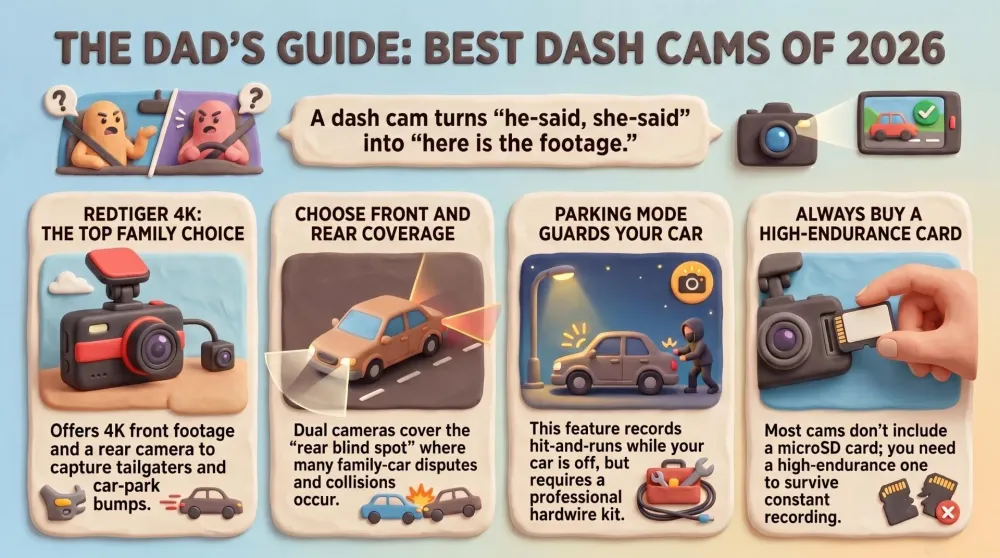
Here’s a scenario every parent eventually lives through: you walk back to the car after the supermarket run, kids in tow, and there’s a fresh dent in the door panel and nobody around to own up to it. Or you’re at a junction, someone clips you, and suddenly it’s your word against theirs while an insurance adjuster decides who pays. A dash cam is the silent, never-tired witness that turns “he said, she said” into “here’s the footage.” For a one-time cost less than a single insurance excess, it’s arguably the best-value gadget you can bolt to a family car.
This guide is for one specific dad: the one who treats the family car as a piece of safety equipment, not a toy. Maybe you’re tired of paying for parking-lot dents that aren’t your fault. Maybe your insurer hinted at a premium discount for cameras. Maybe — and this is the big one lately — you’ve just handed the keys to a newly licensed teenager and you’d like a little honest insight into how the family wagon is actually being driven when you’re not in the passenger seat. There’s a right dash cam for each of those situations, and they’re not all the same camera.
Here’s the methodology, plainly: we weighted the things that matter for a family car — clear footage you can actually read a plate from, rear coverage for the tailgaters and car-park bumpers, a parking mode that watches the car while it sleeps, and GPS that timestamps speed and location for any dispute — over spec-sheet bragging rights. We’re a tech-dad blog with opinions, not a numbers aggregator, so where a feature is marketing fluff we’ll say so. And a quick honesty note up front: dash cams need a microSD card (often not in the box), parking mode needs proper power, and the rules on recording vary by region — we’ll cover all three so nobody buys blind. Several of these also drop hard on Prime Day, if you’d rather not pay full RRP.
The big decision isn’t really brand — it’s how much of the car you want to cover and how much wiring patience you have. So we’ve ranked these in straight recommendation order, from the everyday family champion down to the specialist picks. Let’s dig in.
1. REDTIGER 4K Dash Cam Front and Rear — The Family Car No-Brainer
If you want one camera to protect the whole family car without overthinking it, this is the pair to beat. REDTIGER took the most-requested family feature set — sharp 4K front footage, a rear camera, WiFi for your phone, GPS for the timestamps, and parking mode — and bundled it at a price that undercuts the big-name brands by a wide margin.
AdREDTIGER 4K Dash Cam Front and Rear (opens in a new tab)
Best overall: 4K front, 1080p rear, WiFi and GPS, with parking mode — a flagship feature set at a value price for the whole family car.

What it does well
The headline is the 4K front camera, and resolution genuinely matters here: when the moment that counts arrives, you want to read a number plate two cars ahead, not squint at a blur. The 1080p rear camera is the bit that makes this a proper family system — it captures the tailgater riding your bumper on the motorway, the rear-ender at the lights, and the person who reverses into you in the school car park, which are exactly the incidents a front-only cam misses entirely.
Then there’s the day-to-day convenience. Built-in WiFi means you pull clips straight to your phone in the app — no wrestling a microSD card out of a windshield mount while the kids melt down in the back. GPS stamps every clip with speed and location, which is gold for an insurance dispute and quietly reassuring if a teen is driving. And it supports a parking mode (with the right power setup, more on that below) so the car keeps an eye out while you’re inside the supermarket.
For a single device that covers front, rear, evidence, and peace of mind, the value here is hard to argue with.
Where it falls short
Honesty time. Two cameras and a long rear cable mean the install is more involved than a stick-on front cam — budget an afternoon, or a tidy-cabling tip if you’re not handy. Like almost everything in this category, you’ll need to buy a high-endurance microSD card separately (it’s frequently not in the box), and parking mode wants a hardwire kit rather than the simple 12V plug. The companion app does the job but isn’t the slickest software you’ll ever use.
Who should buy it
The mainstream family dad who wants front and rear protection, WiFi convenience, and GPS evidence without paying flagship-brand prices. If you’ve got one family car and want it fully covered with the least fuss, stop reading and buy this one. Everyone else, keep going.
2. ROVE R2-4K — The Single-Cam Value Champion
Not every car needs two cameras. If your main worry is the road ahead — the car that brakes for no reason, the one that pulls out of a side street into your lane — a great front-only cam covers the majority of real-world claims for less money and less hassle. The ROVE R2-4K has been one of the best-selling dash cams for years for exactly that reason.
AdROVE R2-4K (opens in a new tab)
Best single-cam value: a hugely popular 4K front camera with WiFi and GPS for dads who only want eyes on the road ahead.
What it does well
The R2-4K nails the fundamentals. You get a genuinely sharp 4K front recording that holds up when you need to read a plate, plus built-in WiFi to grab clips on your phone and GPS to log speed and location on every drive. It’s a mature, proven product — the bugs got ironed out generations ago — and it’s dead simple to live with: stick it to the windshield, plug it in, and it loops automatically.
Crucially, it’s affordable, which makes it the easy entry point for a dad who’s never owned a dash cam and doesn’t want to commit flagship money to find out if he likes it. For a second family car, a commuter, or a teen’s first car, it’s a lot of protection for not much outlay.
Where it falls short
The obvious one: no rear camera. Everything behind you — the tailgater, the car-park reverse, the rear-ender — is uncovered, and that’s a meaningful blind spot for a family car. It also leans on a sometimes-fiddly app for setup, and the suction mount, while fine, isn’t as discreet as the tuck-behind-the-mirror designs further down this list. This is a do-one-thing-well camera, not a do-everything one.
Who should buy it
The budget-minded dad who wants reliable front coverage and GPS evidence without the cost or install of a two-camera system. It’s also the smart pick for a teen’s first car or a second household runabout — proven, cheap, and effective where it counts most.
3. VIOFO Dual Dash Cam — The Reliability Pick the Enthusiasts Buy
Ask the people who obsess over dash cams which brand they trust to just keep working for years, and VIOFO comes up again and again. This dual setup pairs a 2K front camera with a 1080p rear, and where it really earns its keep is the unglamorous stuff: rock-solid reliability and one of the best parking modes in the business.
AdVIOFO Dual Dash Cam (2K Front + 1080p Rear) (opens in a new tab)
Best reliability pick: rock-solid hardware with one of the best parking modes in the business, beloved by dash cam enthusiasts.
What it does well
The standout is dependability. VIOFO has a reputation for hardware that survives heat, cold, and years of constant loop recording without the random freezes and corrupted-card dramas that plague cheaper cameras. For a device whose entire job is to be recording at the one moment you need it, “it never lets you down” is the most important spec there is.
The parking mode is genuinely excellent — buffered impact detection and time-lapse options that make it the go-to for anyone serious about catching car-park hit-and-runs. The 2K front and 1080p rear combo is sharp enough for plates in normal conditions, the footage is clean, and the overall package is the one enthusiasts recommend when a friend asks “which one actually lasts?”
Where it falls short
The front camera is 2K rather than 4K, so on paper it gives up some resolution to the REDTIGER — in practice 2K is plenty for most situations, but spec-chasers will notice. It typically costs a touch more than the value picks, the interface is more utilitarian than friendly, and getting the most from the parking mode really wants a hardwire kit. You’re paying for longevity and a best-in-class parking mode, not flashy 4K numbers.
Who should buy it
The dad who plans to fit this once and forget it for five years, and who cares more about the camera actually working than about the biggest number on the box. If parking-mode protection in a busy car park is your main reason for buying, this is the one to get.
4. WOLFBOX G900 Mirror Dash Cam — The Hide-It-In-Plain-Sight Option
Some dads don’t want a gadget cluttering the windshield, and some cars have so much driver-assist hardware up top that there’s no room for another box. The mirror-style dash cam solves both: the WOLFBOX G900 clips over your existing rear-view mirror and replaces it with a big 4K touchscreen, putting the whole rig where you already look.
AdWOLFBOX G900 Mirror Dash Cam (4K) (opens in a new tab)
Best mirror-style: replaces your rear-view mirror with a big 4K touchscreen and a clean rear feed, hiding the whole rig in plain sight.
What it does well
The clever trick is the streaming rear-view display. The rear camera feeds live to the mirror screen, giving you a clear, unobstructed view behind even with the boot packed to the roof with buggies, bikes, and a week’s worth of family-holiday luggage — no more peering past headrests and kids. The 4K front recording is sharp, the big touchscreen makes reviewing clips on the spot genuinely easy, and the whole setup is tidy because it lives where your mirror already was.
It’s also a neat way to add a rear camera without an obvious second box stuck to the glass, which keeps the cabin clean and the camera low-profile.
Where it falls short
Mirror cams are a bit divisive, and for fair reasons. The glossy screen can glare in bright sun, the touch interface takes adjustment if you’re used to a normal mirror, and some drivers find the always-on display distracting at first. Fit varies by vehicle — it straps over your existing mirror, so check it suits yours — and like the others, parking mode wants a hardwire kit and you’ll supply your own microSD card. It’s a styling-and-visibility choice as much as a recording one.
Who should buy it
The dad who hates clutter on the windshield, drives a car with a packed cargo area, or simply loves the streaming rear-view trick. If a clean cabin and an unobstructed rear view matter to you as much as the footage, this is your pick.
5. Vantrue E1 Pro 4K Mini — The Discreet Little Operator
Sometimes the best dash cam is the one nobody notices — including you. The Vantrue E1 Pro 4K Mini is a tiny 4K camera built to vanish behind the rear-view mirror, recording everything while staying completely out of your eyeline and off a thief’s radar.
AdVantrue E1 Pro 4K Mini (opens in a new tab)
Best compact and discreet: a tiny 4K camera that hides behind the mirror and stays out of the way, with GPS and voice control.
What it does well
The headline is size: this thing is genuinely small, and it tucks up behind the mirror so cleanly that passengers often don’t clock it’s there. Despite the tiny body it shoots sharp 4K front footage, includes GPS for speed and location stamping, and adds voice control so you can flag a clip or start a recording hands-free — useful when both hands are busy not crashing. WiFi gets the footage onto your phone, and the discreet profile means it doesn’t scream “expensive gadget, smash the window” to anyone walking past the car park.
For a clean, minimal install that still delivers flagship 4K and the evidence-grade GPS data, it punches above its footprint.
Where it falls short
It’s front-only in this single-cam form, so the rear blind spot returns — the same trade-off as the ROVE, just in a smaller package. The compact body means a fiddlier first-time setup and a smaller (or no) screen to frame the shot, you’ll add your own high-endurance card, and parking mode again leans on proper hardwired power. You’re buying discretion and 4K in a tiny shell, not a do-everything family system.
Who should buy it
The dad who wants the camera to disappear — minimal clutter, low theft profile, no constant reminder it’s there — while still getting 4K and GPS. Great for a clean modern cabin, or as a stealthy second camera, as long as you’ve made your peace with front-only coverage.
How They Compare: The Spec Showdown
This is where the decision actually gets made. Watch the Front/Rear and Parking mode rows especially — for most family cars, those two lines settle the argument faster than the resolution numbers.
| Feature | REDTIGER 4K | ROVE R2-4K | VIOFO Dual | WOLFBOX G900 | Vantrue E1 Pro |
|---|---|---|---|---|---|
| Resolution | 4K front | 4K front | 2K front | 4K front | 4K front |
| Front / Rear | Front + rear | Front only | Front + rear | Front + rear | Front only |
| Parking mode | Yes (hardwire) | Yes (hardwire) | Best-in-class | Yes (hardwire) | Yes (hardwire) |
| Best for | Whole family car | Single-cam value | Reliability | Clean cabin / rear view | Discreet 4K |
| Verdict | Best overall | Best single-cam | Most reliable | Best mirror-style | Best compact |
The table tells a clear story. If you want the whole family car covered front and rear with the most features for the money, it’s the REDTIGER. If you only care about the road ahead, the ROVE wins on simplicity and price. Below that, you’re choosing a priority — bulletproof reliability and parking mode (VIOFO), a clean cabin and streaming rear view (WOLFBOX), or maximum discretion (Vantrue) — and any of those is a perfectly valid reason to shop.
How to Choose: A Decision Framework
If you’ve read this far, here’s how to decide without overthinking it.
Front-only vs front-and-rear is the first fork. Front-only (ROVE, Vantrue) is cheaper, simpler to fit, and covers the most common claims — the car ahead doing something stupid. But a family car spends a lot of time stationary in car parks and stopped at lights, which is precisely where the rear camera earns its keep. If you can stretch the budget, go front-and-rear (REDTIGER, VIOFO, WOLFBOX) — the rear blind spot is the one most family disputes hide in.
Decide how much you care about parking mode. If your car lives on a street or in a busy public car park where door dings and hit-and-runs happen, parking mode is the feature you’ll be most glad you bought — and the VIOFO does it best. But remember parking mode means recording while the engine is off, so it needs constant power: either a hardwire kit wired to your fuse box (tidiest, recommended) or a separate battery pack. The cigarette socket usually dies when the car is off, so the simple plug won’t cut it for parking mode.
Mirror vs discreet is a cabin-preference call. Hate clutter and love a packed-boot rear view? The WOLFBOX mirror cam is for you. Want the camera to vanish entirely? The Vantrue mini hides behind the mirror. Neither is “better” — it’s about how you want the car to look and feel.
AdREDTIGER 4K Dash Cam Front and Rear (opens in a new tab)
Best overall: 4K front, 1080p rear, WiFi and GPS, with parking mode — a flagship feature set at a value price for the whole family car.
The meta-advice, in proper tech-dad spirit: don’t get hypnotized by the resolution number on the box. A 4K camera with no rear coverage, no card in the slot, and no parking power is worse protection than a sensibly wired 2K front-and-rear system. The specs that actually change your outcome are how much of the car you cover, whether it’s actually recording when it matters, and whether you bought the card and the power to make it all work. Nail those three and you’ve bought the right dash cam.
Common Mistakes to Avoid
- Forgetting the microSD card. This is the number-one rookie error. Many dash cams — including several here — ship without a card, and a regular phone card wears out fast under constant loop recording. Buy a high-endurance microSD card (128GB or 256GB, rated for dash cam or surveillance use) at the same time as the camera, or you’ll have a very expensive paperweight on day one.
- Expecting parking mode to work off the cigarette plug. Parking mode records while the car is off, and most 12V sockets go dead with the ignition. Without a hardwire kit wired to a constant-power fuse (or a dedicated battery pack), your parking mode simply won’t run. Budget for it, or fit it once and forget it.
- Ignoring local rules on recording. Dash cams are legal to use in most places, but the details — recording audio, capturing other people, where you can mount it, and how you may use the footage — vary by country and region. Check your local rules before you rely on a camera, and treat this guide as general information, not legal advice.
- Mounting it where it blocks your view. Tuck the camera behind the rear-view mirror, not low in the middle of the glass where it obstructs your sightline (and may fall foul of those local rules).
- Paying full RRP in late June. Dash cams drop hard on Prime Day. Buying a flagship front-and-rear system at full price during a sale event is leaving money on the table.
Pros
- Sharp 4K front footage you can actually read a number plate from
- 1080p rear camera covers tailgaters, rear-enders and car-park bumps
- Built-in WiFi pulls clips straight to your phone, no card wrangling
- GPS stamps speed and location on every clip — gold for disputes and teen drivers
- Parking mode and a genuine flagship feature set at a value price
Cons
- Two-camera install with a long rear cable takes more effort
- No microSD card included — you must buy a high-endurance one
- Parking mode needs a hardwire kit, not the simple 12V plug
Conclusion: The Bottom Line
After comparing five dash cams across every budget, the honest take is simple: the best one for you depends on whether you want the whole car covered and how much wiring patience you have — but there’s a clear winner for most family cars.
For the family-car majority, the REDTIGER 4K Front and Rear is the easy call: sharp 4K ahead, a rear camera for everything behind you, WiFi and GPS for evidence and convenience, and parking mode — a flagship feature set at a value price. The ROVE R2-4K is the proven single-cam value pick for the road ahead; the VIOFO dual is the rock-solid, best-parking-mode choice for buyers who want it to last; the WOLFBOX G900 is the clean-cabin mirror cam with a streaming rear view; and the Vantrue E1 Pro 4K Mini is the discreet little operator that vanishes behind the mirror.
The Final Word: if you’ve got one family car and want it fully protected without fuss, buy the REDTIGER 4K Front and Rear, add a high-endurance card and a hardwire kit, and stop worrying about parking-lot mystery dents. Period.
Related Dadnology guides: Best Electric Shavers & Grooming Tools for Dads (2026 Buyer’s Guide) · Best Electric Toothbrushes for Families (2026 Buyer’s Guide) · Best Smartwatches & Fitness Watches for Dads (2026 Buyer’s Guide)
What is the best dash cam for a family car in 2026?
Do I need a front and rear dash cam, or is front-only enough?
What is parking mode and do I need it?
Does a dash cam come with a memory card?
Are dash cams legal to use?
Is a dash cam useful for a new teen driver?
How much should I spend on a dash cam for a family car?
Keep this in your inbox
One email a week: what we actually watched, built and reviewed — the stuff worth a dad's time. No hype, no daily spam.
Dadnology Weekly
One email a week: the LEGO, gaming and movie news worth a dad's time — plus what we actually reviewed. No hype, no daily spam.
Disclaimer: This review and its visuals were created with the help of AI. Some links may be affiliate links – we may earn a commission if you make a purchase, at no extra cost to you.
You might also like

Prime Day 2026: 5 Best Robot Vacuums for Family Households
Our dad-focused Prime Day guide to the top 5 robot vacuums in 2026 that keep family homes clean – from self-emptying Roombas to powerful all-in-one stations from Shark, Dreame, and eufy.
Never Get Locked Out Again: 5 Best Smart Locks for Families (Prime Day 2026)
A dad-focused guide to the best smart locks for U.S. family homes in 2026 – including August, Schlage, Yale, Eufy, and Level – with picks for renters, Apple families, fingerprint fans, and more.
Top 5 Smart Security Camera Systems for Families (2026) – Dadnology Guide
Our dad-focused guide to the 5 best smart security camera systems for U.S. families in 2026 – from Ring and Arlo to Google Nest, eufy, and Blink – with options for every budget, ecosystem, and privacy preference.