
Best Home Theater Projectors for Movie-Night Dads (2026 Buyer's Guide)
Our dad-tested guide to the best home theater projectors in 2026: from a do-it-all 4K triple laser to a pocket portable and a budget kids-room pick. Top pick: JMGO N1S Ultra.
This post contains affiliate links. We may earn a commission if you make a purchase, at no extra cost to you. As an Amazon Associate, Dadnology earns from qualifying purchases.
🎬 This guide is part of our Amazon Prime Day 2026 Deals Hub — our curated buying guides of the gear actually worth a dad’s money.
Turn the Living Room Wall Into a Cinema
There is a particular kind of magic in flipping off the lights, pointing a projector at a blank wall, and watching a 100-inch picture bloom into existence while the kids go quiet for the first time all day. A television, no matter how big, is furniture. A projector is an event. It is the gadget that turns an ordinary Friday into “movie night,” makes the living room feel like a proper cinema, and somehow makes the same film the kids have seen forty times feel new again because now it is the size of the wall.
But a projector earns its keep beyond the sofa. Drag it out to the patio on a warm evening, hang a sheet between two trees, and you have a back-garden drive-in — popcorn on the grass, blankets, the neighbors’ kids inevitably wandering over. Come the big game, that same projector turns your front room into the best seat in the house: the match at life size, mates round, and nobody squinting at a 55-inch screen from across the room. One box, three completely different family memories.
The catch is that “projector” covers everything from a £200 pocket gadget to a £3000 home-cinema centerpiece, and the marketing is a swamp of made-up brightness numbers and “4K” claims that mean four different things. This guide cuts through it. We picked five projectors across the whole spectrum — from a do-it-all 4K triple-laser living-room champion down to a cheap-and-cheerful pick for the kids’ room — and we are honest about exactly what each one can and cannot do. Because the single thing that makes or breaks a projector is not the spec sheet. It is how it copes with the light in your room.
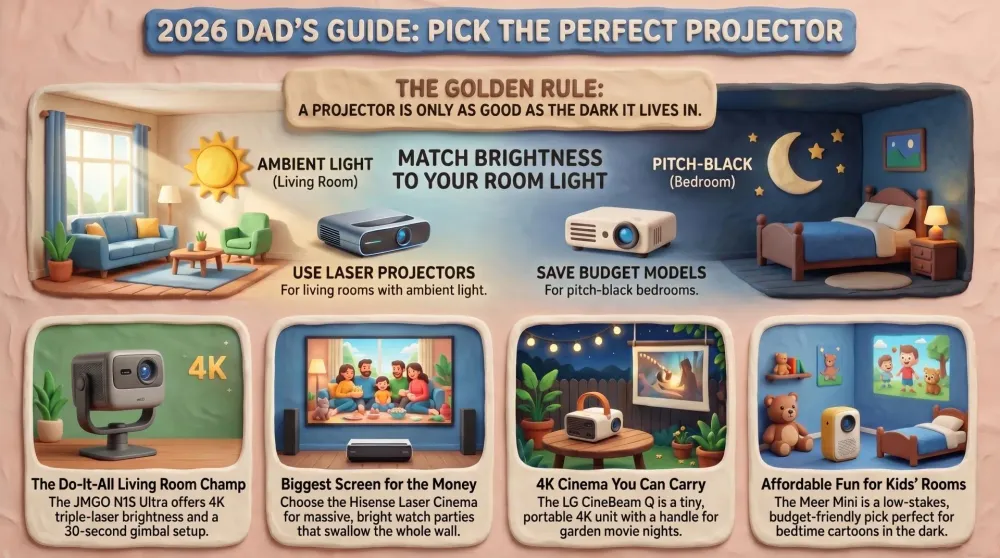
Before the deep dives, one rule to anchor everything: a projector is only as good as the dark it lives in. A bright laser unit in a dim living room beats a dazzling spec sheet fighting an open window every single time. Keep that in mind as we go, because it decides which of these is right for you. Let’s dig in.
1. JMGO N1S Ultra 4K Triple Laser — The Do-It-All Living-Room Champion
If you want one projector that handles family movie night, the big game, and the occasional garden screening without a degree in home cinema, this is the one to beat. The JMGO N1S Ultra pairs a genuine 4K image with a triple-laser light engine — and crucially, it sits on a built-in gimbal stand, so aiming it is a matter of grabbing the body and tilting, not stacking it on books and praying.
AdJMGO N1S Ultra 4K Triple Laser Projector (opens in a new tab)
Best overall: real 4K, triple-laser brightness, and a built-in gimbal stand that makes it the do-it-all living-room pick.

What it does well
The headline is the triple-laser light engine. Instead of a single lamp or a basic LED, it uses separate red, green, and blue lasers, which buys you two things dads actually notice: punchy, accurate color, and enough raw brightness to fight a bit of ambient light. This is the pick that still looks good with a lamp on in the corner or with the early-evening sun not yet fully gone — most cheaper projectors simply surrender in those conditions. You get real 4K resolution, so faces and football pitches are sharp rather than the soft, fake-4K mush some rivals ship.
Then there is the gimbal stand, which sounds like a gimmick until you live with it. Setup that takes other projectors a fiddly five minutes of stacking and keystone-fighting takes this one about thirty seconds: plonk it on the coffee table, tilt the head at the wall, let the autofocus and auto-keystone square the image up, done. For a family box that gets moved between the living room, a bedroom, and the patio, that “just point and go” convenience is the difference between using it every week and leaving it in the cupboard. It also runs Google TV onboard, so the streaming apps are built in — no extra stick required.
Where it falls short
Laser brightness and 4K do not come free, and this is the priciest of the realistically “living-room” picks here (the Epson costs more, but that is a dedicated-room machine). The built-in speakers are fine for a casual watch but, as with almost every projector, you will want a soundbar for proper movie nights — a wall-sized picture with thin built-in audio is a mismatch. And while it copes with some ambient light, “copes with some” is not “ignores all” — point it at a wall opposite a sunny window at 2pm and it will still wash out. No projector wins that fight.
Who should buy it
The dad who wants one projector to do everything and not think about it: movie nights, match days, the odd garden screening, all from a box that sets up in seconds. If you have a normal living room — not a blacked-out cinema cave — and you want the best all-round picture that still looks good when the room is merely dim rather than pitch black, this is your projector. Stop reading and buy it. Everyone with a more specific need, keep going.
2. Hisense Laser Cinema — The Biggest Picture for the Money
Some dads do not want “good,” they want enormous. The Hisense Laser Cinema is built around one idea: throw the largest, brightest image you can onto the wall without spending Epson money. It is the value play for the family that wants the screen to genuinely swallow the room.
AdHisense Laser Cinema (Family) (opens in a new tab)
Best big-picture value: laser brightness for a huge, room-filling image when you want the screen to swallow the wall.
What it does well
This is where laser brightness earns its keep. Where a budget projector gives up at 60 inches in anything but a dark room, the Hisense pushes a big, bold, genuinely room-filling picture that holds up with some lights on — exactly what you need for a lively watch party where nobody wants to sit in pitch black. For the big game with mates round, a bright, huge image that you can actually see with the lights up is worth more than reference-grade color accuracy nobody is studying between pints. It is the crowd-pleaser of the group.
You also get the longevity benefit of laser: around 20,000-plus hours of life with no lamp to replace, instant on/off, and brightness that does not fade after a year the way old lamp projectors did. For a unit that might get heavy weekly use across movie nights and match days, that “it just keeps working” reliability matters.
Where it falls short
It is the value-bright pick, not the picture-perfection pick. Black levels and fine shadow detail do not match the Epson in a properly dark room — in a serious blackout cinema, you would notice the Hisense is brighter but less refined. Depending on the exact model and your room, you will want to check the throw distance carefully, as a big image needs the right gap from the wall to land at the size you want. And, again, plan on a soundbar; the built-in audio is there to get you started, not to do a movie night justice.
Who should buy it
The dad who prioritizes size and brightness over last-percent picture refinement — the watch-party host, the “go big or go home” family, the one who wants the most wow per pound. If your dream is the biggest, punchiest image you can get without stepping up to a dedicated-room machine, this is the value champion.
3. Epson Home Cinema LS11000 4K Laser — The Dedicated-Room Reference Pick
This is the one for the dad who has, or is building, an actual home cinema: a room you can black out, a real screen on the wall, and the appetite for reference-grade picture quality. The Epson LS11000 is not a casual living-room box you tilt at the wall — it is a proper, ceiling-mounted-or-shelved home-cinema projector, and the picture rewards you for treating it like one.
AdEpson Home Cinema LS11000 4K Laser (opens in a new tab)
Best premium / dedicated room: a proper home-cinema projector for a dark room and an enthusiast who wants reference picture quality.
What it does well
In a dark room, this is the best image of the group, full stop. Epson’s laser engine delivers deep, controlled black levels, beautifully accurate color out of the box, and the kind of contrast that makes a film look like film rather than a bright slideshow. Where the Hisense and JMGO are tuned to fight ambient light, the Epson is tuned to reward darkness — give it a blacked-out room and a quality screen and it produces a genuinely cinematic, lean-back image that the brighter picks cannot match for sheer quality.
It is also a precision instrument for setup: generous lens shift and zoom mean you can mount it where the room allows and still land the image perfectly on your screen, which is exactly what a fixed-install cinema needs. The laser light source brings the same long life and instant-on convenience, so once it is dialed in, it just works for years.
Where it falls short
It is the most expensive pick here, and it asks the most of you in return. This is not a grab-it-and-go projector — it expects a dedicated, controllable room, a real screen, and a bit of setup care. Take it out to a bright living room with the curtains open and you are wasting most of what you paid for; its brilliance is contrast in the dark, not brute brightness against the sun. It is overkill, frankly, for the dad who just wants to throw cartoons on the wall on a Saturday.
Who should buy it
The enthusiast dad building a real home cinema: a dark room, a proper screen, and the budget and patience to do it right. If you care about black levels and color accuracy and you can control the light, nothing else here touches it. If you cannot black out the room, save your money — its strengths are exactly the ones you cannot use in a bright space.
4. LG CineBeam Q (4K Portable) — The Carry-It-Anywhere Pick
Not every projector needs to live bolted to the ceiling. Sometimes you want one you can carry from the living room to a bedroom to the back garden in one hand, set down on any table, and have a 4K picture in a minute. The LG CineBeam Q is that projector — a remarkably tiny 4K unit with a built-in carry handle and design that genuinely wants to be moved.
AdLG CineBeam Q (4K Portable) (opens in a new tab)
Best portable: a tiny 4K projector with a carry handle you move room to room or out to the garden in seconds.
What it does well
The magic here is portability with real resolution. Plenty of small projectors are 720p or fake-4K blur boxes; the CineBeam Q packs a proper 4K image into something you can pick up and relocate without a second thought. That makes it the obvious garden-movie-night machine: once it is properly dark outside, carry it out, set it on a patio table, point it at a hung sheet, and you have a drive-in for the kids. Indoors, it is the projector that moves with the family — cartoons in the playroom, a film in the bedroom, the match in the kitchen — without any of it being a production.
It is genuinely good-looking, runs LG’s smart platform with the streaming apps built in, and its auto-setup squares the image up quickly wherever you put it. For a do-anything, go-anywhere second projector, the flexibility is the whole point.
Where it falls short
Physics applies: a tiny, battery-friendly projector cannot match the brightness of the big laser units, so it is at its best in a dark room or after nightfall outdoors, and it washes out faster than the JMGO or Hisense if there is much light around. The image, while sharp, is smaller and dimmer than the heavyweight picks at the same distance, and the built-in sound is strictly get-you-by. This is a convenience-first projector, not a brightness-first one — buy it for where it can go, not for how hard it can punch.
Who should buy it
The dad who values flexibility over raw power: the one moving the projector around the house, taking it camping or to the garden, or short on permanent space for a fixed install. If “I want a real 4K projector I can pick up and take anywhere” is the brief, this nails it — just plan to use it in the dark.
5. Meer Mini Portable Projector — The Cheap-and-Cheerful Kids’ Room Pick
Let’s be honest about how a lot of projector use actually goes in a house with young kids: it is cartoons at bedtime, a film to buy thirty minutes of peace, and the constant low-level risk that whatever you bought gets sticky fingers all over it. For that reality, you do not want to be sweating a flagship. You want the Meer Mini.
AdMeer Mini Portable Projector (opens in a new tab)
Best budget / kids room: cheap, cheerful, and perfectly fine for cartoons and bedtime movies — not a true home cinema.
What it does well
This is the buy-it-without-overthinking pick — cheap enough that it is a low-stakes addition to a kids’ bedroom or a casual second projector for the house. In a dark room, it does the core job perfectly well: throw a big, fun picture on the bedroom wall, queue up the cartoons, and the kids are delighted. It is small, simple, and forgiving — exactly right for a low-pressure, “stick a film on” use case where a pristine cinematic image is not the goal. For bedtime movies and rainy-afternoon cartoons, it punches well above its price.
Where it falls short
Here is the honesty this guide owes you: this is not a home cinema, and pretending otherwise would be doing you a disservice. It is not truly 4K, its brightness is a fraction of the laser picks, and its contrast and color cannot deliver a proper cinematic picture on a big living-room wall. Switch on a light and it washes out almost completely; ask it to fill a large wall and the image goes soft and dim. The built-in speaker is small and tinny. None of this is a defect — it is simply what a budget mini projector is. Buy it for what it does (cheerful cartoons in a dark kids’ room) and it is brilliant value; buy it expecting your main movie-night centerpiece and you will be disappointed.
Who should buy it
The dad who wants an affordable, low-stakes projector for the kids’ room or a casual second unit — cartoons, bedtime films, undemanding fun in a dark room. It is the expendable, cheerful pick, not the serious one. Buy it as the kids’ projector; keep one of the brighter units above for the actual living-room cinema.
How They Compare: The Spec Showdown
This is where the decision actually gets made. Watch the Brightness and Best For rows especially — for projectors, those two lines settle the argument faster than any number on the box, because the right pick is dictated by your room and your use case more than anything else.
| Feature | JMGO N1S Ultra | Hisense Laser Cinema | Epson LS11000 | LG CineBeam Q | Meer Mini |
|---|---|---|---|---|---|
| Resolution | Real 4K | Laser 4K | Reference 4K | Real 4K (portable) | Budget HD (not true 4K) |
| Brightness | Bright (triple laser) | Very bright (laser) | Bright, contrast-first | Modest (dark room) | Low (dark room only) |
| Portability | Moveable (gimbal) | Fixed-ish | Fixed install | Highly portable | Highly portable |
| Best For | Do-it-all living room | Big-picture watch party | Dedicated dark cinema | Garden / room-to-room | Kids room / cartoons |
| Verdict | Best overall | Best big-picture value | Best premium | Best portable | Best budget |
The table tells a clear story. If you want one projector for a normal living room, the JMGO is the all-rounder. If you want the biggest, brightest crowd-pleaser, the Hisense wins. If you have a dark room and an enthusiast’s eye, the Epson is untouchable. Below that, the LG is the go-anywhere 4K pick, and the Meer is the cheerful kids’-room buy — valid choices, just for very different jobs.
How to Choose: A Decision Framework
If you have read this far, here is how to decide without overthinking it. It comes down to three questions: how dark is your room, do you need to move it, and how much do you want to spend.
Start with your room light. This is the single most important factor, full stop. If you have a normal living room with some ambient light and no blackout curtains, you need a bright laser projector — the JMGO N1S Ultra or Hisense Laser Cinema — because anything dimmer will wash out. If you have a room you can genuinely black out, the Epson LS11000 unlocks a picture the bright units cannot match. If your only “dark room” is the kids’ bedroom at night, even a Meer Mini does the job.
Then decide: portable or fixed? If the projector lives in one spot, a heavier unit like the JMGO, Hisense, or Epson is ideal. If you want to carry it to bedrooms, the patio, or a mate’s place, the LG CineBeam Q is built for it, and the JMGO’s gimbal makes it the next-most-moveable of the big units.
Finally, set your budget honestly. The Epson is the premium dedicated-room splurge; the JMGO is the do-it-all sweet spot; the Hisense is the value-bright big-picture buy; the LG trades brightness for portability; the Meer is the cheap second projector. There is no single right answer — there is a right answer for your room and your wallet.
AdJMGO N1S Ultra 4K Triple Laser Projector (opens in a new tab)
Best overall: real 4K, triple-laser brightness, and a built-in gimbal stand that makes it the do-it-all living-room pick.
The meta-advice, in proper tech-dad spirit: do not get hypnotized by the brightness number on the box. Manufacturers love quoting “lumens” with creative math, and a huge figure means nothing if the projector is sitting in a sunlit room. The specs that actually change your movie nights are can it cope with the light I have, is it the size I can fit in my room, and can I be bothered to set it up. Nail those three and you have bought the right projector.
Common Mistakes to Avoid
- Ignoring your ambient light. This is the number-one projector regret. People buy on resolution and price, set it up opposite a window, and wonder why the picture looks grey and faded. Always match the projector’s brightness to your room’s darkness first — a bright laser unit for a lit room, a cheaper one only if you can black out.
- Buying a cheap projector for a bright room. A budget mini projector is genuinely great in a dark kids’ bedroom and genuinely useless in a sunlit living room. If your space has light, you need laser brightness, not a bargain that washes out the moment anyone flicks a switch.
- Forgetting throw distance and screen size. A projector needs a specific gap from the wall to fill the screen size you want — too close and the image is small, too far and it overshoots or goes dim. Measure your room before you buy, and check the projector’s throw distance matches the picture you are picturing.
- Skipping the screen (or the soundbar). A wall works, but a proper screen sharpens and brightens the image noticeably, and built-in projector speakers are an afterthought on every model here. Budget for at least a soundbar if movie night is the goal — a cinema-sized picture with phone-grade audio is a letdown.
- Paying full RRP in late June. Projectors, especially the laser units, drop hard on Prime Day. Buying one of these at full price during a sale event is leaving real money on the table.
Pros
- Real 4K resolution with sharp, accurate triple-laser color
- Bright enough to survive a normal, not-fully-dark living room
- Built-in gimbal stand makes setup a 30-second job
- Google TV onboard, so streaming apps need no extra stick
- Genuinely do-it-all: movie night, big game, and garden screenings from one box
Cons
- Priciest of the realistically living-room picks
- Built-in speakers still want a soundbar for proper movie nights
- Copes with some ambient light, but no projector beats direct sunlight
Conclusion: The Bottom Line
After comparing five projectors across every budget and use case, the honest take is simple: the best projector for you depends on how dark your room is and whether you need to move it — but there is a clear winner for most dads.
For the normal living-room majority, the JMGO N1S Ultra is the easy call: real 4K, triple-laser brightness that holds up when the room is merely dim rather than pitch black, and a gimbal stand that makes setup almost effortless. The Hisense Laser Cinema is the value champion for the biggest, brightest watch-party picture; the Epson LS11000 is the reference pick for a dedicated dark room; the LG CineBeam Q is the carry-anywhere 4K portable for garden nights; and the Meer Mini is the cheerful, cheap kids’-room projector — great for cartoons, not a true cinema.
The Final Word: if you have a normal living room and want one projector to do everything, buy the JMGO N1S Ultra and start planning movie night. Match the brightness to your room first, and everything else falls into place. Period.
Related Dadnology guides: Best Smart TVs for Family Movie Nights (2026 Buyer’s Guide) · Best Soundbars for Movie-Night Dads (2026 Buyer’s Guide) · Marvel IMAX Home Cinema Guide
What is the best home theater projector for movie night in 2026?
How many lumens do I need for a projector?
Are laser projectors better than LED or lamp projectors?
Can I use a projector outside in the garden?
Is a cheap mini projector good enough for a home cinema?
What should I look for when buying a home theater projector?
Keep this in your inbox
One email a week: what we actually watched, built and reviewed — the stuff worth a dad's time. No hype, no daily spam.
Dadnology Weekly
One email a week: the LEGO, gaming and movie news worth a dad's time — plus what we actually reviewed. No hype, no daily spam.
Disclaimer: This review and its visuals were created with the help of AI. Some links may be affiliate links – we may earn a commission if you make a purchase, at no extra cost to you.
You might also like
Prime Big Deal Days October 2026: What a Dad Should Actually Buy
Amazon's October sale runs 6-7 October 2026. Here is what a dad should buy, what to skip, and how to plan the two days without falling for decoy discounts.

Prime Day 2026: 5 Best Robot Vacuums for Family Households
Our dad-focused Prime Day guide to the top 5 robot vacuums in 2026 that keep family homes clean – from self-emptying Roombas to powerful all-in-one stations from Shark, Dreame, and eufy.

Never Get Locked Out Again: 5 Best Smart Locks for Families (Prime Day 2026)
A dad-focused guide to the best smart locks for U.S. family homes in 2026 – including August, Schlage, Yale, Eufy, and Level – with picks for renters, Apple families, fingerprint fans, and more.