
Asteroid City Review: Wes Anderson at His Strangest – and Best
Wes Anderson's most alienating film is also one of his most rewarding — a grief-soaked nested narrative that baffles before it illuminates. Rating: 4/5.
This post contains affiliate links. We may earn a commission if you make a purchase, at no extra cost to you. As an Amazon Associate, Dadnology earns from qualifying purchases.
Asteroid City opens with a black-and-white TV presenter introducing a play called Asteroid City — a play we are about to watch being made, inside the film we are watching, presented as a television programme. If that sentence needed a second read, you are already deep inside what makes this film both infuriating and extraordinary. Wes Anderson’s 2023 feature is not so much a movie as a philosophical diorama: a meditation on grief, creative paralysis, and the inexplicability of certain human experiences, wrapped in the most jaw-dropping ensemble cast assembled in recent memory.
The first 30 minutes are a test. They are designed to be. Anderson punishes impatience here more than anywhere else in his filmography. But if you can sit with the confusion — if you can let the nested structure settle rather than fight it — what emerges by the final act is something genuinely moving. A 4/5 that earned every point the hard way.
AdAsteroid City (Blu-ray + DVD + Digital) (opens in a new tab)
The format for rewatches — and you will rewatch this. The commentary track is essential for unpacking the nested structure and Anderson's visual grammar.

The film arrives with credentials that stop you cold: a cast list that reads like a producer’s fever dream, cinematography by Robert D. Yeoman that makes the Arizona desert look like a pastel planet, and a score by Alexandre Desplat that is all jangling guitar and woozy melancholy. Anderson shot this back-to-back with The French Dispatch, and it shows — both films push his formal ambitions to their limits. But where The French Dispatch was a gleeful anthology sprint, Asteroid City is a slow, deliberate excavation.
For the Dadnology community, this is a film that asks something unusual: not just your attention, but your patience. Reward that patience, and you get one of the decade’s most original explorations of grief, fatherhood, and why we make art in the first place.
The Structure: A Film Inside a Film Inside a Film
The nested architecture is the first thing every reviewer mentions about Asteroid City, usually with a hint of exasperation. Here it is, as clearly as possible.
A black-and-white 1950s television programme is presenting a documentary about a new play called Asteroid City, written by a fictional playwright named Conrad Earp (Edward Norton). The play is set in a tiny desert town called Asteroid City, where a group of families have gathered for a junior stargazer competition. During the competition, an alien appears, steals the titular meteor, and disappears — prompting a government-enforced quarantine. The families cannot leave.
At the centre of those families: Augie Steenbeck (Jason Schwartzman), a widowed war photographer on a road trip with his four children, who has just learned — in the film’s opening minutes — that his wife died five weeks earlier. He hasn’t told his children yet.
The play-within-a-broadcast conceit is not Anderson being difficult for its own sake. It is doing three things simultaneously. First, it creates an emotional distance from the grief at the film’s centre — a distance that feels, paradoxically, truer to how grief actually works than direct-address could manage. Second, it lets Anderson interrogate the creative process itself: we see actors struggling with scenes, directors losing their grip on the material, writers unable to explain what their own work means. Third, it creates a space where the inexplicable — an alien, a sudden death — can exist without requiring resolution.
The film’s thesis is right there in its most quoted line: “You can’t wake up if you don’t fall asleep.” A character asks why they cannot leave the quarantined town. That is the answer they are given. Anderson seems to be saying: there are experiences — grief, creative blocks, incomprehensible encounters — that cannot be shortcut or explained away. They must be lived through. The confusion you feel watching the film is the film’s subject.
Visual Grammar: Symmetry as Emotional Armour
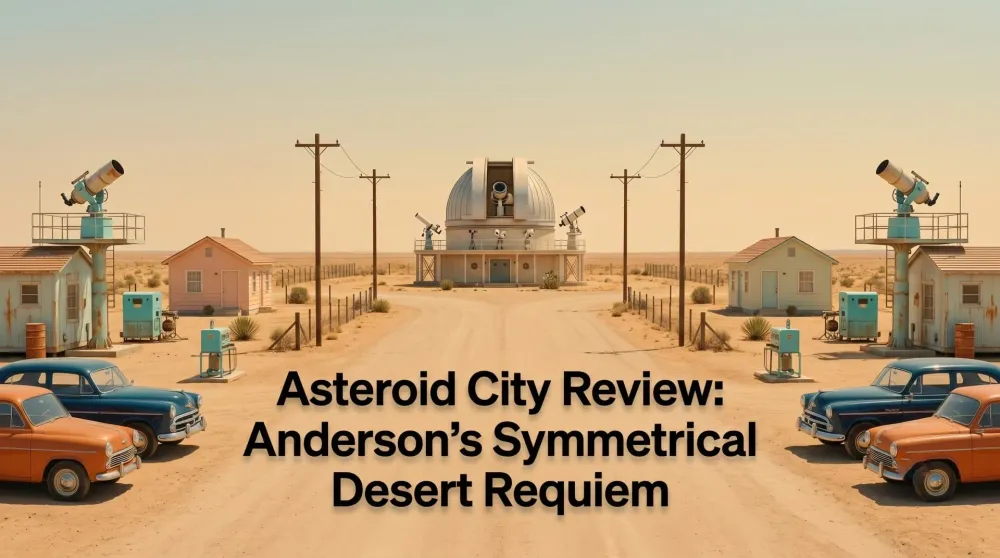
If you have seen five minutes of a Wes Anderson film, you know the visual signature: bilateral symmetry, every frame composed like an illustration, actors who move in deliberate and stylised paths, colour palettes chosen with the precision of a Swiss watchmaker.
In Asteroid City, the technique acquires a specific purpose. The desert sequences are shot in a warm muted palette — sand, ochre, terracotta — punctuated by pops of turquoise and the neon orange of government vehicles. Every shot is a painting. But where some critics read the style as distancing — a barrier between viewer and emotion — Anderson is doing something more precise here: he is using the symmetry as his character Augie would use a camera viewfinder.
Augie is a war photographer. He has built his entire professional and emotional life around framing — around finding meaning in catastrophe through the act of composition. When his wife dies, he cannot stop composing. The film’s immaculate framing is Augie’s grief: the compulsive ordering of chaos into manageable rectangles. The more devastating the subject, the more perfect the frame.
Anderson’s use of the 4:3 black-and-white ratio for the TV documentary sections is equally deliberate. Those sequences feel archival, historical — as if the creative process being documented is already a relic before it is finished. When the film cuts back to the colour desert, there is a jolt: this story is happening now, in the messy present. The formal contrast is the film’s emotional engine.
AdThe Grand Budapest Hotel (Blu-ray) (opens in a new tab)
If Asteroid City is your entry point to Anderson, this is where to go next — the perfect gateway to his visual language, deadpan wit, and hotel-lobby ensemble energy.
The desert location itself — shot partly in Chinchón, Spain, doubling for the American Southwest — is both alien and archaic. Against this backdrop, the characters’ precise, slightly theatrical movement looks exactly right. They are staging their grief the way the film stages its nested stories. Everyone here is performing. Everyone is trying to find the frame that makes sense of something that does not.
The Ensemble: How Does He Keep Getting Them?
Cast lists in Wes Anderson films have stopped being impressive and started being surreal. Asteroid City features Jason Schwartzman, Scarlett Johansson, Tom Hanks, Margot Robbie, Jeffrey Wright, Tilda Swinton, Bryan Cranston, Edward Norton, Adrien Brody, Steve Carell, Liev Schreiber, Hope Davis, Maya Hawke, and Rupert Friend, among others. In any other context, four of those names together would make headlines. Here, they are all supporting cast in a 105-minute film.
How? Two reasons, and they are connected.
First, Anderson has spent 30 years building a genuine creative community. Bill Murray has been in nearly every film since Rushmore. Jason Schwartzman was a teenager when he starred in Rushmore and has never really left. Tilda Swinton, Adrien Brody, Edward Norton — they return again and again not because they are contractually obligated, but because Anderson’s sets are known for being uniquely stimulating environments. He arrives with storyboards that are essentially the finished film, shot-for-shot, and the production becomes a collective act of precise execution. For actors accustomed to sprawling, improvised blockbuster shoots, the precision is — oddly — liberating. You know exactly what the job is. You do it. You feel like part of something specific.
Second, the roles themselves are almost always interesting, even when small. Jeffrey Wright gets three scenes in Asteroid City and manages to convey a complex moral universe in each. Tom Hanks has perhaps six minutes of screen time as Augie’s estranged father-in-law and makes every second count. Actors understand that a small Wes Anderson role is a character, not a cameo.
The result is ensemble work where the margins are as rich as the centre — and the centre, in Schwartzman and Johansson, is genuinely excellent. Their tentative, grief-adjacent chemistry is one of the film’s most understated pleasures: two people who recognise something broken in each other and don’t quite know what to do with the recognition.
What Asteroid City Is Actually About (For Dads)
Strip away the nested structure, the alien, the symmetry, and you are left with a film about a father who does not know how to tell his children their mother is dead.
Augie Steenbeck has the information. He has been carrying it since the film’s opening minutes. He calls his father-in-law, who tells him he has to tell the kids. He calls his own father, who does not know what to say. He stands in the desert, surrounded by his four children who are alive and present and asking for things, and he cannot find the words.
That specific paralysis — the way grief can make you simultaneously functional and inert — is what Asteroid City is really about. Anderson found a genuinely audacious way to embody it: he built a film that is itself unable to complete itself, unable to explain itself, unable to give its audience the resolution they expect. The play-within-a-documentary structure is not pretension. It is the feeling of being a dad who knows something terrible and cannot yet say it.
The alien encounter is the tipping point: after something genuinely inexplicable happens, the expectation that ordinary explanations will suffice collapses completely. The government quarantine — absurd, bureaucratic, circular — mirrors exactly how grief operates. You cannot leave until you have processed it. You cannot process it until you stop trying to leave.
For dads who have ever stood between their children and a reality they did not know how to frame, this film is — eventually, quietly — devastating.
AdThe Wes Anderson Collection: Asteroid City (opens in a new tab)
The official companion book packed with concept art, storyboards, and Anderson's notes on the film. Essential for anyone who wants to understand what the film is actually doing.
Pros
- One of cinema's most extraordinary ensemble casts, every actor earning their screen time
- Visual precision that has a thematic purpose — every perfect frame is Augie's emotional armour against grief
- Genuinely original nested structure that turns out to be about grief, not formalism
- Best-looking Wes Anderson since The Grand Budapest Hotel — the desert palette is stunning
- Rewards rewatches: the second viewing is a meaningfully different film
Cons
- Deliberately alienating for the first 30 minutes — patience is a hard prerequisite
- The black-and-white TV sequences can feel distancing if you have not locked onto the film's internal logic
- Not a film for viewers who need narrative clarity or conventional resolution
Conclusion: Inexplicable, and Worth Every Minute
Asteroid City is the film Wes Anderson made for himself and trusted us to catch up with. It confounds, it withholds, it baffles — and then, in the final act, it does something few films manage: it makes the confusion itself feel earned. A father learning to speak about the unspeakable. A film learning to complete itself. A play whose author cannot quite explain what it means, and turns out to be right not to try.
This is not the entry point to Wes Anderson’s filmography. For that, start with our Grand Budapest Hotel review — his four-Oscar masterpiece and the perfect gateway — or Rushmore. But if you are already a convert — or a parent who has ever stood with information you could not yet say — Asteroid City is something extraordinary: a film that understands what grief actually feels like, and found a form to match it.
The Final Word: Put your phone away, get past the first 30 minutes, and let it work on you. A 4 out of 5 that gets better on the rewatch — and that is high praise.
📺 Movie night sorted: thousands of films and shows are streaming on Prime Video — free for 30 days. Worth a look before you buy the disc.
Frequently Asked Questions
What is Asteroid City about?
Is Asteroid City confusing?
Is Asteroid City worth watching?
What does the line you cannot wake up if you do not fall asleep mean in Asteroid City?
How does Wes Anderson get such incredible casts?
When was Asteroid City released?
Keep this in your inbox
One email a week: what we actually watched, built and reviewed — the stuff worth a dad's time. No hype, no daily spam.
Dadnology Weekly
One email a week: the LEGO, gaming and movie news worth a dad's time — plus what we actually reviewed. No hype, no daily spam.
Disclaimer: This review and its visuals were created with the help of AI. Some links may be affiliate links – we may earn a commission if you make a purchase, at no extra cost to you.
You might also like

The Grand Budapest Hotel Review: Wes Anderson's Masterpiece
If Asteroid City is Wes Anderson at his strangest, The Grand Budapest Hotel is Wes Anderson at his most perfect. A four-Oscar caper where every frame is a painting, the melancholy hides under the slapstick, and Ralph Fiennes gives a career-best comic performance. This is the gateway drug to Anderson — and a genuine 4.5/5.

In the Grey Review: An Hour of Planning, Then 30 Minutes That Rock
Not a film for everyone, and the critics were lukewarm. We had a great time. Gyllenhaal and Cavill are both on form, the first hour builds the plan with Ritchie's usual swagger, and the last half hour is pure action payoff. A grown-up Friday-night film. Rating: 4/5.
Toy Story 5 Review: The Tablet Arrives, and Pixar Finds Its Heart
I went in sceptical after Toy Story 4 and came out with a big, warm, childhood feeling I did not expect. The animation is jaw-dropping, especially on Apple Vision Pro, the screen-time theme lands for parents, and the scary stuff from the older films is gone. It takes a while to grab you, and then it does not let go. Rating: 4.5/5.