
Gladiator (2000) review: Ridley Scott's untouchable epic
Ridley Scott's Gladiator (2000) is a flawless 5/5 historical epic and the film that made Russell Crowe a legend. Still untouchable 26 years later.
This post contains affiliate links. We may earn a commission if you make a purchase, at no extra cost to you. As an Amazon Associate, Dadnology earns from qualifying purchases.
Introduction: The film that refused to be ordinary
⚔️ This review is part of the Gladiator Movies in Order – watch Gladiator (2000) and Gladiator II in order, from Rome’s golden age to its slow, decadent decline.
When Gladiator (2000) hit theaters, the historical epic was considered a dead genre, expensive, unfashionable, and box-office poison since the sword-and-sandal disasters of decades past. Ridley Scott ignored all of that and made one of the finest films of his career anyway. Twenty-six years and one legacy sequel later, nothing, including its own follow-up, has come close to matching it. This is a genuinely flawless film, and we do not say that lightly.
That matters for a simple reason: this is not nostalgia talking. Watched again today, cold, with no rose-tinted memory of seeing it in theaters, Gladiator holds up in every department, the writing, the performances, the score, the craft. For the Dadnology community this is a genuine 5/5, the rare film that earns its reputation on rewatch rather than living off it.
What makes Gladiator work, a quarter-century on, is that Scott never treated the history as a costume. He treated it as a place people actually had to survive.
Narrative architecture: Grief, honor, and a debt to the dead
The emotional engine of Gladiator is simpler than the politics around it suggest: it is a story about a man who has already lost everything trying to find a reason to keep going. General Maximus Decimus Meridius is betrayed by the newly crowned Emperor Commodus, his family is murdered, and he is sold into slavery as a gladiator. Everything that follows is not really about revenge, it is about a man deciding what he still owes the people he could not save.
The setup is efficient and unsentimental. Marcus Aurelius intends to hand power back to the Roman Senate rather than to his own son, naming Maximus as a caretaker instead. Commodus, watching his father choose duty over blood, murders him and seizes the throne. Maximus refuses to kneel, loses his family and his rank in a single night, and ends up fighting for his life in the same arena Commodus now rules from. It is a slow-burn tragedy that never once feels padded across its two-and-a-half-hour runtime.
For a father watching this today, the resonance sits somewhere Scott clearly intended. Maximus’s private ritual, carving small wooden figures of his wife and son before he sleeps, says more about fatherhood and loss than any speech in the film could. It is a quiet, physical habit that turns an action epic into something more personal every time it recurs.
| Character | Maximus | Commodus |
|---|---|---|
| Path to Power | Earned through loyalty and command | Seized through murder and blood right |
| Public Face | The reluctant hero the crowd adopts | The emperor desperate for the crowd's love |
| Driving Force | Duty to family and to Rome's ideals | Insecurity and a starved need for approval |
| Defining Moment | Refusing to kneel in the arena sand | Stabbing Maximus before their final duel |
| What He Wants | To finish his work and rejoin his family | To be loved the way his father never loved him |
The film’s real trick is making Commodus pitiable without ever excusing him, which is what turns their final confrontation into something more than a simple good-versus-evil showdown.
Engineering an Empire: The craft behind Gladiator
What is technically remarkable about Gladiator is how physical it all feels. Scott shot across four countries rather than leaning on a single soundstage, and the difference is immediate: sand and dust behave like sand and dust, armor has real weight, and the Colosseum, built partly as a full-scale set at Fort Ricasoli in Malta, reads as an actual structure rather than a matte painting extension.
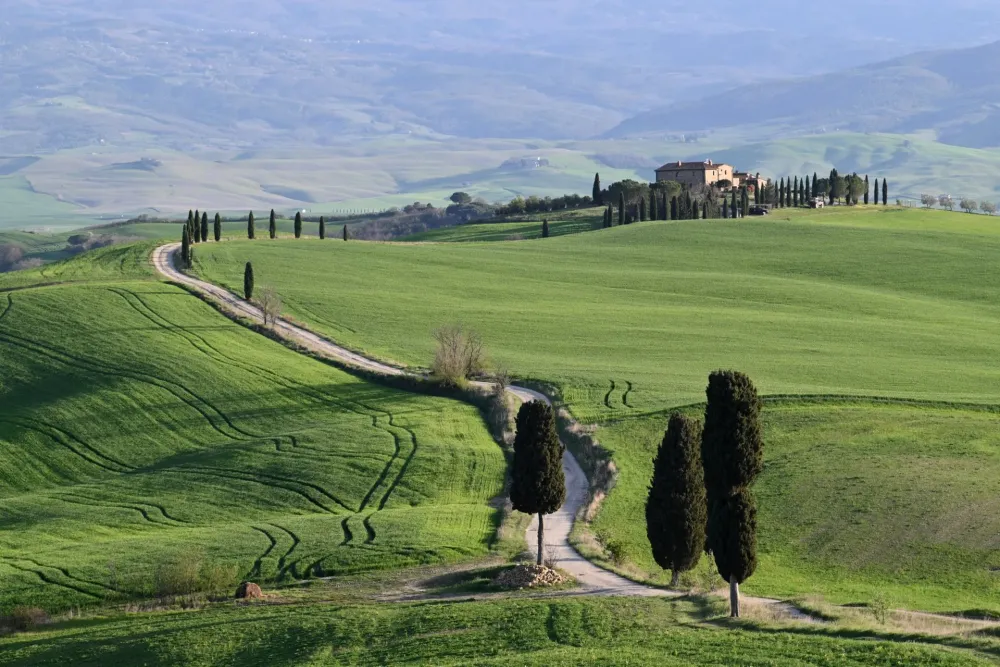
The opening battle in the forests of Germania was filmed in Surrey, England, and the gladiator training camp scenes were shot in Ouarzazate, Morocco, giving the film a genuinely different texture in every act. But the location that means the most to us personally is the one used for Maximus’s vision of home: the wheat fields he walks through, both in his dream on the battlefield and in the film’s final steps into the afterlife, were shot in Tuscany’s Val d’Orcia, on the cypress-lined road running south of Pienza past Podere Belvedere. We made a point of visiting that exact stretch of road ourselves on a trip through Tuscany, and standing there in person, it is genuinely hard to believe Scott needed to dress the set at all.
This obsessive location work pays off in three concrete ways:
- Tangible scale: The Colosseum’s practical elements, combined with era-appropriate digital extensions, give the arena real weight instead of a rendered gloss.
- A believable Rome: Four distinct real-world locations mean the empire itself feels vast rather than confined to one convenient backlot.
- Emotional grounding: The one location shot for pure beauty rather than spectacle, Val d’Orcia, is the film’s emotional anchor, and it works precisely because it looks nothing like the arena.
The result is a film that feels lived-in rather than staged, the same quality that made the sequel’s more soundstage-bound approach a genuinely noticeable step down in texture.
The format benchmark: Watching Gladiator via Apple Vision Pro
Our honest take: Gladiator holds up remarkably well as a Apple Vision Pro watch, even though it predates the format by two decades. This is a film built around scale and crowd noise, and a headset that puts the Colosseum on all sides of you does real justice to that.
The immersion factors hold up:
- Real crowd pressure: The arena scenes, watched in a virtual cinema environment, put the roar of the crowd genuinely around you rather than in front of you.
- The Zimmer envelope: Spatial audio wraps the score’s percussion and Lisa Gerrard’s vocals completely around your head, which is when Now We Are Free hits hardest.
- Dad Alert: This one earns the full ritual treatment. Wait until the house is quiet, and do not half-watch it on a second screen, the emotional beats need your full attention to land.
No headset? A big OLED, a real subwoofer, and the lights off gets you most of the way there. This is a film that rewards volume and darkness in roughly equal measure.
The sonic signature: Hans Zimmer and Lisa Gerrard’s defining score
A film this physical needed a score to match, and Hans Zimmer, working with vocalist and composer Lisa Gerrard, delivered one of the defining soundtracks of its era. This is not incidental music, it is the emotional spine the entire film is built around.
Zimmer built the score on contrast: militaristic percussion for the battle and arena sequences against Gerrard’s wordless, aching vocals for Maximus’s grief and his vision of home. The two registers rarely blend, and that tension is the point.
- The Now We Are Free motif: Gerrard’s vocal theme, first heard in Maximus’s dream of his farm, becomes the film’s emotional thesis by the closing scene, and it is genuinely hard to hear it without feeling something.
- Percussion as violence: The battle themes lean on relentless, mechanical drumming that makes the combat feel less like choreography and more like survival.
- A score that outgrew the film: Now We Are Free went on to a life far beyond the movie itself, still one of the most licensed and referenced pieces of film music from the 2000s.
Pros
- Russell Crowe's career-best performance, carrying the entire film on genuine, understated weight
- One of the finest film scores ever written, with Now We Are Free as a genuine emotional gut-punch
- Four real-world locations give the film a physical, lived-in texture rarely matched since
- A script that never pads its runtime, every scene earns its place across two and a half hours
Cons
- The violence is graphic and sustained, this is firmly not a film for younger viewers
- Some historical liberties are taken with Commodus and the era, though the film never claims to be a documentary
- The pacing is deliberate rather than fast, this rewards patience over instant spectacle
Watch order: this review is part of our Gladiator Movies in Order guide, which covers both films and links to the sequel’s own honest review. If you are building a proper historical-epic weekend, the Gladiator / Braveheart 2-Movie Collection pairs Scott’s Rome with Mel Gibson’s Scotland on one 4K disc.
Conclusion: The benchmark nothing else has matched
With five Academy Awards, including Best Picture and Best Actor, Gladiator did something few films manage: it took a genre everyone had written off and made it feel essential again. Twenty-six years on, including one direct sequel from the same director, nothing has matched it, and that is the clearest evidence of how completely Ridley Scott, Russell Crowe, and Hans Zimmer got this right.
There is no honest asterisk to add here. The pacing is deliberate by design, the violence is brutal by design, and every choice in the film serves the story it is telling. This is as close to a flawless historical epic as the genre has produced.
The Final Word: A non-negotiable classic, still untouchable a quarter-century later, watch it before you watch anything else on this list.
Movie night sorted: thousands of films and shows are streaming on Prime Video, free for 30 days. Worth a look before you commit to buying the disc.
Is Gladiator (2000) worth watching?
Can I watch Gladiator on Apple Vision Pro?
Where was Gladiator filmed?
Is Gladiator (2000) suitable for kids?
Do I need to watch Gladiator before Gladiator II?
Keep this in your inbox
One email a week: what we actually watched, built and reviewed — the stuff worth a dad's time. No hype, no daily spam.
Dadnology Weekly
One email a week: the LEGO, gaming and movie news worth a dad's time — plus what we actually reviewed. No hype, no daily spam.
Disclaimer: This review and its visuals were created with the help of AI. Some links may be affiliate links – we may earn a commission if you make a purchase, at no extra cost to you.
You might also like
Gladiator II (2024) review: A sequel that earns its sand
Gladiator II is a genuinely strong 4.5/5 legacy sequel. Denzel Washington dominates as Macrinus, the flooded arena battle is a real spectacle, and only a slightly rushed finale keeps it from matching the original.
Father of the Bride (1991) review: Still funny, still tender
A family comedy that still works more than thirty years on. Steve Martin and the whole cast are excellent, and for parents of a teenage daughter it hits especially close. Funny, a little wistful, and good for the mood. Rating: 4/5.

Gladiator movies in order: The complete watch guide
A flawless 5/5 original that remains one of the best films ever made, followed by a genuinely strong, if imperfect, legacy sequel at 4.5/5. A saga that earns its place on any dad's shelf.