
Reacher – Season 1: A Faithful, Heavy-Hitting Start That Finally Feels Like Jack
Based on Lee Child’s *Killing Floor*, *Reacher* finally gives fans the larger-than-life drifter they imagined. Alan Ritchson nails the physicality and quiet wit; small character details—new clothes, toothbrush travel—land perfectly. A tight, punchy adaptation with brutal fights and clean plotting.

Photo Credit: Courtesy of Prime Video. © Amazon Content Services LLC.
This post contains affiliate links. We may earn a commission if you make a purchase, at no extra cost to you. As an Amazon Associate, Dadnology earns from qualifying purchases.
This review is part of the Lee Child – Jack Reacher Book Series hub on Dadnology, where we cover every novel and screen adaptation in order.
📺 Introduction
👊 This review is part of our Jack Reacher Master Hub – every Reacher book, film and season in one place, in the right order.
Some adaptations chase plot; Reacher chases presence. Season 1 understands that Jack isn’t merely a set of skills—he’s a silhouette, a way of occupying space, a habit of noticing what others miss, and a moral algorithm that weighs fairness over rules. From the first scene, the series tells you it finally gets him: the stillness before motion, the blunt questions, the mathematical violence when talk is done.
As fans who’ve reviewed the books one by one, we felt instantly at home. The show’s core promise—Killing Floor on screen—arrives with controlled swagger. It’s not maximalist; it’s exact. We watched together, pausing to call out easter eggs and character choices pulled straight from the novels. It’s the rare page-to-screen translation that lets book moments breathe without worshipping them.
AdKilling Floor (Jack Reacher, Book 1) (opens in a new tab)
The explosive debut of Jack Reacher. The basis for Season 1.

🧩 Story & Setting – Southern Noir with Clean Lines
Season 1 lifts the bones of Killing Floor: a stranger steps off a bus into a small Georgia town, gets arrested for a murder he didn’t commit, and unravels a conspiracy that runs deeper than anyone wants to admit. The mystery is readable—causal, not convenient. Each reveal arises from observation and leverage rather than coincidence. We appreciated how the show compresses certain detours but preserves the book’s noir cadence: polite smiles up front, rot under the floorboards.
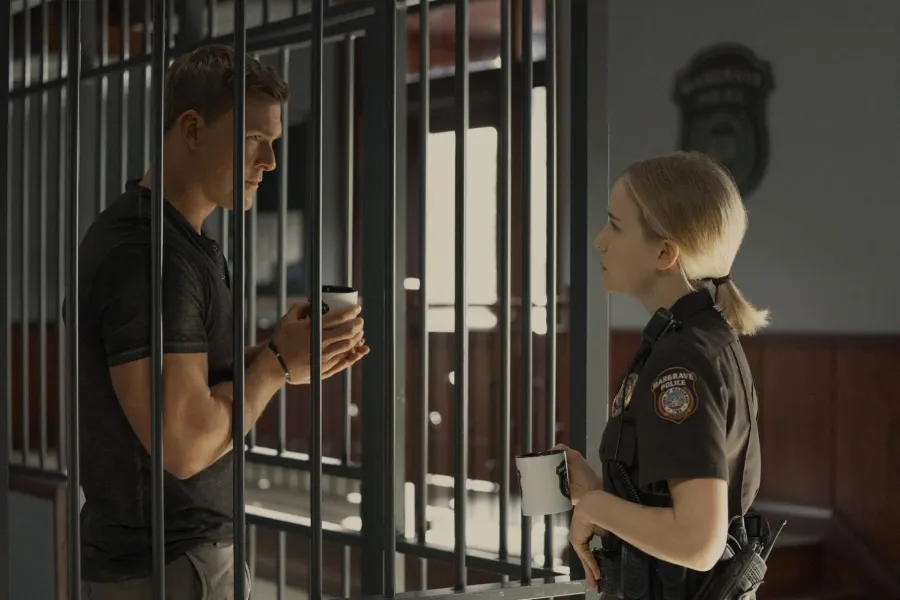
The town feels lived in—diners that actually smell like coffee and grease, dusty road shoulders, municipal buildings with scuffed floors. Geography matters; the show keeps orientations clear so chases and stakeouts make spatial sense. That clarity is half the tension.
👤 Jack Reacher – Why Alan Ritchson Works
Fans asked for a Reacher who looks like Reacher—and got one. We went further into that in Alan Ritchson, action hero explained, which looks at why this specific casting worked when two films with a bigger star did not. Alan Ritchson brings the novel’s physical premise to life: a man whose size is an argument, whose calm reads as threat to bullies and shelter to the decent. More important, he plays the thinking: the micro-glances at exits, the weight of a chair, the calculus behind whether to throw the first punch or wait one second to land the last.

Watch on Prime Video (opens in a new tab)
Stream Reacher Season 1 now.
Small book-true details delight. Reacher traveling with only a toothbrush. Reacher buying new clothes instead of doing laundry. Reacher’s dry, almost courtly politeness with people who deserve it—and the total lack of it with those who don’t. This is the guy we met on page one of Killing Floor, translated rather than reinvented.
🧯 Action – Bone-Crunching, Coherent, and Earned
The fights are short stories: setup, escalation, resolution. Blocking is legible, camera work steady, and sound design merciless—thuds and snaps that register but never wallow. Reacher’s style stays faithful: preemption, angle control, targeting joints and balance, ending things decisively. Crucially, violence carries weight. Aftermaths matter; bruises and consequences hang over later scenes.
Gunfights share the same honesty—sightlines, cover, reloads. No endless magazines, no miracle ricochets. When Reacher wins, you understand how. When he loses a beat, you understand why.
🧠 Adaptation Choices – Respecting the Page, Serving the Screen
Season 1 trims and rearranges, but preserves motivation and tone. Exposition becomes action; monologues become interrogations or scouting walks. The writers resist the temptation to twist for shock value—the mystery’s spine remains intact. If you loved the book’s Southern-noir flavor, the show pours from the same bottle.
A nice touch: the series frequently lets silence do the work. Reacher stands, watches, computes. The camera trusts your attention.
🎭 Supporting Cast – Partners, Adversaries, and Town Texture
Reacher stories work best when the drifter’s stoicism meets local specificity—cops, agents, thugs, and innocents with their own reasons to help or obstruct. Season 1 delivers a credible ecosystem of allies and foils. Relationships build around competence and character, not just convenience, which raises stakes when loyalties get tested.
🌵 The Setting — Southern Noir That Earns Its Geography
Small-town corruption stories live or die on whether the setting feels real or like a movie set. Reacher earns its Georgia backdrop. The heat feels oppressive in the way it needs to — diners where everyone knows everyone’s business, county roads that dead-end fast, law enforcement with small budgets and large loyalties to whoever signs the checks. The show understands that in towns like Margrave, information travels faster than any investigation.
That geography creates stakes the action alone can’t provide. Reacher isn’t just up against bad people — he’s up against a system built to protect those people, which means every ally he finds has something real to lose by helping him. That friction is what elevates this beyond a straightforward action show into a proper Southern noir with muscle.
It’s the atmosphere that novel readers will recognize most immediately. Lee Child’s Killing Floor isn’t just a mystery — it’s about a specific American geography where the rules operate differently and a stranger is always a threat first. The show captures that precisely.
🧮 Tone & Pacing – Brisk Without Hurry
At eight episodes, the season clicks along. Episodes land clean buttons; arcs carry across without filler. We appreciated how the show balances case-work with character: each new clue either tightens the noose or widens the map. It’s an easy couple binge—satisfying per hour, irresistible in sequence.
AdReacher - Season 1 (Blu-ray) (opens in a new tab)
Own the complete first season on Blu-ray.
📺 Standout Moments — Where the Season Peaks
The show opens strong and closes stronger, but the middle stretch — roughly episodes five and six — is where the mystery stops being a Southern noir and becomes a war. Scale shifts, alliances crystallize, and the conspiracy reveals how deep it actually goes. Watch the room change every time Reacher recalibrates what he knows.
The finale earns its resolution through patience: the setup is deliberate, the execution brutal, and the aftermath quiet in a way that rewards everything before it. No fireworks-and-credits rush. The show lets its ending breathe, which is rare in streaming action.
On the supporting side: Roscoe Conklin (the local detective who first arrests Reacher and ends up as his most reliable ally) brings skeptical professionalism to the partnership — her competence earns Reacher’s rare respect, and their dynamic builds without fan-service. Oscar Finlay starts as an obstacle and reveals himself as something more complicated. And when Frances Neagley arrives mid-season as Reacher’s former MP colleague, the show delivers the ultimate cavalry moment: no backstory needed, no setup required, just instant trust-under-fire from someone who’s had your back since before the series started.
🎯 Fans vs. Films – About That Tom Cruise Question
We enjoyed the Tom Cruise films on their own merits, but they’ve never matched the book silhouette. The series does. Ritchson’s size and stillness change every scene’s grammar: doors feel smaller, threats recalibrate, and a room’s bravado drains when he steps through it. If you’ve waited to see the page-accurate Reacher, this is that moment.
👨👩👧 A Dad/Fan Perspective – Watching With Your Partner
As a couple who’s also read the books, we had a blast. The show rewards shared memory—one of us recalled a line from Killing Floor right before the scene echoed it, and we both cheered when the toothbrush/clothes beats landed. It’s violent enough to place at 16+, but it’s not sadistic; the thrills come from clarity and decisiveness, not gore. Perfect “one more before bed” television.
🧱 Where It Stumbles (A Little)
A mid-season exposition dump leans heavier than the rest, and one villain beat skirts cliché before the final turn sharpens it. If you wanted every book subplot intact, you’ll notice certain trims. For us, the trade kept momentum high without breaking logic.
Pros
- Alan Ritchson is page-accurate: physically imposing, observant, quietly funny
- Fights are readable, brutal, and motivated—no shaky-cam nonsense
- Faithful *Killing Floor* adaptation that respects tone and causality
- Southern-noir setting feels tangible; geography and stakes stay clear
- Great couple binge: clean arcs, rewarding book easter eggs
Cons
- A mid-season info dump runs a bit long
- Some book subplots are compressed or omitted
- Violence and menace make this a 16+ watch
🔩 Conclusion
Reacher Season 1 finally gives the novels the screen treatment they’ve earned. It’s tight, tactile, and anchored by a lead who is Jack Reacher—body, brain, and moral compass. As a translation of Killing Floor, it’s respectful without being slavish, brisk without feeling thin, and full of small book-true details that make fans grin. We loved watching together and can’t wait to keep following this version of the character.
📺 Movie night sorted: thousands of films and shows are streaming on Prime Video — free for 30 days. Worth a look before you buy the disc.
📌 FAQ – Frequently Asked Questions
Is Alan Ritchson closer to the book’s Jack Reacher than the film version?
Do I need to read Killing Floor first?
How violent is the show?
How long is Season 1?
Is there anything to watch before Season 1 to understand the universe?
Keep this in your inbox
One email a week: what we actually watched, built and reviewed — the stuff worth a dad's time. No hype, no daily spam.
Dadnology Weekly
One email a week: the LEGO, gaming and movie news worth a dad's time — plus what we actually reviewed. No hype, no daily spam.
Disclaimer: This review and its visuals were created with the help of AI. Some links may be affiliate links – we may earn a commission if you make a purchase, at no extra cost to you.
You might also like
Reacher – Season 2: A Lean, Punchy Return That Doesn’t Quite Hit Season 1’s Highs
Season 2 is a notch below the electric first run, but it’s still an easy recommendation. The opening episode crackles, the 110th’s reunion clicks, and Alan Ritchson once again **is** Jack Reacher—physical, observant, and dryly funny. Pacing dips midseason and a subplot or two lands softer than planned, yet the fights stay clean and the mystery tracks. If you love the books, there’s joy in the details, from travel-light habits to tactical problem-solving. Our verdict: a solid 3.5/5.

Reacher – Season 4: The Season Without a Single Weak Episode
Gone Tomorrow gives season 4 a clean structure — a stranger, a strange city, a subway mystery that spirals into something bigger — and the show never lets go of the tension for eight episodes. There is no bad hour here, which is rare for a season this long. Alan Ritchson is, once again, exactly the Reacher the books built: watchful, dry, and terrifying only when the math says so. Rating: 4.5/5.
New Movies & Shows Coming in September 2026: Our Top Picks
September 2026 is the strongest streaming month of the year so far. The Mandalorian and Grogu hits Disney+ two days into the month, both Spider-Man sequels land two days after that, Slow Horses returns for a sixth season, and the first Reacher spin-off finally arrives. Add the entire Rocky and Creed run plus Deep Impact on Paramount+ and LEGO ONE PIECE closing out the month, and there is a genuine reason to open the TV guide.